

A platform dedicated to providing unbiased reviews of newly launched applications, analyzing everything from their features to their full potential.
info@scoutforge.net© 2026 Scoutforge. All rights reserved.
A platform dedicated to providing unbiased reviews of newly launched applications, analyzing everything from their features to their full potential.
info@scoutforge.net© 2026 Scoutforge. All rights reserved.
A platform dedicated to providing unbiased reviews of newly launched applications, analyzing everything from their features to their full potential.
info@scoutforge.net© 2026 Scoutforge. All rights reserved.
Cycling through all six. Tap any point to stop.
Measured on six things
Managed multiplayer backend for Unity, Unreal, Godot, and...
Standard web dashboard likely meets basic WCAG for developers using it. No specific accessibility features mentioned for in-game SDKs or player-facing elements. Documentation and blog appear readable.
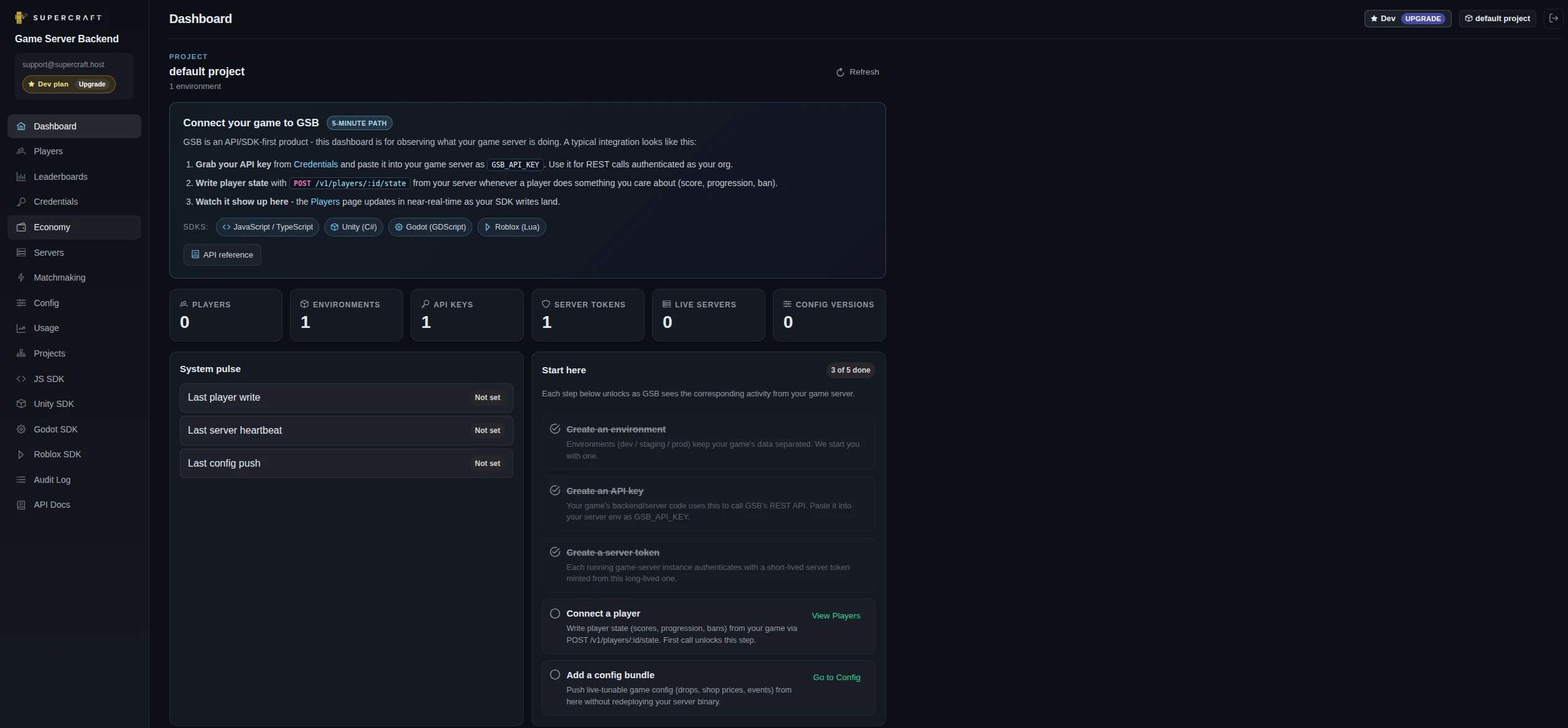
If you're building a multiplayer game, you know the backend is a beast. GSB (Game Server Backend) is a fresh, focused alternative to PlayFab and Nakama that handles the entire runtime infrastructure: player auth (email, guest, OAuth), persistent data, leaderboards with seasonal resets, economy systems, dedicated server registry and matchmaking. It's built specifically for dedicated-server games and live ops, with environment-aware staging and production. The free tier gives 2,000 MAU and 2M API calls/month — no credit card needed. SDKs for Unity, Godot, Roblox, and JavaScript make integration quick. The dashboard is designed to watch live games, not generic apps. I've been testing it with a Godot multiplayer project and the server registry + matchmaking are a lifesaver compared to stitching together separate services. The blog has solid architecture guides on matchmaking, data schemas, and comparing EOS.
Drawn from the product itself, not from a survey.
Demographic
Indie game developers working on multiplayer games
Pain points
Spending months building custom auth, leaderboards, and server management instead of creating gameplay
Primary needs
Ready-to-use backend services with Unity/Godot SDKs, affordable pricing, and live ops features
Demographic
Small to mid-size game studios launching dedicated-server games
Pain points
Struggling to manage server fleets, matchmaking, and player data with fragmented tools
Primary needs
Unified platform for auth, economy, leaderboards, and server registry with environment isolation
Demographic
Roblox developers wanting an external backend for persistent data
Pain points
Limitations of Roblox's built-in data stores for complex leaderboards and economy
Primary needs
Secure server-authoritative backend with Roblox SDK, easy integration, and tiered pricing
Demographic
Game designers prototyping multiplayer features
Pain points
Overwhelmed by backend complexity and wanting a quick way to test matchmaking and economy loops
Primary needs
Free dev tier, simple API, quick setup without DevOps expertise
Written by AI from measured evidence, scored out of 100.
Game Server Backend (GSB) is a focused, developer-friendly BaaS that excels at unifying player services and dedicated-server runtime needs in one platform. It shines for indie multiplayer developers using Unity, Godot, or Roblox who want to avoid months of custom backend work. Strengths include thoughtful auth boundaries, live ops tools, generous free tier, and engine-specific SDKs. While it lacks the enterprise depth of PlayFab or full open-source flexibility of Nakama, it offers better focus and simpler pricing for its target audience. Overall a strong 78/100 — not revolutionary, but a pragmatic, well-executed tool that lets you ship gameplay instead of infrastructure.
SDKs for Unity, Godot, Roblox, and JS enable quick integration. Straightforward API with clear auth boundaries (player JWT, server token, API key). Dashboard designed for observing live games, matchmaking, and servers rather than generic CRUD. Environment isolation (staging/prod) is a big win.
Clean, focused homepage with clear hierarchy, game-centric visuals, and dashboard previews. Professional yet approachable indie dev aesthetic using modern typography and targeted screenshots. Strong information architecture emphasizing dedicated-server focus.
Built on Go + PostgreSQL + Redis for solid performance on core operations like leaderboards, matchmaking tickets, and server heartbeats. No specific latency benchmarks published. Free tier limits (2k MAU, 2M calls/mo) keep it responsive for indies but won't handle viral hits without upgrading.
Server-authoritative design with distinct auth modes prevents client impersonation. Row-level security in Postgres, audited economy transactions, anti-cheat on leaderboard writes. OAuth, email, guest, and Roblox verification supported. Clear separation of player/server/operator privileges.
Standard web dashboard likely meets basic WCAG for developers using it. No specific accessibility features mentioned for in-game SDKs or player-facing elements. Documentation and blog appear readable.
Free Dev tier (2,000 MAU, 2M API calls) with no credit card is very indie-friendly. Predictable paid tiers ($19–$399 based on MAP). Strong focus on live ops (seasonal leaderboards, live config, economy). Blog with deep architecture guides helps adoption. Good for dedicated-server indies avoiding vendor sprawl.
GSB's design strikes a nice balance — clean, game-focused landing page with useful screenshots of the dashboard that actually show live server heartbeats, player activity, and matchmaking queues instead of generic analytics. It's clearly built by people who understand dedicated-server multiplayer pain rather than slapping together another Firebase clone. Usability shines with purpose-built SDKs for Unity, Godot, Roblox, and JS. The unified API with explicit player, server, and operator auth modes is genuinely thoughtful and reduces footguns. Environment-aware staging/production setup is a lifesaver for live ops. Compared to PlayFab's sometimes bloated console or Nakama's self-hosting overhead, this feels lighter and more focused for indies.
Performance relies on a modern stack (Go, Postgres with RLS, Redis) that should handle leaderboards, atomic economy ops, and matchmaking tickets efficiently for small-to-mid scale games. No public benchmarks hurt credibility here. Security is one of the stronger points with clear separation of concerns — servers get proper tokens instead of pretending to be players, economy is audited, and leaderboards have write protections. This architecture directly addresses common cheating and data consistency issues in dedicated server games. It's more trustworthy than many hobbyist backends, though bigger studios will want to see independent audits before trusting it with millions of players.
Accessibility is functional but unremarkable — it's a developer platform first. Growth features are compelling: generous free tier up to 2,000 MAU, predictable paid plans, seasonal leaderboards, live config delivery for balance changes without patches, and solid Roblox integration for external persistence. The blog's architecture guides (matchmaking, data schemas, EOS comparisons) add real value and help teams make informed decisions. It's particularly strong for indie and mid-size teams tired of stitching together Auth0 + custom leaderboards + AWS server lists. The dedicated server registry and matchmaking feel like the standout features that save the most development time.
Conclusion
If you're burning weeks on matchmaking queues, server browsing, or economy syncing, GSB is worth a serious look. The combination of server registry, live config, and seasonal systems in one dashboard is legitimately useful. Start with the free tier, follow their Godot or Unity quickstarts, and see if it clicks for your project. For many small teams, it will be the backend that finally lets them focus on making the game fun.
Named competitors, point by point. Nobody paid to appear here or to be left out.
 Game Server Backend (GSB) Game Server Backend (GSB) |  PlayFab PlayFab |  Nakama Nakama |  Epic Online Services (EOS) Epic Online Services (EOS) | |
|---|---|---|---|---|
| Pricing Model | Free tier (2k MAU, 2M calls), then flat tiers ($19–$399 based on MAP) | Usage-based, can become expensive quickly for smaller teams | Open-source (self-hosted free) or managed with different costs | Mostly free within Epic ecosystem |
| Dedicated Server Tools | Full registry, heartbeats, matchmaking, discovery — core strength | Strong but part of larger, more complex suite | Good with self-hosting required for full control | Matchmaking focused, less dedicated server registry |
| Target Audience | Indie/mid-size dedicated-server multiplayer (Unity, Godot, Roblox) | Broader, including larger studios; can be complex for small teams | Teams comfortable with self-hosting or custom solutions | Developers in Epic ecosystem, less engine-agnostic |
| Live Config & Economy | Strong live config bundles per environment + atomic economy | Comprehensive but can feel bloated | Requires more custom implementation | Limited outside Epic ecosystem |
PlayFab
Microsoft's comprehensive backend for live games, but can be complex and costly for smaller teams. GSB offers simpler pricing and lighter SDKs.
Nakama
Open-source game backend by Heroic Labs. Great for custom solutions but requires self-hosting. GSB is fully managed with a free tier.
Epic Online Services (EOS)
Free but focused on Epic's ecosystem. GSB is engine-agnostic and offers dedicated server tools beyond matchmaking.
Comparing options? See Game Server Backend (GSB) alternatives, scored side by side
What the review was written against. A verdict with no sources is an opinion.

A no-code Solana token creator that deploys SPL tokens in...

A free, open-source platform offering 110 AI agent skills...

Open-source desktop app for switching AI coding providers...

Fast EU VAT validation API for developers, covering 27 EU...

Claw Messenger is an iMessage API service that gives AI a...

PERM Processing Time is an independent data analysis platform that helps users navigate the U.S. Department of Labor’s permanent labor certification process.

AI-powered Dubai real estate data platform with 12M+ DLD ...

BeartIMAGE is a free, web-based image processing platform engineered for fast, bulk photo editing and conversion directly in your browser.

macOS app for App Store screenshots: 3D mockups, auto-tra...

Real-time monetization infrastructure for AI products tha...

A native macOS process explorer and advanced monitor that...

A developer-first financial data API providing structured...
A platform dedicated to providing unbiased reviews of newly launched applications, analyzing everything from their features to their full potential.
info@scoutforge.net© 2026 Scoutforge. All rights reserved.