Cycling through all six. Tap any point to stop.
Measured on six things
AI networking built around your intent
Security
40HTTP probe shows HTTPS not enforced, no HSTS, no CSP, no frame protection, no X-Content-Type-Options, no Referrer-Policy, no Permissions-Policy — 2/12 checklist points (SPF, DMARC only). No SOC 2, ISO, or bug bounty claims found. Standard hardening is largely absent.
Screenshots
1 / 1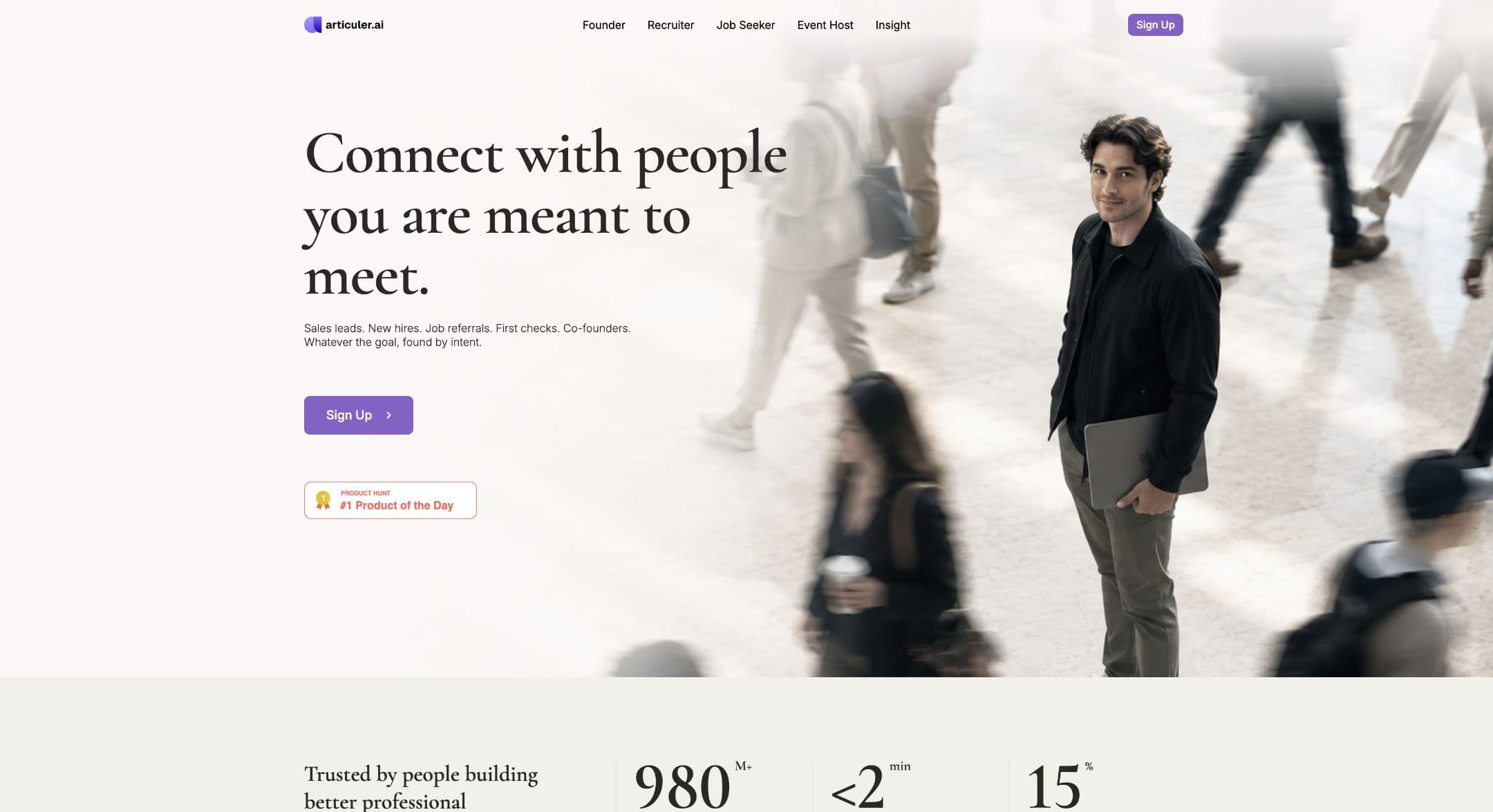
About this app
Articuler is an AI-powered professional networking platform built around your intent. Describe your goal to find relevant professionals across public profiles, curated directories, or event attendee lists. Ranked matches include context and a reason to connect, while Playbook helps prepare outreach and meetings.
Key features
- 1Intent-first matching: describe your goal and get ranked matches across 980M+ professional profiles with context and a reason to connect.
- 2Directory Match: match within curated high-signal lists like recent early-stage VCs or alumni who broke into Big Tech.
- 3Event Match: upload or connect an attendee list and get a ranked plan of who to meet before you walk in, plus a Playbook for outreach and follow-up.
Target customer profile
Drawn from the product itself, not from a survey.
Demographic
Startup founders and co-founders
Pain points
Finding relevant professional contacts for a specific goal.
Primary needs
Find relevant professionals and understand the context for reaching out.
Scout Review
Written by AI from measured evidence, scored out of 100.
Articuler.ai is an intent-first professional networking tool that asks what you want to accomplish, then matches you against global profiles, curated directories, or event attendee lists — with context and a reason to reach out. The pitch is sharp and the event-networking angle is genuinely differentiated. The marketing site is polished and modern. But the measured evidence tells a more mixed story: mobile performance is poor (63/100, 8.3s LCP), security hardening is largely absent (2/12 headers), and the growth story rests on a wedge LinkedIn could copy. Accessibility is the standout at 96/100. A promising idea with an underbuilt technical foundation.
Measure by measure
Usability
60Clear single signup CTA and a real FAQ, plus a resources/guides library. But the FAQ was truncated in our fetch and no pricing page, demo, or docs hub was surfaced — onboarding depth is hard to verify from the outside.
Design
68Modern, well-structured landing page with numbered flows, product mockups, and consistent typography. Sectioned storytelling (global/directory/event match) reads clearly. No independent render of the app UI itself was available, so this judges the marketing site.
Speed
55Lighthouse mobile 63/100 with an 8.3s LCP and 434ms TBT — the largest contentful paint is over three times the 'good' threshold. Desktop is a healthier 78/100. CLS 0 and FCP 1.8s show the layout is stable; the render path is the problem.
Security
40HTTP probe shows HTTPS not enforced, no HSTS, no CSP, no frame protection, no X-Content-Type-Options, no Referrer-Policy, no Permissions-Policy — 2/12 checklist points (SPF, DMARC only). No SOC 2, ISO, or bug bounty claims found. Standard hardening is largely absent.
Accessibility
80Lighthouse accessibility 96/100 with a single failing audit: insufficient color contrast. No a11y statement, WCAG claim, or multi-language support found on the site, which caps the ceiling — but the automated baseline is genuinely strong.
Growth
58Intent-first matching across global profiles, curated directories, and event lists is a real wedge against LinkedIn's search-first model. The event-attendee use case is specific and underserved. But the moat is thin — LinkedIn can copy intent search, and the 980M profile claim depends on data access that isn't explained.
Improvement areas
- Mobile performance: 8.3s LCP and 434ms TBT drag the Lighthouse mobile score to 63/100 — the render path needs real work.
- Security hardening: only 2 of 12 probed headers present (SPF, DMARC); HTTPS not enforced, no HSTS, CSP, or frame protection.
- Evaluation path: no pricing page, no live demo, and a truncated FAQ make it hard to assess the product before signing up.
Design & Usability
The marketing site is polished and modern — numbered flows, product mockups, consistent typography, and a clear three-mode story (global, directory, event). Design-wise it sits comfortably above the average indie SaaS landing page. Usability is thinner: there's a single signup CTA and a real FAQ, plus a resources library with long-form guides, but no pricing page, no live demo, and no docs hub surfaced in our fetch. The FAQ was truncated, so we can't judge its depth. For a product whose entire pitch is 'tell us your intent and we'll match you,' the onboarding path from landing page to first match is not visible from the outside. Competent, not exceptional.
Speed & Security
Speed is the weak spot. Lighthouse mobile scores 63/100 with an 8.3-second LCP — more than three times the 'good' threshold — and 434ms of total blocking time. Desktop is a much healthier 78/100, so the mobile render path is where the weight lives. CLS 0 and FCP 1.8s show the layout is stable and first paint is fine; it's the main-thread work that drags. Security is worse. The HTTP probe found HTTPS not enforced, no HSTS, no CSP, no frame protection, no X-Content-Type-Options, no Referrer-Policy, and no Permissions-Policy — 2 of 12 checklist points, and those two are SPF and DMARC. No SOC 2, ISO, pen-test, or bug bounty claims appear anywhere on the site. For a product that asks users to describe their goals and connect with strangers, that's a thin security posture.
Accessibility & Growth
Accessibility is the strongest measured dimension: Lighthouse scores 96/100 with a single failing audit for insufficient color contrast. No a11y statement, WCAG conformance claim, or multi-language support was found, which caps how high this can go, but the automated baseline is genuinely good. Growth is a judgement call on the idea. Intent-first matching across 980M+ profiles, curated directories, and event attendee lists is a real wedge — LinkedIn is search-first and event networking is genuinely underserved. The event use case ('before you walk in, know who matters') is specific and concrete. But the moat is thin: LinkedIn can add intent search, and the 980M profile claim depends on data access the site doesn't explain. Room to grow, no structural lock-in.
Conclusion
If you're a founder who lives in event attendee lists and cold outreach, Articuler's intent-first matching and Playbook prep are worth a look — the event use case in particular is something LinkedIn doesn't do well. But go in knowing the mobile experience is slow, the security posture is thin, and the 980M profile claim is unverified. The idea is better than the execution right now. Fix the render path, ship the security headers, and this becomes a much easier recommendation.
Suggestions for improvement
- Cut mobile LCP from 8.3s — the render path is the bottleneck, not the assets. Audit main-thread work and defer non-critical JS.
- Add the missing security headers: HSTS, CSP, X-Content-Type-Options, Referrer-Policy, and frame protection. This is a one-afternoon fix.
- Publish a pricing page and a live demo or interactive walkthrough — the signup-only path makes it hard to evaluate before committing.
- Fix the color contrast failure flagged by Lighthouse and add an accessibility statement to make the 96/100 score defensible.
Alternatives comparison
Named competitors, point by point. Nobody paid to appear here or to be left out.
 Articuler.ai |  LinkedIn | |
|---|---|---|
| Matching approach | Intent-first: describe your goal, get ranked matches with context and a reason to connect. | Search-first: keyword and filter-based people search across your network and public profiles. |
| Event attendee matching | Event Match ranks attendees by intent and generates a pre-event plan and conversation brief. | No native attendee-list matching; event networking relies on manual search and connection requests. |
| Outreach preparation | Playbook decodes public signals into what to say, what to ask, and how to follow up. | No built-in outreach prep; users write messages manually or use third-party tools. |
| Network size | Claims access to 980M+ professional profiles (source of data not explained on site). | Over 1 billion members with first-party profile data and verified identity signals. |
| Pricing transparency | No pricing page surfaced in our fetch; signup is the only visible entry point. | Free tier plus published Premium and Sales Navigator subscription tiers. |
Comparing options? See Articuler.ai alternatives, scored side by side
More Productivity apps
View all Productivity
Qamarero
92An all-in-one hospitality software for restaurants and ba...

Puzzly – B2B Lead Generation & Sales Intelligence Platform
92Puzzly is an all-in-one B2B lead generation platform that...

The Stack Newsletter
92A weekly newsletter delivering curated tech jobs, intervi...

StoryPad
92Privacy-first open source journal app with a continuous t...

Vibe Coding Agent Skills
92A free, open-source platform offering 110 AI agent skills...

Notion
92All-in-one AI workspace for docs, projects, and knowledge...

EmbedMyReviews
92White-label reputation management software for agencies s...

QRBliss
91Branded QR codes with AI Brand Sync, 15 free dynamic code...

Strukchad Property Management
91Property management for Kenyan letting agents: rent invoices raised every month, M-Pesa rent prompts to tenants, arrears tracking and landlord statements.

CC Switch
91Open-source desktop app for switching AI coding providers...

Gerty
91Private, local AI assistant for Mac that runs offline

BACKLNK
90Backlnk is a free SEO and AI visibility website: 15 website checks, a full audit as a PDF report, and guides to get found in search and AI answers.


A platform dedicated to providing unbiased reviews of newly launched applications, analyzing everything from their features to their full potential.
info@scoutforge.net© 2026 Scoutforge. All rights reserved.
