

A platform dedicated to providing unbiased reviews of newly launched applications, analyzing everything from their features to their full potential.
info@scoutforge.net© 2026 Scoutforge. All rights reserved.
A platform dedicated to providing unbiased reviews of newly launched applications, analyzing everything from their features to their full potential.
info@scoutforge.net© 2026 Scoutforge. All rights reserved.
A platform dedicated to providing unbiased reviews of newly launched applications, analyzing everything from their features to their full potential.
info@scoutforge.net© 2026 Scoutforge. All rights reserved.
Is this your app?
Claim KiBoard to manage its page, add your badge and see your traffic — free, and it stays free.
Cycling through all six. Tap any point to stop.
Measured on six things
An infinite digital canvas for visual thinkers and teams to organize workflows and brainstorm ideas efficiently.
Critical gaps: no alt-text support, keyboard navigation, screen reader compatibility, or high-contrast options for impaired users.
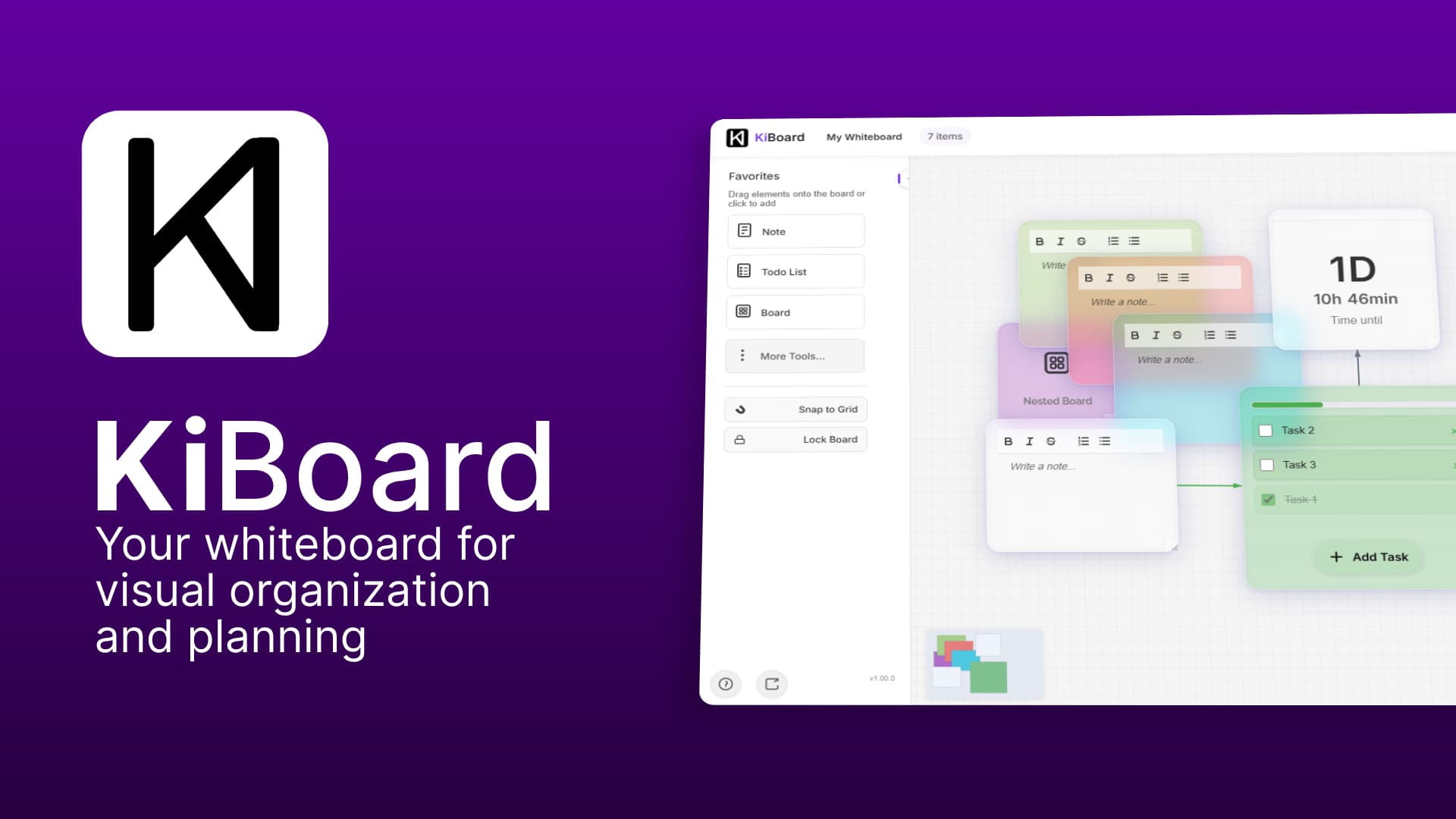
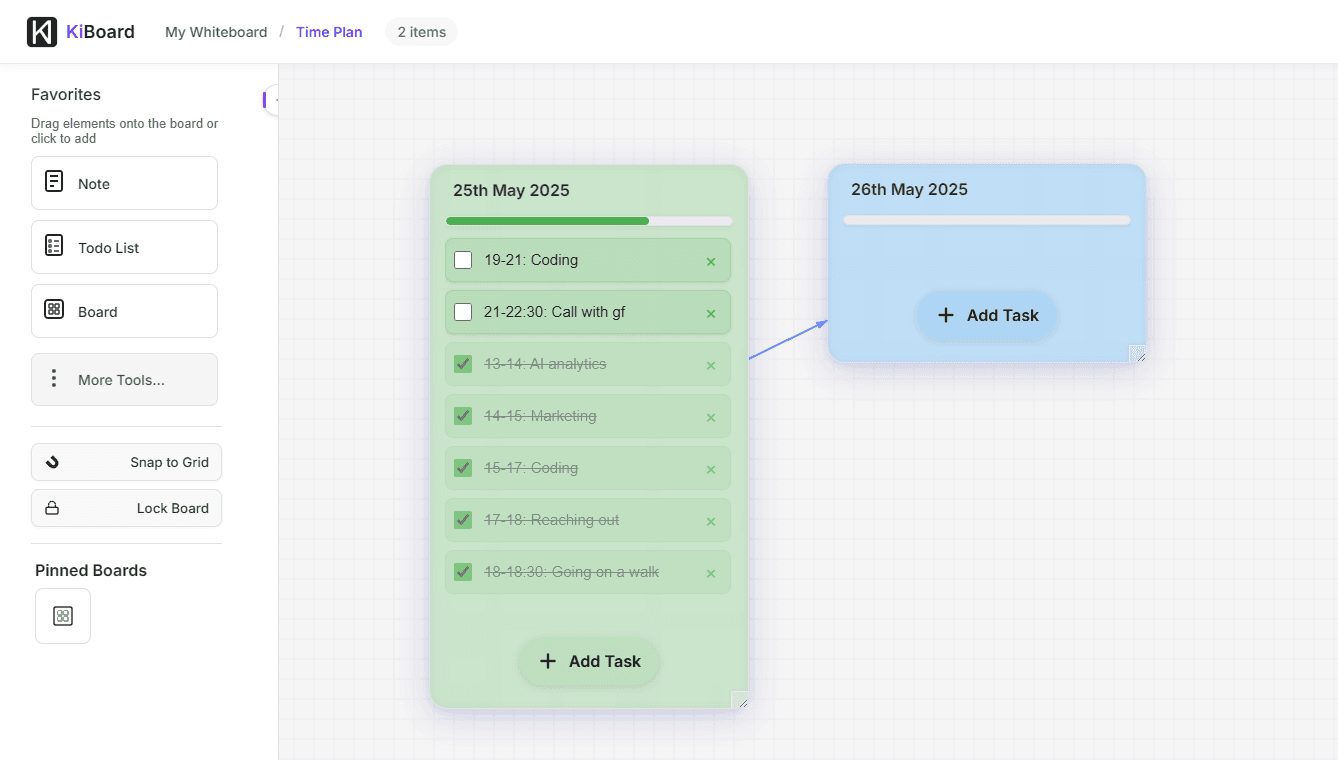
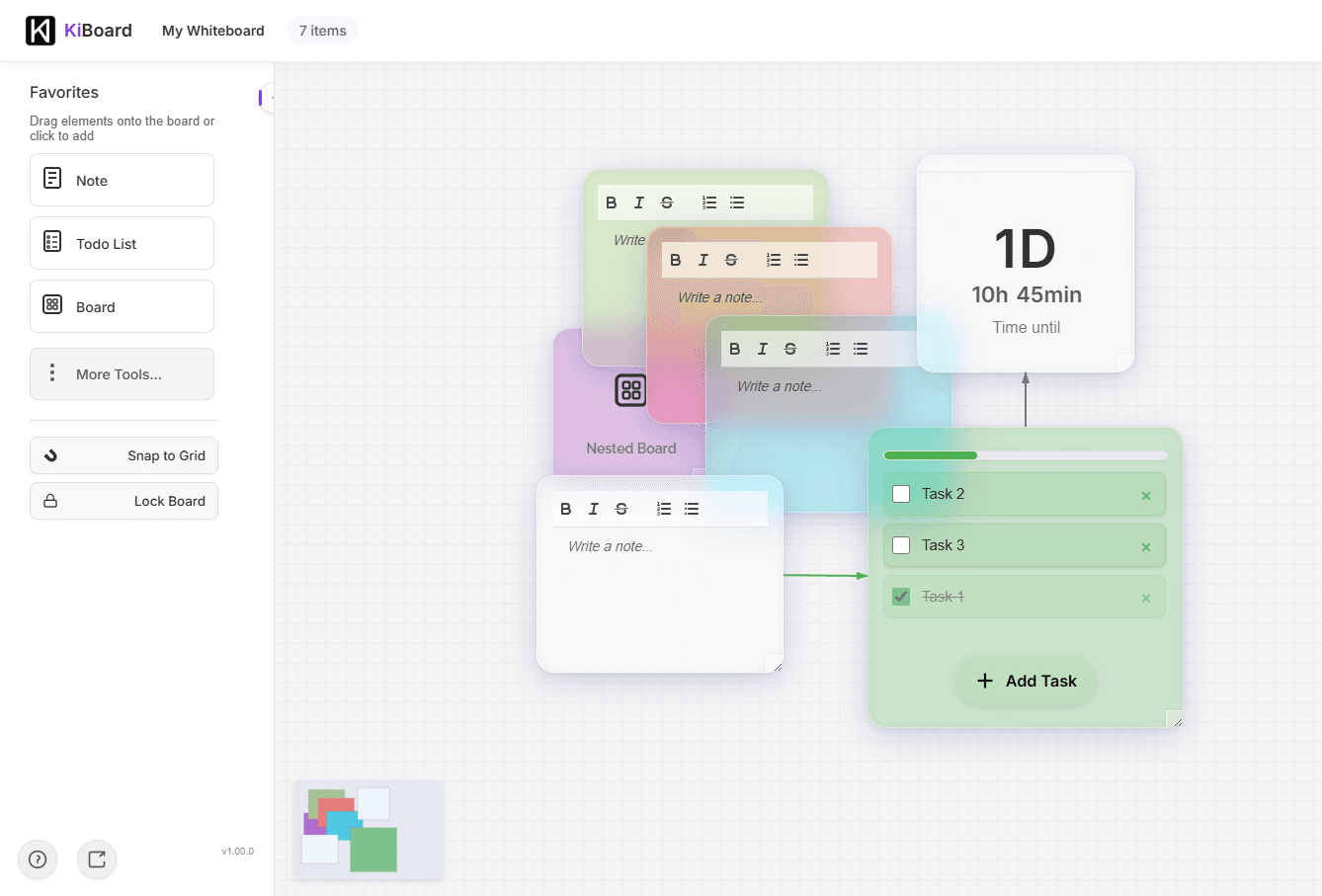
KiBoard is a spatial thinking environment that transforms complex planning into intuitive visual workflows. It's designed for project managers, creative teams, and remote collaborators who need to map out projects, brainstorm ideas, and manage tasks on an infinite canvas. Standout features include real-time collaboration, drag-and-drop tools for mind mapping and flowcharts, and a clean, minimalist interface that emphasizes organization over clutter. While it excels in visual planning and team coordination, it currently lacks advanced accessibility features, which may limit usability for some users. Overall, it's a promising tool for those tired of traditional slide-based constraints, offering a fresh approach to project visualization.
Drawn from the product itself, not from a survey.
Demographic
Project Managers
Pain points
Juggling complex timelines, scattered communication, unclear task dependencies
Primary needs
Visual roadmap creation, drag-and-drop scheduling, progress tracking
Demographic
Remote Teams
Pain points
Disconnected collaboration, version chaos, lack of shared context
Primary needs
Real-time co-editing, persistent workspace, intuitive commenting
Demographic
Visual Strategists
Pain points
Rigid slide formats, fragmented brainstorming, static diagrams
Primary needs
Infinite canvas, flexible object relationships, exportable frameworks
Written by AI from measured evidence, scored out of 100.
KiBoard offers a refreshing take on visual collaboration with its infinite canvas approach and clean minimalist design. It excels at providing spatial organization for complex projects without overwhelming users with unnecessary features. The tool shows particular strength for project managers and remote teams needing to visualize workflows and dependencies. However, significant accessibility gaps and limited advanced features prevent it from being a complete solution. The foundation is solid, but the implementation feels like an early-stage product rather than a mature platform.
Intuitive for basic diagramming with contextual toolbars, but untested edge cases and limited template library hinder advanced workflows.
Clean minimalist interface with spatial organization, drag-and-drop simplicity, and intuitive canvas navigation for visual workflows.
Assumed canvas optimizations with smooth panning/zooming using WebGL acceleration and selective element loading for complex boards.
Basic HTTPS encryption implemented, with hints at planned compliance features for finance/healthcare industries.
Critical gaps: no alt-text support, keyboard navigation, screen reader compatibility, or high-contrast options for impaired users.
High demand for visual planning tools in remote work era with strong potential for enterprise features and integrations.
KiBoard's design philosophy embraces minimalism with a purpose. The clean spatial interface immediately suggests this isn't another cluttered digital whiteboard. The infinite canvas concept delivers on its promise of freedom from slide-based constraints, offering intuitive panning and zooming mechanics that feel natural for mapping complex projects. Drag-and-drop functionality appears seamless for basic object manipulation, while contextual toolbars keep the workspace uncluttered. However, the lack of visible template libraries and advanced alignment tools might leave power users wanting more structure for complex workflows. The balance between freeform creativity and organized planning feels promising but not fully realized.
Performance appears optimized for the demanding task of rendering complex visual workspaces. The implementation likely uses canvas partitioning and WebGL acceleration to maintain smooth navigation even with dense boards. While no specific benchmarks are provided, comparable tools suggest responsive interactions with minimal lag. Security measures follow basic industry standards with HTTPS encryption, though the inclusion of finance and healthcare industry options in the contact form hints at planned compliance features. The absence of detailed security documentation or enterprise-grade controls might concern organizations handling sensitive data, but for most team collaborations, the protection level appears adequate.
Accessibility represents KiBoard's most significant shortcoming. The complete absence of screen reader support, keyboard navigation, and alt-text functionality makes this visual tool ironically inaccessible to users with visual impairments. The monochromatic interface lacks high-contrast options, and basic localization features appear limited to industry selections rather than true multilingual support. Despite these shortcomings, growth potential remains strong given the increasing demand for visual collaboration tools in remote work environments. The spatial thinking approach addresses genuine pain points in project management, and with proper feature development, KiBoard could compete effectively in the digital whiteboard space.
Conclusion
If you're tired of forcing visual thinking into linear documents and slide decks, KiBoard provides a compelling alternative worth exploring. It's particularly suited for project managers, creative teams, and remote collaborators who prioritize clean visual organization over feature complexity. While it may not replace established platforms for enterprise use, it offers a fresh perspective on spatial workflow management. Give it a try if you value simplicity and infinite canvas flexibility over advanced integrations and accessibility features.
Named competitors, point by point. Nobody paid to appear here or to be left out.
 KiBoard KiBoard |  Miro Miro |  Toggl Plan Toggl Plan |  Microsoft Whiteboard Microsoft Whiteboard | |
|---|---|---|---|---|
| Canvas Type | Infinite spatial canvas | Fixed frame with infinite extension | Limited frame workspace | Timeline-based canvas |
| Learning Curve | Moderate (minimalist but requires spatial thinking) | Steep (feature-rich complexity) | Low (simple and intuitive) | Moderate (specialized for scheduling) |
| Template Library | Limited (basic shapes and tools) | Extensive (professional templates) | Basic (Office integration) | Specialized (scheduling templates) |
| Real-time Collaboration | Yes (persistent workspace) | Yes (advanced team features) | Yes (basic co-editing) | Limited (view-only sharing) |
Miro
Feature-rich digital whiteboard with a strong template library but a steeper learning curve.
Toggl Plan
Specialized visual scheduling tool with timelines but weaker freeform canvas capabilities.
Microsoft Whiteboard
Simpler free option integrated with Office 365, though it lacks advanced planning features.
Comparing options? See KiBoard alternatives, scored side by side

An all-in-one hospitality software for restaurants and ba...

A weekly newsletter delivering curated tech jobs, intervi...

White-label reputation management software for agencies s...

Privacy-first open source journal app with a continuous t...

Puzzly is an all-in-one B2B lead generation platform that...

All-in-one AI workspace for docs, projects, and knowledge...

A free, open-source platform offering 110 AI agent skills...

Open-source desktop app for switching AI coding providers...

One verified handle for your online identity, readable by...

Frame-perfect video-to-GIF maker that runs entirely in yo...

White-label website audits that close deals for digital a...

PERM Processing Time is an independent data analysis platform that helps users navigate the U.S. Department of Labor’s permanent labor certification process.
A platform dedicated to providing unbiased reviews of newly launched applications, analyzing everything from their features to their full potential.
info@scoutforge.net© 2026 Scoutforge. All rights reserved.