

A platform dedicated to providing unbiased reviews of newly launched applications, analyzing everything from their features to their full potential.
info@scoutforge.net© 2026 Scoutforge. All rights reserved.
A platform dedicated to providing unbiased reviews of newly launched applications, analyzing everything from their features to their full potential.
info@scoutforge.net© 2026 Scoutforge. All rights reserved.
A platform dedicated to providing unbiased reviews of newly launched applications, analyzing everything from their features to their full potential.
info@scoutforge.net© 2026 Scoutforge. All rights reserved.
Cycling through all six. Tap any point to stop.
Measured on six things
AI chief of staff for founders and small teams
Real problem (founders losing strategic focus), specific audience, and a mission-centric wedge. Differentiators are real but copyable by Notion AI or Motion.
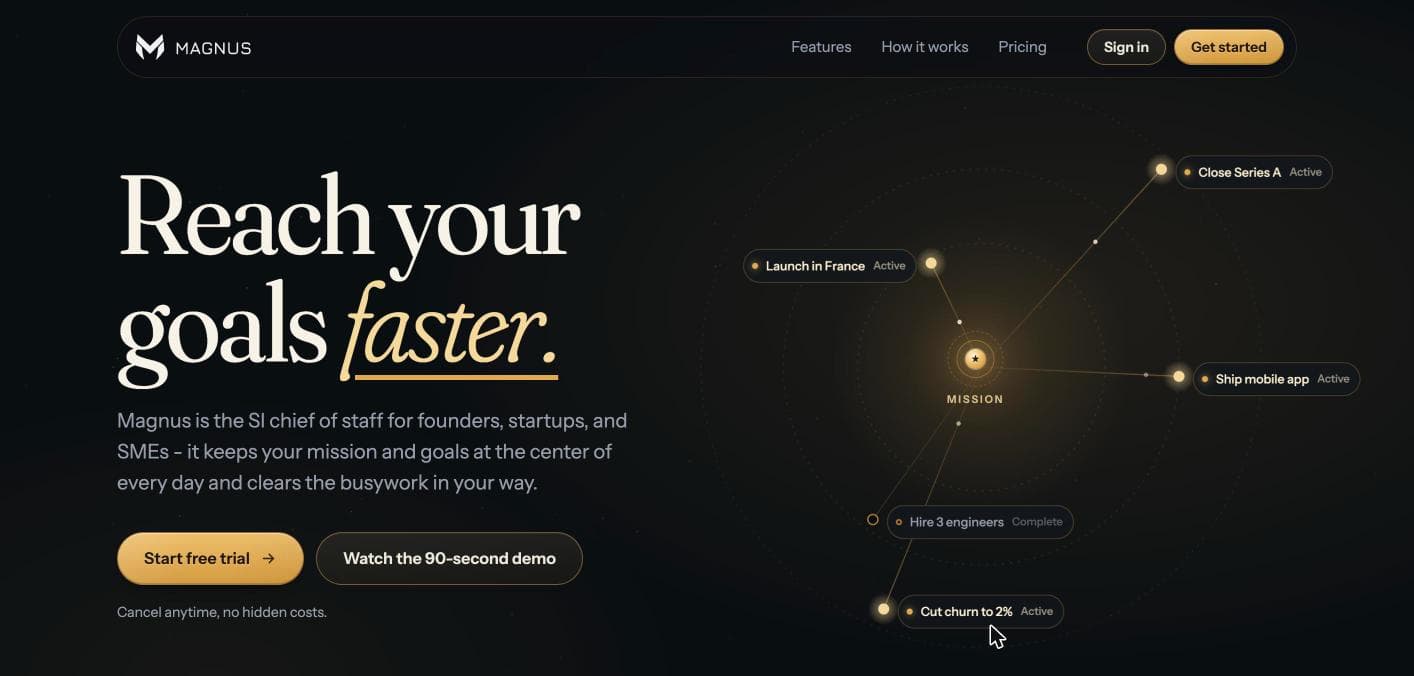
Magnus is an AI chief of staff for founders, startups and small businesses. You tell it what the company is working towards, and it keeps those goals in view, suggests the next steps and writes the documents you keep putting off. It creates PDF, Word and Excel files, with templates for pitch decks, NDAs, OKRs, proposals and invoices. It uses your company notes to keep answers accurate, and connects to Google, Slack, GitHub and Notion. You can talk to it out loud through a lip-synced 3D avatar. Magnus runs in the browser and has apps for Mac, iPhone, iPad, Android and Linux, in 38 languages. There is a free trial, then it costs $29.99 a month with your own API keys (Claude, OpenAI or Grok) or $49.99 a month all inclusive.
Drawn from the product itself, not from a survey.
Demographic
Startup founders
Pain points
Overwhelmed by endless tasks, losing sight of strategic goals
Primary needs
A tool to prioritize high-impact activities and automate busywork
Demographic
Small business owners
Pain points
Limited resources, struggling to manage daily operations and growth
Primary needs
An affordable AI assistant to streamline operations and track progress
Demographic
SME managers
Pain points
Difficulty aligning team efforts with company mission
Primary needs
Centralized goal tracking and task automation to improve efficiency
Written by AI from measured evidence, scored out of 100.
Magnus is a well-built early-stage AI chief of staff with a genuinely fast site, clean design, and a clear mission-centric pitch. The technical execution is above average — 100/100 Lighthouse on both mobile and desktop, a full security-header stack, and broad platform coverage in 38 languages. Where it thins out is the layer users actually live in: no visible docs, no help center, no published compliance or accessibility statements, and a differentiation story that leans on positioning rather than a defensible moat. The free trial and named integrations lower the barrier to trying it, and the $29.99 bring-your-own-key tier is a smart price point for cost-conscious founders. It is a credible tool for a founder who wants goal tracking and document generation in one place — provided they are comfortable being an early adopter of a product still building out its trust and support surfaces.
Free trial, 90-second demo, and named integrations (Google, Slack, GitHub, Notion) are solid. No docs, help center, or onboarding detail appeared in the fetched content.
Clean, modern dark landing page with a clear goal-tracking dashboard mockup and consistent branding. Native app UI could not be judged from the collected evidence.
Lighthouse mobile and desktop both scored 100/100, with LCP 784ms, CLS 0.043, and TBT 19ms. Genuinely fast, well-optimized delivery.
Full security-header stack (HSTS, CSP, frame protection, Referrer-Policy, Permissions-Policy) plus SPF and DMARC, 12/12 on the probe. No published audits or SOC 2 found.
Lighthouse accessibility 100/100 on automated checks, 38 languages, and apps across Mac, iPhone, iPad, Android, and Linux. No WCAG statement found.
Real problem (founders losing strategic focus), specific audience, and a mission-centric wedge. Differentiators are real but copyable by Notion AI or Motion.
Magnus presents a polished, modern dark landing page with a clear goal-tracking dashboard mockup and consistent branding — the visual language reads confident and current. Usability signals are thinner: a free trial, a 90-second demo, and named integrations with Google, Slack, GitHub, and Notion are all good table stakes, but the fetched site content contained no help center, no documentation, and no onboarding detail. For a product whose whole pitch is 'tell it your goals and it handles the rest,' the absence of visible docs is a real gap — users will want to know how company notes are ingested, how the avatar works, and what the templates actually produce. The product ships across Mac, iPhone, iPad, Android, and Linux in 38 languages, which is a genuinely broad surface for a young tool. Design lands above average; usability is competent but under-explained.
Speed is the standout: Lighthouse scored 100/100 on both mobile and desktop, with LCP 784ms, CLS 0.043, TBT 19ms, and FCP 784ms. That is a genuinely well-optimized site, not a heavy SPA dragging its feet. Security is strong on the automated probe — HTTPS enforced, HSTS, CSP, frame protection, X-Content-Type-Options, Referrer-Policy, and Permissions-Policy all present, plus SPF and DMARC configured, for a 12/12 checklist score. What is missing is the layer above headers: no SOC 2, ISO 27001, pen-test summary, or bug-bounty program appeared in the fetched content. For a tool that ingests company notes, connects to Slack and GitHub, and generates legal documents like NDAs, that compliance gap matters more than it would for a toy. The technical hygiene is real; the trust documentation is not yet there.
Accessibility scores well on automated checks — Lighthouse returned 100/100 — and the product covers 38 languages with apps on Mac, iPhone, iPad, Android, and Linux, which is unusually broad platform coverage for an early-stage tool. No WCAG conformance statement or accessibility page was found, so the automated score is the ceiling of what can be verified. Growth is a judgement on the idea: the problem Magnus names — founders losing sight of strategic goals while drowning in busywork — is real and worth paying for. The target customer is specific (founders, startups, SMEs), and the wedge is mission-centric guidance plus document generation and a 3D avatar. The risk is differentiation: Notion AI, Reclaim.ai, and Motion all sit adjacent, and mission-centric framing is a positioning choice rather than a technical moat. The category has headroom, but Magnus needs to prove the wedge is more than a landing-page line.
Conclusion
Magnus is worth a free-trial run if you are a founder who wants goals, notes, and document generation in one place and you already have API keys to bring. The speed and design make it pleasant to use, and the integrations cover the tools most small teams already run. Go in expecting to figure things out yourself — the docs and compliance pages are not there yet — and treat the 3D avatar as a demo feature rather than a reason to buy. If the mission-tracking workflow clicks for you, the $29.99 BYO-key tier is a reasonable bet. If you need SOC 2 paperwork before you can put company notes into a tool, wait a few quarters.
Named competitors, point by point. Nobody paid to appear here or to be left out.
 Magnus Magnus |  Notion AI Notion AI | Reclaim.ai |  Motion Motion | |
|---|---|---|---|---|
| Core positioning | AI chief of staff focused on mission and goal alignment for founders and SMEs. | AI writing and summarization inside a workspace, no dedicated chief-of-staff layer. | AI scheduling assistant optimizing calendar and time, not strategic goals. | AI task and day planner, no mission-centric guidance. |
| Document generation (PDF/Word/Excel) | Templates for pitch decks, NDAs, OKRs, proposals, and invoices. | Text drafting inside Notion pages; export limited, no native Excel/PDF templates. | Not a document tool; focuses on scheduling. | Not a document tool; focuses on task planning. |
| Integrations | Google, Slack, GitHub, Notion. | Native to Notion; connects via Notion's own integration ecosystem. | Google Calendar, Slack, and task tools. | Calendar, project management, and task tools. |
| Pricing model | $29.99/mo with your own API keys, or $49.99/mo all-inclusive; free trial. | Add-on to Notion plans, billed per member. | Free tier plus paid plans per user. | Per-user subscription, no BYO-key option. |
| Platform coverage | Browser, Mac, iPhone, iPad, Android, Linux; 38 languages. | Web, desktop, and mobile apps. | Web app and calendar integrations. | Web and mobile apps. |
Notion AI
AI-powered workspace that assists with writing, summarizing, and task management, but lacks dedicated chief of staff features.
Reclaim.ai
AI scheduling assistant that optimizes your calendar and tasks, but focuses more on time management than strategic goal alignment.
Motion
AI productivity app that automatically plans your day and tasks, but doesn't offer the same level of mission-centric guidance.
Comparing options? See Magnus alternatives, scored side by side

An all-in-one hospitality software for restaurants and ba...

A weekly newsletter delivering curated tech jobs, intervi...

White-label reputation management software for agencies s...

Privacy-first open source journal app with a continuous t...

Puzzly is an all-in-one B2B lead generation platform that...

All-in-one AI workspace for docs, projects, and knowledge...

A free, open-source platform offering 110 AI agent skills...

Open-source desktop app for switching AI coding providers...

One verified handle for your online identity, readable by...

Frame-perfect video-to-GIF maker that runs entirely in yo...

White-label website audits that close deals for digital a...

Automated quote follow-up for trades and service businesses.
A platform dedicated to providing unbiased reviews of newly launched applications, analyzing everything from their features to their full potential.
info@scoutforge.net© 2026 Scoutforge. All rights reserved.