

A platform dedicated to providing unbiased reviews of newly launched applications, analyzing everything from their features to their full potential.
info@scoutforge.net© 2026 Scoutforge. All rights reserved.
A platform dedicated to providing unbiased reviews of newly launched applications, analyzing everything from their features to their full potential.
info@scoutforge.net© 2026 Scoutforge. All rights reserved.
A platform dedicated to providing unbiased reviews of newly launched applications, analyzing everything from their features to their full potential.
info@scoutforge.net© 2026 Scoutforge. All rights reserved.
Cycling through all six. Tap any point to stop.
Measured on six things
Cloud AI agents with persistent disk, memory, and real CL...
Real problem (persistent agent environments), specific wedge (managed disk + MCP + scheduled workflows), and a category with headroom. Domain is ~0.4 years old; traction is context, not the score.
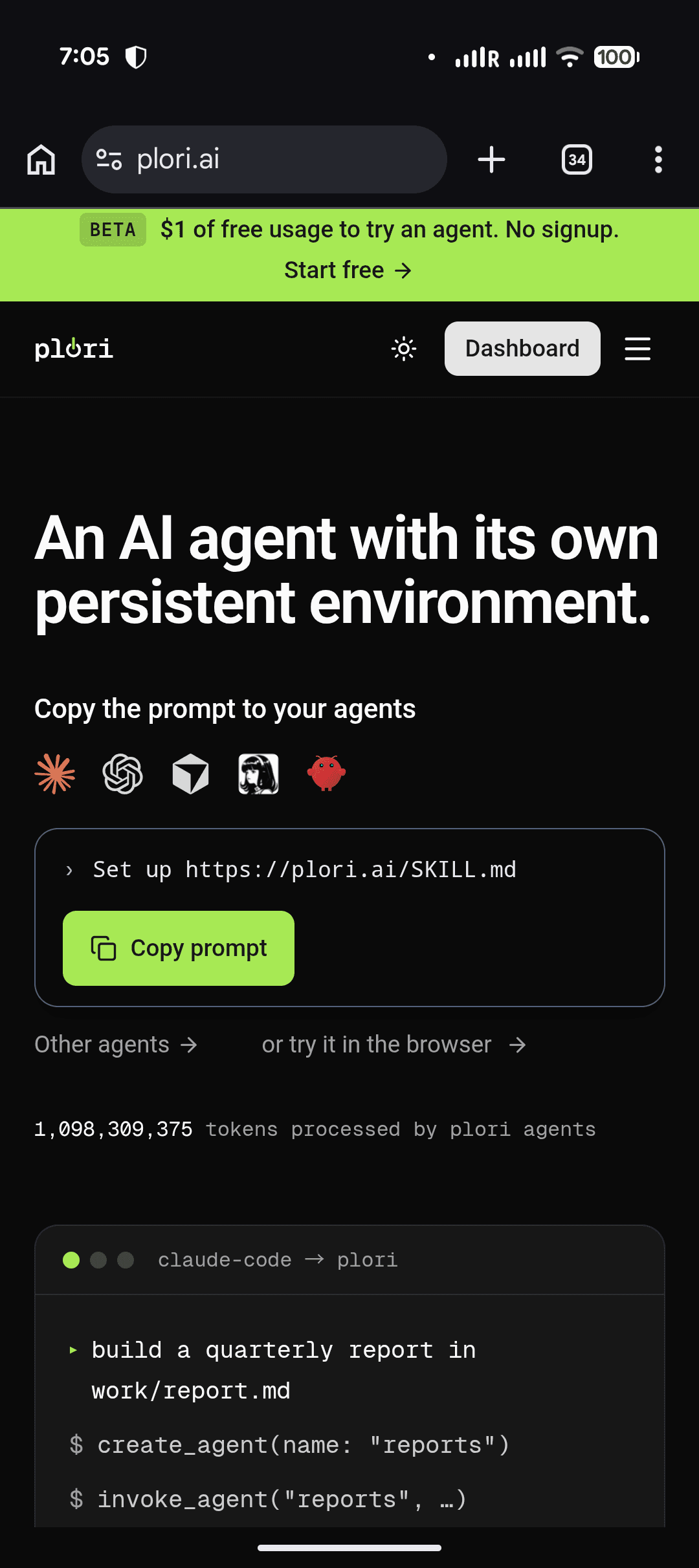
Plori is a cloud platform that gives AI agents their own persistent environment—complete with a durable disk, a full suite of preinstalled CLI tools (shell, Python, Node, git, web search), and long-term memory. Unlike ephemeral sandboxes, each Plori agent runs on a dedicated machine with its own disk, allowing it to retain files and context across sessions. You can interact with your agent directly in the browser or connect it to your existing tools (like Claude Code, Cursor, or any MCP client) to delegate long-running tasks. Plori agents can build and publish websites, automate workflows on schedules or webhooks, and even research social platforms like X and Reddit. The platform emphasizes isolation and security, with every agent running in its own environment. It's currently in beta, offering $1 of free usage to start, and supports BYOK (Bring Your Own Key) for LLM providers. Whether you're a developer offloading test suites, a marketer automating lead collection, or a researcher ...
Drawn from the product itself, not from a survey.
Demographic
Software Developers & Engineers
Pain points
Running long test suites, migrations, or background tasks locally blocks their machine and requires constant supervision.
Primary needs
A persistent cloud environment where agents can execute long-running jobs, retain state, and report back without tying up local resources.
Demographic
Marketing & Growth Professionals
Pain points
Manual social media research, lead collection from webhooks, and content publishing are time-consuming and error-prone.
Primary needs
Automated workflows that can scrape X/Reddit, collect leads into Google Sheets, publish articles, and send alerts to Discord—all on a schedule.
Demographic
Technical Product Managers & Founders
Pain points
Juggling multiple AI tools and agents without a unified way to delegate tasks or maintain context across sessions.
Primary needs
A central agent hub with memory that integrates with existing AI tools (Claude, Cursor) and can build custom workflows without coding.
Written by AI from measured evidence, scored out of 100.
Plori is a cloud platform that gives AI agents a persistent environment — dedicated machine, durable disk, preinstalled CLI tools (shell, Python, Node, git, web search), and long-term memory — with MCP integration so you can drive it from Claude Code, Cursor, or any MCP client. The pitch is sharp and the execution is above-average for a beta: a fast, well-built marketing site (Lighthouse 94 mobile / 100 desktop), a no-signup free tier, a genuinely deep docs set, and full HTTP security header hygiene. Pricing is credit-based ($0 free with $5 usage, $20 Pro, $100 Power) with a clear explanation of what a credit buys. The gaps are the usual beta gaps: no SOC 2 or compliance page, no accessibility statement, no published runtime benchmarks, and a growth story that depends on out-executing frameworks that are chasing the same persistent-memory feature. For a developer who wants to hand off long-running jobs today, it's a credible option. For an enterprise buyer, it's early.
No-signup free trial, $1-$5 free usage, 12+ docs pages (quickstart, CLI, disk, workflows, BYOK, REST API), and one-prompt MCP setup for Claude Code/Cursor. Onboarding path is genuinely short.
Dark developer-tool aesthetic with a terminal-style hero showing a real claude-code → plori run and numbered example cards. Consistent 'plri' branding; landing page craft is above-average for an early beta.
Lighthouse mobile 94/100 (LCP 3.0s, CLS 0.018, TBT 30ms, FCP 1.1s) and desktop 100/100. Marketing site is fast; product runtime speed is a separate question the site doesn't benchmark.
Full header hygiene (HSTS, CSP, frame protection, Referrer-Policy, Permissions-Policy), SPF and DMARC configured, 12/12 probe checklist. Per-agent dedicated-machine isolation claimed. No SOC 2, ISO, or bug bounty page found.
Lighthouse accessibility 100/100 with one failing audit (visible text labels without matching accessible names). No WCAG statement, a11y page, or multi-language support found in fetched content.
Real problem (persistent agent environments), specific wedge (managed disk + MCP + scheduled workflows), and a category with headroom. Domain is ~0.4 years old; traction is context, not the score.
Plori's landing page is a competent developer-tool surface: a terminal-style hero showing a real claude-code → plori run, numbered example cards (Claude Code over MCP, Node.js scale-to-zero, X/Reddit research, Google Sheets OAuth, Telegram, Reddit Ads, X API), and a consistent 'plri' wordmark. It reads as a product built by people who use the tools they're selling to. Usability is the stronger story: no signup required to try an agent, $1-$5 of free usage, and a docs index with 12+ guides covering quickstart, CLI, disk, publishing, memory, schedules, workflows, BYOK, and a documented REST API with an OpenAPI 3.1 spec. MCP setup is one prompt via SKILL.md. The onboarding path from landing page to a real task is short and well-signposted. Where it thins out: no live demo video, no customer testimonials, and the docs are dense enough that a non-developer target customer (the marketer persona) will hit a wall fast.
Speed is measured and strong: Lighthouse mobile 94/100 (LCP 3.0s, CLS 0.018, TBT 30ms, FCP 1.1s) and desktop 100/100. That's the marketing site, not the agent runtime — Plori doesn't publish benchmarks for how fast an agent actually executes a test suite or a migration, which is the number a developer would actually want. Security is solid on the basics: HTTPS enforced, HSTS, CSP, frame protection, X-Content-Type-Options, Referrer-Policy, Permissions-Policy all present, SPF and DMARC configured, 12/12 on the header probe. The product claims each agent runs on its own dedicated machine with isolation between accounts. What's missing is the compliance layer: no SOC 2, no ISO 27001, no published pen-test, no bug bounty, no security page. For a beta that's normal, but for a platform asking developers to hand it long-running jobs and credentials, it's the gap that will slow enterprise adoption.
Accessibility scores 100/100 on Lighthouse with one failing audit — visible text labels without matching accessible names — which is a small, fixable issue. There's no WCAG conformance statement, no accessibility page, and no multi-language support in the fetched content, so the automated green is doing more work than it should. Growth is the more interesting question. The problem Plori names is real: agents that forget everything between sessions are genuinely annoying, and a persistent disk plus long-term memory plus scheduled workflows is a coherent answer. The target customer is specific (developers offloading long test suites, marketers automating social research, PMs juggling multiple AI tools). The wedge against the listed alternatives is clear — LangChain, AutoGPT, and AgentGPT are frameworks or ephemeral-session tools; Plori is a managed persistent environment with MCP integration. The limit: every major agent framework is racing toward the same persistent-memory feature, and Plori's differentiation is execution and integration breadth, not a structural moat. The category has headroom; the defensibility is thinner than the pitch implies.
Conclusion
Plori is the kind of product that's easy to underestimate because the pitch sounds like a feature, not a company: 'your agent gets a disk.' But the execution behind that pitch is real — measured site performance, a full security header posture, a docs set that actually explains the billing model, and MCP integration that meets developers where they already are. The honest read is that Plori is a well-built beta with a clear wedge and a category that's about to get crowded. If the team ships the compliance layer and publishes runtime benchmarks before the frameworks catch up on persistence, this becomes a serious product. If they don't, it becomes a nice feature that someone else bundles. Worth trying on the free tier; worth watching on the paid tiers.
Named competitors, point by point. Nobody paid to appear here or to be left out.
 Plori Plori |  LangChain LangChain |  AutoGPT AutoGPT |  AgentGPT AgentGPT | |
|---|---|---|---|---|
| Persistent environment | Yes — dedicated machine with durable disk and long-term memory per agent | No — framework only; persistence requires self-hosting | No — typically runs in ephemeral sandboxes | No — temporary browser sessions without persistent disk |
| MCP / client integration | Yes — single MCP endpoint for Claude Code, Cursor, ChatGPT, any MCP client | Partial — tool/agent framework, no hosted MCP endpoint | No — standalone agent, no MCP client integration | No — browser-only interface |
| Scheduled workflows / webhooks | Yes — schedule, webhook, and manual triggers built by the agent in chat | No — requires custom orchestration code | No — single-run autonomous execution | No — manual browser-triggered runs |
| Pricing model | Free ($5 usage), Pro $20/mo, Power $100/mo — credit pool + disk add-ons | Open-source free; costs are self-hosted infra + LLM API | Open-source free; costs are LLM API usage | Free tier plus paid plans; browser-based usage |
| Site publishing / hosting | Yes — serve any directory at your-name.plori.site, private by default | No — framework, no hosting | No — no publishing capability | No — no publishing capability |
LangChain
An open-source framework for building LLM-powered applications with agents and tools, but requires self-hosting for persistent environments.
AutoGPT
An experimental open-source agent that can autonomously perform tasks, but lacks a persistent cloud environment and often runs in ephemeral sandboxes.
AgentGPT
A browser-based autonomous AI agent platform, but typically runs in temporary sessions without persistent disk or workflow scheduling.
Comparing options? See Plori alternatives, scored side by side

An all-in-one hospitality software for restaurants and ba...

A weekly newsletter delivering curated tech jobs, intervi...

White-label reputation management software for agencies s...

Privacy-first open source journal app with a continuous t...

Puzzly is an all-in-one B2B lead generation platform that...

All-in-one AI workspace for docs, projects, and knowledge...

A free, open-source platform offering 110 AI agent skills...

Open-source desktop app for switching AI coding providers...

One verified handle for your online identity, readable by...

Frame-perfect video-to-GIF maker that runs entirely in yo...

White-label website audits that close deals for digital a...

Automated quote follow-up for trades and service businesses.
A platform dedicated to providing unbiased reviews of newly launched applications, analyzing everything from their features to their full potential.
info@scoutforge.net© 2026 Scoutforge. All rights reserved.