

A platform dedicated to providing unbiased reviews of newly launched applications, analyzing everything from their features to their full potential.
info@scoutforge.net© 2026 Scoutforge. All rights reserved.
A platform dedicated to providing unbiased reviews of newly launched applications, analyzing everything from their features to their full potential.
info@scoutforge.net© 2026 Scoutforge. All rights reserved.
A platform dedicated to providing unbiased reviews of newly launched applications, analyzing everything from their features to their full potential.
info@scoutforge.net© 2026 Scoutforge. All rights reserved.
Cycling through all six. Tap any point to stop.
Measured on six things
Screen stocks using 30+ value disciplines. Receive an email when your investment thesis breaks.
Real problem (forgetting to check filings), specific target (DIY value investors), and a concrete wedge: nightly guardrail re-testing that Morningstar, Seeking Alpha and Koyfin don't offer. Early stage, no traction yet.
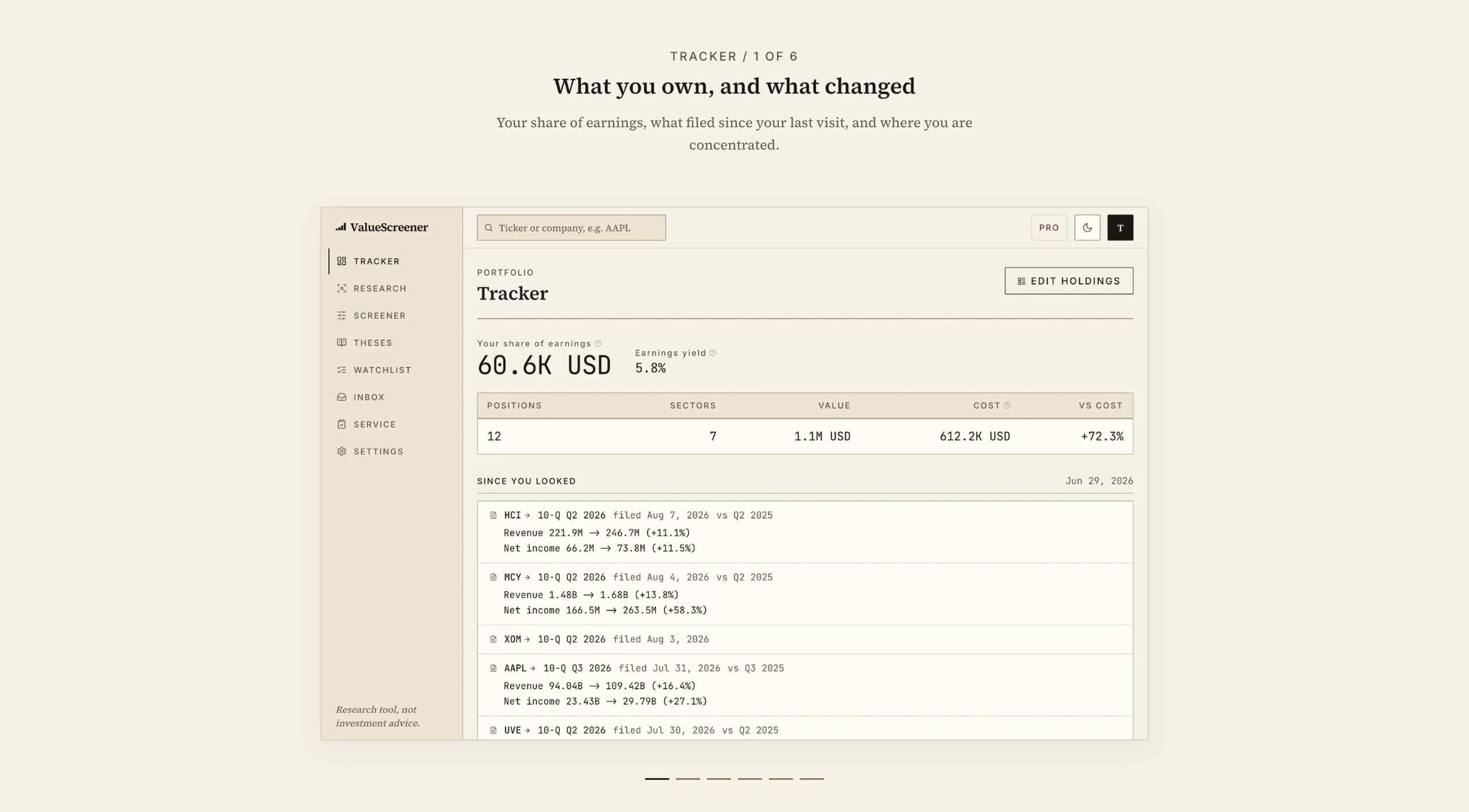
ValueScreener is a value investing stock screener and thesis monitoring tool for people who pick their own stocks. The screener runs 30+ documented disciplines against every company we track, so you find candidates passing a named strategy, not a generic stock information screen. Every stock page shows sourced figures on whether a company is cheap, good and safe, ranked against peers. Once you own a stock, write down why: the numbers that must stay true, as guardrails like "operating margin stays above 12%." Every night, guardrails and any saved screen are re-tested against the newest filings. Most nights nothing changes, so you hear nothing. The first night a guardrail breaks or a company enters/leaves a screen, you get one email with the arithmetic and filing behind it.
Drawn from the product itself, not from a survey.
Demographic
Individual value investors
Pain points
Manually tracking dozens of stocks and forgetting to check new filings; spreadsheet updates are tedious and outdated.
Primary needs
Automated nightly monitoring of investment theses with clear, actionable alerts when assumptions break.
Demographic
Financial advisors and portfolio managers
Pain points
Managing client portfolios requires constant vigilance but lacks scalable tools for thesis tracking.
Primary needs
A reliable system to monitor multiple holdings and receive timely notifications on fundamental changes.
Demographic
DIY investors using Graham/Buffett strategies
Pain points
Difficulty applying complex screening criteria consistently and staying updated on portfolio health.
Primary needs
Access to pre-built screens based on legendary investors' methods and real-time monitoring of their own criteria.
Written by AI from measured evidence, scored out of 100.
ValueScreener is a value investing screener and thesis monitor that runs 30+ documented disciplines against every company it tracks and re-tests your written guardrails nightly. The pitch is sharp: you write down why you own a stock, set conditions like 'operating margin stays above 12%', and you hear nothing until one breaks — then you get one email with the arithmetic and the filing behind it. The execution is above average for an early-stage product. The homepage is visually disciplined and the Graham-Alman card shows real test names, thresholds and pass/fail dots rather than a vague score. Speed is excellent (Lighthouse mobile 93, desktop 100). Security headers are fully configured (12/12). Accessibility scores 100/100 on automated checks. The weaknesses are the usual early-stage ones: a blank homepage section, cramped inbox mockup, low-contrast active nav, no published security audits, no accessibility statement, and no traction signals yet. The idea itself is well-positioned against Morningstar, Seeking Alpha and Koyfin, none of which offer automated thesis-break monitoring. At $29/mo or $228/yr with a 14-day trial and 30-day refund, the pricing is honest and the value proposition is clear. It's a competent, focused tool for a specific audience — worth a trial if you're the kind of investor who writes down your reasons and then forgets to check them.
One plan, clear pricing, 14-day trial with card, one-click cancel, 30-day refund. The app sidebar is labeled but the active 'Tracker' item has low contrast. Onboarding path is straightforward.
Clean off-white palette, restrained black CTAs, and a genuinely informative Graham-Alman card with status dots. The blank second section and cramped inbox mockup keep it from the top of the band.
Lighthouse mobile 93/100 (LCP 3.0s, CLS 0, TBT 0ms), desktop 100/100. Lightweight marketing page with no heavy SPA overhead. LCP is the only metric keeping it out of the 90s.
Full security header suite (HSTS, CSP, frame protection, Referrer-Policy, Permissions-Policy), SPF and DMARC configured, 12/12 probe points. No SOC 2, ISO or pen-test report published — normal for stage, but unverified.
Lighthouse accessibility 100/100. No WCAG statement or keyboard-nav docs, and the visual audit flagged tiny text in the inbox mockup. Automated checks pass; manual coverage is unverified.
Real problem (forgetting to check filings), specific target (DIY value investors), and a concrete wedge: nightly guardrail re-testing that Morningstar, Seeking Alpha and Koyfin don't offer. Early stage, no traction yet.
The homepage is visually disciplined: off-white background, restrained black buttons, and a Graham-Alman card that actually shows the test names, thresholds and pass/fail dots rather than a vague 'score'. The app screenshot in the maker media section shows a compact tracker table with ticker, sector, value, cost and YoY change — scannable and dense in a good way. The problems are execution details: a blank second section in the render breaks continuity, the inbox mockup uses very small text with tight line-height, and the active 'Tracker' nav item has low contrast. Usability is straightforward — one plan, $29/mo or $228/yr, 14-day trial with card, first charge day 15, one-click cancel, 30-day refund. The onboarding path is clear and the CTA repeats with honest microcopy. The main friction is that the app sidebar's active state is hard to read, and there's no free tier or live demo to try before handing over a card.
Speed is a genuine strength. Lighthouse mobile scores 93/100 with LCP 3.0s, CLS 0, TBT 0ms and FCP 927ms; desktop hits 100/100. The site is a lightweight marketing page — no heavy SPA, no bloated JS — and there are no user complaints about lag. The only mobile metric keeping it out of the 90s is LCP, which is still solid. Security is well-configured at the infrastructure level: HTTPS enforced, HSTS, CSP, frame protection, X-Content-Type-Options, Referrer-Policy and Permissions-Policy all present, plus SPF and DMARC — 12/12 on the probe checklist. What's missing is published assurance: no SOC 2, ISO 27001, pen-test report or bug bounty page. For a tool that handles portfolio data and email alerts, that's a gap worth closing as it grows, but it's normal for a product this young. The pricing page does mention a 'data-issue link that reaches a person', which is a small transparency signal.
Accessibility scores 100/100 on the Lighthouse audit, which covers automated axe-core checks — color contrast, alt text, form labels, ARIA. That's a strong baseline. What's unverified is the manual side: no accessibility statement, no WCAG conformance claim, no keyboard-navigation documentation, and the visual audit flagged very small text and tight line-height in the inbox example mockup, which could hurt readability on mobile. The product is US-listed companies only (NYSE, NASDAQ, AMEX), so multi-language support isn't a near-term concern. Growth is a judgement on the idea: the problem is real — DIY value investors manually track dozens of stocks and forget to check new filings — and the target is specific. The wedge is concrete: 30+ documented disciplines (Graham, Piotroski, Altman, Beneish) plus nightly re-testing of user-written guardrails with a single email on breach. Morningstar, Seeking Alpha and Koyfin offer screening and research but not automated thesis-break monitoring, so there's a genuine gap. The limit is market size: this is a niche of self-directed value investors willing to pay $29/mo, and the domain was registered in September 2026, so traction is unproven.
Conclusion
ValueScreener isn't trying to be a Bloomberg terminal or a social investing network. It's a narrow tool for a specific behavior: writing down why you own something and then actually checking whether that reason still holds. The nightly re-testing with one-email-on-breach is the kind of feature that sounds boring until you realize it's the exact thing most DIY investors fail at. The product is early — domain registered September 2026, no traction signals — so the honest read is: the idea is sound, the execution is above average for its stage, and the pricing is fair. If you're a value investor who already uses Graham or Buffett-style criteria and you've ever been surprised by a filing you didn't read, this is worth the 14-day trial. If you want a free screener with a big community, this isn't that. The main things to watch are published security assurance and whether the nightly monitoring actually delivers on its 'never a false alarm' promise at scale.
Named competitors, point by point. Nobody paid to appear here or to be left out.
 ValueScreener ValueScreener |  Morningstar Morningstar |  Seeking Alpha Seeking Alpha |  Koyfin Koyfin | |
|---|---|---|---|---|
| Automated thesis-break monitoring with email alerts | Yes — nightly re-testing of user-written guardrails with one email on breach | No — research and portfolio tracking, no automated thesis-break alerts | No — crowdsourced research and portfolio tools, no personalized thesis-break alerts | No — financial data and screening, no automated monitoring of user-defined theses |
| Pre-built screens based on legendary investor methods | Yes — 30+ documented disciplines including Graham, Piotroski, Altman, Beneish | Partial — star ratings and moat analysis, not named investor test suites | No — analyst ratings and quant scores, not Graham/Buffett test suites | Partial — custom screening, no pre-built legendary investor disciplines |
| Pricing model | $29/mo or $228/yr, 14-day trial with card, 30-day refund | Free tier plus premium subscription (varies by region) | Free tier plus Premium (~$239/yr) | Free tier plus paid plans (varies) |
| Market coverage | US-listed only (NYSE, NASDAQ, AMEX) | Global coverage across many exchanges | Primarily US-listed, some international | Global coverage across many exchanges |
Morningstar
Comprehensive investment research and portfolio tracking, but lacks automated thesis monitoring and custom screen alerts.
Seeking Alpha
Crowdsourced investment research and portfolio tools, but not focused on personalized thesis break alerts.
Koyfin
Financial data and analytics platform with screening, but no automated monitoring of user-defined investment theses.
Comparing options? See ValueScreener alternatives, scored side by side

A free, comprehensive financial calculator platform with ...

A no-code Solana token creator that deploys SPL tokens in...

Automated bookkeeping software that extracts data from re...

AI invoice follow-up that drafts reminders and tracks next steps.

A top-rated virtual assistant agency that matches busines...

Connect your bank to AI for real answers about your money.

A developer-first financial data API providing structured...

Stripdo is a smart invoicing tool that automatically gene...

Real-time monetization infrastructure for AI products tha...

Professional quoting with reusable pricing rules, polished proposals and online customer approvals.

All-in-one CIRO exam prep for CIRE and 8 other exams, wit...

Dokta is an AI-powered document management and invoicing ...
A platform dedicated to providing unbiased reviews of newly launched applications, analyzing everything from their features to their full potential.
info@scoutforge.net© 2026 Scoutforge. All rights reserved.