

You have an app. You have a website. Now you want people to find you. The advice you keep hearing is "submit to directories" — and then you open a submission form and realize you have no idea what to put in the tagline field, which category to pick, or whether you should pay $5 to skip a queue.
Getting listed is not about spamming your URL into a hundred forms; it is about passing a human review on a handful of surfaces where your buyers actually compare software.
Most founders treat directory submissions as a checkbox. They paste a generic description, upload one blurry screenshot, and then wonder why the listing sits buried three pages deep with zero clicks. The founders who get accepted quickly — and get featured — treat each submission like a small landing page with a specific audience and a specific job.
This guide covers the mechanics: what editors check before accepting you, how to write a listing that gets approved and clicked, how to handle review sites when you have zero reviews, and a 30-day plan you can run solo.
Why Directory Listings Still Matter in 2026
The old SEO playbook said directories were backlink farms: submit to 500 of them, get 500 links, rank. That playbook is dead. Google's spam policies now explicitly list low-quality directory and bookmark site links as an example of link spam. If you are chasing directories purely for link juice, you are building a penalty risk, not an asset.
What changed is what directories actually do now. They are discovery and comparison surfaces. Buyers do not Google "best project management software" and click a random blog post anymore — they go to G2, Capterra, or a niche directory and compare options side by side. Launch platforms like Product Hunt are where early adopters go to see what shipped this week. Curated directories like AlternativeTo are where people go when they are actively hunting for a replacement for a tool they already use.
For an early-stage app, a good listing on the right directory does three things: it puts you in front of people who are already in buying mode, it gives you a persistent presence that compounds as you collect reviews, and it creates a trail of credible mentions that a serious reviewer or journalist will check when they evaluate you.
The key word is "right." A listing on a directory where your buyers never go is worthless. A listing on a directory where your buyers compare tools — with a sharp tagline, honest pricing, and real screenshots — is a quiet acquisition channel.
The Three Types of Listing (and What Each One Is For)
Not all directories are the same thing. Treating them as interchangeable is the fastest way to waste a week.
Launch platforms — Product Hunt, BetaList. These are events, not databases. You submit once, on a specific day, and the value comes from a spike of attention in the first 24–48 hours. The listing may live on afterward, but the payoff is the launch moment. You prepare for these like a product launch, not a form submission.
Review and comparison sites — G2, Capterra, and Scout Forge. These are where buyers go to evaluate options. The listing is persistent, the value compounds over time as reviews accumulate, and the audience is commercial. A good listing here is a conversion asset, not a one-time event. These sites also carry scoring systems — G2 has its Grid, Capterra has its ratings, and Scout Forge scores every app independently on a 0–100 scale across six dimensions: design, usability, speed, security, accessibility, and growth. Scores are evidence-based and money cannot buy them; paid promotion is labelled separately.
Curated and niche directories — AlternativeTo, SaaSHub, Indie Hackers, Crunchbase. These are smaller, more focused audiences. AlternativeTo captures people searching for an alternative to a specific tool. SaaSHub is a SaaS-focused directory with category and competitor listings. Indie Hackers is a community of makers where a product listing sits alongside discussions. Crunchbase is a company database, useful for credibility and funding research but not a traffic driver.
Each type has a different payoff and a different submission process. We will walk through each.
What Editors and Reviewers Actually Check Before Accepting You
Every directory has a human or algorithmic review step. The specifics vary, but the rejection reasons are remarkably consistent. Here is what reviewers are looking for, based on the published guidelines we could verify.
A working website with real content. This is the number one gate. If your site is a "coming soon" page, a login wall with no public information, or a dead link, most directories will reject you. Product Hunt is explicit: it does not feature waitlisted products. G2 verifies profiles against the actual product. If a reviewer cannot understand what your app does from your public site, they cannot approve your listing.
A clear, honest description. Vague marketing language — "revolutionary platform that transforms workflows" — gets you rejected or, worse, approved and ignored. Reviewers want to know what the product does, who it is for, and what problem it solves. Product Hunt's guidelines say it features products that are useful, novel, high craft, and creative. If your description does not communicate usefulness, you fail the first test.
Screenshots that show the product. A listing without screenshots looks like vaporware. Product Hunt requires at least two gallery images in addition to a thumbnail. Every review site we checked expects visual proof that the product exists and works. Screenshots of your actual UI, not your logo, not a stock photo.
Pricing transparency. If your pricing is "contact us" or hidden behind a sales call, some directories will still list you, but your listing will underperform. Buyers on comparison sites filter by price. A listing with no pricing information gets skipped. You do not need to be cheap — you need to be clear.
Category fit. Submitting your app to the wrong category is the fastest silent rejection. A reviewer sees a project management tool submitted under "Social Media" and assumes you are spraying submissions without reading. Pick the category where your actual users would look.
No duplicate listings. If you already have a listing and you submit again, you get flagged. If you have multiple products, each needs its own distinct listing with its own description.
Working contact information. Reviewers need to reach you. A dead email address or missing contact page is a red flag.
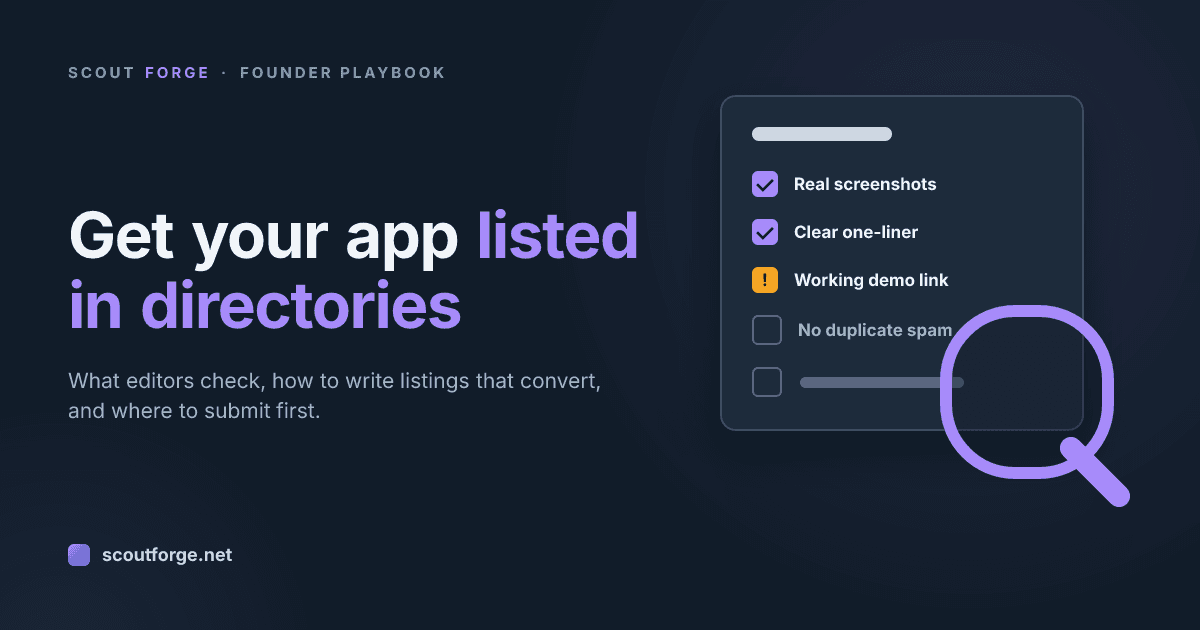
Before you submit anywhere, run this pre-submission checklist:
- Your website is live, fast, and explains the product in one screen.
- Your pricing page is public (or you have a clear "free tier" statement).
- You have at least three high-resolution screenshots of the actual product.
- You have a 60-character tagline and a 500-character description drafted.
- You know the exact category where your buyers look.
- Your contact email is reachable.
- You have not submitted this product to this directory before.
How to Write a Listing That Gets Approved and Clicked
Most founders write listings for themselves. They describe features, use internal jargon, and hide the price. Listings that get clicked are written for the reader who is skimming a page of thirty alternatives and deciding in three seconds whether to click.
The tagline is a promise, not a description. You have 60 characters on Product Hunt, and similar constraints elsewhere. "Project management software" is a description. "The project tracker for solo devs" is a promise. The second one tells the reader who it is for and why it is different.
Before: "All-in-one productivity platform with AI-powered features"
After: "Plan your week in 5 minutes, not 5 hours"
The first one could describe a hundred products. The second one is specific, concrete, and makes a reader want to know more.
The short description answers three questions. What does it do? Who is it for? Why is it different from the obvious alternatives? If you cannot answer all three in 500 characters, your positioning is not clear enough for a directory listing.
The category is a discovery decision, not a filing decision. Do not pick the category that describes your technology. Pick the category where your buyer is looking. A tool that helps e-commerce stores manage inventory belongs in "E-commerce," not "Databases" — even if it is technically a database.
Screenshots tell the story your words cannot. The first screenshot should show the core workflow, not the login page. The second should show the result — a report, a dashboard, a finished output. If your product has a distinctive interface, show it. If your product is an API, show the documentation or a sample response.
Pricing honesty beats pricing cleverness. If you have a free tier, say so. If you have a paid plan, say what it costs. Comparison sites have filters for "free" and "under $X per month." A listing with honest pricing gets filtered in; a listing with no pricing gets filtered out.
Link the listing to your main site, not a landing page. Reviewers and buyers both check that the link goes somewhere real. A dedicated landing page for directory traffic is fine, but it needs to be live and explain the product.
For a deeper dive on what earns a high score on review platforms, read our piece on what makes an app score 90+ on Scout Forge. The short version: reviewers reward clarity, craft, and evidence of real usage over marketing polish.
Submitting to Review and Comparison Sites (G2, Capterra, Scout Forge)
Review sites are the highest-effort, highest-payoff category. The listing itself is usually free, but the value comes from reviews — and getting your first reviews is the hard part.
G2. Creating a basic profile and collecting reviews is free. G2's research team verifies new profiles in about 3–5 business days, so do not expect instant approval. Reviews must come from actual users of your product within the past two years; employees and competitors are ineligible. Moderation takes up to 3 business days. If you want custom CTAs and structured review campaigns, the Starter plan is $299 per month or $2,999 per year as of November 2026. The free tier is enough to get started.
The first-review problem is real. Your product page will be sparse until real users leave reviews, so you need a plan to get them. Ask your beta users, your first ten customers, and anyone who has sent you a thank-you email. Make the ask specific and easy: a direct link to the review form, a one-line prompt, and a clear statement of how long it takes.
Capterra. Listings are free; PPC advertising starts at a $500 per month minimum, which is not worth it for most early-stage apps. The free listing, with real reviews, is enough. The review-sourcing dynamic is similar to G2: you need genuine users, and the value compounds as reviews accumulate.
Scout Forge. Listing your product on Scout Forge is free, and every app goes through the same independent scoring process. We do not sell scores — the Promotion Store sells clearly labelled placement, never scores. The review process looks at the actual product, not just the listing: design, usability, speed, security, accessibility, and growth. You can list your product here — it takes about ten minutes, and the score is the same whether you are a solo founder or a funded startup.
The advantage of Scout Forge over G2 and Capterra for early-stage apps is that you do not need a critical mass of user reviews to get a score. The score is based on the product itself, which means a well-built app from an unknown founder can rank alongside established tools. That is the point.
Handling the first-review problem. Every review site has the same chicken-and-egg issue: you need reviews to get visibility, and you need visibility to get reviews. The fix is to treat review requests as part of your onboarding. When a user has been active for two weeks and has used the core feature, send a short email asking for a review on the platform where your buyers are. Make it easy: link directly to the review form. Do not ask on day one, and do not ask users who churned in frustration.
Submitting to Launch and Curated Directories
Launch platforms are a different game. You are not building a persistent asset; you are executing a one-day event.
Product Hunt. Submissions are free, but the rules changed significantly in 2025–2026. There are no more Launch Now or Coming Soon pages, and the upvote system has been replaced with a points system. The description limit is now 500 characters. Your personal account must be at least one week old before you can submit, and company accounts are prohibited.
Product Hunt is selective: it features products that are useful, novel, high craft, and creative. It does not feature waitlisted products, directories, templates, services, or non-tech submissions. If your app is a thin wrapper around an API, you will likely be rejected. If it has a unique angle, a polished interface, and a working product, you have a shot.
Prepare for launch day: a 40-character name, a 60-character tagline, a 500-character description, a 240x240 thumbnail, and at least two 1270x760 gallery images. The launch is free; ads are sold separately and prohibited during launches. For more on where else to launch, see our Product Hunt alternatives guide.
BetaList. BetaList is for pre-launch and early-stage startups, and it is paid-only as of 2026. There is no free submission option; the price is shown on the submission form after you sign in, and you get a full refund if you are not selected. BetaList is worth it if you are pre-launch and want early signups, but do not submit a half-finished product — the review is selective.
AlternativeTo. Free submissions enter a long queue — thousands of apps, by some accounts. A $5 one-time priority review typically processes in 1–2 business days. For most founders, paying the $5 is a no-brainer: it is the cheapest way to skip a queue that could otherwise take months. AlternativeTo is especially valuable if your app is an alternative to an established tool, because that is exactly what its users are searching for.
SaaSHub. Free submission requires you to list your categories and competitors, and approval is manual with no published timeline. A featured listing is $99 per month, which is not worth it for most early-stage apps. The free listing is fine, but expect to wait.
Indie Hackers. Adding a product requires a free account, and there is no listing fee. The value is less about the listing itself and more about the community — an active Indie Hackers presence, where you share your build journey, drives more attention than a static product page. If you are an indie maker, this is worth doing early.
Crunchbase. Creating and editing a company profile is free; a Pro plan starts at $49 per month billed annually for the first year, but you do not need it to get listed. Crunchbase is not a traffic driver; it is a credibility signal. Investors, journalists, and potential partners check Crunchbase. Make sure your profile is accurate and up to date.
Turning a Listing Into Traffic (Not Just a Badge)
A listing that sits untouched is a badge, not a channel. The founders who get real value from directories treat the listing as an asset they actively manage.
Link to the listing from your site. A "As seen on" footer with your directory listings is not just social proof — it is a signal to the directories that you value the listing, and it drives a small amount of referral traffic back. More importantly, it gives your users a place to leave reviews without you having to ask every time.
Use UTM tags on every directory link. When you link to your site from a directory listing, tag it. When you share your listing on social media, tag it. You need to know which directories actually send traffic, and UTM tags are the only way to see it. In your analytics tool of choice — Linito is a good option if Google Analytics feels overwhelming — create a simple naming convention: utm_source=producthunt, utm_medium=directory, utm_campaign=listing.
Track what matters. Impressions and clicks are vanity metrics. Track signups, trial starts, or whatever your activation event is, broken down by directory. If a directory sends 1,000 clicks and zero signups, the listing is not the problem — the audience is wrong, or your landing page does not match the listing's promise. If a directory sends 50 clicks and 10 signups, double down on it.
Update the listing when the product changes. A listing that describes version 1.0 while you are on version 3.0 is a conversion killer. Reviewers and buyers both notice. Schedule a quarterly listing review: update screenshots, refresh the description, add new categories if you have expanded. Tools like LaunchDirectories — which scores 80 on Scout Forge — can help you keep track of which directories you have submitted to and which need updates.
For a broader view of how directory links fit into an early-stage SEO strategy, read our directory backlinks playbook. The short version: quality over quantity, and directories are a discovery channel first, a link-building tactic second.
Common Mistakes That Get Listings Rejected or Ignored
Most rejections are avoidable. Here are the failure modes we see most often.
Submitting too early. A "coming soon" page, a waitlist, or a product that crashes on load will get you rejected on Product Hunt and ignored on G2. Wait until you have a working product, real screenshots, and at least a handful of users.
Keyword-stuffed descriptions. "AI-powered project management software for agile teams, startups, and enterprises" is not a description; it is a list of search terms. Reviewers reject it, and buyers skip it. Write for the human reading the page.
Ignoring category fit. Submitting to a broad category because it has more traffic is a trap. You will be buried under established products and get zero clicks. A niche category with less traffic but higher relevance converts better.
Duplicate listings. Submitting the same product twice to the same directory — even with a different name or URL — gets both listings flagged. Check before you submit.
Never updating the listing. A listing with outdated screenshots, dead pricing, or a broken link is worse than no listing. It signals neglect to reviewers and buyers alike.
Treating every directory as equal. A listing on a directory where your buyers never go is wasted effort. Focus on the three or four directories where your specific audience actually compares software.
A Repeatable 30-Day Directory Submission Plan
You can run this plan solo, in about an hour a day. The goal is not to submit to every directory — it is to get accepted by the right ones and make the listings work.
Week 1: Prep the assets. Write your 60-character tagline, your 500-character description, and your longer "about" copy. Take five to ten high-resolution screenshots of your actual product. Make your pricing page public. Create a UTM tagging convention. This is the foundation; do not skip it.
Week 2: Submit to review and comparison sites. Start with Scout Forge — the listing is free and the score is based on the product, not your review count. Then submit to G2 and Capterra. These have the longest verification times, so get them in early. While you wait, send review requests to your first ten users.
Week 3: Submit to curated directories. AlternativeTo (pay the $5 for priority review), SaaSHub, Indie Hackers, and Crunchbase. These are lower effort and mostly manual review, so batch them in one sitting.
Week 4: Plan your launch and measure. If you are ready for a launch event, prepare your Product Hunt submission — remember the account age requirement and the new points system. If you are pre-launch, consider BetaList. Then set up your analytics to track referral traffic from each directory, and schedule a quarterly listing review.
Follow up. If a submission has been pending for more than two weeks, check the directory's support channel. Most directories do not send rejection notices, so a pending status often means "we have not looked at it yet" rather than "you were rejected." A polite follow-up sometimes shakes it loose.
Verdict: Where to Submit First and What to Skip
If you have one hour this week, here is the priority order.
Submit first: Scout Forge. It is free, the review is based on your actual product, and you do not need a review count to get a score. List your product here. For early-stage apps, it is the highest-value, lowest-friction listing available.
Submit second: G2 and Capterra. Free listings, persistent presence, and the audience is commercial. The verification takes a few days, so start early. The paid tiers are not worth it until you have traction.
Submit third: AlternativeTo. Five dollars for priority review is the best money you will spend on directory submission. If your app is an alternative to an established tool, this is a direct line to people actively looking for you.
Submit fourth: Indie Hackers and Crunchbase. Low effort, low traffic, but useful for credibility and community. Do them in a single sitting.
Plan for: Product Hunt or BetaList. These are events, not listings. Do them when you have a launch story to tell, not as a routine submission.
Skip for now: paid featured listings on SaaSHub, Capterra PPC, and G2 Starter. At $99 to $500 per month, these are not worth it until you have revenue to justify the spend. The free listings get you most of the value.
Directory submission is not glamorous, and it is not a growth hack. It is a slow, compounding channel that rewards clarity, honesty, and consistency. The founders who treat it as a one-time checkbox get nothing. The founders who treat it as an ongoing presence get a steady trickle of high-intent traffic — and a few of them get featured.
FAQ
Do directories charge for a listing?
Most review and comparison sites offer free basic listings. G2's basic profile is free, Capterra is free, Scout Forge is free, and Crunchbase is free. Some curated directories charge for expedited review — AlternativeTo charges $5 for priority review, and BetaList is paid-only. Paid featured placements exist on most platforms, but they are optional and rarely worth it for early-stage apps.
How long does approval take?
It varies widely. G2 verifies new profiles in about 3–5 business days. AlternativeTo's priority review processes in 1–2 business days, while the free queue can take much longer. SaaSHub has no published timeline. Product Hunt reviews happen around your scheduled launch day. If a submission has been pending for more than two weeks, follow up.
Do directory links help SEO?
Directly, not much. Google's spam policies list low-quality directory links as link spam, and most directories use nofollow attributes. The SEO value is indirect: directory listings drive real referral traffic, which can lead to mentions, backlinks from real sites, and brand searches — all of which do help SEO. Treat directories as a discovery channel, not a link-building tactic.
Can I list a pre-launch app?
On BetaList, yes — that is what it is for. On Product Hunt, no — waitlisted products are explicitly not featured. On review sites like G2 and Scout Forge, you need a working product with real functionality. If you are pre-launch, focus on BetaList, Indie Hackers, and building a waitlist.
How many directories should I submit to?
Quality over quantity. Five to eight well-chosen directories — a mix of review sites, curated directories, and one launch platform — is more than enough for most early-stage apps. Submitting to fifty low-quality directories is wasted effort and can even hurt your SEO. Focus on the directories where your specific buyers actually compare software.
Ready to get your app in front of real reviewers? List your product on Scout Forge — it is free, and every app gets the same independent score. Browse our Startup Growth articles for more founder playbooks, or explore the full category list to see where your app fits.
