A permanent dofollow backlink is not something you buy — it is something you verify, earn, and then monitor like any other asset on your site. The founders who chase "permanent dofollow backlink" as a search term are usually asking a more honest question underneath: "Which links actually pass value, and how do I know they will still be there in six months?" That is the question worth answering.
The mechanics are simple. A dofollow link is any link without a rel="nofollow", rel="sponsored", or rel="ugc" attribute. Google treats those qualified links as hints to exclude from ranking consideration; an unqualified link is a normal followed link. "Permanent" is the part people get wrong. No link is guaranteed permanent. A site can remove your link, nofollow it, redesign its pages, or shut down entirely. What you can control is choosing sources that tend to keep links live and checking them on a schedule.
This guide walks through how to tell dofollow from nofollow, which legitimate sources still pass equity in 2026, what to avoid, and a concrete 30-day plan for a new site. We write from the perspective of a review platform that scores apps independently — we see hundreds of founders trying to build their first link profile, and we see which tactics hold up.
What a Permanent DoFollow Backlink Actually Is
A backlink is a link from one website to another. The "dofollow" label describes what the link does not have: a rel attribute that tells Google to treat it as a hint rather than a vote.
Google's official guidance on qualifying outbound links breaks this into four states. A link with no rel attribute at all is a normal followed link. A link with rel="nofollow" tells Google not to pass ranking credit. A link with rel="sponsored" is for paid placements and advertisements. A link with rel="ugc" is for user-generated content like forum posts and comments. Google says it treats all three qualified values as hints about whether to consider the link for ranking purposes.
The practical takeaway: a dofollow link is the default state of a link. You do not add anything to make a link dofollow. You only add attributes to make it not dofollow, or to label it as sponsored or user-generated content.
"Permanent" means something narrower than people assume. It means the link stays live at the same URL, on the same page, with the same attribute, for as long as that page exists. A directory listing that stays up for three years is effectively permanent. A guest post that gets deleted during a site cleanup is not. The honest framing: treat permanence as a maintenance task, not a one-time purchase.
Why Dofollow Links Still Matter in 2026 (And What They Don't Do)
Google has spent years downplaying links publicly while its systems still use them heavily. The spam policies are clear about what is not allowed: buying or selling links for ranking purposes, exchanging money for links, or using automated programs to create links. What the policies do not say is that links no longer matter.
For a new SaaS or app site, dofollow links do three things. First, they help Google discover your pages faster. A link from an actively crawled site is a discovery path. Second, they contribute to your site's authority over time, especially when they come from topically relevant pages. Third, they send actual referral traffic when the source has real readers.
What a single dofollow link will not do is move your rankings. If your site has zero links and you earn one from a mid-tier directory, do not expect a visible change in Search Console. Link building is cumulative and slow. The sites that rank for competitive commercial terms typically have hundreds or thousands of referring domains, not ten. Set your expectations accordingly: your first ten dofollow links are the foundation, not the finish line.
How to Check Whether a Backlink Is Dofollow and Permanent
You do not need a paid tool to verify a single link. You need a browser and, for monitoring, a free backlink checker.
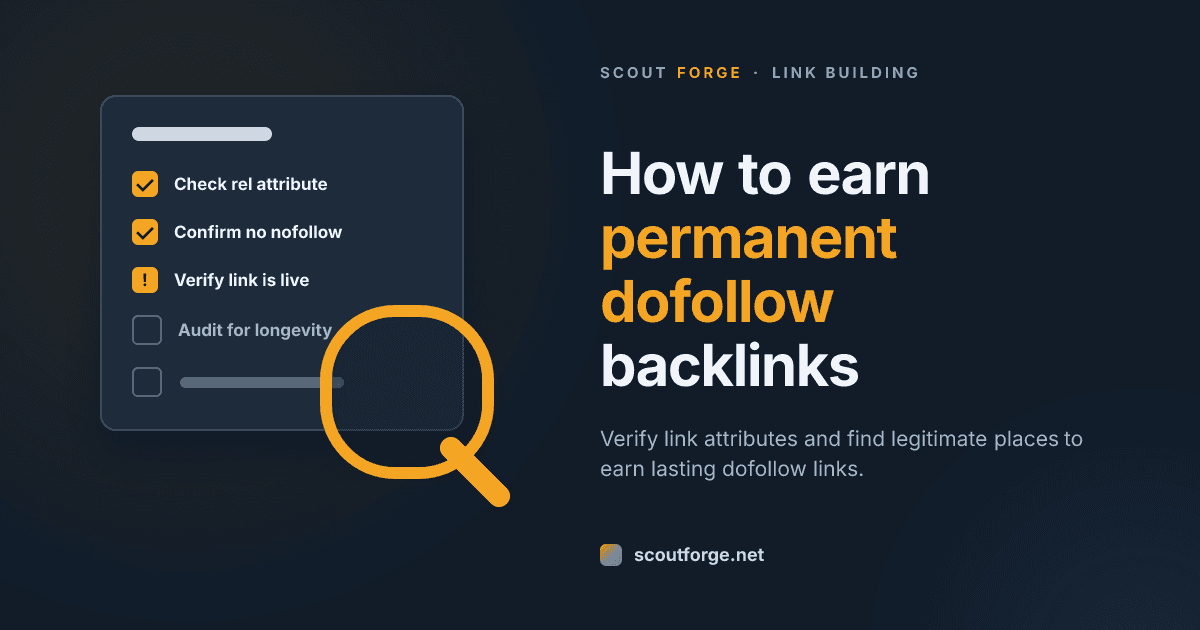
The manual check. Open the page that links to you in your browser. Right-click the link and select "Inspect" or "Inspect Element." The developer tools panel will highlight the anchor tag. Look at the rel attribute. If you see rel="nofollow", rel="sponsored", or rel="ugc", the link is qualified and may not pass equity. If the rel attribute is absent entirely, or contains only unrelated values like rel="noopener", the link is dofollow.
The free tool check. For link discovery and attribute reporting, Moz Link Explorer offers 10 free queries per month with a Moz Community account, including a follow vs nofollow breakdown. Ahrefs has a free plan with limited Site Explorer access — up to 1,000 backlinks at once for verified sites. Semrush gives free accounts one demo project and 10 reports per day. Ubersuggest provides a free backlink checker with limited daily searches.
The permanence check. This is the step most founders skip. Bookmark every page that links to you. Set a calendar reminder for 60 and 180 days out. Re-run the manual check on each link. Confirm the page still resolves, the link still points to your URL, and the rel attribute has not changed. A link that was dofollow in month one can silently become nofollow in month four.
The Legitimate Sources of Dofollow Links for a New Site
Not all link sources are equal, and not all of them pass equity. Here is the honest landscape for a new site in 2026.
Directories and listing sites. Quality varies enormously. Some directories mark all outbound links nofollow. Others, including Scout Forge's featured placements, explicitly provide dofollow links. The key is to check each directory's policy before you spend time submitting.
Profile pages. Sites like GitHub, Medium, and Reddit let you create a profile with a link to your website. Many of these links are nofollow or ugc per platform policy. They still have value for discovery and referral traffic, but do not count them as equity links.
Open-source repositories. If your product has a public repo, a GitHub README with a link to your site is a real asset. The link itself may be nofollow, but the repo page can rank and drive actual users.
Guest posts and editorial mentions. This is where the highest-value dofollow links come from, and where the most spam lives. A genuinely useful article on a relevant site, with a natural link to your product in context, is the gold standard. A paid post with a keyword-rich anchor is a manual-action risk.
Community platforms. Reddit, Stack Overflow, and niche forums can send meaningful traffic. Most links are ugc or nofollow. Use them for visibility, not equity.
Directories and Listing Sites: What Still Passes Link Equity
The directory landscape splits into three tiers.
Scout Forge. We are transparent about our own model because it reflects how good directories should work. A free listing on Scout Forge gives you a permanent app page with an editorial score — but the free listing does not include a dofollow backlink. Paid featured placements include a dofollow backlink, and they are labelled as paid placement. The score is never for sale. If you want to understand the full mechanics, read our guide on getting featured on Scout Forge. To submit your app, start at the app registration page.
Product Hunt and similar launch platforms. Product Hunt is free to submit and can drive a spike of traffic and early users. The outbound link from your product page is typically nofollow or qualified. Treat it as a launch channel, not an equity play.
Crunchbase, G2, and niche directories. These vary. Some pass dofollow links from company profiles; others nofollow everything. Before you invest time in a directory, inspect an existing listing's outbound link with the manual method above. If every link on the page is nofollow, decide whether referral traffic alone justifies the submission.
The broader directory strategy is covered in our SaaS directory backlinks playbook and our list of the best directories to submit your SaaS startup. Those pieces cover where to submit; this one is about verifying what you actually get.
Profile, Community, and Open-Source Links
GitHub. GitHub is free for public repositories. A well-maintained repo with a README that links to your documentation and product site is a legitimate asset. The links are typically nofollow, but the repo page itself can rank for your product name and send qualified traffic.
Medium. Medium is free to publish. Your author bio can include a link to your site. Many Medium outbound links are nofollow. The value is in building topical authority and getting your content in front of Medium's audience — not in the link attribute.
Reddit. Reddit is free to use. Profile links and most post links are ugc or nofollow. Reddit's value is brutal, honest feedback and occasional traffic spikes. Do not spam your product into subreddits; participate genuinely or stay out.
The pattern across all three: these platforms are for discovery, credibility, and referral traffic. Count them as part of your link profile, but do not count them as dofollow equity links.
Guest Posts and Editorial Links Without Buying Link Schemes
The highest-value dofollow links come from editorial placements: a writer at a relevant publication covers your product, or you contribute a genuinely useful piece to a site your customers read.
The earned path. Build something linkable. That could be original research, a free tool, a dataset, or a definitive guide. Then tell people who might care. When a writer links to your asset because it is useful, the link is editorial, dofollow, and durable.
The contributed path. Pitch guest posts to sites in your niche. The pitch should lead with the specific article idea and why their readers will care. The link to your site should appear naturally in the body or author bio, not as a keyword-stuffed anchor.
The warning. Google's spam policies are explicit: buying or selling links for ranking purposes is link spam. If you pay for a guest post and the link is not marked rel="sponsored", you are in violation. The risk is not theoretical — paid links without proper qualification can trigger manual actions. If you pay for placement, insist on the sponsored attribute and treat the link as a visibility play, not an equity play.
What to Avoid: Link Schemes, PBNs, and "Permanent" Link Marketplaces
Google's spam policies list the tactics that get sites in trouble. Buying or selling links for ranking purposes. Exchanging money for links. Using automated programs to create links. These are not gray areas; they are explicit violations.
Private blog networks (PBNs). A network of sites built solely to link out to paying customers. Google has been devaluing and penalizing PBNs for over a decade. The "permanent dofollow backlink" marketplaces that sell links from networks of low-quality sites are selling you a liability.
Link exchanges at scale. Swapping links with dozens of unrelated sites is a pattern Google can detect. A few genuine, relevant cross-references between complementary products are fine. A spreadsheet of reciprocal links is a scheme.
"Permanent" link marketplaces. Any service that promises permanent dofollow links for a flat fee is almost certainly selling links from a network Google already knows about. The links may be dofollow today and worthless tomorrow. Worse, they can actively harm your site if the network gets flagged.
The rule: if a link is easy to buy, it is easy for Google to ignore.
A 30-Day Plan to Earn Your First Ten Dofollow Links
Here is a week-by-week plan for a new site. Adjust the specifics to your niche, but keep the sequence.
Week 1: Foundation and core listings.
- Set up Google Search Console and verify your site. The Links report will show top linking sites and pages, though it does not distinguish dofollow from nofollow in the summary.
- Submit your app to Scout Forge. The free listing gives you a permanent page and editorial score; if you want the dofollow link, evaluate the featured placement. Start at the app registration page.
- Identify five niche directories in your category. Check each one's outbound link attribute before submitting.
Week 2: Profiles and open-source.
- Create or polish your GitHub profile and repo. Link to your product site and documentation.
- Set up Medium and publish one article that answers a real question your customers ask.
- Create profiles on two or three relevant communities. Fill them out completely. A bare profile with a link reads as spam.
Week 3: One linkable asset.
- Publish something worth linking to: original data, a free tool, a template, or a definitive guide.
- Share it in the communities where you have been participating, not just dropping links.
- Email three to five people who have written about adjacent topics. Tell them about the asset. Do not ask for a link; let the asset earn it.
Week 4: Verification and outreach.
- Run the manual dofollow check on every link you have earned so far. Log each one in a spreadsheet with the URL, source, date, and
relattribute. - Pitch two guest posts to relevant sites. Lead with the article idea, not your product.
- Set calendar reminders for 60 and 180 days to re-check every link.
How to Track and Audit Your Dofollow Links Over Time
A link profile is a living asset. Track it like one.
Search Console. The Links report shows your top linking sites and pages. It is free and updates regularly. Use it to spot new links and to notice when a major source drops off. It does not show the rel attribute, so use it for discovery, not verification.
A free backlink checker. Moz Link Explorer gives you 10 free queries per month with follow vs nofollow breakdowns. Use those queries strategically: check your most valuable links, not every link.
A simple spreadsheet. Columns: source URL, target URL, date earned, date last checked, rel attribute, status. This is the permanence audit. A link that was dofollow and live on day one but nofollow and gone on day 180 is a data point you need. Either reach out to the site owner or stop counting the link.
The audit rhythm. Check new links immediately. Re-check all links at 60 days. Re-check the top ten at 180 days. After that, quarterly is enough for most sites.
Verdict: Where to Spend Your Effort First
If we rank source types by effort-to-value for a new site, the order is clear.
First: directories with real editorial standards. A permanent page on a platform that actually reviews and scores your product — like Scout Forge — is durable, visible, and potentially dofollow. It is also low effort relative to the payoff. Start here.
Second: profiles and open-source. These are fast, free, and build your discoverability even when the links are nofollow. Do them in week one and two.
Third: one genuine editorial push. A linkable asset plus a handful of well-targeted pitches beats fifty directory submissions. This is the highest-effort, highest-value work. Do it once, do it well, and repeat quarterly.
Skip entirely: paid link marketplaces, PBNs, and bulk link exchanges. The risk is not worth the illusion of progress.
For founders who want to see how their SEO toolkit compares, our SEO Tools category lists reviewed apps like SERPView, which scores 80, and SEO Statsify, which scores 68. And if you want to understand how we score apps — and why money cannot buy a score here — read our methodology.
FAQ
Are dofollow links from directories worth it?
Yes, from directories with real editorial standards and topical relevance. A dofollow link from a relevant directory page is a legitimate, durable asset. A dofollow link from a low-quality directory that exists only to sell links is worthless or harmful. Check the directory's outbound link attributes and its acceptance requirements before you submit.
Can a dofollow link become nofollow?
Yes. A site owner can add rel="nofollow" to any outbound link at any time, or remove the link entirely. That is why permanence is a maintenance task. Re-check your most valuable links every few months and log any changes.
Do I need hundreds of backlinks to rank?
For competitive commercial terms, yes — most ranking sites have hundreds or thousands of referring domains. For a new site targeting long-tail, low-competition keywords, ten relevant, dofollow links from real sites can be enough to start ranking. Build the foundation first, then compound.
Is buying backlinks ever safe?
No, if the purpose is ranking and the link is not qualified as sponsored. Google's spam policies explicitly prohibit buying or selling links for ranking purposes. Paid links with rel="sponsored" are allowed but pass no equity. Buying dofollow links from a marketplace is a manual-action risk.
How do I check if a specific link is dofollow without a paid tool?
Open the linking page in your browser, right-click the link, and select "Inspect." Look at the anchor tag's rel attribute. No rel attribute, or only unrelated values like rel="noopener", means dofollow. rel="nofollow", rel="sponsored", or rel="ugc" means the link is qualified.
Are Reddit and Medium backlinks useless?
Not useless, but not equity links. Most Reddit and Medium outbound links are ugc or nofollow. They still drive referral traffic, build visibility, and help Google discover your pages. Count them as discovery and credibility assets, not dofollow equity.
Browse our Marketing & Sales category for more playbooks on directories, link building, and launch strategy. If you are building an app or SaaS, list your product on Scout Forge — the listing is free, permanent, and scored by the same independent process as every other app on the platform.
