

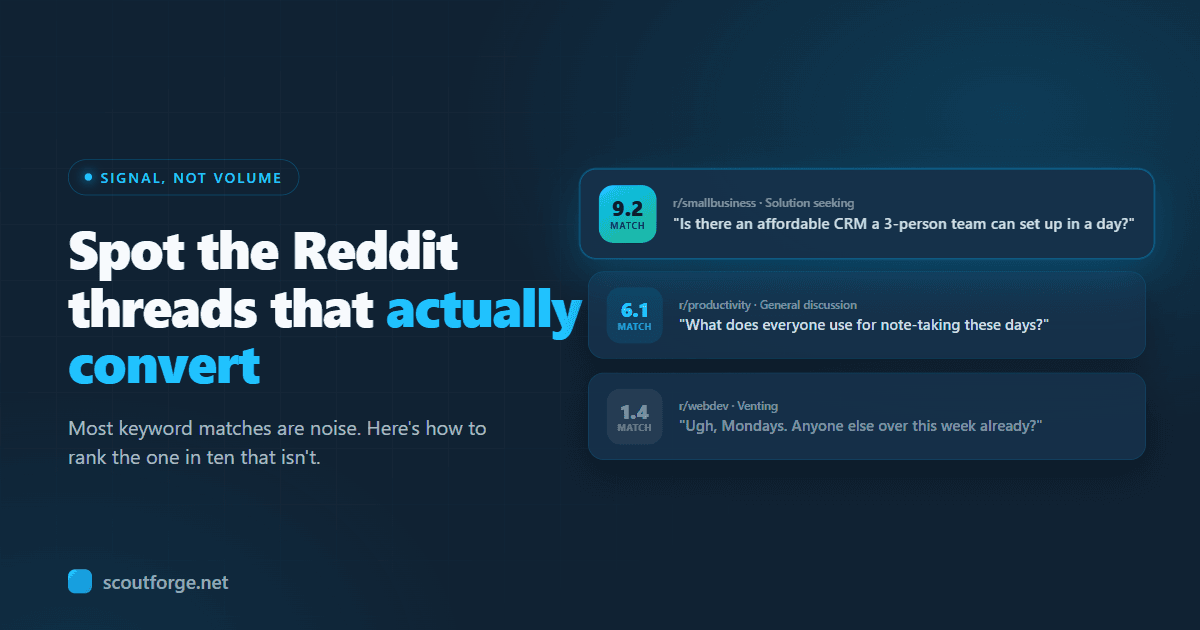
If you've spent real time on Reddit looking for customers, you already know the problem isn't finding mentions of your category — it's that most of what you find is noise. Search your keyword and you'll get old threads, unrelated tangents, people venting with no intention of buying anything, and a handful of posts from someone who's genuinely about to pick a tool. Roughly nine matches out of ten waste a reply.
Reddit lead generation, done properly, is the practice of finding public conversations where someone is actively evaluating a solution to a problem you solve — and replying helpfully, transparently, as yourself. It is not spam outreach: no scraping private data, no mass messaging, no fake accounts, no DMing strangers who never asked a question. If your "lead generation" involves anything on that list, it's a different activity wearing the same name, and it gets Reddit accounts banned for good reason.
This article is about the part that actually matters: telling the one in ten thread apart from the nine.
What buyer intent actually looks like in text
Buyer intent isn't a single signal — it's a spectrum. On one end, someone is venting about a bad week with no interest in a fix. On the other, someone is actively comparing two tools and about to pay for one of them this week. Most threads sit somewhere in between, and reading that position correctly is the whole skill.
It helps to separate four things people often lump together:
- General awareness — someone mentions your category exists, with no stated need. Low signal.
- Customer research — someone is genuinely curious how others solve a problem, often for a blog post, thesis, or idle interest rather than their own use. Looks like intent, usually isn't.
- Passive social listening — you monitoring a space for trends and sentiment, not for a specific person to respond to. Useful for strategy, not for a reply.
- Active buying intent — someone has a real, current problem and is visibly moving toward a decision. This is the one worth your time.
The taxonomy below is how to recognize that fourth category in the wild.
The high-intent signal taxonomy
These are the phrasing patterns that reliably separate someone deciding from someone just talking. All examples below are generic and fictional — illustrative phrasing, not real posts.
"Alternative to [competitor]" requests
Someone names a specific tool they're unhappy with or can't afford, and asks what else exists. Naming a real competitor is itself a strong signal — they've already done the category research and are past the "what even is this" stage.
- "What's a good alternative to [Competitor], it's gotten too expensive for our team."
- "Anyone switched away from [Competitor]? Looking for something similar but simpler."
"Looking for a tool that…" requirement lists
A specific list of needs is a decision brief in disguise — it tells you exactly what to address in a reply, and it tells you the poster has thought hard enough about this to write it down.
- "Looking for a tool that does X, Y, and Z, ideally under $50/month."
- "Need something that handles [specific workflow] — bonus if it integrates with [other tool]."
Complaint threads about a competitor's pricing or feature change
A price increase, a feature removal, or a policy change sends a predictable wave of "is this the last straw" threads. These posters are often further along than they realize — the switching decision is emotional before it's rational.
- "[Competitor] just raised prices again, is anyone else looking to jump ship?"
- "They removed the feature I actually used [Competitor] for. What are people moving to?"
Budget or team-size mentions
A stated budget or team size does double duty: it's a strong intent signal (they're thinking concretely about cost) and it's your first qualification data point (can you actually serve them).
- "We're a 4-person team, what's realistic to spend on this monthly?"
- "Solo founder here, don't want to overpay for seats I won't use."
Deadline language
Urgency is one of the few signals you can't fake your way into reading — someone with a real deadline is not idly browsing.
- "Need this set up before our launch next week."
- "Our current tool's contract ends this month, need a replacement fast."
Implementation-help requests
Someone asking how to do something with a tool — including yours or a close substitute — is often already committed and just needs help executing. This is a warmer conversation than a comparison thread, not a colder one.
- "How do people usually set up [workflow] with [Category] tools? Getting stuck."
- "Just signed up for [Competitor], regretting it — is there an easier option for [specific task]?"
Medium and low intent
Two thread types look promising and usually aren't.
"What does everyone use for X?" polls attract dozens of replies, most from people answering out of habit rather than need, and the original poster is frequently doing informal research rather than shopping. Worth a light-touch, no-pitch answer if you have real expertise to add — not worth a product pitch, because you don't yet know if anyone there is buying.
General rants ("I hate how complicated project management software is") are venting, not evaluation. They're a decent source of pain-point language for your own marketing copy, but replying with a product suggestion to someone who hasn't asked for one usually reads as tone-deaf, not helpful.
The exception in both cases: if the original poster replies to someone else with a specific requirement or names a tool they're now trying, the thread has just moved from low to high intent — worth revisiting.
A simple qualification framework you can apply manually
Once you've found a plausible thread, run it through six factors before you decide whether — and how — to reply.
| Factor | Question to ask | Low | High |
|---|---|---|---|
| Relevance | Does the stated problem match what you actually solve? | Tangential overlap | Direct match |
| Urgency | Is there a deadline or trigger event? | None mentioned | Explicit timeline |
| Fit | Does their team size, budget, or use case fit your product? | Wrong segment entirely | Squarely your ICP |
| Poster authority | Can this person plausibly decide or influence the purchase? | Uninvolved bystander | Founder/owner/decision-maker |
| Timing | How old is the thread, and is it still active? | Days old, dead | Hours old, live discussion |
| Community rules | Does this subreddit allow this kind of reply? | Self-promotion banned | Explicitly welcomed or neutral |
A thread doesn't need to score high on all six to be worth a reply — but a thread that's low on relevance and fit is rarely worth your time regardless of how urgent or active it looks. Community rules is the one non-negotiable: however high the intent, replying somewhere that explicitly bans it costs you the account, not just the thread.
Timing: why hours matter
Reddit threads have a short attention window. The original poster and anyone genuinely interested are watching in the first few hours; after that, engagement drops off fast and a new comment is unlikely to be seen by anyone who matters.
That changes your strategy by thread age, not just whether you reply:
- Under a few hours old: a direct, specific answer to the actual question is well-placed. The poster is still reading replies.
- Same day, slowing down: still worth a reply if the intent signal is strong, but keep expectations modest — you're now competing with whatever the poster already decided from earlier comments.
- Days old: usually only worth replying if you have something genuinely new to add, and mostly for the SEO value of a well-written comment that ranks later — not for reaching the original poster.
This is also the practical argument for checking your target subreddits often rather than in occasional bursts: the same reply posted at hour 2 and posted at hour 30 are two different opportunities.
From discovery to conversation
Finding the thread is step one. What you do next determines whether it converts or gets you flagged as a pitch-bot.
Public reply beats DM, almost always. A helpful public comment benefits everyone reading the thread, builds your visible reputation, and doesn't feel like being singled out. Move to DM only if the poster invites it ("DM me") or the conversation genuinely needs specifics unsuitable for a public thread (pricing negotiation, account-specific troubleshooting) — and always disclose who you are before you do.
Follow up without being pushy. If someone responds with a question, answer it fully and let the conversation breathe. If they go quiet, that's an answer too — don't send a second unsolicited message chasing a reply that didn't come.
Track it somewhere, even if it's just a spreadsheet. A simple log — thread link, date, subreddit, whether you replied, whether they engaged — turns scattered effort into a pattern you can actually learn from. Track outcomes you can honestly measure: replies received, profile or link clicks if you're tagging them, and signups you can trace back to a specific thread. Don't invent a "conversion rate" from a sample of five threads; small numbers don't support a real benchmark yet.
Here's the difference between a reply that converts and one that doesn't, using fictional products in a fictional thread:
Thread: "Looking for a tool that tracks expenses for a 3-person freelance studio, don't need anything enterprise-y."
Bad reply:
"You need ExpenseWiz! 🚀 #1 rated expense tool, trusted by thousands. Sign up here: [link] — 20% off this week only!!"
Teardown: no disclosure, no engagement with the actual requirement (3-person, not enterprise), hype language, and a discount pushed uninvited — reads as an ad because it is one.
Good reply:
"For a team that size, honestly a lot of people just use a shared spreadsheet until it breaks down around 5-10 people. If you want something purpose-built without enterprise pricing, I'd look at a few options aimed at small studios specifically. Full disclosure, I built ExpenseWiz for exactly this — happy to answer questions, but worth comparing a couple before you commit."
Teardown: answers the actual question first (including the honest "you might not need a tool yet" option), discloses ownership plainly, doesn't oversell, and treats the poster as capable of deciding.
FAQ
Isn't replying to Reddit threads to promote my product spammy? Not inherently — spam is unsolicited, deceptive, or disproportionate to your contribution. A disclosed, relevant reply to someone who's actually asking is participation, not spam. The taxonomy above exists specifically to keep you on the right side of that line: reply where there's real intent, skip where there isn't.
How many threads should I expect to find in a day? It depends entirely on your category's activity and how many communities you watch — there's no universal number, and anyone quoting you one is guessing. Judge the process by whether the threads you do find are genuinely high-intent, not by volume.
Should I always disclose that I'm the founder? Yes, every time you mention your own product. It costs you nothing, it's consistent with how Reddit expects self-promotion to work, and it's the difference between a trusted answer and a callout waiting to happen.
What's the difference between this and cold email lead generation? Cold email reaches people who never asked; Reddit intent-matching finds people who are already, publicly, asking. That's the entire advantage — and also why the same aggressive tactics that merely annoy in email get you banned on Reddit.
Can I do this without any tool at all? Completely — everything in this article is a manual method. Saved searches and the framework above do the same job; a tool just saves you the hours of scanning and ranking by hand.
Once you can tell a real buyer signal from noise, the bottleneck becomes time, not skill. If you want the full surrounding playbook — subreddit mapping, account building, and the organic plays beyond just replying — see our complete guide to Reddit marketing for SaaS, or start with the basics of finding your first customers on Reddit.
