

You launched. You told people. You refreshed the analytics dashboard forty times in the first three hours. And the line stayed flat, or ticked up by exactly the number of people who love you personally. That's a genuinely miserable feeling, and it's also an extremely common one — most launches don't work the first time, and almost nobody talks about it out loud.
Here's the part that actually costs founders weeks: they diagnose it in the wrong order. The instinct after a quiet launch is to redesign the landing page, because a redesign feels like doing something. But if the real problem is that twelve people saw your product, no amount of hero-copy polish will save you — you fixed a step nobody reached. Diagnosis has an order, and skipping ahead is the single most expensive mistake in this whole process.
The diagnostic order
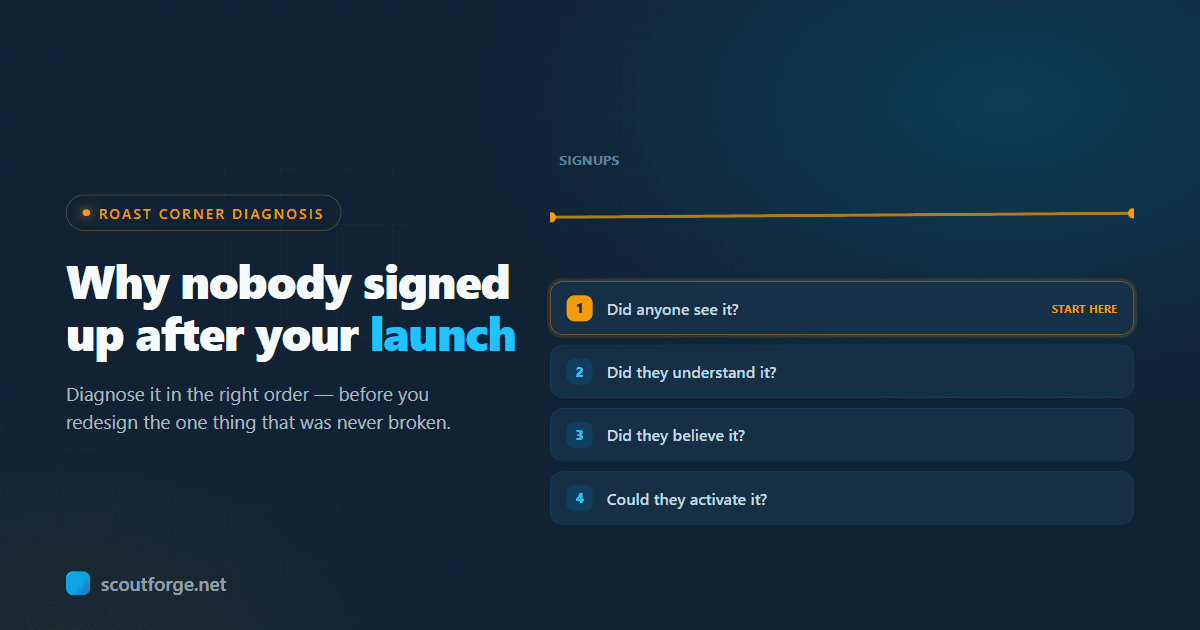
Four questions, asked strictly in this sequence:
- Did anyone actually see it? (Distribution)
- Did they understand it in five seconds? (Comprehension)
- Did they believe it was real and worth trusting? (Trust)
- Could they actually start using it once they decided to try? (Activation)
Never debug step 3 before step 1. If your traffic numbers are near zero, your landing page copy is not the problem — you don't have enough data to know if it's the problem, because almost nobody has read it yet. Work top to bottom. Each layer below tells you how to tell if you're stuck there, and what to do about it.
Distribution failures
This is where most flat launches actually live, and it's the least fun to admit because it means the product was never really tested.
Launched to no audience
What it looks like: you posted the announcement to your own social accounts, which had approximately the same followers before launch as after — friends, family, a few old colleagues, none of whom are your customer.
The fix: find the places your actual buyer already hangs out and already talks about this problem — relevant subreddits, niche forums, Slack or Discord communities, industry newsletters that accept guest mentions. This takes real research, not a single post. Go find the threads where someone is already asking for something like what you built, and answer as a person who happens to have built it — not as a launch announcement dropped into a room that never asked for one.
One-channel launch
What it looks like: everything hinged on one post, one platform, one day. It did fine, or it didn't, and either way the story ended in 24 hours.
The fix: spread launch-adjacent activity across several surfaces over one to two weeks — a directory listing here, a community post there, a short outreach batch to people who've mentioned the problem publicly. No single channel has to carry the whole thing.
No follow-up
What it looks like: you launched once and stopped. The people who almost tried it, didn't. The people who bookmarked it for later, forgot.
The fix: treat launch week as a campaign with several small pushes, not one big moment — a progress update, a specific use-case post, a direct reply to anyone who showed interest and went quiet.
Comprehension failures
If people are landing on your page and bouncing in under ten seconds, this is your layer — and it's usually fixable in an afternoon.
Vague hero copy
What it looks like: the first thing a visitor reads doesn't tell them what happens if they use your product. It tells them how you feel about your product instead.
The fix: say what changes for the user, specifically, in the first sentence.
❌ "The all-in-one platform for modern teams." ✅ "Turn a messy Slack thread into a shared task list in one click."
The first one could be pasted onto almost any SaaS homepage unchanged. The second one is unmistakably about one thing, and a reader knows in one sentence whether it's for them.
Feature-speak instead of outcome-speak
What it looks like: a bullet list of what the product has — "real-time sync, custom fields, API access" — with no sentence anywhere describing what a user actually gets.
The fix: for every feature bullet, add the outcome it produces. "Real-time sync" becomes "never work from a stale version again." Features are true, but outcomes are what someone decides to sign up for.
Trust failures
Comprehension gets someone reading. Trust decides whether they hand over an email address to a product from a company they've never heard of.
No social proof
What it looks like: the page asserts it's great, with nothing external backing that up — no reviews, no independent scoring, no evidence anyone besides you has used it.
The fix: an independent, unbiased listing does real work here, because a claim you make about yourself and a claim someone else makes about you carry different weight. You can list your app on Scout Forge for free and get scored and reviewed independently — full disclosure, that's our platform, and we're mentioning it because a third-party read is specifically the kind of proof a brand-new product can't manufacture on its own landing page.
No pricing page
What it looks like: every plan says "Contact us" for a product that's obviously not enterprise software, or pricing is simply nowhere to be found.
The fix: put a real number somewhere findable. Hidden pricing reads as a negotiation tactic even when that's not the intent, and it makes a new visitor do work they didn't sign up for just to know if they can afford you.
Anonymous team
What it looks like: no names, no faces, no "who made this" anywhere — just a product that appeared from nowhere asking for an email address.
The fix: put a real person's name and face somewhere on the site. A founder who's visible is a founder who's accountable, and that alone lowers the trust bar meaningfully for a first-time visitor.
Activation failures
The rarest layer to get stuck on, but the most infuriating — because this is where someone genuinely wanted to try your product and still didn't make it through.
Signup wall before value
What it looks like: a visitor who's ready to try the thing hits an account-creation form before they've seen anything resembling the product itself.
The fix: let people see or do something real before you ask for an account — a live demo, a sample result, a no-signup preview. Ask for the email after you've earned it, not before.
Empty-state dead ends
What it looks like: someone finally signs up, and lands on a completely blank dashboard with no indication of what to do next. They close the tab.
The fix: give a fresh account a first task, a sample project, or a guided first action — anything that isn't a blank screen asking the user to invent their own onboarding.
The 48-hour triage plan
Work this in order. Don't skip ahead to step 4 because it's more comfortable than step 1.
- Check raw traffic. If it's near zero, stop everything else and go fix distribution first — nothing downstream matters yet.
- Watch a real person load your homepage (screen-share, no hints) and time how long it takes them to say what your product does in their own words. Over ten seconds is a comprehension problem.
- Read your own hero section out loud. If it could describe five other products unchanged, rewrite it around one specific outcome.
- Find your pricing page in under five seconds, as a stranger would. If you can't, neither can they.
- Sign up for your own product on a fresh account, ideally on someone else's laptop with no cookies. Note the exact moment you'd have quit.
- Fix the earliest broken step you found — and only that one — before touching anything downstream.
When paid visibility makes sense (and when it's a waste)
Paid visibility amplifies whatever is already true about your product. It does not fix comprehension, trust, or activation problems — it just shows those problems to more people, faster, at a cost.
That's why the order matters here too: only once your hero copy converts a stranger, your trust signals hold up, and a new signup can actually reach value should you spend money to get more strangers there. Before that point, paid traffic is an expensive way to confirm a leak you could have found for free with steps 2 through 5 above.
Once those layers are genuinely fixed, paid visibility is a legitimate lever — a Promotion Store listing (disclosure: also ours) is one option for buying qualified attention rather than hoping the algorithm notices you. The honest test is simple: if you paid for ten new visitors right now, would your current page convert them? If you're not sure, that's your answer.
FAQ
How long should I wait before assuming my launch failed? Give distribution a real week before drawing conclusions — a single quiet launch day tells you very little. If traffic stayed flat for a week despite genuine effort across multiple channels, that's your signal to work the diagnostic order.
What if I'm stuck on more than one layer at once? Common, and still work top to bottom. Fixing comprehension while distribution is still near zero just means a better page nobody's reading — fix the earliest layer first, then re-check the next one with fresh eyes.
Is a redesign ever the right first move? Only if you've confirmed real traffic is already landing on the page and bouncing fast specifically because of comprehension — not before. A redesign aimed at a problem you haven't confirmed is a guess wearing a to-do list.
My numbers are technically fine — a few signups, just fewer than I hoped. Does this still apply? Yes. A trickle instead of a flat line usually means one layer is a partial leak rather than a total block — walk the same diagnostic order to find which one, just expect a smaller, more specific fix than a founder starting from zero.
If you want an honest read on where your product actually stands — not the version you'd write about yourself — list your app on Scout Forge and opt into a public review. We score it independently and, if you're up for it, roast it too. Better to hear it from us than to keep guessing which layer is actually broken.
