Cycling through all six. Tap any point to stop.
Measured on six things
One company brain for every AI tool your team uses.
Growth
62A real problem — AI tools with no company context — with a concrete MCP wedge into Claude, ChatGPT and Cursor. Specific segments named. But Guru and Slab already own 'AI knowledge base', so the moat is thin.
Screenshots
1 / 1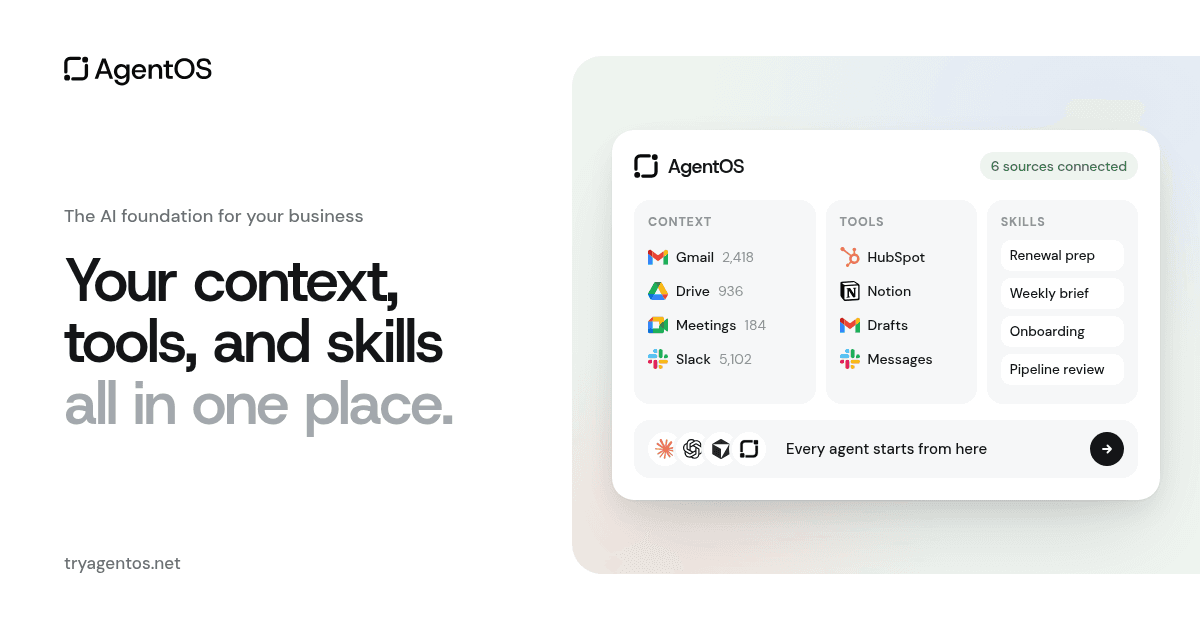
About this app
AgentOS gives a team one shared company brain. Connect your tools and knowledge once, and every AI tool your team uses, like ChatGPT, Claude and your own agents, works from the same context. No more re-explaining your company in every new chat. Teams use it to run workflows, keep work in sync and get answers grounded in what the company actually knows.
Key features
- 1Shared company context layer connecting email, Slack, docs and calls, accessible to Claude, ChatGPT, Cursor and custom agents over MCP.
- 2Source-cited answers: every response links back to the underlying message, doc or call it was drawn from.
- 3Skills and bots: save a workflow once (e.g. client prep brief) and have agents run it the same way every time.
Target customer profile
Drawn from the product itself, not from a survey.
Demographic
Sales and account management teams
Pain points
Scattered deal info across emails, calls, and CRMs; slow client prep
Primary needs
Quick access to deal history and client context; automated prep briefs
Demographic
Customer support and success teams
Pain points
Knowledge buried in docs and Slack; inconsistent answers
Primary needs
Unified knowledge base with source citations; fast, accurate responses
Demographic
Engineering and product teams using AI coding assistants
Pain points
AI tools lack company context; manual copy-paste between tools
Primary needs
Shared memory for AI agents; seamless integration with Cursor and ChatGPT
Scout Review
Written by AI from measured evidence, scored out of 100.
AgentOS is a well-presented early-stage bet on a real problem: your AI tools don't know your company, and re-explaining context in every chat is a tax. The pitch — one shared company brain, connected over MCP to Claude, ChatGPT and Cursor, with every answer traceable to a source — is specific and demonstrably shown on the homepage rather than just claimed. The in-hero mock with numbered citations is the strongest thing here. Execution is uneven: design is polished but has visible seams (a blank demo pane, ghosted pricing buttons, a generic mountain hero), speed is fast to start and slow to finish at 3.8s mobile LCP, and security is table-stakes only — no SOC 2, no HSTS, SSO behind Enterprise — for a product that reads your email and call transcripts. Pricing is transparent and the free tier is genuinely free. The category is crowded with Guru and Slab, so the MCP-native framing is the whole bet.
Measure by measure
Usability
66Free plan with 500 starting credits and no card is a genuinely low-friction entry, and the FAQ pre-empts the obvious objections. But the middle of the page is thin, and pricing sits a long scroll away from the hero.
Design
70Coherent two-tone type system and a genuinely convincing in-hero product mock with numbered source chips. Undermined by a half-empty 'Connect it once' pane, ghosted secondary pricing buttons, and a generic mountain hero photo.
Speed
68Lighthouse mobile 87/100 with zero layout shift and a 915ms FCP, but a 3.8s LCP on mobile holds it back from the top of the band. Desktop lands at 79/100. Solid, not snappy.
Security
72HTTPS enforced with CSP, frame protection, and DMARC in place — 9/12 on the header checklist. Missing HSTS and Permissions-Policy, and SSO is gated behind Enterprise with no published SOC 2 or audit.
Accessibility
80Lighthouse accessibility 96/100 with a single failing contrast audit, matching the visual audit's note about pale gray small-size copy. No WCAG statement or a11y page published, but the automated baseline is strong.
Growth
62A real problem — AI tools with no company context — with a concrete MCP wedge into Claude, ChatGPT and Cursor. Specific segments named. But Guru and Slab already own 'AI knowledge base', so the moat is thin.
Improvement areas
- No published security page, SOC 2, ISO or bug bounty for a product that ingests sensitive company communications.
- Mobile LCP of 3.8s and missing HSTS/Permissions-Policy headers are easy wins left on the table.
- Homepage demo has a blank Claude pane and ghosted secondary pricing CTAs, undercutting the integration story.
Design & Usability
AgentOS's homepage is a cut above the average early-stage AI landing page. The two-tone headline system is applied consistently, and the in-hero mock — a 'Renewal prep' chat with numbered source chips and a Sources row — makes the 'every answer, with the source' promise visible rather than asserted. The 'An answer you can follow' section reinforces it with a citation badge on a real email card. Where it slips: the 'Connect it once' mock ships with a mostly blank Claude pane, reading as an unfinished placeholder, and the secondary pricing buttons have almost no fill, so they dissolve into their cards. Usability is decent — a free plan with 500 starting credits and no card is a genuinely low-friction entry, and the FAQ pre-empts the obvious objections about Otto and CRM corruption. The cost is density: the middle sections are thin, and pricing sits a long scroll below the fold.
Speed & Security
Speed is measured, not vibes: Lighthouse mobile 87/100 with a 915ms FCP and zero cumulative layout shift, but a 3.8s LCP that sits above the 2.5s 'good' threshold. Desktop lands at 79/100. The page is fast to start and slow to finish — the headline arrives quickly, the largest element does not. Security is the softer dimension. The header probe shows HTTPS enforced with CSP, frame protection, X-Content-Type-Options, Referrer-Policy, SPF and DMARC — 9 of 12 checklist points. Missing: HSTS and Permissions-Policy. More importantly for a product that ingests email, Slack, docs and call transcripts, there is no published SOC 2, ISO certification, pen-test summary or bug bounty in the site content, and SSO is gated behind an Enterprise 'talk to us'. The FAQ's 'you choose what it can read' and 'writes are evidence gated' are good instincts, but they are claims, not audits.
Accessibility & Growth
Accessibility scores well on the automated side: Lighthouse 96/100 with a single failing audit for insufficient color contrast, which lines up exactly with the visual audit's note about pale gray small-size body copy and captions. No WCAG statement, accessibility page or multi-language support is published, so the score sits in the upper-middle of the band rather than the top. Growth is the more interesting question. The problem AgentOS names is real and current — AI coding assistants and chat tools have no company context, so teams re-explain themselves into every new window. The MCP-based wedge into Claude, ChatGPT and Cursor is concrete and timely, and the segments named (sales prep, support knowledge, engineering assistants) are specific. The honest limit: Guru and Slab already occupy 'AI knowledge base with integrations' with established customers and years of shipping. AgentOS's differentiator is the agent-native, MCP-first framing rather than a new category. That is a real wedge, but a narrow one until the shared-context layer becomes something teams can't unplug.
Conclusion
If you're a small team already living in Claude or ChatGPT and tired of pasting the same context into every thread, AgentOS is worth the free plan — 500 credits, no card, and the source-citation model is the right instinct for trust. If you're a larger org evaluating this for sales or support, wait for the security story to mature: no published audit, no HSTS, SSO gated behind Enterprise. The product's own FAQ is unusually honest about what it is and isn't ('it replaces nothing', 'writes are evidence gated'), which is a good sign. The question is whether a shared context layer over MCP becomes infrastructure teams can't unplug, or a nice wrapper that Guru and Slab absorb into their next release.
Suggestions for improvement
- Publish a security page with SOC 2 status, data handling, and subprocessor list — this is the #1 blocker for the sales and support buyers you're targeting.
- Enable HSTS and add a Permissions-Policy header; both are one-line fixes on an otherwise solid 9/12 header profile.
- Fix the 'Connect it once' mock so the Claude pane shows a real exchange — an empty pane undercuts the exact integration story you're selling.
- Raise contrast on small gray body copy and captions; it's the single failing Lighthouse audit and the one thing a human reviewer also flagged.
Alternatives comparison
Named competitors, point by point. Nobody paid to appear here or to be left out.
 AgentOS |  Guru | Slab | |
|---|---|---|---|
| Core positioning | Shared company brain / context layer for AI agents over MCP | AI-powered knowledge management with verified answers | Team knowledge base with AI search and integrations |
| MCP / agent-native integration | Yes — Claude, ChatGPT, Cursor and custom agents connect over MCP | Integrations with Slack, Drive, etc.; not MCP-first | Slack, Google Drive integrations; not MCP-first |
| Source-cited answers | Yes — numbered citations back to messages, docs and calls | Yes — verified answers with source attribution | AI search over knowledge base with linked results |
| Free tier | Yes — 200 credits/month + 300 signup, no card | Free trial; paid plans only | Free plan available for small teams |
| Published security certifications | None published; SSO on Enterprise only | SOC 2 Type II and enterprise security program | SOC 2 and enterprise security documentation |
Guru
AI-powered knowledge management that connects to your apps and provides verified answers.
Slab
Team knowledge base with AI search and integrations for Slack, Google Drive, and more.
Comparing options? See AgentOS alternatives, scored side by side
More Productivity apps
View all Productivity
Puzzly – B2B Lead Generation & Sales Intelligence Platform
92Puzzly is an all-in-one B2B lead generation platform that...

Qamarero
92An all-in-one hospitality software for restaurants and ba...

EmbedMyReviews
92White-label reputation management software for agencies s...

StoryPad
92Privacy-first open source journal app with a continuous t...

Notion
92All-in-one AI workspace for docs, projects, and knowledge...

The Stack Newsletter
92A weekly newsletter delivering curated tech jobs, intervi...

Vibe Coding Agent Skills
92A free, open-source platform offering 110 AI agent skills...

QRBliss
91Branded QR codes with AI Brand Sync, 15 free dynamic code...

Gerty
91Private, local AI assistant for Mac that runs offline

Strukchad Property Management
91Property management for Kenyan letting agents: rent invoices raised every month, M-Pesa rent prompts to tenants, arrears tracking and landlord statements.

CC Switch
91Open-source desktop app for switching AI coding providers...

PitchWhip
90AI cold call scripts & direct dials from LinkedIn


A platform dedicated to providing unbiased reviews of newly launched applications, analyzing everything from their features to their full potential.
info@scoutforge.net© 2026 Scoutforge. All rights reserved.
