Real problem (SDR research time), specific wedge (live 20+ provider waterfall with reveal-back-on-miss), and a bundled prep+reveal+log workflow Lusha and Kaspr don't offer. Early stage.
Screenshots
1 / 7
PitchWhip
PitchWhip
PitchWhip
PitchWhip
PitchWhip
PitchWhip
PitchWhip
About this app
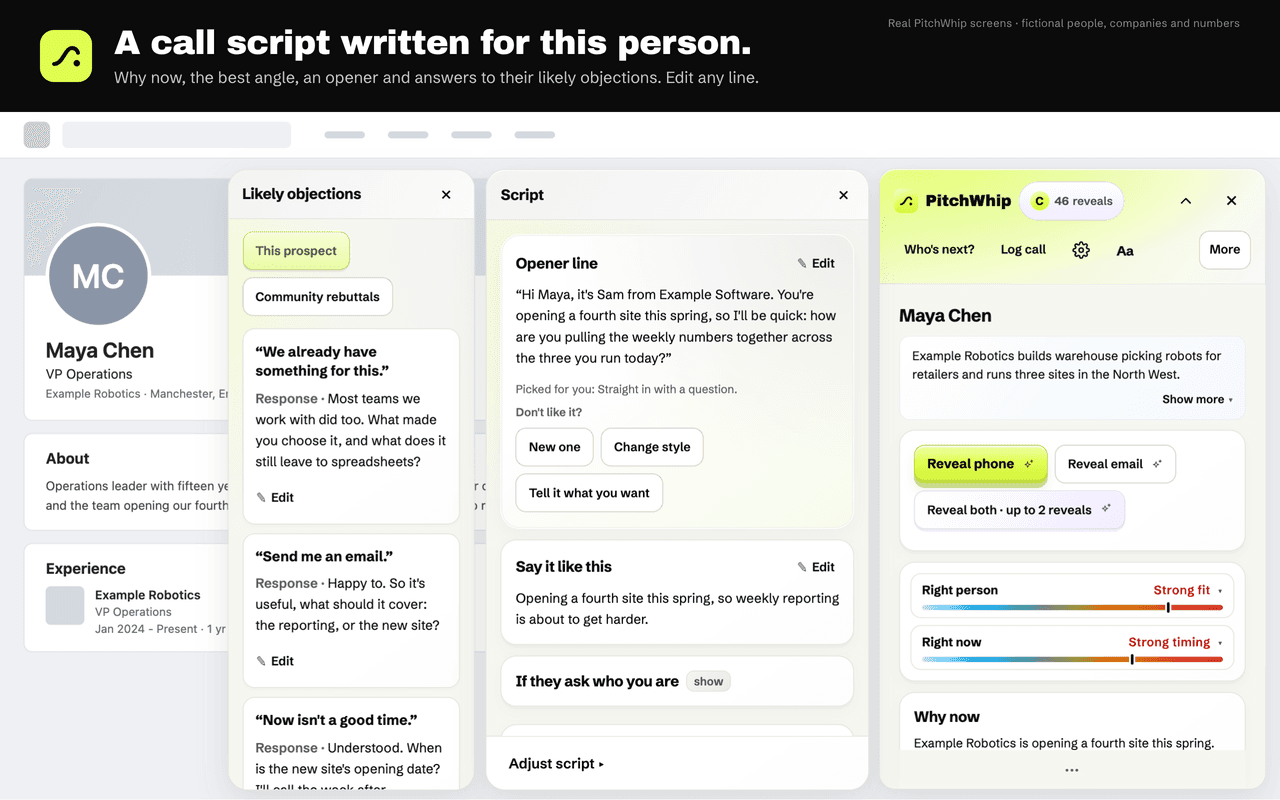
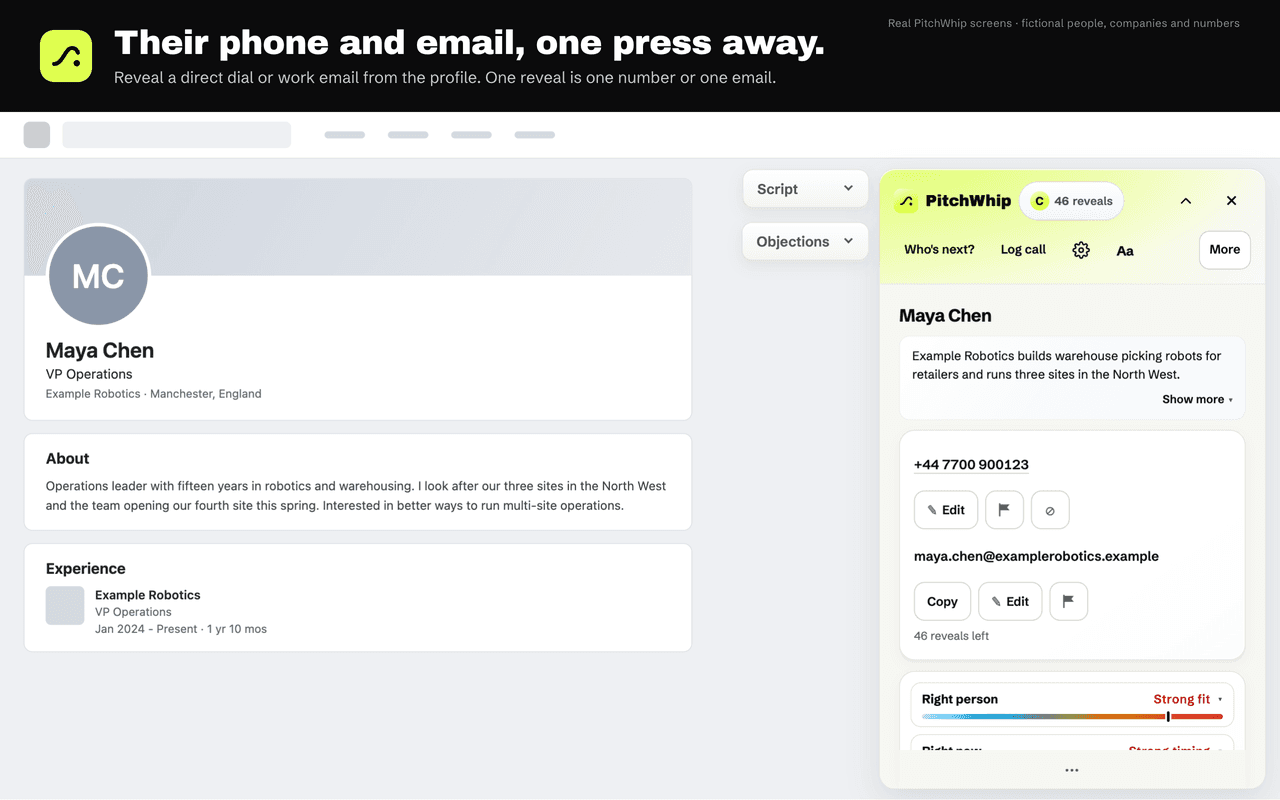
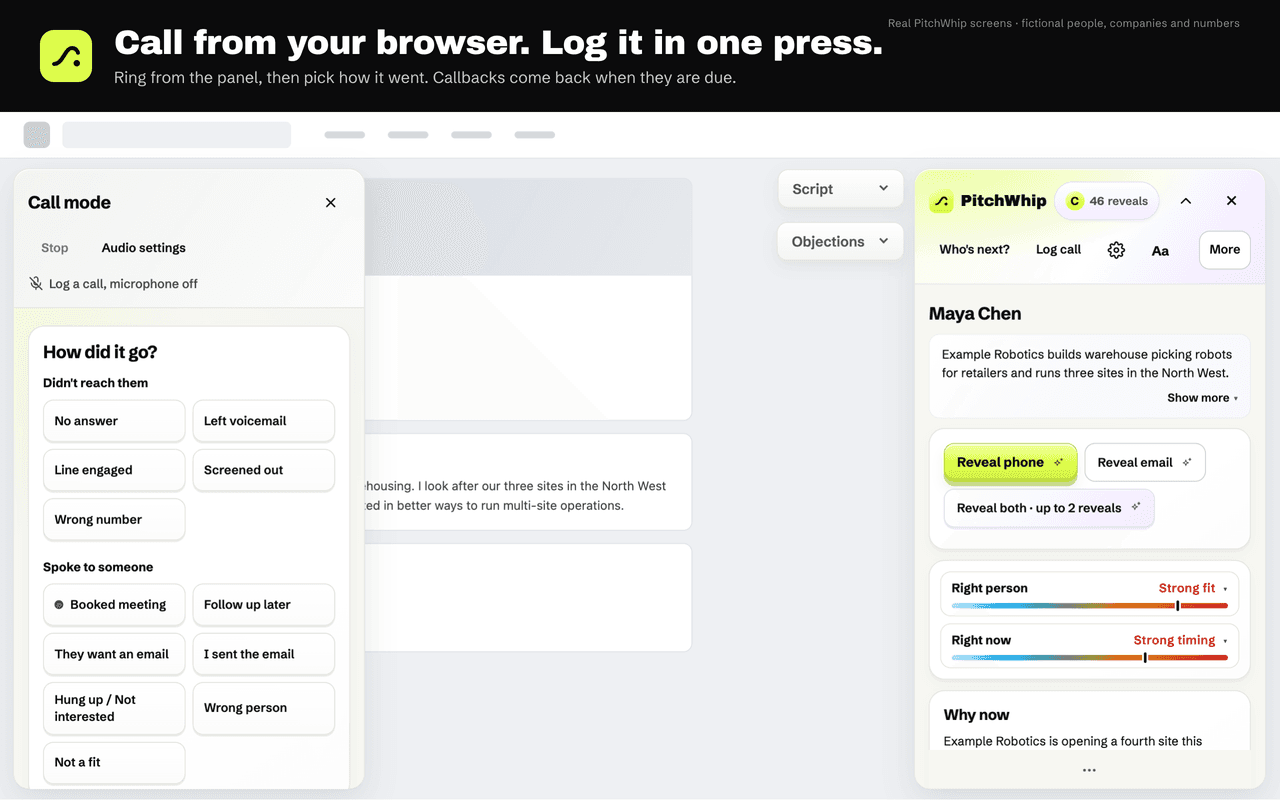
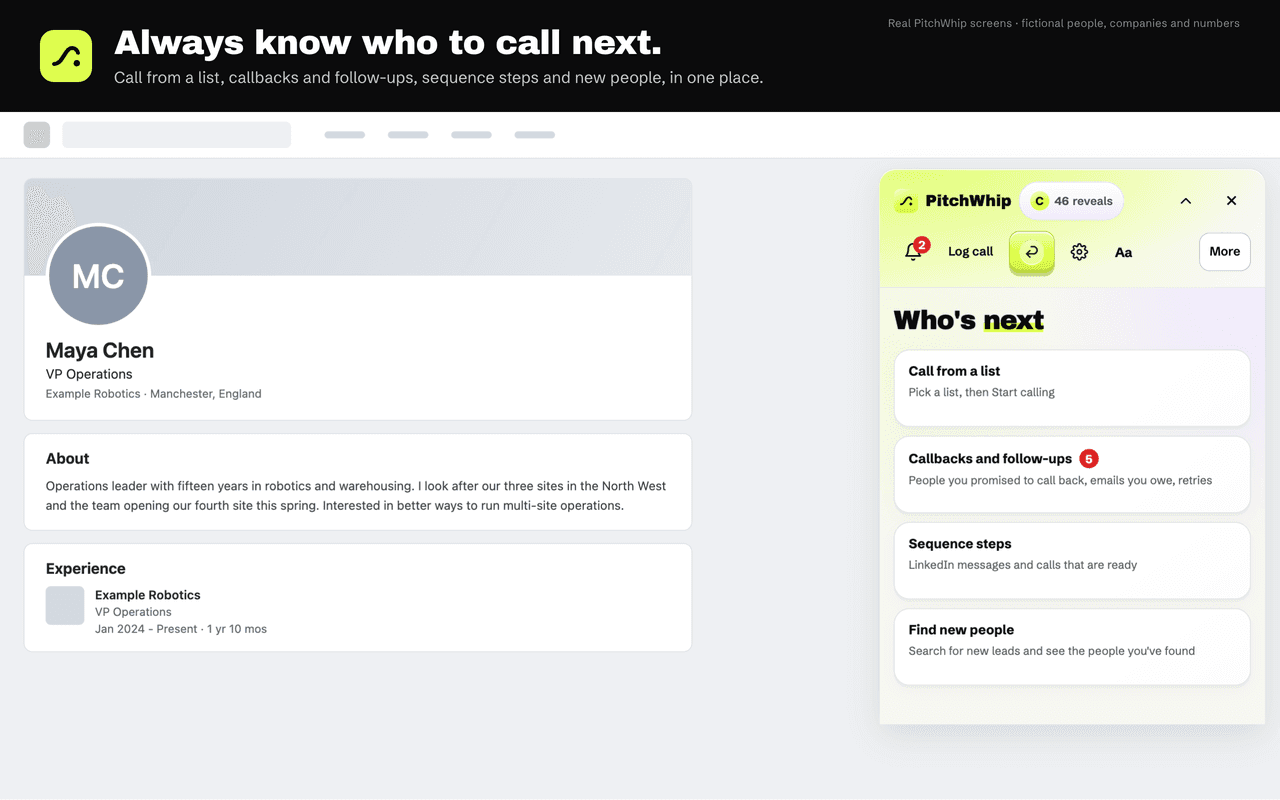
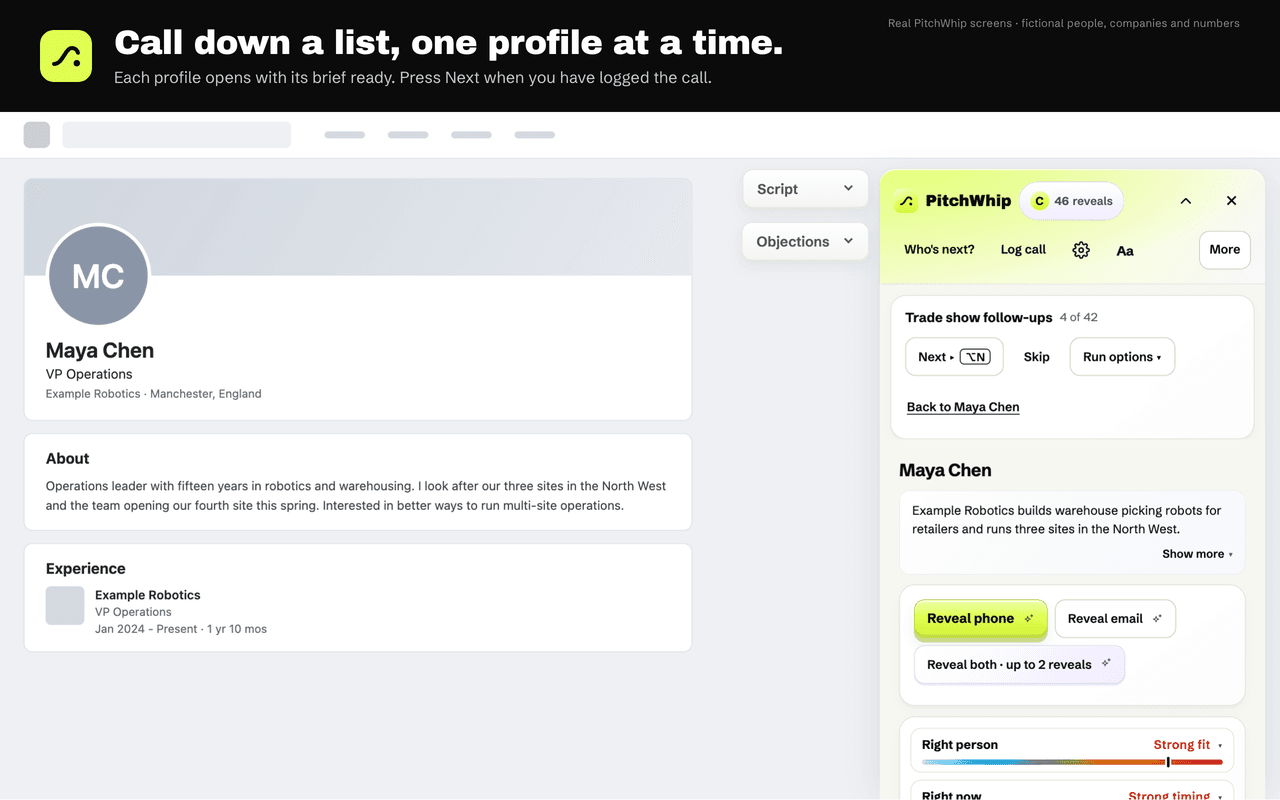
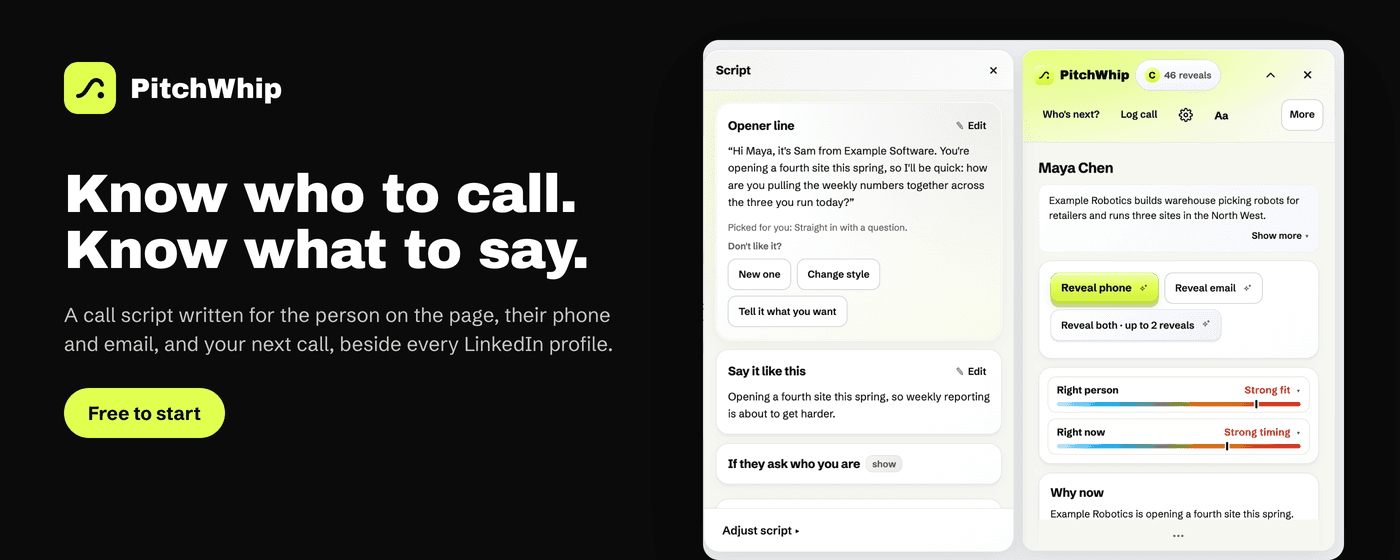
PitchWhip is a Chrome extension that turns any LinkedIn profile into a prepared sales call. Open a prospect's profile, and it drafts a research brief, a personalized opener, and even likely objections—all before you dial. It also reveals direct dials or work emails on demand, searching a network of 20+ providers so you're not relying on stale database records. After the call, log outcomes with one tap, schedule follow-ups, and trigger automated email sequences. With built-in CRM sync to HubSpot, Salesforce, and Google Sheets, PitchWhip keeps your pipeline tidy without manual data entry. It's built for SDRs, founders, and sales teams who want to spend less time researching and more time talking. The free plan gives you 3 scripts a day and one reveal; Pro at $49/month unlocks 50 reveals, prospect discovery, and sequences.
Key features
1LinkedIn profile → sourced brief, personalized opener and likely objections before you dial.
2One-click reveal of direct dial or work email via a live 20+ provider waterfall, with reveal-back-on-miss within 30 days.
3One-tap call logging, callbacks, follow-up email sequences, and CRM sync to HubSpot, Salesforce and Google Sheets.
Target customer profile
Drawn from the product itself, not from a survey.
Demographic
Sales Development Reps (SDRs) making 40+ calls a day
Pain points
Switching between Lusha, LinkedIn, and CRM tabs; wasting time on manual research; dead numbers eating into call blocks
Primary needs
Quick access to direct dials, ready-made call scripts, and automatic call logging without leaving LinkedIn
Demographic
Founders and solo agency owners doing founder-led sales
Pain points
Limited time for sales; lack of research bandwidth; inconsistent follow-up
Primary needs
One tool to find prospects, get contact info, and generate openers without hiring a sales team
Demographic
Sales managers onboarding new hires
Pain points
Inconsistent script quality; slow ramp-up; difficulty tracking rep activity and data quality
Primary needs
Standardized briefs and openers, pooled reveals, and visibility into call logs and numbers found
Human reviews
What people found in PitchWhip
Written by Scout Forge members. We do not verify that a reviewer purchased or installed the app.How we handle reviews
Paid review
Funded by the developer, who could not block publication — and the reviewer was paid the same either way.
8credits
Priproven com
Nov 10, 2026
orking on this project has been an absolute pleasure from start to finish. The team exhibited exceptional professionalism, deep industry expertise, and a strong commitment to quality. Every milestone was met with clear communication, attention to detail, and flawless execution. If you are looking for a reliable partner who consistently delivers top-tier results, this is the one. Truly a 5-star experience!
Test an app and get paid in credits
Developers fund these. You keep the credits whatever your verdict.
Scout Review
Written by AI from measured evidence, scored out of 100.
PitchWhip is a Chrome extension that turns a LinkedIn profile into a prepared sales call: a sourced brief, a personalized opener, likely objections, and a one-click reveal for a direct dial or work email via a 20+ provider waterfall. The free tier is work-email-only with 3 scripts a day and one reveal; Pro is $49/seat/month (or $490/year) for 50 reveals, prospect discovery and sequences. The marketing site is fast (Lighthouse 95 mobile / 100 desktop), the security headers are complete (13/13), and the guides are unusually thorough for an indie tool. The gaps are the compliance layer (no SOC 2/ISO found) and accessibility polish (broken <dl> semantics, no WCAG statement). The idea is well-positioned against Lusha, Kaspr and Apollo, but the differentiator is a partner integration rather than proprietary data.
Measure by measure
Usability
74
Twelve numbered guides with step counts and time estimates, a work-email-only free tier, and a documented install-to-first-call path. Onboarding is genuinely thought through.
Design
78
Sharp, confident landing page with a mock call-sheet card, honest 'fictional prospect' labeling, and a coherent brand voice. Screenshots are real and the workflow is legible at a glance.
Speed
88
Lighthouse mobile 95/100 (LCP 2.9s, CLS 0, TBT 58ms) and desktop 100/100. The marketing site is genuinely fast with no layout shift.
Security
76
Full security-header sweep (13/13): HSTS, CSP, frame protection, secure cookies, SPF and DMARC. Scoped LinkedIn-only permissions disclosed. No published audit or SOC 2 found.
Accessibility
70
Lighthouse a11y 94/100, but failing audits include malformed definition lists and visible labels without matching accessible names. No WCAG statement published.
Growth
62
Real problem (SDR research time), specific wedge (live 20+ provider waterfall with reveal-back-on-miss), and a bundled prep+reveal+log workflow Lusha and Kaspr don't offer. Early stage.
Improvement areas
No published SOC 2, ISO or bug-bounty program — a gap for team and enterprise buyers.
Accessibility polish: malformed <dl> semantics and label/name mismatches; no WCAG conformance statement.
Differentiator is a partner waterfall, not proprietary data — moat is thin against Apollo bundling.
Design & Usability
PitchWhip's site is one of the more confident sales-tool landing pages in recent memory: a mock call-sheet card showing the brief, opener and reveal in one glance, with honest 'fictional prospect' labeling instead of fake logos. The workflow — open profile, read brief, reveal number, dial, log — is legible without scrolling to a features grid. Usability backs it up: twelve numbered guides with step counts and time estimates, a work-email-only free tier with no card, and a documented install-to-first-call path. The one gap is that the extension itself is the product and we're judging the marketing surface; the guides suggest the in-product flow is equally considered.
Speed & Security
Speed is a genuine strength: Lighthouse mobile 95/100 with LCP 2.9s, CLS 0 and TBT 58ms, and desktop a perfect 100/100. No layout shift, no heavy SPA tax — the site loads before a prospect's profile finishes rendering. Security is solid on the fundamentals: HTTPS enforced, HSTS, CSP, frame protection, X-Content-Type-Options, Referrer-Policy, Permissions-Policy, secure cookies, plus SPF and DMARC — a clean 13/13 on the header probe. The site also discloses scoped permissions ('Runs only on linkedin.com', 'never presses Send on LinkedIn'). What's missing is the compliance layer enterprise buyers ask for: no SOC 2, ISO or bug-bounty page found in the collected evidence.
Accessibility & Growth
Accessibility scores 94/100 on Lighthouse but the failing audits are real: malformed definition lists, definition items not wrapped in <dl>, and visible text labels without matching accessible names. No WCAG conformance statement is published, so buyers relying on a11y procurement will have to ask. Growth is the more interesting question. The problem — SDRs burning call blocks on research and dead numbers — is real and specific. The wedge is concrete: a live waterfall across 20+ providers with a reveal-back-on-miss guarantee written into the terms, bundled with script drafting and one-tap logging that Lusha and Kaspr don't offer. Against Apollo.io the pitch is weaker on database breadth but stronger on LinkedIn-native prep. The category has headroom, but the moat is thin — the waterfall is a partner integration, not proprietary data.
Conclusion
If you're an SDR or founder-led seller living in LinkedIn tabs and losing call blocks to research, PitchWhip is worth a free install — the work-email gate is low friction and the reveal-back-on-miss guarantee is a genuinely fair term. If you're buying for a team, ask about SOC 2 and data-handling before you commit seats, and check the a11y story if procurement cares. The product is competent and clearly positioned; the question is whether the prep-plus-reveal bundle is enough to pull you off Apollo once Apollo copies the workflow.
Suggestions for improvement
Publish a security/compliance page with SOC 2 status or a pen-test summary — enterprise buyers will ask.
Fix the failing <dl> semantics and label/name mismatches flagged by Lighthouse; add a WCAG conformance statement.
Show a real (consented) customer case study alongside the fictional demo to build trust.
Clarify the calling-minutes pricing (from US$15) on the main pricing page, not just in the footer.



 PitchWhip
 Lusha
 Kaspr
 Apollo.io


