Cycling through all six. Tap any point to stop.
Measured on six things
Scan packaged-food barcodes and turn ingredient lists into plain-English explanations, body-impact maps, and evidence-backed context.
Speed
44Lighthouse mobile performance 44/100 with a brutal 9.3s LCP and 607ms TBT. Desktop scores 92/100, so the gap is mobile-specific. CLS is near-perfect at 0.001, so at least nothing jumps around while you wait.
Screenshots
1 / 1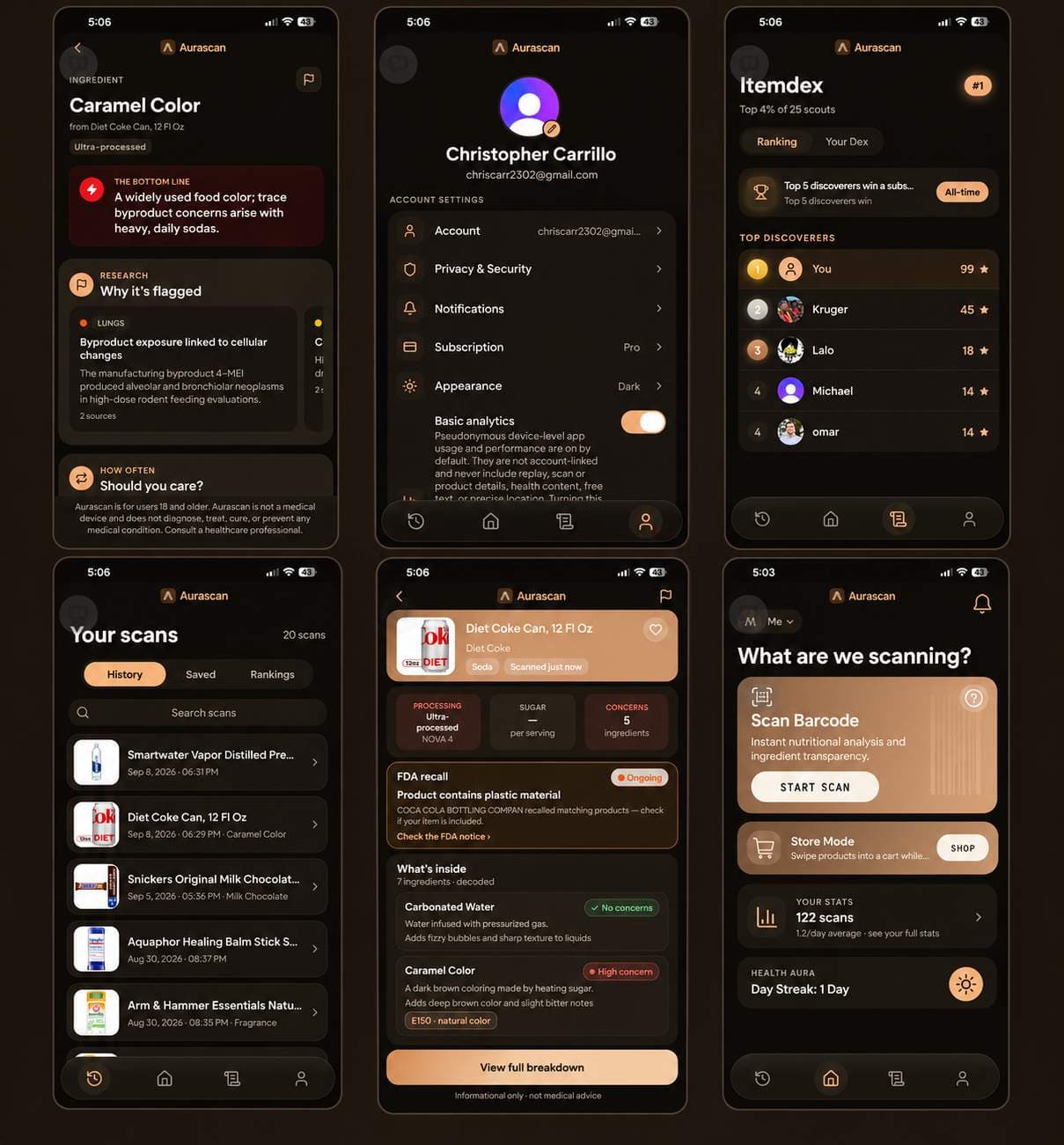
About this app
Aurascan is a food label scanner and ingredient transparency app that helps people understand packaged foods in seconds. Scan a barcode to identify a product, decode its ingredient list in plain English, see how selected ingredients may interact with body systems, and explore the strength of the evidence behind each explanation. Aurascan also adds processing context and lets users track scans and food patterns over time. Unlike tools that reduce a product to a single black-box score, Aurascan is built to show its work: what an ingredient is, why it is used, where it may act in the body, and how strong the supporting evidence is. The goal is simple: help users make informed choices without needing a biochemistry degree. Aurascan is education-first and is not medical advice or a diagnostic tool.
Key features
- 1Barcode scanning with plain-English ingredient decoding, including E-number explanations and additive flags.
- 2Body-system mapping that shows which ingredients may interact with nervous system, gut, or immune function.
- 3Evidence-strength ratings for each ingredient explanation, plus NOVA processing scores and scan-history tracking.
Target customer profile
Drawn from the product itself, not from a survey.
Demographic
Health-conscious millennials
Pain points
Confusing ingredient lists, misleading health claims, lack of time to research
Primary needs
Quick, reliable food analysis; clear guidance on product healthiness
Demographic
Parents with dietary-sensitive kids
Pain points
Hidden allergens, difficulty decoding labels, worry about additives
Primary needs
Allergen alerts, simple explanations, safe product recommendations
Demographic
Fitness enthusiasts and dieters
Pain points
Tracking macros is tedious, unsure about processed foods, want to optimize diet
Primary needs
Personalized insights, processing scores, progress tracking
Scout Review
Written by AI from measured evidence, scored out of 100.
Aurascan is a pre-launch beta with a polished landing page, a clear five-step product story, and a genuinely differentiated pitch: show the evidence behind every ingredient call instead of hiding behind a single score. The mobile performance is poor (44/100, 9.3s LCP) for an app that lives on your phone in a grocery aisle. Security is competent but incomplete. Accessibility is strong. The real question is growth: the problem is real, the segments are specific, but the competition is free (Open Food Facts) or entrenched (Yuka). 96 waitlist signups is a start. The product needs to ship and prove the evidence-first approach actually changes what people buy.
Measure by measure
Usability
52Onboarding is a single email field for a waitlist — no demo, no trial, no docs. Pricing tiers are named but not fully detailed. For a pre-launch beta, that's expected, but there's little to evaluate yet.
Design
68Dark, confident landing page with a clear five-step story and real ingredient examples. Phone mockups and testimonial marquee feel modern, though the design is judged from site structure rather than a captured visual audit.
Speed
44Lighthouse mobile performance 44/100 with a brutal 9.3s LCP and 607ms TBT. Desktop scores 92/100, so the gap is mobile-specific. CLS is near-perfect at 0.001, so at least nothing jumps around while you wait.
Security
62HTTPS enforced with HSTS, frame protection, and Referrer-Policy in place — 8/12 checklist points. Missing CSP, Permissions-Policy, and DMARC. No SOC 2, ISO, or bug bounty published, which is normal for a pre-launch beta.
Accessibility
80Lighthouse accessibility 96/100 — strong automated result. Two failing audits: insufficient color contrast and non-sequential heading order. No WCAG statement or multi-language support found, but the automated baseline is solid.
Growth
58Real problem, specific segments, and a genuine wedge: showing evidence strength instead of a black-box score. But it's up against Yuka's installed base and Open Food Facts' free open database.
Improvement areas
- Mobile performance: 9.3s LCP and 44/100 Lighthouse score make the core in-store use case painful.
- Security headers: missing CSP, Permissions-Policy, and DMARC; no published privacy policy or data-handling page.
- Pre-launch accessibility: no demo, no docs, no pricing details — the product is entirely behind a waitlist.
Design & Usability
Aurascan's landing page is genuinely well-crafted: dark, confident, and built around a clear five-step story that walks you from barcode to body impact. The ingredient examples (E951, E330, E150d) are real, not decorative, and the testimonial marquee adds social proof. But design is judged from site structure here, not a captured visual audit, so the score stays in the good-but-not-exceptional range. Usability is the weaker half: onboarding is a single email field for a waitlist, with no demo, no trial, and no documentation. Pricing tiers are named (Free 5 scans/day, Plus, Pro) but not fully detailed. For a pre-launch beta that's understandable, but there's almost nothing to actually evaluate yet — you're signing up for a promise, not a product.
Speed & Security
Speed is a tale of two devices. Desktop Lighthouse performance is 92/100 — genuinely fast. Mobile is 44/100 with a 9.3-second LCP and 607ms TBT. For an app whose entire use case is standing in a grocery aisle pointing your phone at a barcode, that mobile number is a real problem. CLS is 0.001, so at least the layout is rock-solid. Security sits at 8/12 checklist points: HTTPS enforced, HSTS, frame protection, X-Content-Type-Options, and Referrer-Policy all present. Missing CSP, Permissions-Policy, and DMARC. No SOC 2, ISO, or bug bounty published — normal for a pre-launch beta, but worth watching as the product handles health-adjacent scan data.
Accessibility & Growth
Accessibility is a strong 96/100 on Lighthouse, with two real failures: insufficient color contrast and non-sequential heading order. No WCAG statement or multi-language support found, but the automated baseline is genuinely good. Growth is the harder question. Aurascan names a real problem — confusing ingredient lists, hidden additives, misleading health claims — and targets three specific segments: health-conscious millennials, parents with dietary-sensitive kids, and fitness enthusiasts. Its wedge is showing evidence strength and body-system mapping instead of a single black-box score, which is a real differentiator against Yuka and Fooducate. But Open Food Facts is free and open, and Yuka has a massive installed base. The idea has room; the moat is thin.
Conclusion
Aurascan is worth watching. The evidence-first approach is the right instinct in a category full of fear-mongering and black-box scores. But a waitlist and a landing page aren't a product yet. Ship the app, fix the mobile load time, publish a privacy policy, and get real users scanning real barcodes. If the body-map and evidence-strength features work as advertised, there's a genuine niche here. If they're just a nicer UI on top of the same NOVA score everyone else uses, the 96 waitlist signups will stay exactly that.
Suggestions for improvement
- Fix mobile performance: 9.3s LCP is unacceptable for an app used in grocery aisles. Optimize images, defer non-critical JS, and test on real mid-range phones.
- Publish a privacy policy and data-handling page. You're handling health-adjacent scan data — users need to know where it goes.
- Add a live demo or interactive sample scan on the landing page. A waitlist with no product preview is a hard sell.
- Detail the pricing tiers fully. 'Free 5 scans/day, Plus, Pro' without prices or feature breakdowns leaves buyers guessing.
Alternatives comparison
Named competitors, point by point. Nobody paid to appear here or to be left out.
 Aurascan.app |  Yuka |  Open Food Facts |  Fooducate | |
|---|---|---|---|---|
| Ingredient decoding in plain English | Yes — decodes each ingredient with plain-English explanations and E-number context. | Partial — flags additives but does not explain each ingredient in depth. | Yes — raw ingredient lists available, but no plain-English decoding. | Partial — explains some ingredients but focuses on letter grades. |
| Evidence-strength transparency | Yes — shows how strong the evidence is behind each ingredient explanation. | No — single black-box score with no evidence transparency. | No — raw data only, no evidence ratings. | No — letter grade with limited sourcing. |
| Body-system impact mapping | Yes — maps flagged ingredients to nervous system, gut, and immune systems. | No — no body-system mapping. | No — no body-system mapping. | No — no body-system mapping. |
| Processing score (NOVA) | Yes — NOVA processing score shown next to every product. | Partial — factors processing into score but not as a standalone NOVA metric. | Yes — NOVA classification available in the database. | Partial — factors processing into letter grade. |
| Scan history and pattern tracking | Yes — tracks scans, clean rate, streaks, and patterns over weeks. | Partial — basic scan history, no pattern tracking. | No — no personal tracking features. | Partial — basic history, limited pattern analysis. |
| Free tier availability | Yes — Free tier includes 5 scans per day. | Yes — free with optional premium features. | Yes — completely free and open source. | Yes — free with premium subscription options. |
Yuka
Scan food and cosmetic products to get a health score based on nutritional and additive data.
Open Food Facts
A collaborative database of food products with ingredient and nutrition information.
Fooducate
Scan food products to see a letter grade and get suggestions for healthier alternatives.
Comparing options? See Aurascan.app alternatives, scored side by side
More Health & Wellness apps
View all Health & Wellness
StoryPad
92Privacy-first open source journal app with a continuous t...

Pushup RPG: Fitness Quest
90Pushup RPG is a camera-based push-up counter and fitness RPG for home workouts. Real push-ups and squats become attacks as you defeat 48 foes across 8 biomes, earn XP and loot, join guilds, and battle in live 40-second duels. Free on iOS and Android.

Gryper
89Workout tracker with muscle heatmaps and volume landmarks

Snapkin: Photo Calorie Counter
88Snapkin is a calorie tracker you use by photographing your plate.

Innermost
87An AI-powered emotional support app that acts as a person...

Mantra Meditation Timer
85A minimalist, distraction-free meditation timer for mantr...

TDEE Calculator
84Free TDEE calculator that estimates maintenance calories, weight loss targets, muscle gain calories, and macro recommendations based on your body stats and activity level.

WellWired
84AI explained simply for older adults, with safety lessons...

TheBean.ai
84Adaptive AI personal trainer that evolves with your progr...

FitLifeBud
84AI meal plans for your week, with one aisle-sorted shopping list

SayLift
84Voice workout log and calorie counter for iPhone

FormBlends
82A personalized GLP-1 weight loss platform offering physic...


A platform dedicated to providing unbiased reviews of newly launched applications, analyzing everything from their features to their full potential.
info@scoutforge.net© 2026 Scoutforge. All rights reserved.
