Cycling through all six. Tap any point to stop.
Measured on six things
Snapkin is a calorie tracker you use by photographing your plate.
Growth
62A real, specific problem with a clear wedge: photo-first logging for people who quit trackers. Differentiated against MyFitnessPal, Lose It! and Cronometer, but the wedge is copyable.
Screenshots
1 / 1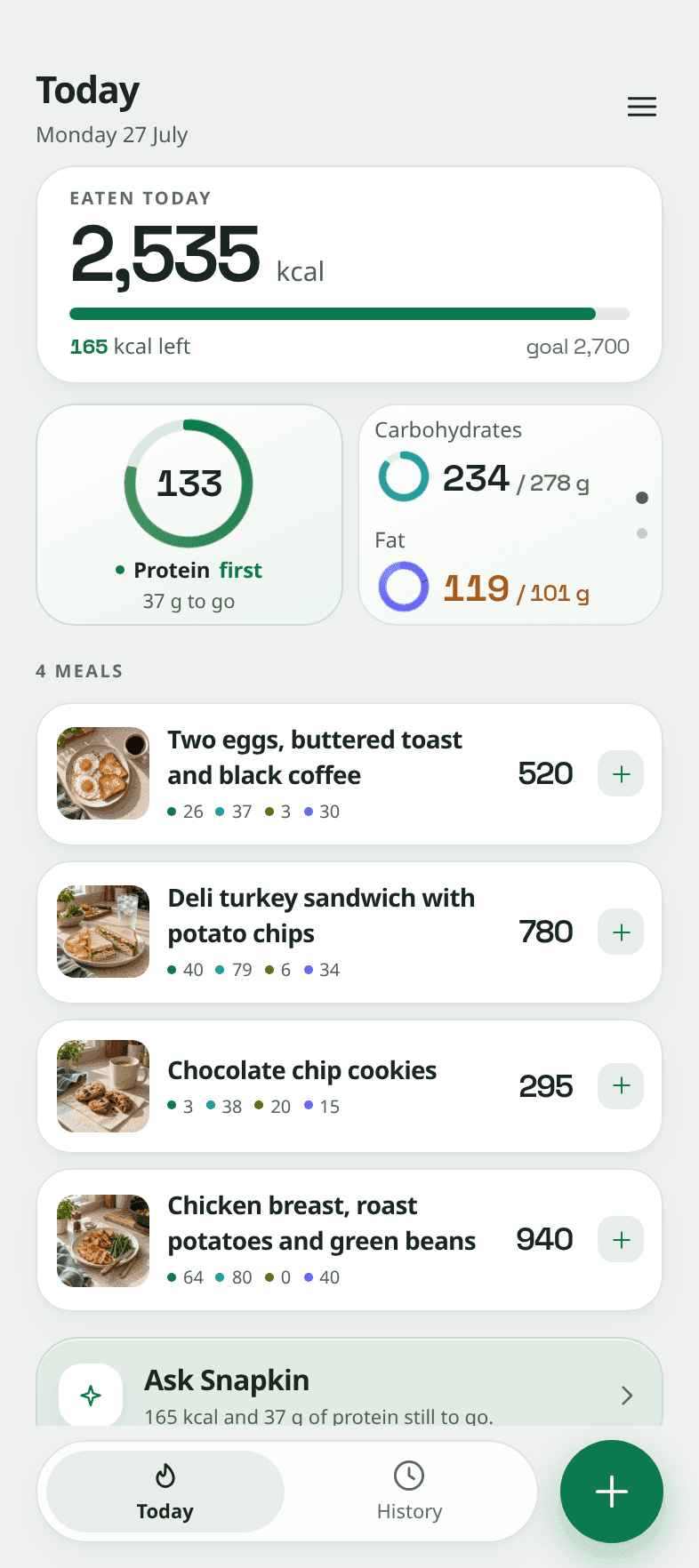
About this app
Snapkin is a calorie tracker you use by photographing your plate. There's no scale to weigh with, no barcode to scan and no database to search. Take one photo per meal. Snapkin works out what is on the plate, how many calories it has, and how much protein you have had today. It runs on iPhone and Android in 10 languages, and costs €9.99 a month or €99.99 a year.
Key features
- 1Photo-first meal logging: one photo per meal, no scale, barcode or database search required.
- 2Protein-first dial with Home Screen widgets on iPhone and Android, plus offline logging that syncs later.
- 3Fridge, freezer, cupboard and restaurant-menu photo analysis, with stated rougher accuracy on those.
- 4Ten fully localised languages, including meal questions, remembered habits and the coach.
Target customer profile
Drawn from the product itself, not from a survey.
Demographic
Busy professionals aged 25-45
Pain points
No time to weigh food or log every ingredient; previous trackers felt like a chore.
Primary needs
Quick, effortless meal logging that fits into a hectic lifestyle without sacrificing accuracy.
Scout Review
Written by AI from measured evidence, scored out of 100.
Snapkin is a photo-first calorie tracker that removes the weighing, barcode scanning and database searching that make most trackers collapse on a busy day. The measured evidence backs the technical side: Lighthouse mobile performance 96/100 with a 2.5s LCP and zero blocking time, accessibility 100/100, and 10 of 12 security checklist points with HTTPS, HSTS, SPF and DMARC in place. The app UI, judged from 14 store screenshots, is clean and consistent, with the protein dial as the clear centrepiece. Usability is genuinely short-loop: one photo, sometimes one question, then nothing to confirm. The weak spots are support and commitment: no public help centre, and a yearly plan paid upfront at €49.99 with no trial while monthly gets three free days. At €9.99 a month it is priced above MyFitnessPal and Lose It! premium tiers, so the photo-first promise has to carry real weight.
Measure by measure
Usability
68Core loop is genuinely short: one photo, maybe one question, done. 'Usual meal' repeat, undo and offline logging are real time-savers. No public help centre; support is an email link in Settings.
Design
72Judged on the app UI and store material, not the site. 14 screenshots show a clean photo-first flow and a prominent protein dial; the lowercase wordmark and typography are consistent and modern.
Speed
88Lighthouse mobile 96/100 with LCP 2.5s, CLS 0.004 and TBT 0ms; desktop 97/100. The marketing site is light and the demo is short. No lag complaints found in the collected evidence.
Security
74HTTPS enforced with HSTS, plus frame protection, X-Content-Type-Options, Referrer-Policy, Permissions-Policy, SPF and DMARC. 10/12 on the header probe. No CSP header and no published audit or bug bounty.
Accessibility
80Lighthouse accessibility 100/100, with one failing audit on visible text labels lacking matching accessible names. Ten localised languages including meal questions and the coach. No published WCAG statement.
Growth
62A real, specific problem with a clear wedge: photo-first logging for people who quit trackers. Differentiated against MyFitnessPal, Lose It! and Cronometer, but the wedge is copyable.
Improvement areas
- No public help centre or documentation; support is limited to an email link inside Settings.
- Yearly plan is paid upfront at €49.99 with no trial, while monthly gets three free days.
- No Content-Security-Policy header, and no published SOC 2, pen test or bug bounty.
- No published WCAG conformance statement despite a 100/100 automated accessibility score.
Design & Usability
Judged on the app itself, since Snapkin ships through the App Store and Google Play and the website is marketing. The 14 store screenshots show a coherent, modern UI: a photo capture screen, a protein ring given top billing, and two widget sizes. The lowercase wordmark and restrained typography carry over from the site, which is well built but not the product. Usability is where the concept earns its keep. The loop is one photo, sometimes one question with a stated ±90 kcal impact, then nothing to confirm or save. 'Usual meal' repeats a past meal in a few taps, answers can be undone, and meals logged without signal upload later. The gaps are support and trial structure: there is no public help centre or docs page in the fetched content, support is an email link buried in Settings, and the yearly plan is paid upfront with no trial while monthly gets three free days.
Speed & Security
Speed is the strongest measured dimension. Lighthouse mobile performance is 96/100 with LCP 2.5s, CLS 0.004, TBT 0ms and FCP 2.0s; desktop scores 97/100. The site is a light marketing page with a short replayable demo rather than a heavy web app, and no user complaints about lag surfaced in the collected evidence. Security sits in solid-but-unremarkable territory. The probe confirms HTTPS with HSTS, frame protection, X-Content-Type-Options, Referrer-Policy, Permissions-Policy, SPF and DMARC, for 10 of 12 checklist points. The missing piece is a Content-Security-Policy header, and there is no published SOC 2, ISO, pen-test result or bug bounty in the site content. Privacy policy and terms are linked from Settings, which is the minimum expected for a consumer health app handling meal photos and weight data.
Accessibility & Growth
Accessibility scores well on automated checks: Lighthouse returns 100/100, with a single failing audit about visible text labels not matching accessible names. The product also localises ten languages properly, including the meal questions, the remembered habits and the coach, which is more than most competitors bother with. What is missing is a published WCAG conformance statement or accessibility page, so the claim rests on tooling rather than commitment. Growth is a judgement on the idea, not the traction. Snapkin names a real and specific problem: people quit calorie trackers because weighing rice and logging every ingredient is a chore. Its wedge is photo-first logging with no scale, barcode or database, a protein-first dial, and photo-the-fridge and photo-the-menu features that MyFitnessPal, Lose It! and Cronometer do not offer in that form. The category has headroom, but the wedge is copyable and the incumbents have the distribution. Traction is early: domain registered September 2026, iOS release September 2026, no store ratings yet.
Conclusion
Snapkin is aimed at a real and well-named problem, and it is honest about the limits of photo estimation: it publishes 83% median accuracy per meal, within 17% of a kitchen scale, and says on screen when a fridge or menu photo is rougher. That transparency is rarer than it should be in this category. The question is whether the wedge holds. Photo-first logging is the obvious next step for every tracker, and MyFitnessPal, Lose It! and Cronometer all have the user base to bolt it on. Snapkin's defence is execution: the model testing write-up, the protein-first framing, the offline queue and the ten-language localisation are the kind of details that take time to copy. For a busy professional who has already quit two trackers, this is a credible third attempt. For everyone else, the €49.99 upfront yearly ask is a lot of trust for an app with no store ratings yet.
Suggestions for improvement
- Publish a help centre or docs page; right now support is a single email link inside Settings.
- Add a Content-Security-Policy header to close the one real gap in an otherwise strong security posture.
- Offer a short trial on the yearly plan, or let monthly users convert without losing the launch price.
- Publish a WCAG conformance statement to back up the 100/100 automated accessibility score.
Alternatives comparison
Named competitors, point by point. Nobody paid to appear here or to be left out.
 Snapkin: Photo Calorie Counter |  MyFitnessPal |  Lose It! |  Cronometer | |
|---|---|---|---|---|
| Meal logging method | Photo of the plate; no scale, barcode or database | Manual entry plus barcode scanning and food database | Manual entry plus barcode scanning; no AI photo recognition | Manual entry focused on precise micronutrient data |
| Stated accuracy | 83% median per meal, within 17% of a kitchen scale; 90% over a week | Depends on user-entered portions and database accuracy | Depends on user-entered portions and database accuracy | High accuracy for micronutrients when entries are weighed |
| Pricing | €9.99/month or €49.99/year launch price (normally €99.99) | Free tier with ads; premium subscription for advanced features | Free tier with ads; premium subscription for advanced features | Free tier; paid Gold tier for advanced nutrition features |
| Free trial | Three days free on monthly; yearly paid upfront with no trial | Free tier available indefinitely; premium trial offered | Free tier available indefinitely; premium trial offered | Free tier available indefinitely; Gold trial offered |
| Language support | Ten languages, with meal questions and coach localised | Multiple languages supported across app and database | Primarily English-language experience | Multiple languages supported for interface and data |
| Offline logging | Photo taken offline is queued on device and uploads later | Requires connection for database lookups and syncing | Requires connection for database lookups and syncing | Requires connection for database lookups and syncing |
MyFitnessPal
A comprehensive calorie tracker with a vast food database, barcode scanner, and community features. However, it requires manual logging and can be time-consuming.
Lose It!
A popular calorie counting app with a user-friendly interface and a large food database. It offers barcode scanning and meal logging but lacks AI photo recognition.
Cronometer
A detailed nutrition tracker that focuses on micronutrients and provides accurate data. It requires manual entry and is more suited for data-driven users.
Comparing options? See Snapkin: Photo Calorie Counter alternatives, scored side by side
More Health & Wellness apps
View all Health & Wellness
StoryPad
92Privacy-first open source journal app with a continuous t...

Innermost
87An AI-powered emotional support app that acts as a person...

Mantra Meditation Timer
85A minimalist, distraction-free meditation timer for mantr...

TheBean.ai
84Adaptive AI personal trainer that evolves with your progr...

FitLifeBud
84AI meal plans for your week, with one aisle-sorted shopping list

TDEE Calculator
84Free TDEE calculator that estimates maintenance calories, weight loss targets, muscle gain calories, and macro recommendations based on your body stats and activity level.

WellWired
84AI explained simply for older adults, with safety lessons...

RAADS-R Test
82Free 80-item RAADS-R autism self-assessment for adults, with instant total and domain scores, privacy-first access, and clear non-diagnostic guidance.

FormBlends
82A personalized GLP-1 weight loss platform offering physic...

Health Studio
81An AI-powered healthcare platform that centralizes remote patient monitoring, clinical trial management, and medical device integration for improved efficiency.

Body Type Calculator
81Find your body shape instantly from measurements—for men ...

Talk Journal
81An AI-powered voice journaling app that transcribes spoken thoughts into written entries for effortless daily reflection and mental wellness.


A platform dedicated to providing unbiased reviews of newly launched applications, analyzing everything from their features to their full potential.
info@scoutforge.net© 2026 Scoutforge. All rights reserved.
