Cycling through all six. Tap any point to stop.
Measured on six things
Financial forecasting and valuation tool for startups.
Growth
40Very early-stage (founder LinkedIn/YouTube activity only); no GitHub repo, minimal community mentions, no review sites coverage; pricing tiers launched recently.
Screenshots
1 / 1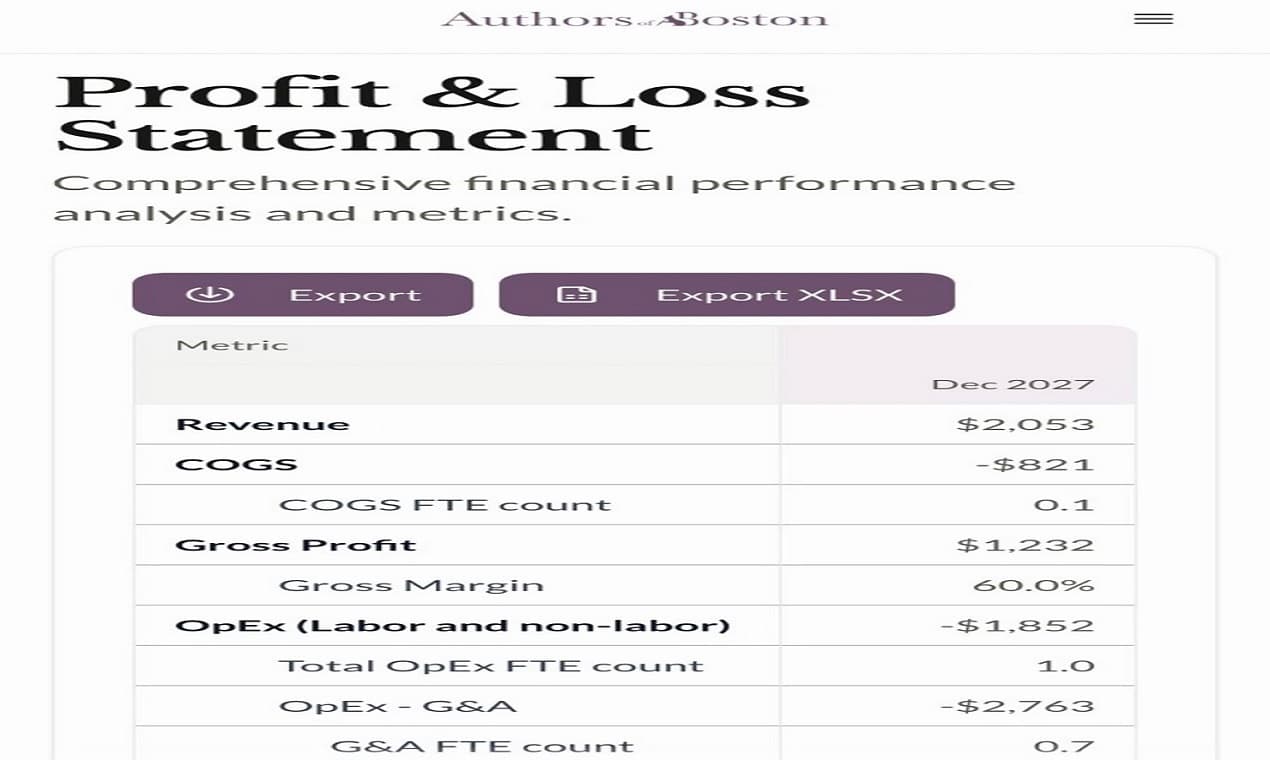
About this app
Authors of Boston is my new favorite tool for financial planning. It generates valuations and cash forecasts in minutes, backed by world-class underwriting. The three-step process—cash, labor, revenue—makes it incredibly intuitive. I love that I can connect bank and accounting data to keep everything updated automatically. The pricing is flexible too, from a free ad-supported plan to a premium one that offers priority support and an ad-free experience. It's a game-changer for founders who want to impress investors without spending days building models.
Key features
- 13-step cash/labor/revenue forecasting with bank integrations
- 2Automated valuations and cash flow forecasts
- 3Flexible pricing: free ad-supported to $50/mo premium
Target customer profile
Drawn from the product itself, not from a survey.
Demographic
Startup founders and CEOs
Pain points
Time-consuming manual financial modeling, difficulty impressing investors with rigorous forecasts
Primary needs
Quick and accurate valuations, easy integration with financial data
Demographic
Financial analysts in early-stage companies
Pain points
Slow responses to investor requests for burn rate and cash forecasts
Primary needs
Automated cash flow analysis, scenario planning
Demographic
Small business owners
Pain points
Lack of financial expertise, spreadsheet complexity
Primary needs
Simple guided forecasting, real-time data integration
Scout Review
Written by AI from measured evidence, scored out of 100.
A promising concept for startup financial modeling that delivers on the promise of simplicity and automation in theory, but real-world evidence is thin. Strong on targeted features for early-stage companies yet held back by lack of maturity across performance, security, and community metrics.
Measure by measure
Usability
76Three-step guided process praised for intuition; bank/accounting integrations mentioned for auto-updates; no public user testing or onboarding walkthroughs available.
Design
70Clean, minimal landing page with clear 3-step flow (cash, labor, revenue) highlighted; professional but sparse visuals and no interactive demo.
Speed
63Claims 'valuations and cash forecasts in minutes'; no independent benchmarks, load tests, or performance data published anywhere.
Security
60Mentions data connections but no security audits, bug bounties, SOC2, or compliance details found on site or searches.
Accessibility
50No WCAG mentions, screen reader testing, or accessibility docs; mobile support unknown beyond generic claims.
Growth
40Very early-stage (founder LinkedIn/YouTube activity only); no GitHub repo, minimal community mentions, no review sites coverage; pricing tiers launched recently.
Improvement areas
- Lack of independent reviews, benchmarks, and security documentation
- Minimal community traction and early-stage visibility
- No accessibility or advanced UI features evident
Design & Usability
Authors of Boston presents a straightforward 3-step interface centered on cash, labor, and revenue inputs, which aligns with its marketing as intuitive for founders. The homepage emphasizes automatic data connections and quick outputs, suggesting decent usability for the core workflow. However, the design remains basic with limited visual appeal or advanced UI elements compared to established fintech tools.
Speed & Security
The tool markets itself on speed—generating forecasts in minutes via world-class underwriting—but lacks any public performance benchmarks or independent validation. Security appears standard for a new SaaS with bank integrations but offers no audits or advanced protections, keeping confidence moderate for sensitive financial data.
Accessibility & Growth
Accessibility documentation is entirely absent, scoring low as expected for early tools without explicit testing. Growth is minimal; the product is in its infancy with only founder-driven content on LinkedIn and YouTube, no open-source presence, and negligible third-party reviews or community engagement.
Conclusion
For founders needing quick cash forecasts without Excel hell, it could save time once proven—but treat it as experimental until more data emerges.
Suggestions for improvement
- Add public case studies and user testimonials with real metrics.
- Publish performance benchmarks and security certifications.
- Build a community forum or GitHub presence for feedback.
- Implement basic accessibility features and WCAG compliance.
Alternatives comparison
Named competitors, point by point. Nobody paid to appear here or to be left out.
 Authors of Boston |  Pulse |  Float |  LivePlan | |
|---|---|---|---|---|
| Core cash flow forecasting | Yes, 3-step guided with valuations | Yes, focused on small business cash flow | Yes, cash flow forecasting and management | Yes, integrated with full business planning |
| Startup valuation generation | Yes, core feature | No | No | Limited, more planning-focused |
| Bank/accounting integrations | Yes, automatic updates claimed | Yes | Yes | Yes |
| Pricing model | Free ad-supported to $50/mo premium | Subscription-based (typically $29+/mo) | Subscription (starts ~$15-99/mo) | Subscription (~$15-40/mo) |
Pulse
Cash flow forecasting tool for small businesses
Float
Cash flow forecasting and management platform
LivePlan
Business planning and financial forecasting software
Comparing options? See Authors of Boston alternatives, scored side by side
Sources
What the review was written against. A verdict with no sources is an opinion.
More Finance apps
View all Finance
CalcFi
92A free, comprehensive financial calculator platform with ...

CreateMyCoin
92A no-code Solana token creator that deploys SPL tokens in...

Stellar Staff
88A top-rated virtual assistant agency that matches busines...

Receipt Bot
88Automated bookkeeping software that extracts data from re...

BringMe Money
88AI invoice follow-up that drafts reminders and tracks next steps.

Prop Firm Consistency Calculator
88Check your prop firm consistency rule and best-day percen...

OpenBudget
87Connect your bank to AI for real answers about your money.

StockFit API
87A developer-first financial data API providing structured...

HISAB 360
87A Windows Excel add-in that pulls your ledger data into the workbook, reconciles it, and drafts the reports - all in plain English, inside Excel.

Stripdo
87Stripdo is a smart invoicing tool that automatically gene...

Credyt
87Real-time monetization infrastructure for AI products tha...

FX Terminal
87Free browser-based forex research terminal: live charts, economic calendar, COT reports, retail sentiment, strength meter and bond yields. No signup.https://fxterminal.app/


A platform dedicated to providing unbiased reviews of newly launched applications, analyzing everything from their features to their full potential.
info@scoutforge.net© 2026 Scoutforge. All rights reserved.
