Cycling through all six. Tap any point to stop.
Measured on six things
Validate startup ideas with simulated buyer crowds before...
Speed
47Lighthouse mobile 51/100 with LCP 6.4s and TBT 852ms; desktop 91/100. Mobile users wait over six seconds for the main content to paint.
Screenshots
1 / 5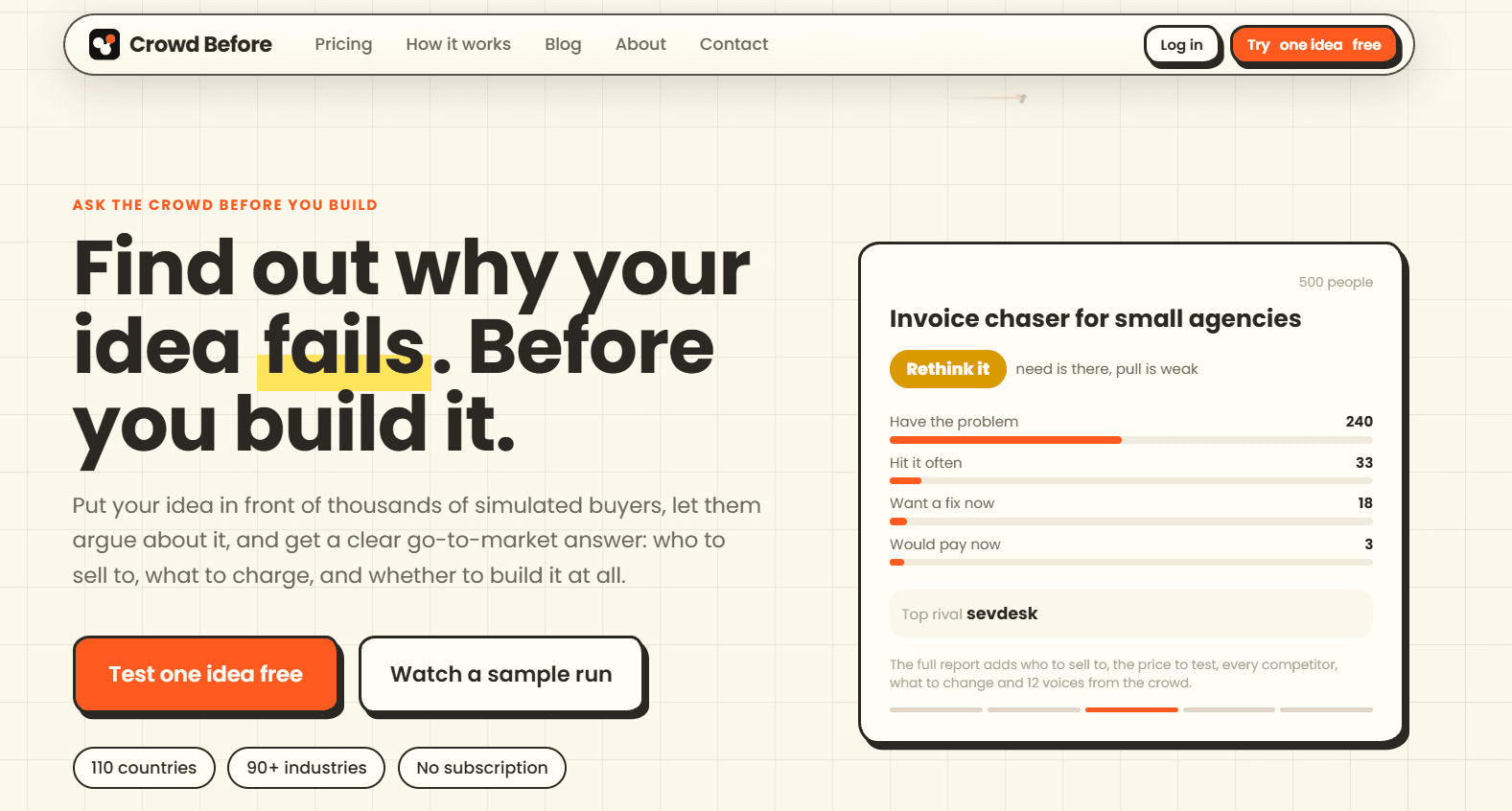
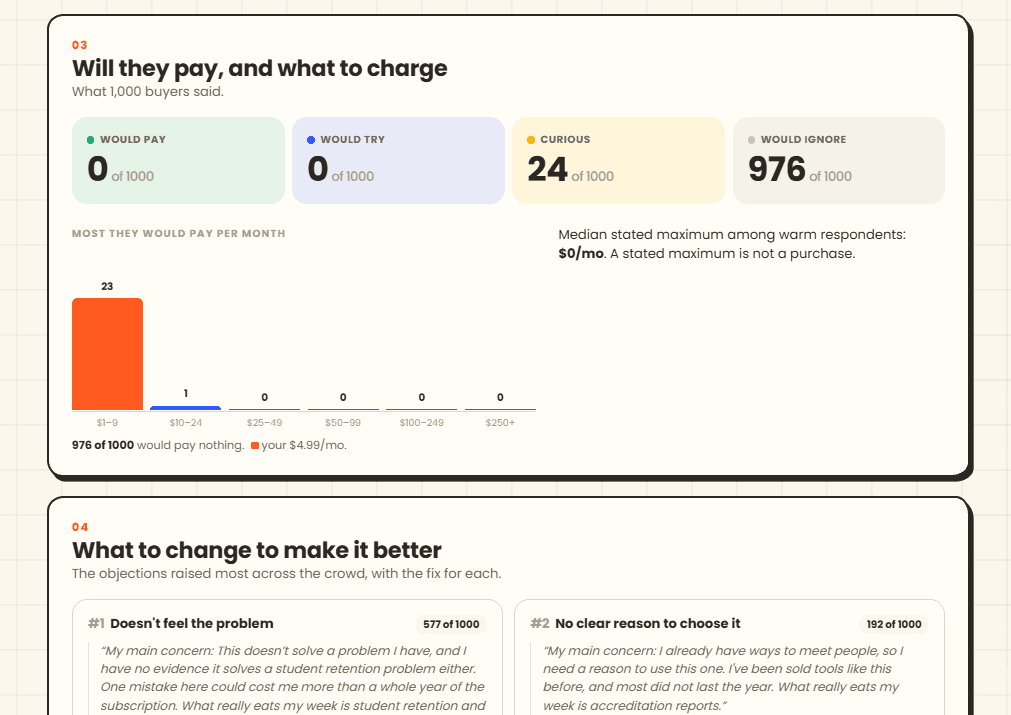
About this app
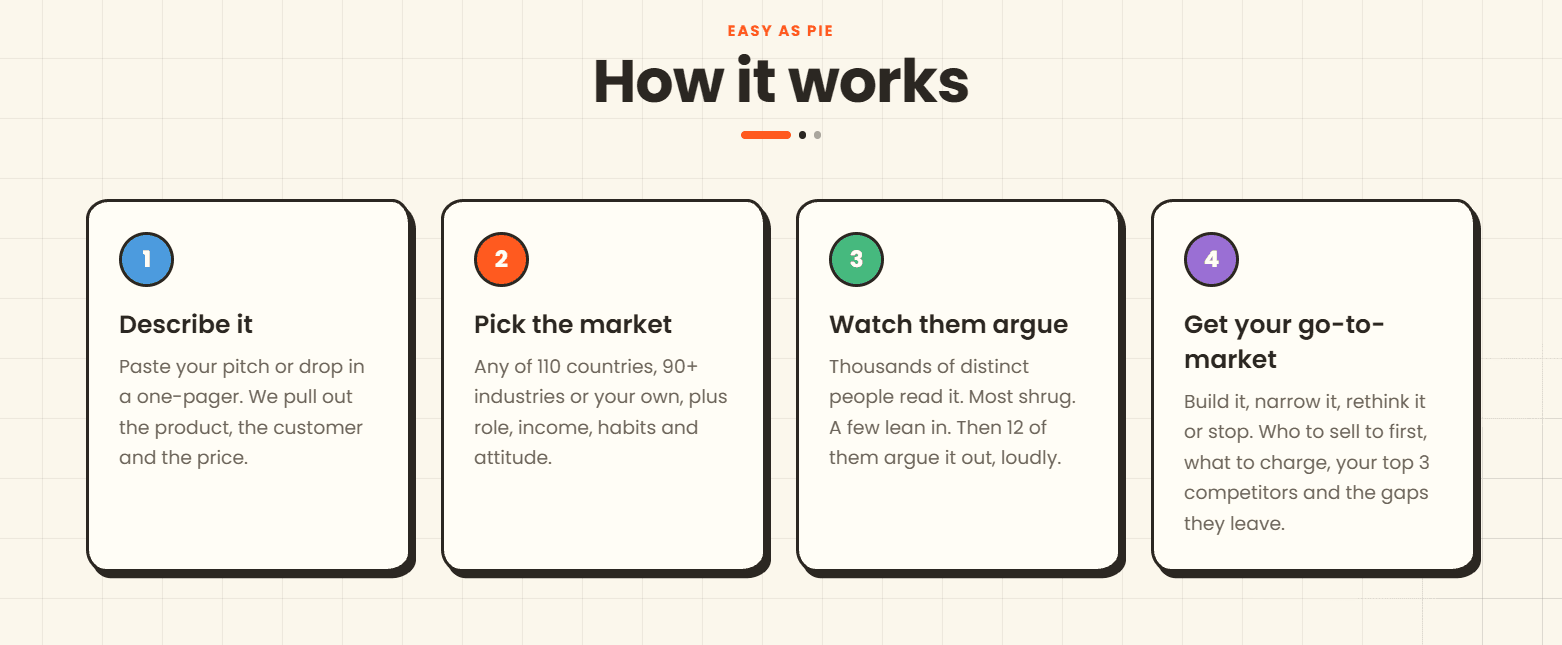
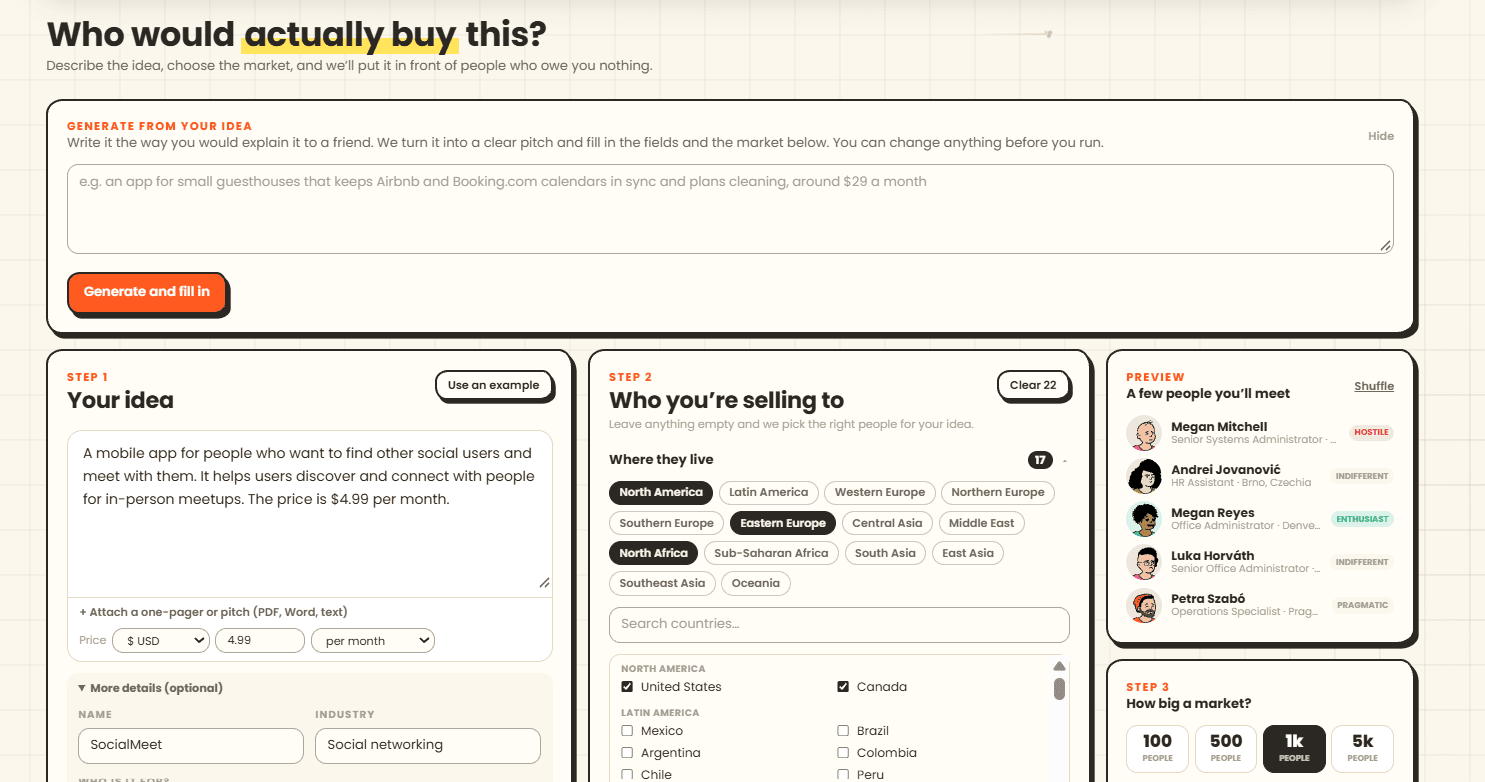
Crowd Before is a web-based platform that simulates market feedback for startup ideas. Users describe their product concept, select a target market from over 110 countries and 90+ industries, and then thousands of simulated buyer personas interact with the pitch. The system generates a detailed report that answers four critical questions: whether to build and launch, who to sell to first, what price to test, and who the top competitors are. It also provides actionable feedback, including what to change and why, based on the crowd's reactions. The platform emphasizes that it is not real market research but a simulated environment to uncover potential flaws early. Pricing is credit-based with no subscription, and a free tier allows testing one idea with up to 100 people. Standout features include the ability for 12 selected personas to argue about the idea, providing qualitative insights, and a focus on go-to-market strategy rather than just validation.
Key features
- 1Simulated crowd of thousands of AI buyer personas reacting to your pitch across 110 countries and 90+ industries
- 212 selected personas argue the idea out loud, surfacing qualitative objections and counterpoints
- 3Report answers four questions: build it or not, who to sell to first, what to charge, and top competitors
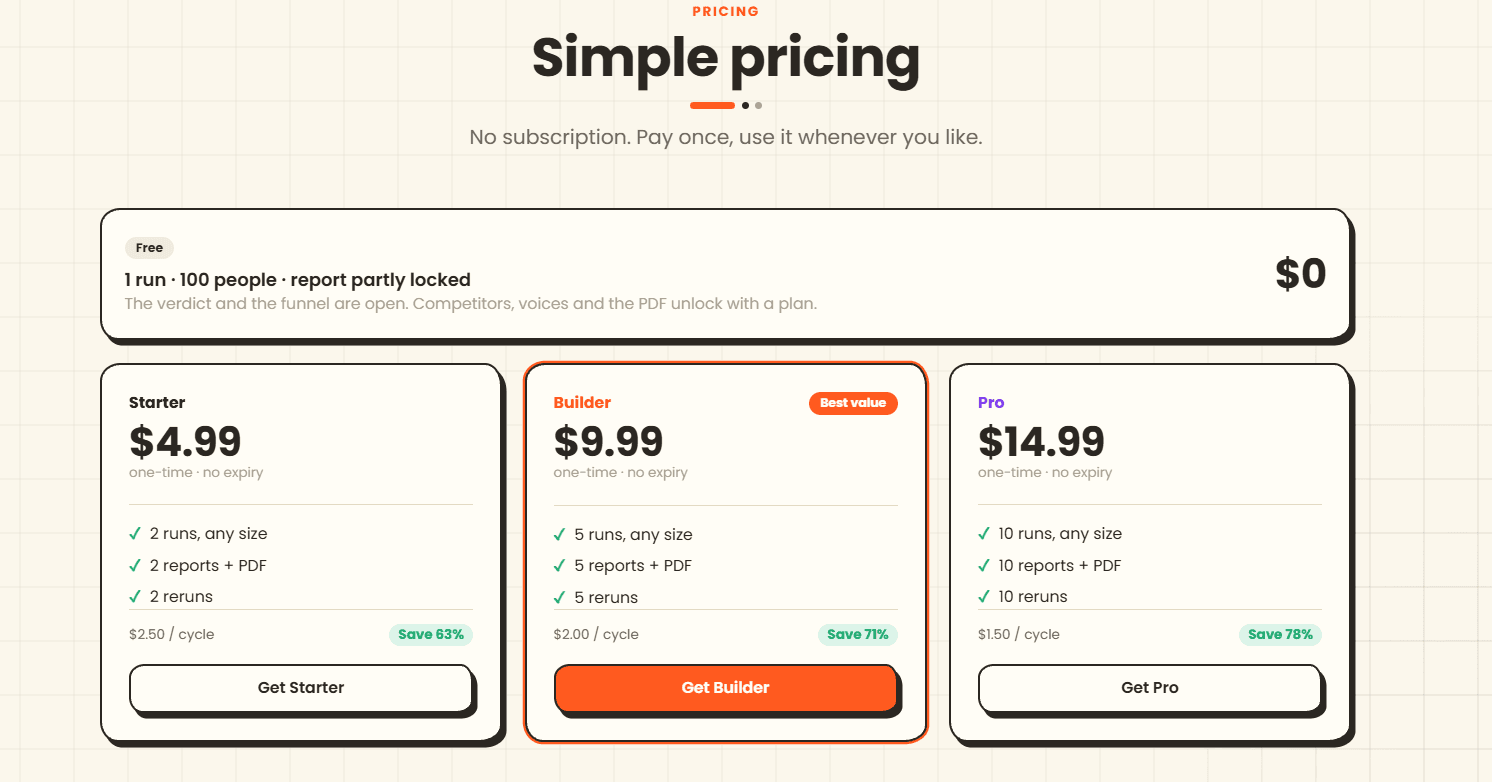
- 4Credit-based one-time pricing from $4.99 with no subscription; free tier tests one idea with 100 people
Target customer profile
Drawn from the product itself, not from a survey.
Demographic
Solo founders and indie makers
Pain points
Spending months building a product that nobody wants; lack of access to honest feedback; limited budget for market research.
Primary needs
Quick, affordable validation of ideas; clear guidance on target market and pricing; competitor analysis before investing time and money.
Demographic
Startup product managers and teams
Pain points
Difficulty in prioritizing features and segments; internal bias in decision-making; pressure to launch quickly with limited data.
Primary needs
Objective data to inform product roadmaps; identification of early adopters; evidence to support go-to-market strategies.
Demographic
Agency owners and consultants
Pain points
Clients with unvalidated ideas; need to provide value-added services; limited time for in-depth market research.
Primary needs
Fast turnaround for client idea validation; credible reports to present; tools to facilitate brainstorming and strategy sessions.
Scout Review
Written by AI from measured evidence, scored out of 100.
Crowd Before is a simulated market-feedback tool for founders who can't afford real market research. You describe an idea, pick a market from 110 countries and 90+ industries, and thousands of AI buyer personas react — then 12 of them argue about it. The output is a report answering four questions: build it or not, who to sell to first, what to charge, and who your competitors are. Pricing is credit-based with no subscription: free for one idea with 100 people, then $4.99 for 2 runs, $9.99 for 5, $14.99 for 10, credits never expiring. The design is genuinely good — the sample report card and avatar grid sell the product visually. Speed on mobile is the biggest problem at 51/100 Lighthouse with a 6.4s LCP. Security hygiene is strong (11/12 headers). Accessibility is decent but has real gaps in table markup and contrast. The idea is well-positioned against surveys and UserTesting, though the 'simulated, not real research' caveat is doing a lot of work.
Measure by measure
Usability
68Clear 4-step flow, free 100-person run with no card, and a pricing page that spells out credit costs. Report preview shows exactly what you get before paying.
Design
71Coherent orange accent, rounded card system and a realistic sample report card give the homepage real product feel. Avatar grid gets noisy and hero CTAs compete for attention.
Speed
47Lighthouse mobile 51/100 with LCP 6.4s and TBT 852ms; desktop 91/100. Mobile users wait over six seconds for the main content to paint.
Security
74Strong header hygiene: HTTPS, HSTS, CSP, frame protection, Referrer and Permissions policies all set (11/12). DMARC missing; no SOC 2 or pen-test claims published.
Accessibility
70Lighthouse a11y 89/100. Failing: insufficient color contrast, malformed list markup, table cells without headers. No accessibility statement or WCAG mention on site.
Growth
62Real problem, specific buyer (solo founders, PMs), and a clear wedge: simulated personas at $4.99 vs surveys or $5k agency research. Category has room; execution is early.
Improvement areas
- Mobile performance: 6.4s LCP and 852ms TBT on Lighthouse mobile (51/100) versus 91/100 desktop
- Accessibility: failing contrast, malformed list markup, and table cells without headers in the report UI
- Security transparency: no published SOC 2, pen-test or data-handling page; DMARC record missing
- Pricing clarity: the 10/2/5/17 credit breakdown adds friction to what is essentially a per-idea cost
Design & Usability
The homepage does the hard part well: it shows the product instead of describing it. A floating sample report card with progress bars and a 'Build it' verdict tells you in two seconds what you're buying, and the 4-step flow maps cleanly onto the actual product. The orange accent system is consistent across CTAs, pills and report UI, and the avatar grid is a smart visual metaphor for the 'crowd.' Where it slips: the hero stacks three CTAs (free test, sample run, plus AI logos) and dilutes the primary action, and the trusted-by logo wall is crammed into two tight rows with mismatched sizes and edge truncation. Usability is stronger than design — the free 100-person run with no card is a genuinely low-friction entry, and the pricing page spells out credit costs (10 for a run, 2 to unlock, 5 for a what-if) rather than hiding them. The report preview reduces abstraction. The main friction is the credit ledger itself, which reads more complicated than it is.
Speed & Security
Speed is the weak spot. Lighthouse mobile performance lands at 51/100 with an LCP of 6.4 seconds and 852ms of total blocking time — that's a slow first impression on the device most indie founders will actually use. Desktop scores 91/100, which tells you the payload is heavy and mobile rendering is doing the suffering, not the server. CLS is a clean 0 and FCP is 1.5s, so the bones are fine; it's the main-thread work and late-painting hero that hurt. Security is the opposite story: the HTTP probe found HTTPS enforced, HSTS, CSP, frame protection, X-Content-Type-Options, Referrer-Policy and Permissions-Policy all set — 11 of 12 checklist points. The one gap is DMARC, which leaves the domain partially spoofable for email. There are no published SOC 2, ISO or pen-test claims, which is normal for a product at this stage but means security rests entirely on solid hygiene rather than audited assurance.
Accessibility & Growth
Accessibility sits at 89/100 on the automated Lighthouse scan, which sounds better than it is. The failing audits are the ones that actually bite: insufficient color contrast, list elements that aren't wrapped in list parents, and table cells in a large table with no headers. For a product whose entire value is a data-dense report, missing table headers is a real problem for screen reader users. There's no accessibility statement or WCAG mention anywhere on the site. Growth is the more interesting question. The problem is real and specific — solo founders and PMs burning months on unvalidated ideas with no budget for real research. The wedge is clear: simulated personas with 12 arguing voices and go-to-market output, priced from $4.99 one-time against SurveyMonkey's respondent-recruitment problem, UserTesting's usability-only focus, and agency research at $5,000+. That's a defensible position. The honest limit: the category is crowded with AI validation tools, the domain is brand new, and the 'simulated, not real research' disclaimer caps how much a serious PM team will lean on it.
Conclusion
If you're a solo founder about to spend three months on an idea, Crowd Before is a cheap way to get a second opinion before you commit — and at $4.99 for two runs, the downside is a coffee. The free tier is genuinely free (100 people, no card), so there's no reason not to try it. Just go in clear-eyed: this is a structured simulation, not evidence. The personas will tell you what a plausible buyer might think, not what a real one will pay. Use it to stress-test your pitch and find the objections you haven't considered, then go ask ten real humans the questions the report surfaces. The mobile performance needs work before it feels premium, and the accessibility gaps matter if you're selling to teams with procurement standards. But as a pre-build gut check for indie makers, the value proposition holds up.
Suggestions for improvement
- Fix mobile performance: 6.4s LCP and 852ms TBT are costing you users on the device most founders actually browse on.
- Add table headers and fix list markup in the report UI — for a data-dense product, screen reader access is table stakes.
- Publish a plain-language security page covering data handling, retention and the simulated-persona model's privacy posture.
- Simplify the credit math on the pricing page into a single 'cost per idea' line; the 10/2/5/17 breakdown reads harder than it is.
Alternatives comparison
Named competitors, point by point. Nobody paid to appear here or to be left out.
 Crowd Before Crowd Before |  SurveyMonkey SurveyMonkey |  Google Forms Google Forms |  UserTesting UserTesting | |
|---|---|---|---|---|
| Feedback source | Simulated AI buyer personas (100 to 5,000 per run) | Real respondents you must recruit and pay | Real respondents you must distribute to yourself | Real users via video usability sessions |
| Time to results | Minutes per run | Days to weeks depending on recruitment | Days to weeks depending on distribution | Days to schedule and complete sessions |
| Pricing model | One-time credits from $4.99; free tier for one idea | Monthly subscription plus respondent costs | Free tool; you pay respondents separately | Subscription or per-session, higher cost tier |
| Go-to-market output | Who to sell to, price to test, top competitors, Game Plan PDF | Raw survey data and basic charts | Raw form responses and summary charts | Usability findings and video highlights |
| Primary use case | Pre-build idea validation and go-to-market direction | General surveys and market research at scale | Simple free surveys and data collection | Usability testing of existing sites and prototypes |
SurveyMonkey
A popular online survey tool that allows you to create and distribute surveys to real people. It can be used for market research but requires access to a target audience and takes time to collect responses.
Google Forms
A free tool for creating surveys and quizzes. Like SurveyMonkey, it requires distribution to real respondents and lacks the simulated crowd and instant analysis features of Crowd Before.
UserTesting
A platform that provides real user feedback on websites, apps, and prototypes through video recordings. It focuses on usability testing rather than idea validation and is more expensive.
Comparing options? See Crowd Before alternatives, scored side by side
More Productivity apps
View all Productivity
StoryPad
92Privacy-first open source journal app with a continuous t...

Puzzly – B2B Lead Generation & Sales Intelligence Platform
92Puzzly is an all-in-one B2B lead generation platform that...

Qamarero
92An all-in-one hospitality software for restaurants and ba...

Notion
92All-in-one AI workspace for docs, projects, and knowledge...

EmbedMyReviews
92White-label reputation management software for agencies s...

The Stack Newsletter
92A weekly newsletter delivering curated tech jobs, intervi...

Vibe Coding Agent Skills
92A free, open-source platform offering 110 AI agent skills...

CC Switch
91Open-source desktop app for switching AI coding providers...

username.md
90One verified handle for your online identity, readable by...

What the GIF
89Frame-perfect video-to-GIF maker that runs entirely in yo...

AuditCloser
89White-label website audits that close deals for digital a...

NudgeWin
89Automated quote follow-up for trades and service businesses.


A platform dedicated to providing unbiased reviews of newly launched applications, analyzing everything from their features to their full potential.
info@scoutforge.net© 2026 Scoutforge. All rights reserved.