Cycling through all six. Tap any point to stop.
Measured on six things
Per-app and per-tab volume mixer for Mac, pay once
Security
52HTTPS enforced with frame protection and Referrer-Policy, but no HSTS, CSP, Permissions-Policy or DMARC (6/12 probe points). Local-only, no-telemetry claims are unverified.
Screenshots
1 / 4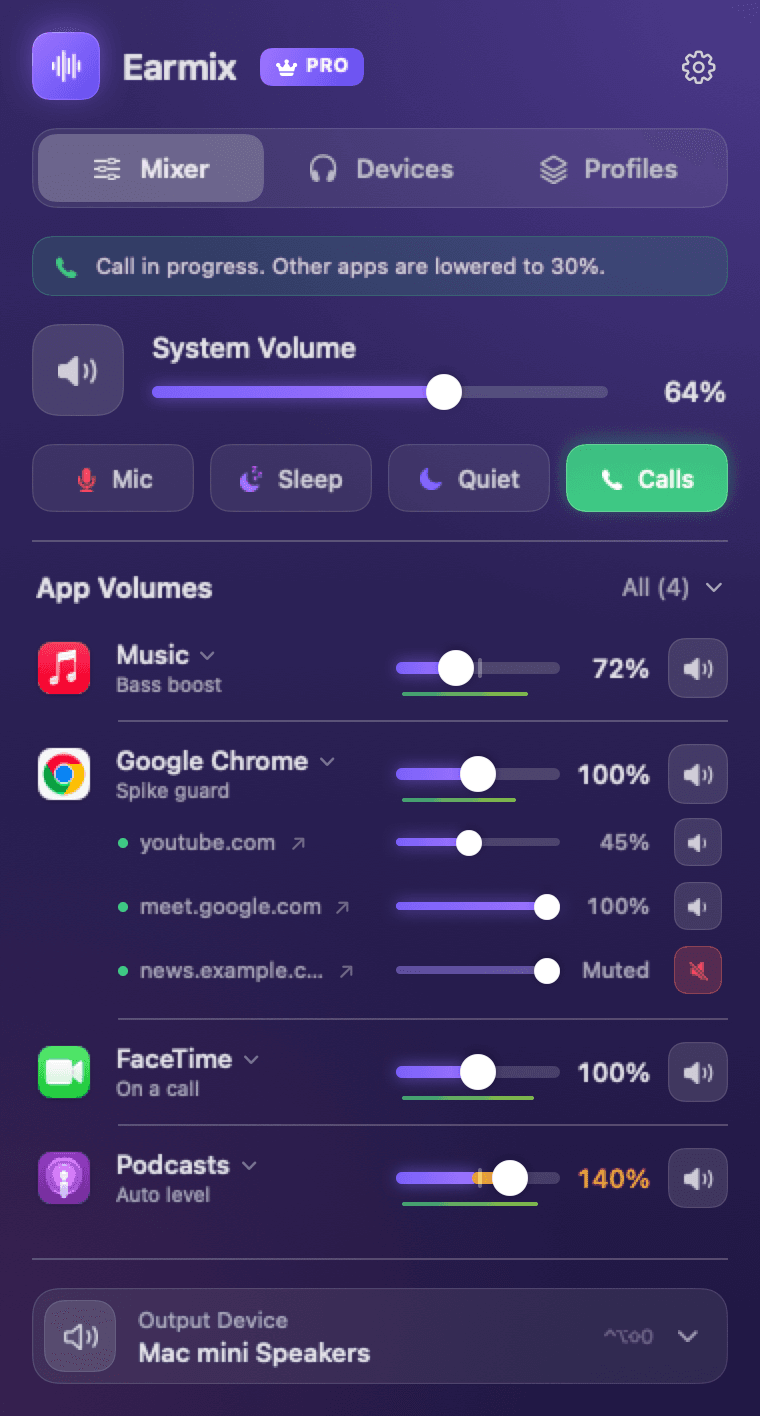
About this app
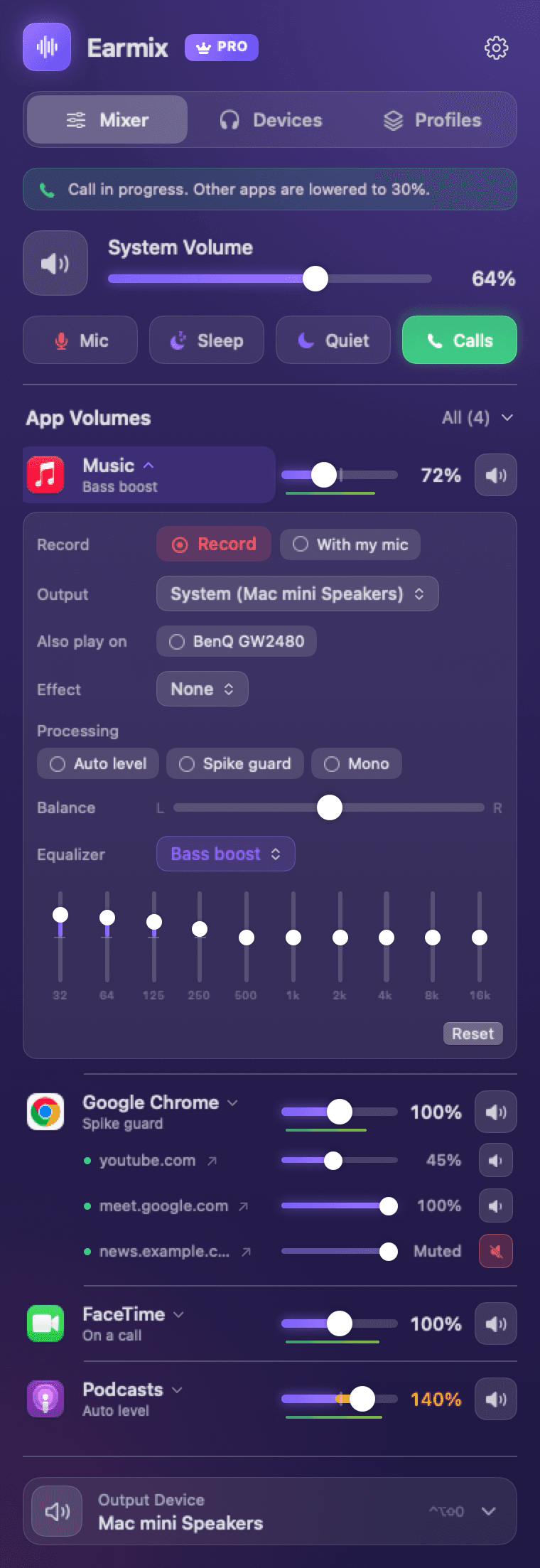
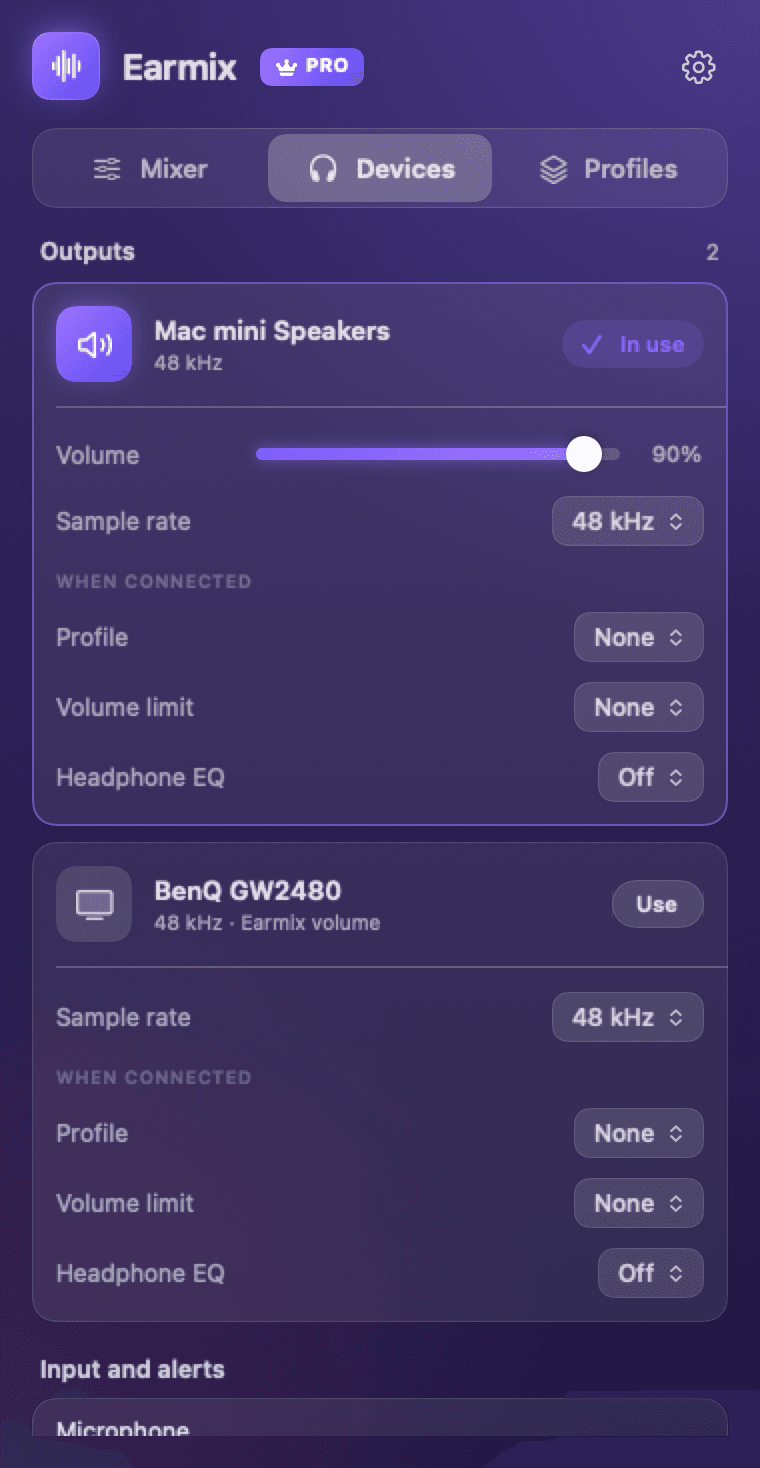
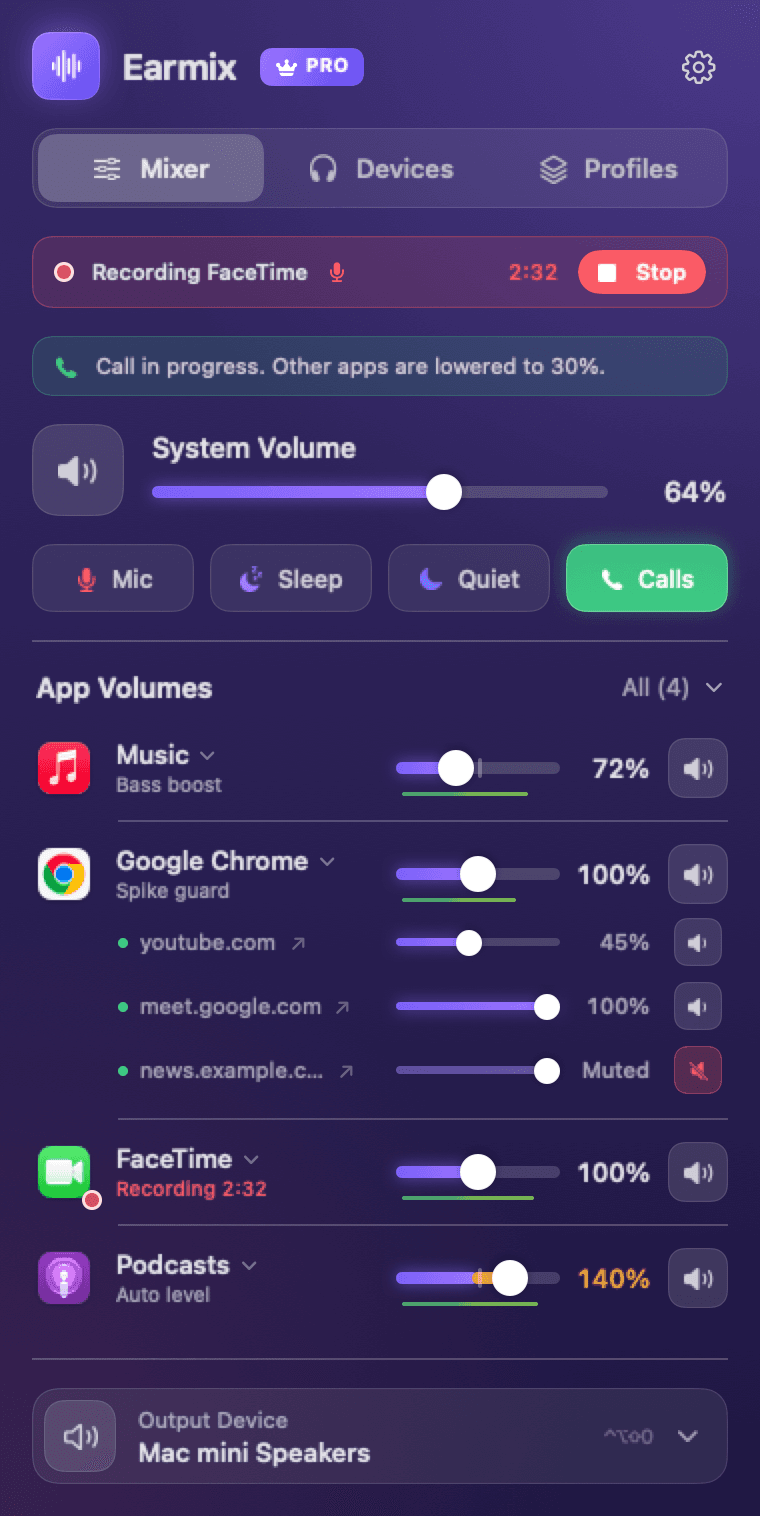
Earmix is a menu bar volume mixer for Mac. Every app and every browser tab gets its own volume, from 0 to 400% with a limiter, plus mute, balance, mono, a 10-band EQ, auto level and spike guard. Each app can play through its own output, so music goes to the speakers while a call stays in your headphones. When any app uses the microphone, the others duck on their own. It records any app or call to an .m4a file with your voice mixed in, mutes your mic everywhere with one shortcut, and includes measured correction curves for 52 popular headphones. The free Earmix Tabs extension adds per-tab volume in Chrome, Edge, Brave, Arc, Vivaldi, Opera, Firefox and Safari, and a free iPhone app works as a remote. Everything runs on your Mac, with no account and no telemetry. For macOS 14.2 or later, Apple silicon and Intel. $12.99 once at the early-bird price (regular $49), with a 1-day free trial and a 14-day money-back guarantee.
Key features
- 1Per-app and per-browser-tab volume from 0 to 400% with a limiter, mute, balance and mono.
- 210-band EQ per app, 52 measured headphone correction curves, auto level and spike guard.
- 3Per-app output routing, auto-ducking on mic use, call recording to .m4a and one-shortcut mic mute.
Target customer profile
Drawn from the product itself, not from a survey.
Demographic
Remote workers and frequent video callers
Pain points
Call audio competes with background music and notifications
Primary needs
Auto-duck other apps during calls and mute mic quickly
Demographic
Podcasters and content creators
Pain points
Need per-app EQ and clean routing without buying an audio interface
Primary needs
Per-app EQ, output routing, and call recording
Demographic
Audiophiles and headphone users
Pain points
Built-in macOS volume control lacks EQ and headphone correction
Primary needs
Headphone EQ profiles and volume limiting
Scout Review
Written by AI from measured evidence, scored out of 100.
Earmix is a menu-bar volume mixer for Mac that gives every app and browser tab its own volume (0–400% with a limiter), mute, balance, mono, a 10-band EQ, auto level and spike guard, plus per-app output routing, call ducking, call recording to .m4a, one-shortcut mic mute and 52 headphone correction curves. A free browser extension adds per-tab volume across Chrome, Edge, Brave, Arc, Vivaldi, Opera, Firefox and Safari, and a free iPhone app acts as a remote. It's $12.99 at early-bird (regular $49), one-time, with a 1-day trial and 14-day refund, for macOS 14.2+ on Apple silicon and Intel. The site is fast and the app UI is well considered; the gaps are security hardening, a single-language app, and some UI clipping in the iPhone build.
Measure by measure
Usability
64Five labelled iPhone tabs, big quick-action tiles and a no-card 1-day trial make onboarding easy to grasp. Small low-contrast sub-row text and a blocking discount modal work against it.
Design
70Judging the app UI and store material: the iPhone Mixer and Desk dial are distinctive and legible, with consistent purple accents. The floating tab bar clips content and the Mac row shows a garbled glyph.
Speed
82Lighthouse mobile 91/100 with LCP 977ms, CLS 0.002 and TBT 0ms; desktop 97/100. A genuinely snappy, lightweight marketing site with no measured lag.
Security
52HTTPS enforced with frame protection and Referrer-Policy, but no HSTS, CSP, Permissions-Policy or DMARC (6/12 probe points). Local-only, no-telemetry claims are unverified.
Accessibility
78Lighthouse accessibility audit scored a clean 100/100, and the app ships native iOS/Mac UI. Localized in only one language and no published WCAG statement caps it.
Growth
62A real, specific problem (macOS's one global slider) with concrete wedges: per-tab volume, iPhone remote, call ducking, one-time price. Crowded by SoundSource and free Background Music.
Improvement areas
- Security hardening: add HSTS, CSP, Permissions-Policy and DMARC; publish a security page.
- Fix iPhone tab bar overlap, clipped helper text and the garbled glyph in the Mac output row.
- Localize beyond one language and publish an accessibility statement to back the audit score.
Design & Usability
Judged on the app UI and store screenshots rather than the landing page: the iPhone Mixer has a clean hierarchy — device header, big master volume, quick-action tiles, presets, then per-app rows — and the Desk radial dial is a distinctive, legible control. The Mac popover packs a lot into one list without losing scannability. The problems are execution-level: the floating tab bar overlaps scrolling content and clips text like 'Weekly sync', toggle helper copy gets cut off, and the Mac output row renders a garbled glyph instead of an icon. Usability is helped by five clearly labelled tabs, large labelled quick actions, a cardless 1-day trial and a 14-day refund. It's hurt by small, low-contrast sub-row text and a blocking Black Friday modal that hides the homepage until dismissed.
Speed & Security
Speed is the standout measured result: Lighthouse mobile 91/100 with LCP 977ms, CLS 0.002 and TBT 0ms, and desktop 97/100 — a lightweight, snappy site with no measured lag or complaints. Security is the weak flank. The HTTP probe found HTTPS enforced, frame protection, X-Content-Type-Options and Referrer-Policy, but no HSTS, no CSP, no Permissions-Policy and no DMARC — 6 of 12 checklist points. The site makes strong privacy claims (no account, no telemetry, audio never leaves the Mac, Apple notarization), which are plausible for a local audio utility but not independently verified: no SOC 2, no security page, no bug bounty found. For an indie Mac utility that's not unusual, but it's table stakes rather than a strength.
Accessibility & Growth
Accessibility scores well on the automated side — Lighthouse returned a perfect 100/100 — and the product ships native iOS and Mac interfaces rather than a web app, which helps keyboard and screen-reader behavior. Against that: the App Store listing shows localization in only one language, and no WCAG or accessibility statement was found. Growth is a judgement on the idea. The problem is real and specific — macOS gives you one global slider, and people juggling a call, music and an autoplay tab feel it. The differentiators are concrete: per-tab volume via a free extension across eight browsers, an iPhone remote, auto-ducking on mic use, 52 headphone correction curves, and a one-time price against SoundSource's paid model. The limit is the category: SoundSource is the established incumbent and Background Music is free and open source, so Earmix has to win on the tab-level and phone-remote wedge rather than the core feature.
Conclusion
If you're a remote worker who lives in calls with music running underneath, or a podcaster who wants per-app EQ and routing without buying an audio interface, Earmix is aimed squarely at you and the one-time price is easy to justify against a subscription. The free trial and 14-day refund lower the risk of trying it. Go in knowing the security posture is basic (no HSTS/CSP/DMARC, no published audit) and the app is English-only for now. If you mainly want per-app volume and nothing more, the free Background Music may be enough; if you want the tab-level control, phone remote and EQ, Earmix is the more complete tool.
Suggestions for improvement
- Add HSTS, a Content-Security-Policy and DMARC, and publish a short security page describing the local-only audio path.
- Fix the iPhone tab bar overlap and the clipped helper text, and replace the garbled glyph in the Mac output row.
- Make the Black Friday modal dismissible or delay it — it currently blocks the hero on first load.
- Localize the app beyond one language and publish an accessibility statement to back up the 100/100 audit.
Alternatives comparison
Named competitors, point by point. Nobody paid to appear here or to be left out.
 Earmix |  SoundSource | Background Music | |
|---|---|---|---|
| Per-app volume control | Yes, 0–400% with limiter | Yes | Yes |
| Per-browser-tab volume | Yes, via free extension (8 browsers) | No | No |
| Per-app EQ and headphone correction | 10-band EQ, 52 headphone curves | Per-app EQ and effects | No EQ |
| Per-app output routing | Yes, two outputs at once | Yes | Limited |
| iPhone remote app | Yes, free on App Store | No | No |
| Pricing model | $12.99 early-bird, one-time ($49 regular) | Paid license | Free, open source |
SoundSource
Rogue Amoeba's Mac audio control app with per-app volume and routing.
Background Music
A free, open-source Mac app that sets a separate volume for each app.
Comparing options? See Earmix alternatives, scored side by side
More Productivity apps
View all Productivity
Puzzly – B2B Lead Generation & Sales Intelligence Platform
92Puzzly is an all-in-one B2B lead generation platform that...

Qamarero
92An all-in-one hospitality software for restaurants and ba...

EmbedMyReviews
92White-label reputation management software for agencies s...

StoryPad
92Privacy-first open source journal app with a continuous t...

Notion
92All-in-one AI workspace for docs, projects, and knowledge...

The Stack Newsletter
92A weekly newsletter delivering curated tech jobs, intervi...

Vibe Coding Agent Skills
92A free, open-source platform offering 110 AI agent skills...

QRBliss
91Branded QR codes with AI Brand Sync, 15 free dynamic code...

Gerty
91Private, local AI assistant for Mac that runs offline

Strukchad Property Management
91Property management for Kenyan letting agents: rent invoices raised every month, M-Pesa rent prompts to tenants, arrears tracking and landlord statements.

CC Switch
91Open-source desktop app for switching AI coding providers...

PitchWhip
90AI cold call scripts & direct dials from LinkedIn


A platform dedicated to providing unbiased reviews of newly launched applications, analyzing everything from their features to their full potential.
info@scoutforge.net© 2026 Scoutforge. All rights reserved.
