Cycling through all six. Tap any point to stop.
Measured on six things
Private AI workspace for law and accounting firms with ze...
Speed
46Desktop scores 77 but mobile collapses to 48/100 with an 11.6s LCP — roughly five times the 'good' threshold. Heavy hero media is dragging the mobile experience down badly.
Screenshots
1 / 1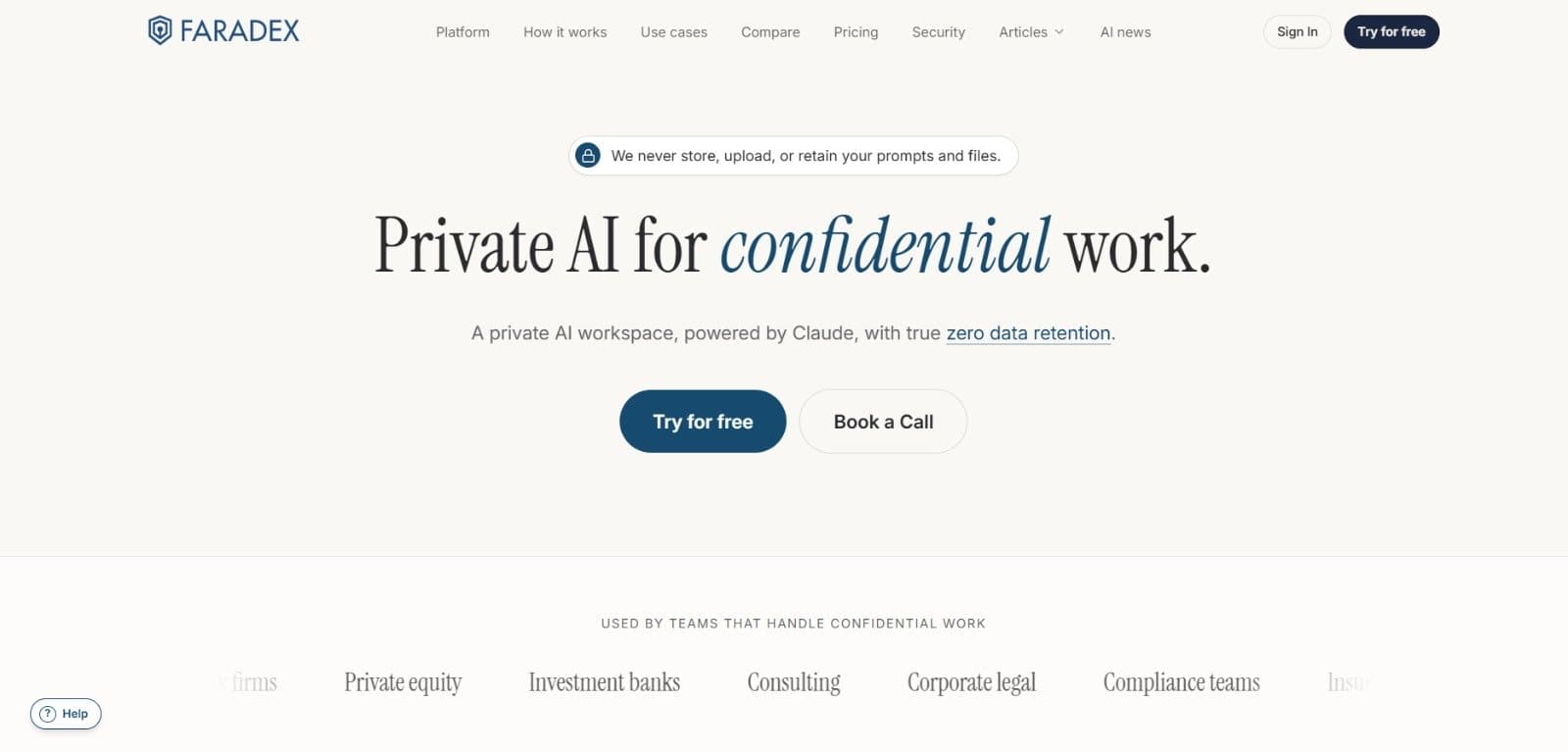
About this app
Faradex is a private AI workspace built for professionals who handle sensitive client files—law firms, accounting practices, investment banks, and compliance teams. Powered by Claude models (Haiku, Sonnet, Opus), it offers a multi-agent system that researches, drafts, and analyzes documents in parallel, 24/7. What sets Faradex apart is its true zero data retention: your prompts and files are never stored, uploaded, or seen by AI providers like OpenAI or Anthropic. Each workspace is single-tenant, isolated, and encrypted with AES-256, with US-only data residency and SOC 2 compliance. You can spin up a workspace in minutes, invite your team with role-based access, and deploy agents like 'Oz' to review contracts, conduct due diligence, or track regulatory changes. Unlike consumer AI tools or vertical solutions like Harvey and CoCounsel, Faradex combines agentic AI, private server hosting, and team collaboration without public disclosure risk. It's ideal for firms that need frontier-mod...
Key features
- 1True zero data retention: prompts and files never stored, uploaded, or seen by AI providers, with single-tenant isolated workspaces.
- 2Multi-agent system powered by Claude (Haiku, Sonnet, Opus) that researches, drafts, and analyzes documents in parallel 24/7.
- 3Team collaboration with role-based access (Admin/Editor/Viewer), audit logs, SSO, AES-256 encryption, and US-only data residency.
Target customer profile
Drawn from the product itself, not from a survey.
Demographic
Law firms (partners, associates, paralegals)
Pain points
Client confidentiality risks with public AI, ethical obligations, slow document review
Primary needs
Secure AI for contract review, legal research, due diligence with zero data leakage
Demographic
Accounting firms (CPAs, auditors, tax advisors)
Pain points
Sensitive financial data exposure, compliance with regulations, manual document analysis
Primary needs
Private AI for audit support, tax research, and client file analysis without retention
Demographic
Investment banks and private equity (analysts, VPs)
Pain points
Deal confidentiality, fast due diligence, collaboration across teams
Primary needs
Secure multi-agent AI for deal management, document indexing, and real-time insights
Scout Review
Written by AI from measured evidence, scored out of 100.
Faradex is a well-positioned private AI workspace for regulated professional firms, and its core pitch — true zero data retention, single-tenant isolation, Claude-powered agents — addresses a real, expensive fear. The landing page has genuine craft: an editorial serif hero, a real product mockup, and a clear comparison against consumer and vertical AI. But the execution has visible cracks: a broken demo video on the homepage, an 11.6-second mobile LCP, missing security headers, SOC 2 paywalled to the top tier, and accessibility failures including disabled zoom. The pricing model — fixed size and tier at purchase — is a friction point for growing firms. It's a credible early-stage product with sharp positioning and rough edges that need sanding before it earns enterprise trust.
Measure by measure
Usability
60Clear nav, obvious CTA, and a simple three-step onboarding model. But the demo video is broken, pricing locks size and tier at purchase, and Secure IV is advertised while 'not yet available'.
Design
68Editorial serif hero, disciplined card grid, and a real product mockup give it a professional legal-tech voice. Undone by a broken video player and near-unreadable micro-text in feature cards.
Speed
46Desktop scores 77 but mobile collapses to 48/100 with an 11.6s LCP — roughly five times the 'good' threshold. Heavy hero media is dragging the mobile experience down badly.
Security
55HTTPS, HSTS, SPF, and DMARC are in place, and the site claims SOC 2, AES-256, and US residency. But security headers are mostly missing (6/12) and SOC 2 is gated to the $680 tier, not baseline.
Accessibility
70Lighthouse a11y lands at 89/100, but real failures remain: low contrast, broken heading order, user-scalable=no blocking zoom, no main landmark, and a large table without headers. No WCAG statement published.
Growth
62A real, expensive problem (confidential AI for regulated firms) with a concrete wedge — true zero retention and single-tenant isolation — that Harvey and CoCounsel don't lead with. Early stage, but the positioning is sharp.
Improvement areas
- Broken demo video on the homepage and cropped logo strip undermine the professional, trust-first impression.
- Mobile performance is poor (48/100, 11.6s LCP) and security headers are largely missing despite enterprise claims.
- SOC 2 is gated to the $680 tier, pricing locks size and tier at purchase, and accessibility failures (zoom disabled, low contrast) remain.
Design & Usability
Faradex's homepage reads like it was designed by someone who understands legal buyers: a confident serif headline, a navy italic accent on 'confidential', and a product mockup showing Oz flagging contract clauses with @mentions. The card system is disciplined and the spacing is calm. But the polish cracks in obvious places — the embedded demo video renders a 'Player error' overlay with 'Send Error Log' and 'Reload Player' buttons, the logo strip crops wordmarks mid-word, and the micro-text in the 'Isolated by default' and 'Zero document retention' cards is too low-contrast to read. Usability is competent: short nav, CTA everywhere, a clean three-step onboarding model. The pricing page is where it gets awkward — size and tier are 'fixed once you buy', and Secure IV is advertised while marked 'not yet available'.
Speed & Security
Speed is the weakest measured dimension. Desktop Lighthouse scores a respectable 77, but mobile collapses to 48/100 with an 11.6-second LCP and 1.1s TBT — roughly five times the 'good' LCP threshold. For a product whose buyers are partners checking a link between meetings, that mobile experience is a real conversion risk. Security is a mixed bag. The fundamentals are there: HTTPS enforced, HSTS, SPF, DMARC, and site claims of AES-256 encryption, US-only residency, audit logs, and SSO. But the HTTP probe found only 6 of 12 checklist items — no CSP, no frame protection, no X-Content-Type-Options, no Referrer-Policy, no Permissions-Policy. And SOC 2, the certification regulated buyers actually require, is gated to the $680/mo Secure III tier rather than offered as baseline.
Accessibility & Growth
Accessibility scores 89/100 on Lighthouse, which sounds strong until you read the failing audits: insufficient color contrast, non-sequential heading order, a viewport that disables user scaling, no main landmark, and a large table without headers. The user-scalable=no setting is the most concerning — it blocks pinch-zoom for anyone who needs it. No WCAG conformance statement is published. On growth, the idea holds up well: Faradex targets a specific, high-budget segment (law, accounting, PE, compliance) with a genuine differentiator — true zero data retention and single-tenant isolation — that Harvey, CoCounsel, and ChatGPT don't lead with. The category has clear headroom as regulated firms adopt AI under ethical pressure. The limit is execution: the domain is under a year old, and out-executing Harvey is a tall order.
Conclusion
Faradex is aiming at the right problem with the right wedge, and the design language suggests someone who understands legal buyers. But 'trust us with confidential files' is a high bar, and a broken video, a slow mobile page, and missing security headers undercut that trust before a prospect ever books a call. Fix the demo, fix the headers, make SOC 2 baseline, and this becomes a serious contender. Leave it as-is and it reads as a promising pitch with a leaky funnel.
Suggestions for improvement
- Fix the broken video embed on the homepage — a 'Player error' overlay is the worst possible first impression for a trust-based product.
- Improve mobile performance: an 11.6s LCP will lose partners before the page renders. Compress hero media and defer non-critical scripts.
- Add the missing security headers (CSP, frame protection, X-Content-Type-Options, Referrer-Policy, Permissions-Policy) to match the security claims.
- Make SOC 2 baseline rather than gated to the $680 tier, and publish a WCAG conformance statement with the contrast and zoom issues fixed.
Alternatives comparison
Named competitors, point by point. Nobody paid to appear here or to be left out.
 Faradex | Harvey |  CoCounsel (Casetext) |  ChatGPT | |
|---|---|---|---|---|
| Zero data retention / private deployment | True zero retention, single-tenant isolated workspace, US-only residency | Not single-tenant or zero-retention by default | No private server deployment | No private server or zero-retention guarantee |
| Multi-agent parallel document work | Oz agent researches, drafts, analyzes in parallel 24/7 | Contract analysis and legal research, limited agentic depth | Document review and research, no multi-agent collaboration | Single general-purpose assistant, no agent orchestration |
| Team collaboration with role-based access | Admin/Editor/Viewer roles, shared workspace, audit logs | Team features for law firms, less granular isolation | Limited multi-agent collaboration | Consumer/team plans, no private workspace isolation |
| Compliance certifications | SOC 2 (Secure III tier), AES-256, SSO, US residency | Enterprise security posture, not zero-retention by default | Thomson Reuters enterprise compliance | SOC 2 for enterprise plans, no private deployment |
| Pricing model | $340–$680/mo, size and tier fixed at purchase | Enterprise/custom pricing | Subscription via Thomson Reuters | Free tier plus $20/mo Plus, $25–30/user Team |
Harvey
Vertical AI for law firms offering contract analysis and legal research, but not single-tenant or zero-retention by default.
CoCounsel (Casetext)
AI legal assistant for document review and research, part of Thomson Reuters, but lacks private server deployment and multi-agent collaboration.
ChatGPT
General-purpose AI chatbot with no private server, team collaboration, or zero document retention guarantees.
Comparing options? See Faradex alternatives, scored side by side
More Productivity apps
View all Productivity
Puzzly – B2B Lead Generation & Sales Intelligence Platform
92Puzzly is an all-in-one B2B lead generation platform that...

Qamarero
92An all-in-one hospitality software for restaurants and ba...

EmbedMyReviews
92White-label reputation management software for agencies s...

StoryPad
92Privacy-first open source journal app with a continuous t...

Notion
92All-in-one AI workspace for docs, projects, and knowledge...

The Stack Newsletter
92A weekly newsletter delivering curated tech jobs, intervi...

Vibe Coding Agent Skills
92A free, open-source platform offering 110 AI agent skills...

QRBliss
91Branded QR codes with AI Brand Sync, 15 free dynamic code...

Gerty
91Private, local AI assistant for Mac that runs offline

Strukchad Property Management
91Property management for Kenyan letting agents: rent invoices raised every month, M-Pesa rent prompts to tenants, arrears tracking and landlord statements.

CC Switch
91Open-source desktop app for switching AI coding providers...

PitchWhip
90AI cold call scripts & direct dials from LinkedIn


A platform dedicated to providing unbiased reviews of newly launched applications, analyzing everything from their features to their full potential.
info@scoutforge.net© 2026 Scoutforge. All rights reserved.
