

A platform dedicated to providing unbiased reviews of newly launched applications, analyzing everything from their features to their full potential.
info@scoutforge.net© 2026 Scoutforge. All rights reserved.
A platform dedicated to providing unbiased reviews of newly launched applications, analyzing everything from their features to their full potential.
info@scoutforge.net© 2026 Scoutforge. All rights reserved.
A platform dedicated to providing unbiased reviews of newly launched applications, analyzing everything from their features to their full potential.
info@scoutforge.net© 2026 Scoutforge. All rights reserved.
Cycling through all six. Tap any point to stop.
Measured on six things
Grant discovery and management software: search federal, state and foundation grants, then track deadlines, tasks and awards with your team.
Real problem, four named segments, and a free tier plus nonprofit discount as a wedge. But the differentiator against Instrumentl is thin — mostly price and AI drafting.
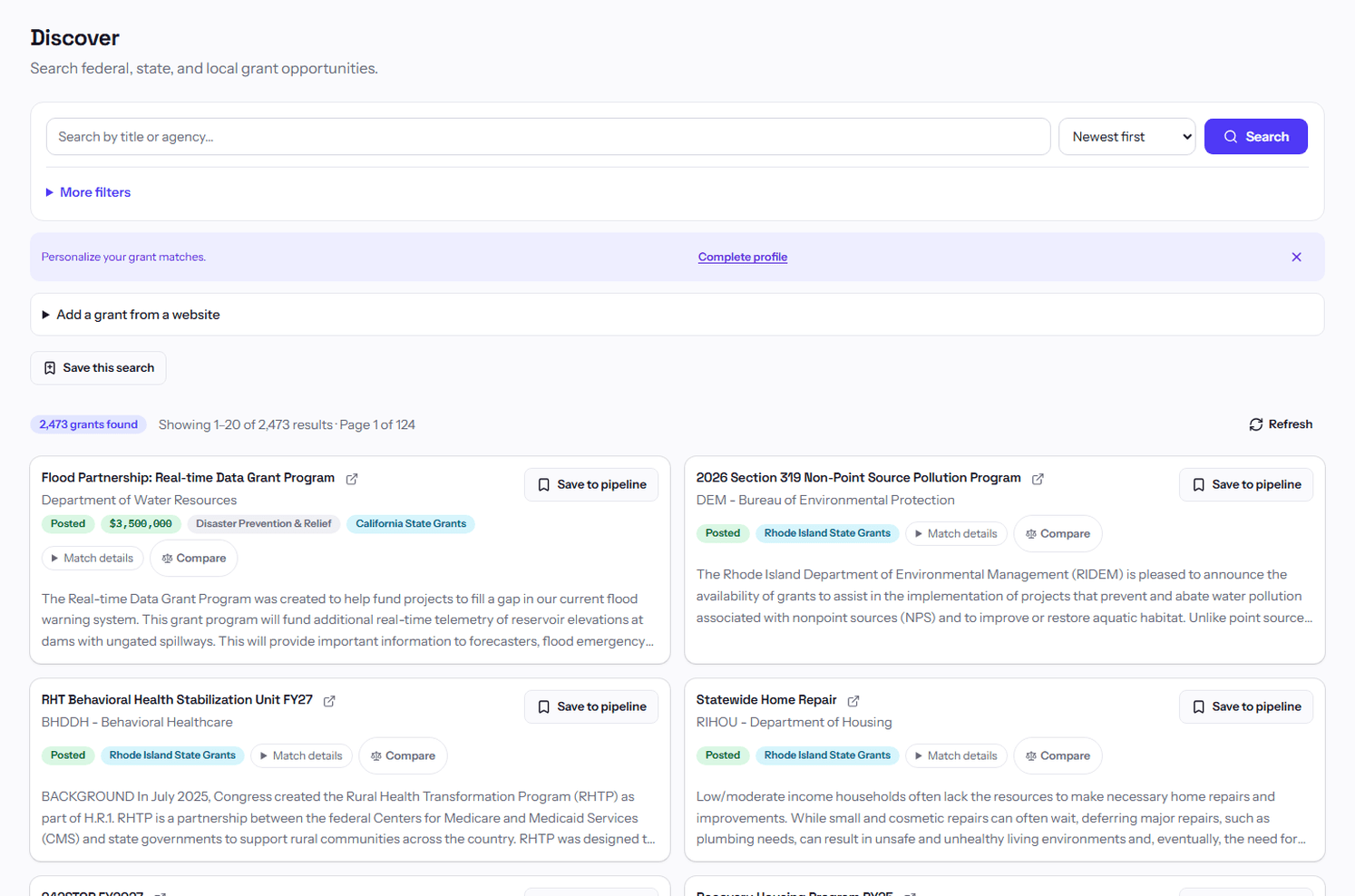
GrantCue is grant discovery and management software for nonprofits, research institutions, SBIR/STTR startups and public-sector teams. It brings live federal, state and foundation funding listings into one searchable catalog, with eligibility filters, saved searches and alerts when new matches appear. Saved grants move through a pipeline with deadlines, tasks, assignees and reminders, so a team can see what is due and who owns it. On the Team plan, a proposal assistant helps draft application sections, and reporting tracks awards and what is owed after them. A free plan covers one user. Paid plans run from $49 a month (Essentials, 3 users) through $109 (Team, 8 users) and $229 (Organization, 20 users), every account starts with a 14-day Team trial, and nonprofits get 25% off with the code NONPROFIT.
Drawn from the product itself, not from a survey.
Demographic
Nonprofit organizations
Pain points
Scattered grant information, missed deadlines, inefficient tracking
Primary needs
Affordable grant discovery, deadline reminders, collaboration tools
Demographic
Research institutions
Pain points
Complex funding sources, lack of centralized system, administrative burden
Primary needs
Comprehensive grant database, fit scoring, team collaboration
Demographic
Startups (SBIR/STTR)
Pain points
Navigating multiple agency calendars, limited grant experience
Primary needs
AI guidance, proposal writing assistance, pipeline management
Demographic
Public sector agencies
Pain points
Part-time grant management, fragmented processes
Primary needs
User-friendly interface, deadline tracking, reporting
Written by AI from measured evidence, scored out of 100.
GrantCue is a grant discovery and pipeline tool aimed at nonprofits, research institutions, SBIR/STTR startups and public-sector teams, and it is a more polished product than its age suggests. The measured evidence backs that up: Lighthouse mobile performance 90 and desktop 99, accessibility 100, and a clean 12/12 on the security header probe. The site itself is well-crafted, with a live grant card in the hero and a consistent card language across marketing and product. The free plan is genuinely free — one user, ten tracked grants, no card — and every account gets 14 days of Team, which is a low-friction way to try the AI features before paying. Pricing runs $49 for three users, $109 for eight and $229 for twenty, with 25% off for nonprofits. The honest weaknesses are a crowded navigation bar, buried advanced filters, no published compliance documentation, and a positioning problem: against Instrumentl, the differentiator is mostly price and AI drafting rather than anything an incumbent cannot copy. It is a competent, fast, accessible product with a real market and a soft moat.
Clear Search-Save-Stay-on-time flow, free tier with no card, 14-day Team trial, and save/compare actions right on result cards. Advanced filters are tucked behind an understated link.
Clean, cohesive grant cards and disciplined typography carry a long homepage well. Nav density and near-identical card styling in the how-it-works and org sections flatten hierarchy.
Lighthouse mobile 90/100 and desktop 99/100, with CLS 0 and 98ms TBT. LCP of 3.5s on mobile is the one soft spot on an otherwise fast, well-built page.
Full 12/12 header checklist: HTTPS enforced, HSTS, CSP, frame protection, Referrer-Policy, Permissions-Policy, plus SPF and DMARC. No published SOC 2 or audit claim found.
Lighthouse accessibility 100/100 with a single failing audit on visible-text labels lacking matching accessible names. No WCAG statement or multi-language support found on the site.
Real problem, four named segments, and a free tier plus nonprofit discount as a wedge. But the differentiator against Instrumentl is thin — mostly price and AI drafting.
GrantCue's homepage is genuinely well-made: clean sans-serif type, generous whitespace, and grant cards that use the same green posted tags and blue links on both the homepage and the Discover page, so the product feels like one thing rather than a marketing site bolted onto an app. The hero does real work — a live OJJDP FY 2026 card with a $750k max award and 21 days left is a better demo than any screenshot. The problems are density and hierarchy. The nav bar stacks eight links plus Sign in and Start free, which is a lot of decisions before anyone reads the headline, and the how-it-works cards and organization-type cards are visually near-identical, so the page reads as one long flat scroll. On usability, the core loop is legible: search, save to My grants, get reminded. The free plan needs no card, every account gets 14 days of Team, and result cards carry Save to pipeline and Compare right where you'd want them. The weak spot is discovery of power features — 'More filters' is the quietest link on the Discover page, which is a strange place to hide the thing that separates a real grant search from a text box.
Speed is the strongest measured dimension here. Lighthouse gives the site 90/100 on mobile and 99/100 on desktop, with a cumulative layout shift of exactly zero and total blocking time of 98ms — that is a page that does not jump around while you read it. First contentful paint lands at 1.2s. The one blemish is a 3.5s mobile largest contentful paint, which is slower than ideal but not enough to call the site sluggish, and no user complaints about lag surfaced in the collected evidence. The site also claims grant data refreshes from Grants.gov and state portals nightly with stats updated at least every 15 minutes, which is a data-freshness promise rather than a performance one, but it implies a real ingestion pipeline behind the page. Security is solid on the transport and header layer: HTTPS enforced, HSTS, a content security policy, frame protection, X-Content-Type-Options, Referrer-Policy and Permissions-Policy all present, plus SPF and DMARC on the domain — a clean 12/12 on the probe checklist. What is missing is the paperwork buyers in this category actually ask for. There is no SOC 2, ISO 27001, pen-test summary or bug-bounty program visible in the fetched site content, and for a product that will hold grant strategy, budgets and draft proposals for nonprofits and public agencies, that absence is the gap between 'secure enough' and 'procurement-approved.'
Accessibility is a strong measured result: Lighthouse scores the site 100/100 on its axe-core audit, which covers contrast, landmarks, form labeling and the usual structural checks. The single failing audit — elements with visible text labels that do not have matching accessible names — is a real but narrow defect, typically an icon button or link whose visible text and accessible name diverge. Beyond the automated run, the site publishes no accessibility statement and no WCAG conformance claim, and there is no evidence of multi-language support, so a public-sector or research buyer with a formal a11y requirement has nothing to point at. Growth is the harder question. The problem GrantCue names is real and expensive: grant opportunities scattered across browser tabs, deadlines buried in inboxes, three versions of the same tracking spreadsheet. It names four segments with distinct copy — research offices that never got an enterprise system, SBIR/STTR startups juggling eleven agency calendars, public-sector teams where grants management is half of somebody's job, and nonprofits. The free tier for one user, the 25% nonprofit discount and the Founding 10 locked-price offer are concrete acquisition wedges. What is thin is the reason to switch from Instrumentl, which already owns this category: the pitch reduces to cheaper pricing plus AI drafting and fit scoring, both of which incumbents are adding. The category has headroom, but GrantCue's wedge is a price and a feature, not a structural advantage.
Conclusion
If you are a small nonprofit or a lab office still running grants out of a shared spreadsheet, GrantCue is worth the free plan this afternoon — the search, the pipeline and the deadline reminders are the parts that actually stop you missing money, and they cost nothing to try. The 14-day Team trial is the right way to test the AI writing and fit scoring before deciding whether $49 or $109 a month beats the hours you currently lose to tab-hunting. Go in with clear eyes about the trade: you are buying a cheaper, faster, more modern tool than the incumbents, not a deeper one. Check whether the funders you actually chase are covered by the 2,973 active opportunities and 49 monitored states before you commit, and if your organization has a procurement process, ask GrantCue directly for whatever security documentation they can provide, because the site does not publish it. For a team of one to eight that has outgrown spreadsheets and does not want an enterprise contract, this is a reasonable place to land.
Named competitors, point by point. Nobody paid to appear here or to be left out.
 GrantCue GrantCue |  Instrumentl Instrumentl |  Granthub Granthub | |
|---|---|---|---|
| Entry paid price | $49/mo for 3 users (Essentials); free plan for 1 user | Paid plans only; pricing quoted on request, generally higher entry point | Paid plans only; pricing quoted on request |
| Free tier | Yes — 1 user, 10 tracked grants, 3 AI summaries/mo, no card | No permanent free plan; trial-based access | No free plan; demo-based access |
| AI proposal drafting | Yes — writing workspace on Team plan, fast-model writing on Essentials | AI-assisted features present; drafting depth varies by plan | Focused on tracking and reporting rather than AI drafting |
| Pipeline / deadline tracking | Kanban pipeline, tasks, assignees, ICS feed, email and Teams reminders | Pipeline and deadline tracking with team collaboration | Application and award tracking with reporting |
| Nonprofit discount | 25% off with code NONPROFIT | Nonprofit-focused pricing; discount terms not published | Discount terms not published |
Instrumentl
Grant discovery and management platform for nonprofits and other grant seekers.
Granthub
Grant management software for tracking applications and awards.
Comparing options? See GrantCue alternatives, scored side by side

An all-in-one hospitality software for restaurants and ba...

A weekly newsletter delivering curated tech jobs, intervi...

White-label reputation management software for agencies s...

Privacy-first open source journal app with a continuous t...

Puzzly is an all-in-one B2B lead generation platform that...

All-in-one AI workspace for docs, projects, and knowledge...

A free, open-source platform offering 110 AI agent skills...

Open-source desktop app for switching AI coding providers...

One verified handle for your online identity, readable by...

Frame-perfect video-to-GIF maker that runs entirely in yo...

White-label website audits that close deals for digital a...

Automated quote follow-up for trades and service businesses.
A platform dedicated to providing unbiased reviews of newly launched applications, analyzing everything from their features to their full potential.
info@scoutforge.net© 2026 Scoutforge. All rights reserved.