Cycling through all six. Tap any point to stop.
Measured on six things
A unified AI platform with multi-model APIs, ready-to-use office tools, and enterprise solutions.
Usability
57OpenAI- and Anthropic-compatible endpoints plus named clients (Claude Code, Codex, Cline) mean low integration friction, and $1 trial credits help. But no public docs or help center surfaced in the site content.
Screenshots
1 / 1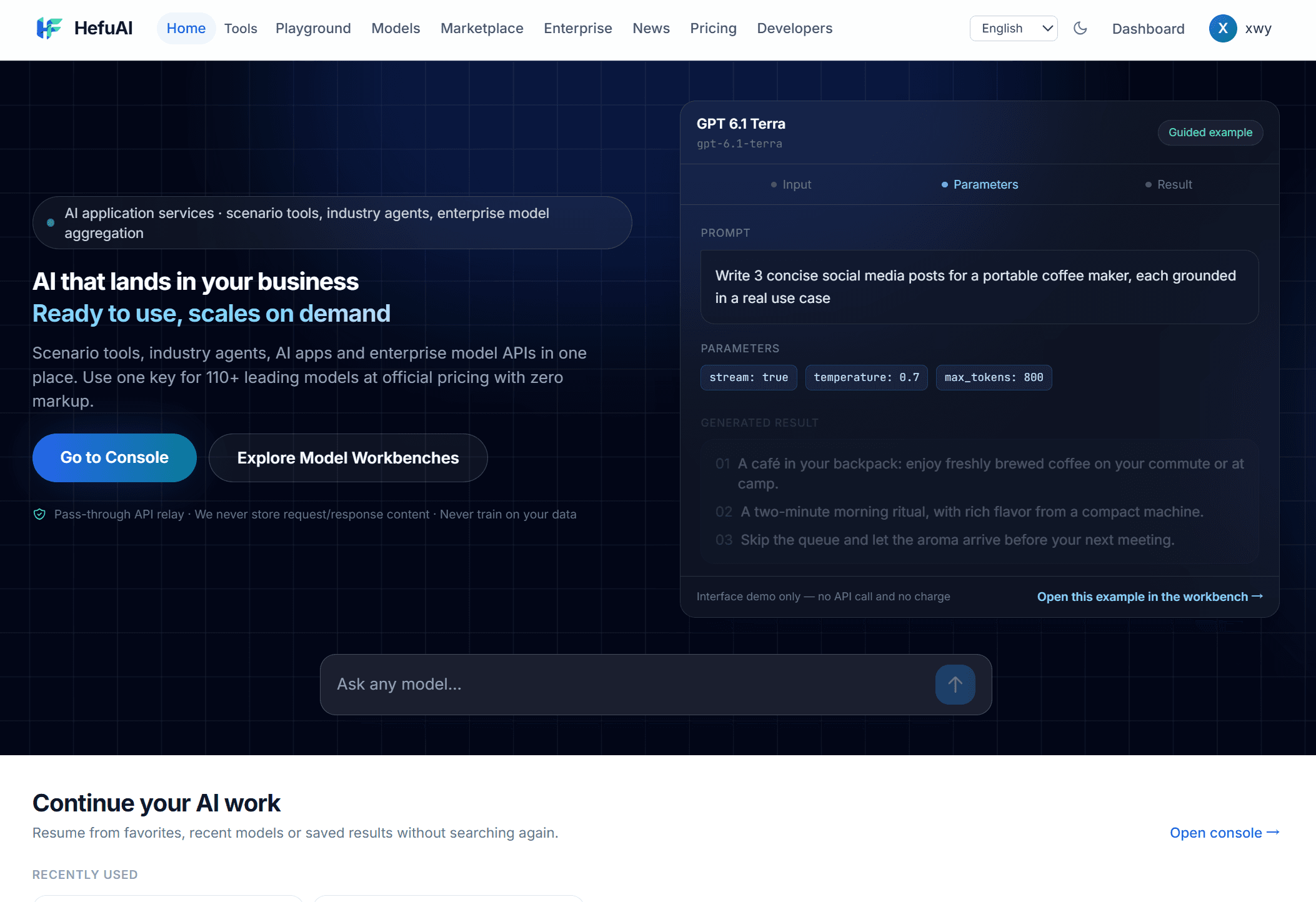
About this app
HeFu AI combines multi-model API access, ready-to-use office tools, enterprise services, and third-party integrations. Developers can access multiple AI models with one API key through OpenAI-compatible and Anthropic-compatible endpoints. Supported clients include Claude Code, Codex, and Cline. Model switching, unified usage tracking, and pay-as-you-go billing simplify integration and cost management. Office Agents help teams create Amazon listings, A+ content, Shopify product pages, customer reply drafts, marketing content, and recruitment materials. Review analysis identifies recurring customer concerns and improvement opportunities. Enterprise options include white-label, multi-tenant solutions, private deployment, and customization. The open platform supports OAuth authorization for third-party apps. Users can start with an office tool or connect their own application through the API. New accounts receive $1 in trial credits.
Key features
- 1Unified multi-model API with OpenAI-compatible and Anthropic-compatible endpoints, one key for Claude Code, Codex, and Cline.
- 2Office agents for Amazon listings, A+ content, Shopify pages, customer replies, marketing copy, and review analysis.
- 3White-label, multi-tenant enterprise deployment with OAuth authorization for third-party apps.
Target customer profile
Drawn from the product itself, not from a survey.
Demographic
Developers, SaaS founders, and technical teams
Pain points
Managing multiple model integrations, API keys, and separate usage bills
Primary needs
Unified API access, easy model switching, and centralized usage tracking
Demographic
Cross-border e-commerce sellers and store operations teams
Pain points
Time-consuming product copywriting, customer replies, and review analysis
Primary needs
AI tools for Amazon listings, Shopify pages, customer replies, and review insights
Demographic
Marketing, content, and recruitment teams
Pain points
Repetitive writing tasks and limited technical resources for adopting AI
Primary needs
Ready-to-use tools for marketing content, recruitment materials, and daily work
Demographic
Businesses and service providers building branded AI services
Pain points
Managing customer branding, access permissions, and usage across multiple tenants
Primary needs
White-label solutions, tenant isolation, OAuth integration, and deployment options
Scout Review
Written by AI from measured evidence, scored out of 100.
HeFuAI is an ambitious bundle: a multi-model API gateway with OpenAI- and Anthropic-compatible endpoints, a set of office agents for e-commerce and marketing work, and white-label enterprise deployment. Measured against its stated peers, it's technically competent — security headers are near-perfect at 11/12, accessibility scores 92/100, and the JavaScript is efficient. The weaknesses are focus and proof: the landing page tries to sell to developers, sellers, and enterprises at once, no public documentation surfaced, and there are no published audits for the enterprise buyers it targets. Speed is middling on mobile due to layout shift and a 3.6s LCP. It's a real product with real plumbing that hasn't yet decided who it's for.
Measure by measure
Usability
57OpenAI- and Anthropic-compatible endpoints plus named clients (Claude Code, Codex, Cline) mean low integration friction, and $1 trial credits help. But no public docs or help center surfaced in the site content.
Design
58Dark, developer-flavored landing page with API snippets and product cards. Bilingual copy and dense feature blocks crowd out a single clear hero message, so the value prop takes scrolling to find.
Speed
57Lighthouse mobile 69/100 and desktop 75/100. TBT of 12ms and FCP under a second are genuinely snappy, but LCP 3.6s and CLS 0.258 drag the experience down on mobile.
Security
74Strong header hygiene: HTTPS enforced, HSTS, CSP, frame protection, Referrer-Policy, plus SPF and DMARC — 11/12 checklist points. Permissions-Policy is the gap, and no SOC 2 or audit claims appear.
Accessibility
70Lighthouse accessibility 92/100 with most checks passing. Two real failures remain: insufficient color contrast and undersized touch targets. No WCAG statement or a11y documentation found.
Growth
62Real, specific wedge: unified multi-model API bundled with ready-made office agents and white-label multi-tenant deployment. Three audiences is a focus problem, not a market problem.
Improvement areas
- No public documentation, quickstart, or help center surfaced — integration path is unclear.
- No SOC 2, ISO, or penetration test claims despite targeting enterprise and white-label buyers.
- Mobile layout shift (CLS 0.258) and 3.6s LCP; contrast and touch target accessibility failures.
Design & Usability
The site reads as a developer tool that got dressed up as a platform. Dark theme, code snippets, and product cards signal technical credibility, and the OpenAI/Anthropic-compatible endpoints with named client support (Claude Code, Codex, Cline) are exactly what a developer evaluating a gateway wants to see. The problem is scope: three audiences — developers, e-commerce sellers, and white-label enterprise — all get equal billing on one page, so no single visitor gets a clear 'this is for you' moment. Bilingual copy adds reach but also density. The $1 trial credit is a sensible low-friction entry, but with no public docs or help center surfaced, the path from 'interested' to 'integrated' is left to the visitor to figure out.
Speed & Security
Speed is a mixed bag with real numbers behind it: Lighthouse mobile 69/100 and desktop 75/100, with TBT at 12ms and FCP at 936ms showing a well-behaved JavaScript bundle. The drag is LCP at 3.6s and CLS at 0.258 — the page shifts under the reader, which is the kind of thing that quietly erodes trust on a product page. Security is the strongest dimension measured: HTTPS enforced with HSTS, a real CSP, frame protection, X-Content-Type-Options, Referrer-Policy, plus SPF and DMARC for email. That's 11 of 12 header checks. The missing Permissions-Policy is minor. What's absent is the paper trail — no SOC 2, ISO, or penetration test claims anywhere, which matters for the enterprise and white-label buyers this product explicitly courts.
Accessibility & Growth
Accessibility lands at 92/100 on the automated Lighthouse audit, which is a genuinely good result, but the two failures are the classic ones: insufficient color contrast and touch targets too small or too tightly spaced. Those are the failures automated tools catch precisely because humans miss them, and they hit mobile users hardest — a problem for a product with cross-border e-commerce sellers in its target list. No WCAG conformance statement was found. On growth, the idea has a real shape: OpenRouter owns the pure model-gateway lane, Coze and Dify own agent building, and HeFuAI's bet is bundling unified API access with ready-made office agents and white-label multi-tenant deployment. That's a defensible combination for service providers who want to resell branded AI. The risk is dilution — three audiences, one product, and no single one served deeply enough to lock in.
Conclusion
If you're a developer who wants one key across multiple models with Claude Code or Cline compatibility, the technical foundation here is solid enough to trial with the $1 credit. If you're an enterprise evaluating white-label deployment, ask for the security documentation directly — the headers are good but the compliance paper trail isn't public. And if you're an Amazon or Shopify seller, the office agents are the pitch, but you'll want to see them work before committing. The product's biggest unlock isn't more features; it's picking a primary audience and building the docs, onboarding, and proof that audience needs.
Suggestions for improvement
- Publish real documentation: quickstart, endpoint reference, and client setup guides for Claude Code, Codex, and Cline.
- Split the landing page by audience — separate paths for developers, sellers, and white-label partners.
- Fix CLS 0.258 and LCP 3.6s on mobile; reserve space for late-loading elements and preload the hero asset.
- Resolve the two accessibility failures: bump contrast ratios and enlarge touch targets on mobile.
Alternatives comparison
Named competitors, point by point. Nobody paid to appear here or to be left out.
 HeFuAI |  OpenRouter | Coze | Dify | |
|---|---|---|---|---|
| Unified multi-model API access | Yes — OpenAI- and Anthropic-compatible endpoints | Yes — core product, broadest provider coverage | Partial — model selection within agent builder | Partial — model integrations inside app platform |
| Ready-to-use office/business tools | Yes — Amazon, Shopify, replies, marketing, recruitment | No — API gateway only | Yes — buildable assistants and bots | Yes — buildable agents and workflows |
| Visual workflow / agent builder | No — fixed office agents, not a builder | No | Yes — visual workflows and plugins | Yes — visual workflows and RAG pipelines |
| White-label / multi-tenant deployment | Yes — white-label, tenant isolation, private deploy | No | Limited — channel deployment, not white-label | Partial — self-hosted deployment available |
| Pay-as-you-go billing | Yes — pay-as-you-go with unified usage tracking | Yes — credit-based usage billing | Yes — credit-based tiers | Yes — cloud plans plus free self-host |
| Free trial credits | $1 trial credit on new accounts | Free-tier models available | Free tier with limited credits | Free self-hosted / sandbox tier |
OpenRouter
A unified API platform for accessing AI models from multiple providers, with model routing, provider selection, and centralized credit-based billing.
Coze
An AI application and agent development platform with visual workflows, plugins, and knowledge integration. Users can build assistants and deploy them through supported channels or APIs.
Dify
An AI application development platform for building agents, visual workflows, and retrieval-augmented generation pipelines, with model integrations and cloud or self-hosted deployment options.
Comparing options? See HeFuAI alternatives, scored side by side
More Productivity apps
View all Productivity
Notion
92All-in-one AI workspace for docs, projects, and knowledge...

Qamarero
92An all-in-one hospitality software for restaurants and ba...

EmbedMyReviews
92White-label reputation management software for agencies s...

StoryPad
92Privacy-first open source journal app with a continuous t...

Puzzly – B2B Lead Generation & Sales Intelligence Platform
92Puzzly is an all-in-one B2B lead generation platform that...

The Stack Newsletter
92A weekly newsletter delivering curated tech jobs, intervi...

Vibe Coding Agent Skills
92A free, open-source platform offering 110 AI agent skills...

QRBliss
91Branded QR codes with AI Brand Sync, 15 free dynamic code...

Gerty
91Private, local AI assistant for Mac that runs offline

CC Switch
91Open-source desktop app for switching AI coding providers...

username.md
90One verified handle for your online identity, readable by...

PitchWhip
90AI cold call scripts & direct dials from LinkedIn


A platform dedicated to providing unbiased reviews of newly launched applications, analyzing everything from their features to their full potential.
info@scoutforge.net© 2026 Scoutforge. All rights reserved.
