

A platform dedicated to providing unbiased reviews of newly launched applications, analyzing everything from their features to their full potential.
info@scoutforge.net© 2026 Scoutforge. All rights reserved.
A platform dedicated to providing unbiased reviews of newly launched applications, analyzing everything from their features to their full potential.
info@scoutforge.net© 2026 Scoutforge. All rights reserved.
A platform dedicated to providing unbiased reviews of newly launched applications, analyzing everything from their features to their full potential.
info@scoutforge.net© 2026 Scoutforge. All rights reserved.
Cycling through all six. Tap any point to stop.
Measured on six things
Recruiter-informed job search and role-fit analysis platf...
Can't test onboarding — there's no product, just a waitlist. The 0:35 demo and interactive role-fit example are good pre-launch signals, but signup-to-value is unmeasurable until Sept 27.
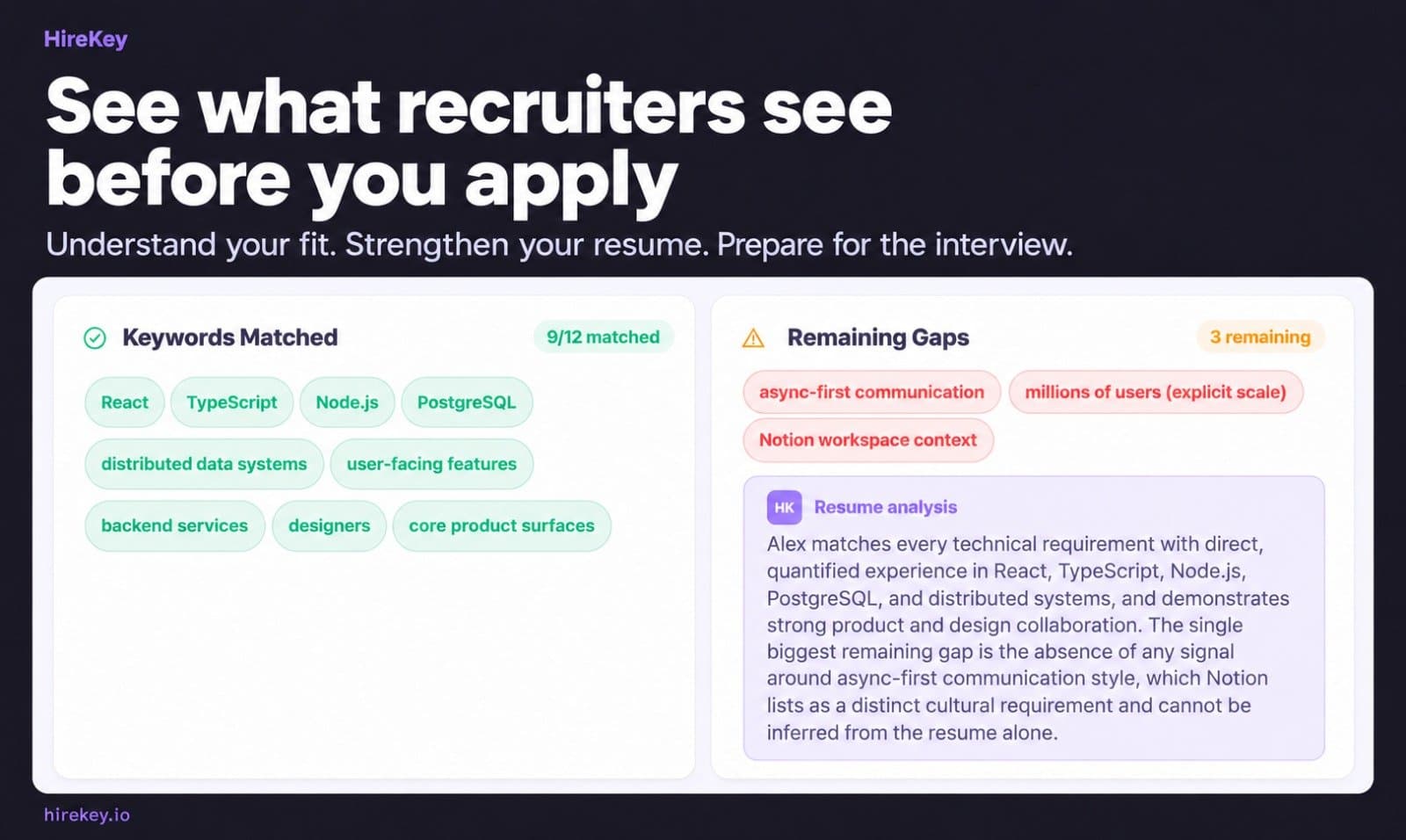
HireKey is a job search platform launching on September 27, 2026, built on ten years of tech recruiting experience from companies like Microsoft and Amazon. Instead of relying on opaque ATS scores, it compares your documented experience against a specific job description, showing what matches, what's missing, and what you can improve before you hit apply. Features include role-fit analysis, resume tailoring that works only from the experience you supply, interview prep, cover letter drafting, and a job application tracker with pipeline intelligence. The free tier covers 5 resume tailoring and interview sessions per month, while Premium at $39/month unlocks 50 sessions, unlimited cover letters, and company research briefs. Waitlist members get the Recruiter Resume Fix Kit plus 25% off their first Premium month.
Drawn from the product itself, not from a survey.
Demographic
Software engineers and technical professionals applying to competitive roles
Pain points
High ATS scores but no callbacks; unclear which requirements their resume actually proves
Primary needs
Honest gap analysis and role-fit feedback grounded in real recruiting judgment
Demographic
Product managers, designers, and data professionals in mid-to-senior job searches
Pain points
Struggling to articulate scope and impact; resume undersells real contributions
Primary needs
Resume tailoring and interview preparation that reflect their actual work
Demographic
Marketers, sales professionals, and operators juggling multiple active applications
Pain points
Losing track of stages, deadlines, and follow-ups across scattered spreadsheets
Primary needs
Centralized application tracking with pipeline visibility and timely reminders
Demographic
Career changers and remote-first job seekers targeting async-heavy teams
Pain points
Adjacent experience not translating on paper; unsure how to bridge apparent gaps
Primary needs
Guidance on framing transferable skills truthfully without inflating claims
Written by AI from measured evidence, scored out of 100.
HireKey is a pre-launch job search platform that compares your documented experience against a specific job description and shows what matches, what's missing, and what to do next — explicitly without inventing experience. The pitch is grounded in ten years of tech recruiting at Microsoft and Amazon, and the differentiator is honest gap analysis rather than opaque ATS scoring. The marketing site is genuinely well-built: a dark editorial layout, a numbered four-step role-fit walkthrough using a real Notion job description, and a 0:35 demo. Speed is strong (mobile 82, desktop 97, TBT 0ms), security headers are complete (12/12), and accessibility audits at 92 with three real failures. The honest limit is that none of this is testable — there is no product, no trial, no docs, and no pricing page, only a waitlist and a September 27, 2026 date. The idea is specific and the problem is real, but Jobscan, Teal, and Rezi already occupy the adjacent ground.
Can't test onboarding — there's no product, just a waitlist. The 0:35 demo and interactive role-fit example are good pre-launch signals, but signup-to-value is unmeasurable until Sept 27.
Pre-launch marketing site only — no app UI yet. The dark editorial layout and the numbered 4-step role-fit walkthrough are genuinely well-crafted and specific, not generic SaaS filler.
Lighthouse mobile 82/100, desktop 97/100, TBT 0ms — a genuinely light marketing page. CLS 0.15 is the one real ding, above the 0.1 good threshold.
12/12 on the HTTP probe — HSTS, CSP, frame protection, SPF, DMARC all present. No SOC 2, ISO, pen-test, or bug bounty published, which is normal for pre-launch but caps the score.
Lighthouse a11y 92/100, but three real failures: unnamed dialogs, insufficient contrast, and out-of-order headings. No WCAG statement or a11y page found.
Real problem, specific wedge (recruiter-informed gap analysis vs. opaque ATS scores), but crowded category — Teal, Jobscan, and Rezi already own tracking, JD-matching, and formatting respectively.
Design and usability are hard to separate here because there is no product — only a marketing site and a waitlist. The site itself is well above the pre-launch average: a dark editorial layout, a numbered four-step walkthrough that actually shows the role-fit output rather than describing it, and a 0:35 demo video. The interactive example uses a real Notion job description against resume excerpts and lands on 9/12 keyword matches, which is more concrete than most pre-launch pages manage. But usability is a different question. There is no signup, no trial, no docs, no help center — just an email field and a September 27, 2026 date. Signup-to-value cannot be measured, and the free tier (5 sessions/month) and $39 Premium are stated in the description but not surfaced on a pricing page in the fetched content. The site is good at selling a promise; it cannot yet be judged on delivering one.
Speed is the strongest measured dimension. Lighthouse mobile performance is 82/100 with TBT at 0ms and FCP at 2.9s, and desktop hits 97/100 — this is a lightweight, largely static marketing page with minimal main-thread blocking. The one real flaw is CLS 0.15, above the 0.1 'good' threshold, meaning something on the page shifts layout on mobile. Security is solid on the technical layer: the HTTP probe returned 12/12, with HTTPS enforced, HSTS, CSP, frame protection, X-Content-Type-Options, Referrer-Policy, Permissions-Policy, SPF, and DMARC all present. What's missing is the compliance layer — no SOC 2, ISO, pen-test report, or bug bounty program is published, and there is no security page or data-handling documentation. For a pre-launch product that will ask users to upload resumes containing personal and employment data, that documentation gap is worth flagging before launch, not after.
Accessibility scores 92/100 on the Lighthouse audit, but the failing audits are real: dialogs and alertdialogs without accessible names, insufficient color contrast, and non-sequentially-descending headings. There is no accessibility statement, no WCAG conformance claim, and no multi-language support in the fetched content. Since no app UI exists yet, keyboard and screen-reader behavior in-product is unassessable. Growth is a judgement on the idea, not the traction. The problem HireKey names is real and specific: job seekers with high ATS scores and no callbacks who cannot tell which requirements their resume actually proves. The wedge is honest gap analysis grounded in ten years of recruiting experience at Microsoft and Amazon, versus opaque keyword scoring. That is a genuine differentiator. But the category is crowded — Jobscan owns JD-match scoring, Teal owns tracking plus a Chrome extension, and Rezi owns ATS-friendly formatting. HireKey's bet is that 'we tell you what's missing, not just what matches' is enough to pull users off three established tools. It might be. It is not obviously a wedge the incumbents cannot copy.
Conclusion
The case for HireKey rests on a single bet: that job seekers are tired of being scored by a black box and would rather be told, plainly, which requirement their resume fails to prove. That is a better pitch than most resume tools have. The execution on the marketing side backs it up — the role-fit walkthrough is the most concrete pre-launch demo in this category, and the technical foundation (speed, headers, a11y baseline) is solid. What remains unproven is everything that matters: whether the gap analysis is actually useful, whether the $39/month Premium tier holds up against Jobscan's cheaper match scoring, and whether 'honest' is a feature people pay for or just a nice thing to say. The waitlist is the right move. The September 27 date is the real test.
Named competitors, point by point. Nobody paid to appear here or to be left out.
 HireKey HireKey |  Teal Teal |  Jobscan Jobscan |  Rezi Rezi | |
|---|---|---|---|---|
| Core approach to resume-job matching | Recruiter-informed gap analysis: shows what matches, what's missing, and what to improve, without inventing experience | ATS keyword matching plus job tracker and Chrome extension for saving jobs | Match-rate scoring of resume and LinkedIn against a specific job description | AI resume builder focused on ATS-friendly formatting and automated bullet generation |
| Application tracking | Yes — job application tracker with pipeline intelligence, stage visibility, and reminders | Yes — job tracker is a core feature, with Chrome extension for saving listings | Limited — focused on match scoring, not full pipeline tracking | Limited — resume builder first, tracking is secondary |
| Interview preparation | Yes — interview prep sessions included in free and Premium tiers | Some interview resources, not a core session-based feature | Not a primary feature — focused on resume/LinkedIn optimization | Not a primary feature — focused on resume generation |
| Pricing model | Free tier (5 sessions/month); Premium $39/month for 50 sessions, unlimited cover letters, company research briefs | Freemium with paid Teal+ subscription tiers | Freemium with monthly/annual paid plans for unlimited scans | Freemium with paid Pro plan for unlimited resumes and AI features |
| Launch status | Pre-launch — waitlist open, launching September 27, 2026 | Live, established product with active user base | Live, established product and category leader in JD matching | Live, established product with active user base |
Teal
Job tracker and resume builder with ATS keyword matching and Chrome extension for saving jobs.
Jobscan
Resume and LinkedIn optimization tool that scores match rates against specific job descriptions.
Rezi
AI-powered resume builder focused on ATS-friendly formatting and automated bullet generation.
Comparing options? See HireKey alternatives, scored side by side

An all-in-one hospitality software for restaurants and ba...

A weekly newsletter delivering curated tech jobs, intervi...

White-label reputation management software for agencies s...

Privacy-first open source journal app with a continuous t...

Puzzly is an all-in-one B2B lead generation platform that...

All-in-one AI workspace for docs, projects, and knowledge...

A free, open-source platform offering 110 AI agent skills...

Open-source desktop app for switching AI coding providers...

One verified handle for your online identity, readable by...

Frame-perfect video-to-GIF maker that runs entirely in yo...

White-label website audits that close deals for digital a...

Automated quote follow-up for trades and service businesses.
A platform dedicated to providing unbiased reviews of newly launched applications, analyzing everything from their features to their full potential.
info@scoutforge.net© 2026 Scoutforge. All rights reserved.