Cycling through all six. Tap any point to stop.
Measured on six things
AI car research for Greece & Europe
Speed
57Desktop Lighthouse 96/100 is genuinely quick, but mobile performance sits at 69 with a 5.1s LCP and 4.2s FCP — the phone experience is where most Greek buyers will land first.
Screenshots
1 / 4

About this app
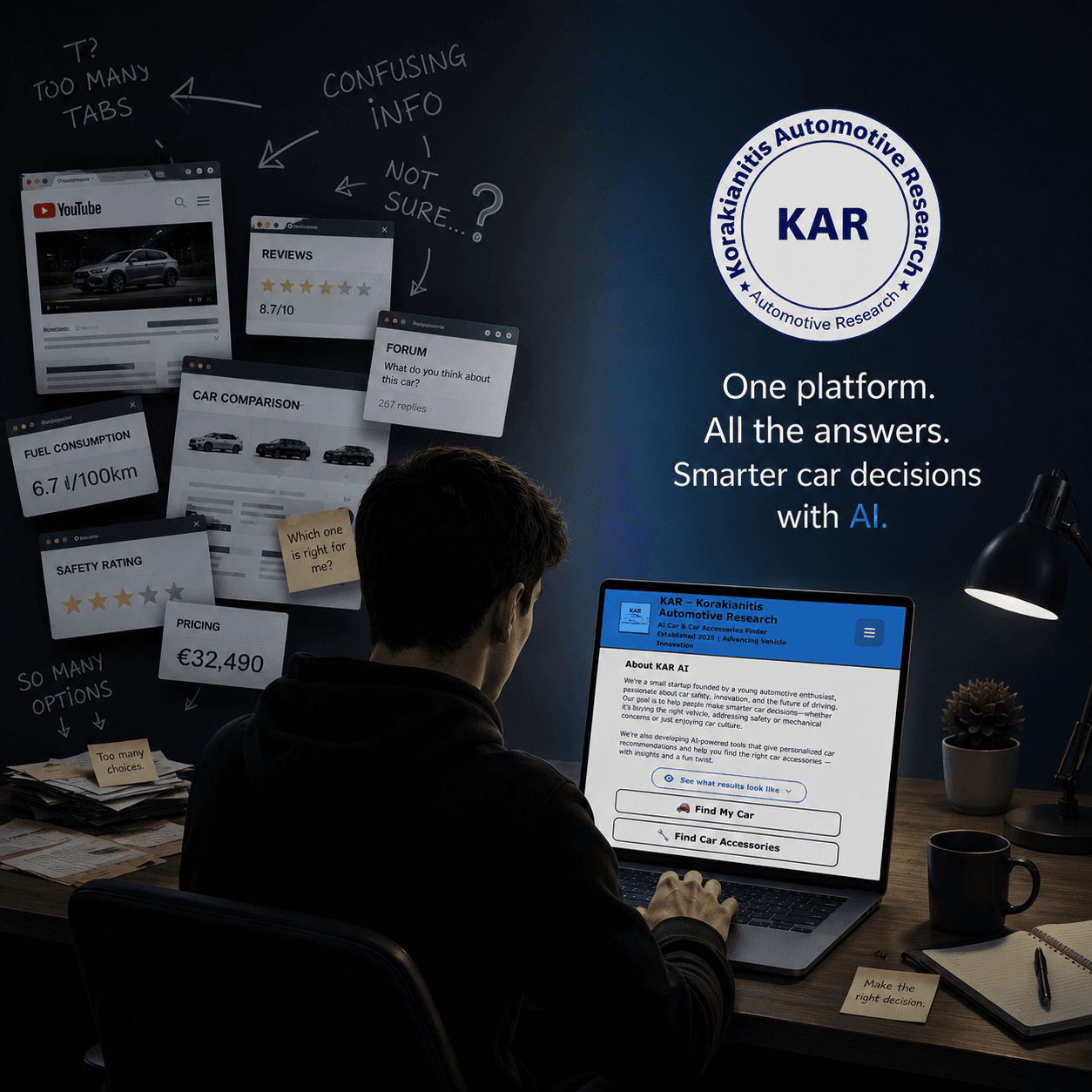
KAR Auto Research is an independent, AI-powered car research platform built specifically for drivers in Greece and Europe. Instead of leaving you to juggle a dozen browser tabs and half-trustworthy forum posts, KAR takes a short brief — your budget, how you drive, and the things you absolutely won't compromise on — and returns a ranked, fully explained shortlist of cars that actually fit. What sets it apart is the honesty baked into the process: every recommendation pulls together live market listings, Euro NCAP crash-test results, road tax, fuel or charging costs and depreciation tables for your specific market, and each pick comes with its reasoning attached, including the compromises. The platform spans a full research suite: Find My Car builds your shortlist, Compare Cars puts finalists head-to-head, Safety Check surfaces crash ratings and assistance systems, and the Cost of Ownership tool projects what a car really costs across the years you'll keep it. There's also an Accessor...
Key features
- 1Find My Car: a 5-question brief (budget, driving, deal-breakers) returns a ranked shortlist with reasoning and stated compromises
- 2Market-localized data: live listings, Euro NCAP results, road tax, fuel/charging and depreciation tables for Greece and Europe
- 3Full research suite: Compare Cars, Safety Check, Cost of Ownership and a fitment-checked Accessories & Parts finder
- 4Independence guarantee: no manufacturer or dealer pays for placement, stated explicitly on the homepage and method section
- 5No-email 30-second demo: five questions, three picks, reasoning shown before any account is required
Target customer profile
Drawn from the product itself, not from a survey.
Demographic
First-time car buyers in Greece/Europe, 25–35, budget €15k–€30k
Pain points
Overwhelmed by listings, unsure which safety ratings actually matter, afraid of hidden running costs
Primary needs
Plain-language guidance and a shortlist they can trust without dealer pressure
Demographic
Families upgrading to a crossover or SUV, 35–50, budget €25k–€45k
Pain points
Boot space, seating and reliability trade-offs, hard to compare running costs across models
Primary needs
Side-by-side comparisons covering practicality, safety and total cost of ownership
Demographic
Cost-conscious long-term owners watching fuel and tax, 40–60
Pain points
Fuel, road tax and depreciation figures are scattered and often outdated
Primary needs
Accurate, market-specific cost over ownership years and low-risk reliability picks
Demographic
Existing owners maintaining a car, any age, seeking parts and upkeep
Pain points
OEM vs aftermarket parts confusion and unmatched fitment
Primary needs
A fitment-checked parts finder plus garage reminders and current value
Scout Review
Written by AI from measured evidence, scored out of 100.
KAR Auto Research is a genuinely interesting indie play: an AI car-research tool built specifically for Greece and Europe, with market-localized pricing, Euro NCAP data, road tax and depreciation baked into every recommendation. The independence claim is the sharpest thing about it — no dealer or manufacturer pays for placement, and the method section says so out loud. The product suite is coherent (Find My Car, Compare Cars, Safety Check, Cost of Ownership, Accessories & Parts), and the no-email 5-question demo is a smart way to prove the reasoning before asking for a signup. Design is clean and confident; the recommendation cards do real explanatory work. Speed is split — desktop is excellent, mobile LCP is a problem. Security headers are better than most funded startups, though DMARC is missing and no compliance certifications are published. Accessibility is strong on automated checks but has two real failures and no WCAG statement. Growth is the most promising dimension: a specific, underserved segment, a clear wedge against ChatGPT, Carwow and AutoScout24, and a category with headroom — tempered by a small home market and very early traction. Worth watching, and worth trying the demo.
Measure by measure
Usability
68The no-email 5-question demo is a smart low-friction hook, and the tool suite (Find My Car, Compare, Safety, Cost) is clearly mapped. Docs and help-center depth are unverified, so it stays short of excellent.
Design
71Clean navy/blue system, strong hero with real car photography, and ranked recommendation cards that read well. Dense paragraphs and tiny price text in the example panel drag it below the top of the band.
Speed
57Desktop Lighthouse 96/100 is genuinely quick, but mobile performance sits at 69 with a 5.1s LCP and 4.2s FCP — the phone experience is where most Greek buyers will land first.
Security
74Strong header hygiene: HTTPS enforced, HSTS, CSP, frame protection and Referrer-Policy all present (11/12 probe points). DMARC is missing and no SOC 2, ISO or pen-test claims are published.
Accessibility
79Lighthouse a11y 97/100 with EN/ΕΛ language support is solid. Two real failures remain — contrast ratio and mismatched accessible names — and no WCAG statement or a11y page was found.
Growth
63A real, specific problem — Greek/European buyers juggling listings, NCAP and tax tables — with an independence wedge ChatGPT and dealer-funded Carwow can't easily copy. Early stage, but the idea has room.
Improvement areas
- Mobile performance: 5.1s LCP and 4.2s FCP on Lighthouse mobile (69/100) versus 96/100 on desktop
- Email security: DMARC record missing despite otherwise strong header hygiene (11/12 probe points)
- Accessibility: two Lighthouse failures (contrast ratio, mismatched accessible names) and no WCAG conformance statement
- Documentation: no help center or onboarding guide surfaced; method section is the only explanation of how KAR works
Design & Usability
KAR's homepage is one of the better-designed indie car tools you'll click into this month. The navy/blue system is consistent, the hero pairs a bold headline with an actual Toyota Yaris Cross photo, and the ranked recommendation cards — Best match, Best value, Best reliability — do the heavy lifting of explaining what the product actually does. The method section's side-by-side table against 'General AI chatbot' is a smart, uncluttered way to stake out the independence claim. Where it slips is density: long explanatory paragraphs stack below the fold, and the example match panel renders prices and specs in text small enough to make you lean in. Usability is the stronger half. The 'Try a 30-second match' flow asks five questions with no email, no password, no account — a genuinely low-friction way to see how KAR reasons before committing. The full suite (Find My Car, Compare Cars, Safety Check, Cost of Ownership, Accessories & Parts) is clearly mapped, and the demo even has a graceful error state with retry. What we couldn't verify is documentation depth — no help center or onboarding guide surfaced in the collected evidence, so the score stays short of excellent.
Speed & Security
Speed is a tale of two devices. Desktop Lighthouse lands at 96/100, which is genuinely fast. Mobile tells a different story: 69/100 with a 5.1-second LCP and 4.2-second FCP. For a product whose target users are 25–35-year-olds researching cars on their phones, that first paint delay is the difference between a demo and a bounce. CLS is a clean 0 and TBT is a healthy 128ms, so the layout is stable and the main thread isn't choking — it's the initial payload and hero image that need work. Security is the quiet overachiever. The HTTP probe returned 11 of 12 checklist points: HTTPS enforced, HSTS, CSP, frame protection, X-Content-Type-Options, Referrer-Policy and Permissions-Policy all present. That's better header hygiene than plenty of funded startups. The gap is DMARC — missing — which leaves the domain open to spoofing, a real concern for a product that will eventually email buyers about listings and reports. There's also no published SOC 2, ISO 27001 or pen-test report, and no bug-bounty program, so the compliance story is thin beyond the headers. For an early-stage Greek consumer tool that's not unusual, but it caps the score in the mid-70s rather than the 80s.
Accessibility & Growth
Accessibility is strong on paper: Lighthouse scores 97/100, the site ships an EN/ΕΛ language toggle, and the layout is responsive. Two real failures remain — insufficient background/foreground contrast and visible text labels without matching accessible names. Those aren't cosmetic; they're exactly the kind of thing that locks screen reader users out of the demo flow that KAR is proudest of. There's also no WCAG conformance statement or dedicated accessibility page, which for a product aimed at families and older buyers is a missed trust signal. Growth is where the idea earns its keep. The problem KAR names is real and specific: Greek and European buyers juggling a dozen tabs for listings, Euro NCAP results, road tax, fuel costs and depreciation. The independence positioning — 'No manufacturer or dealer pays for placement' — is a genuine wedge against Carwow (dealer-funded) and AutoScout24 (listing-first, light on analysis). Against ChatGPT, the argument is freshness and market specificity: live listings and dated cost tables versus a model that guesses prices confidently. The target segments are named with unusual precision (first-time buyers €15k–€30k, families €25k–€45k, long-term cost watchers), and the market-localization is the kind of thing incumbents structurally can't copy quickly. The limit is scale: Greece is a small market, expansion to 'Europe' is a much harder localization problem, and the domain is only 1.4 years old with no visible traction beyond LinkedIn and Instagram. The idea has room; execution and distribution will decide how much.
Conclusion
The honest verdict: KAR is doing the unglamorous work that car-buying tools usually skip — showing the compromises alongside the picks, labelling where every figure came from, and refusing dealer money. That's a real differentiator in a category where 'best car' lists are usually just paid placements in a trench coat. The execution gaps are fixable: mobile LCP needs a hero-image diet, DMARC needs a DNS record, contrast and accessible names need a pass, and the docs need to exist beyond the method section. None of those are existential. The bigger question is distribution — Greece is a small market, and 'Europe' is a localization marathon, not a checkbox. If KAR can prove the model works in one market and then replicate it, the wedge is real. If it stays a beautifully reasoned tool that nobody outside Athens finds, the honesty won't matter. Try the 30-second demo; it's the best argument the product makes.
Suggestions for improvement
- Fix mobile LCP (5.1s): compress and lazy-load the hero image, and consider serving a smaller mobile variant to get under 2.5s.
- Add a DMARC record to close the email-spoofing gap — especially important once KAR starts emailing buyers about listings and reports.
- Publish a help center or onboarding guide covering the five-stage method, cost tables and data sources; the demo is good but the docs are invisible.
- Fix the two Lighthouse a11y failures (contrast ratio, accessible names) and add a WCAG conformance statement to build trust with family and older buyers.
Alternatives comparison
Named competitors, point by point. Nobody paid to appear here or to be left out.
 KAR Auto Research |  ChatGPT |  Carwow |  AutoScout24 |  Euro NCAP | |
|---|---|---|---|---|---|
| Market-specific pricing and running-cost data (tax, fuel, depreciation) | Yes — live listings, road tax, fuel/charging and depreciation tables localized for Greece and Europe | No — training-data knowledge, often guesses prices and lacks current market figures | Partial — UK-focused pricing and dealer offers, not Greece/Europe cost-of-ownership tables | Listings only — browsing inventory without total-cost or depreciation analysis | No — safety ratings only, no pricing or running-cost data |
| Personalized ranked shortlist with explained reasoning | Yes — ranked picks (Best match / Best value / Best reliability) with reasoning and stated compromises | Partial — can produce a list on request, but no live data and no structured ranking methodology | Partial — reviews and dealer offers, but recommendations lean on dealer participation | No — search results and filters, not explained recommendations | No — provides ratings, not personalized recommendations |
| Independence from manufacturers and dealers | Yes — 'No manufacturer or dealer pays for placement' stated on homepage and method section | Yes — no dealer funding, but no market data either | No — dealer participation is central to the model | No — marketplace funded by dealer and seller listings | Yes — independent crash-test authority, but no buying guidance |
| Safety ratings combined with buying and cost analysis | Yes — Euro NCAP results and assistance systems integrated into every recommendation and the Safety Check tool | Partial — can discuss NCAP ratings but may be outdated and unverified | Partial — includes safety ratings in reviews, not integrated with cost analysis | Minimal — listings may mention safety features but no structured NCAP integration | Yes for safety only — authoritative ratings, no pricing or ownership cost |
| Free trial or no-account demo before signup | Yes — 5-question, no-email, no-password 30-second match demo | Yes — free tier available, though car research quality varies | Yes — free browsing and comparison tools | Yes — free to browse listings | Yes — all ratings publicly available for free |
ChatGPT
General-purpose AI chatbot that can discuss cars, but its knowledge is frozen at a training date and it often guesses prices confidently rather than looking up today's listings.
Carwow
Popular car comparison and buying platform with reviews and dealer offers, though it's more UK-focused and leans on dealer participation rather than fully independent research.
AutoScout24
Large European marketplace for used and new car listings, great for browsing inventory but light on explained recommendations and total-cost analysis.
Euro NCAP
Official crash-test authority providing authoritative safety ratings, but it doesn't combine safety with pricing, running costs or personalised recommendations.
Comparing options? See KAR Auto Research alternatives, scored side by side
More Productivity apps
View all Productivity
Notion
92All-in-one AI workspace for docs, projects, and knowledge...

Qamarero
92An all-in-one hospitality software for restaurants and ba...

EmbedMyReviews
92White-label reputation management software for agencies s...

StoryPad
92Privacy-first open source journal app with a continuous t...

Puzzly – B2B Lead Generation & Sales Intelligence Platform
92Puzzly is an all-in-one B2B lead generation platform that...

The Stack Newsletter
92A weekly newsletter delivering curated tech jobs, intervi...

Vibe Coding Agent Skills
92A free, open-source platform offering 110 AI agent skills...

QRBliss
91Branded QR codes with AI Brand Sync, 15 free dynamic code...

Gerty
91Private, local AI assistant for Mac that runs offline

CC Switch
91Open-source desktop app for switching AI coding providers...

username.md
90One verified handle for your online identity, readable by...

PitchWhip
90AI cold call scripts & direct dials from LinkedIn


A platform dedicated to providing unbiased reviews of newly launched applications, analyzing everything from their features to their full potential.
info@scoutforge.net© 2026 Scoutforge. All rights reserved.
