Cycling through all six. Tap any point to stop.
Measured on six things
AI life-balance planner connecting Wheel of Life, goals, ...
Design
58Dark, disciplined dashboard with a meaning-bearing accent palette and a purpose-built bento layout. The marketing homepage is weaker: a large empty void below the hero and tiny low-contrast body copy undercut the polish.
Screenshots
1 / 6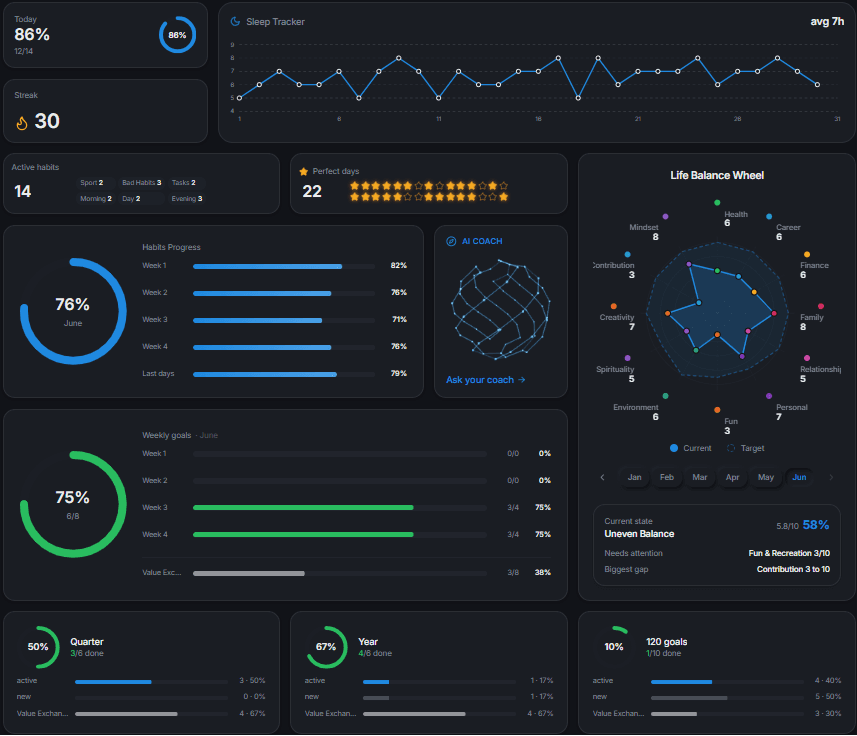
About this app
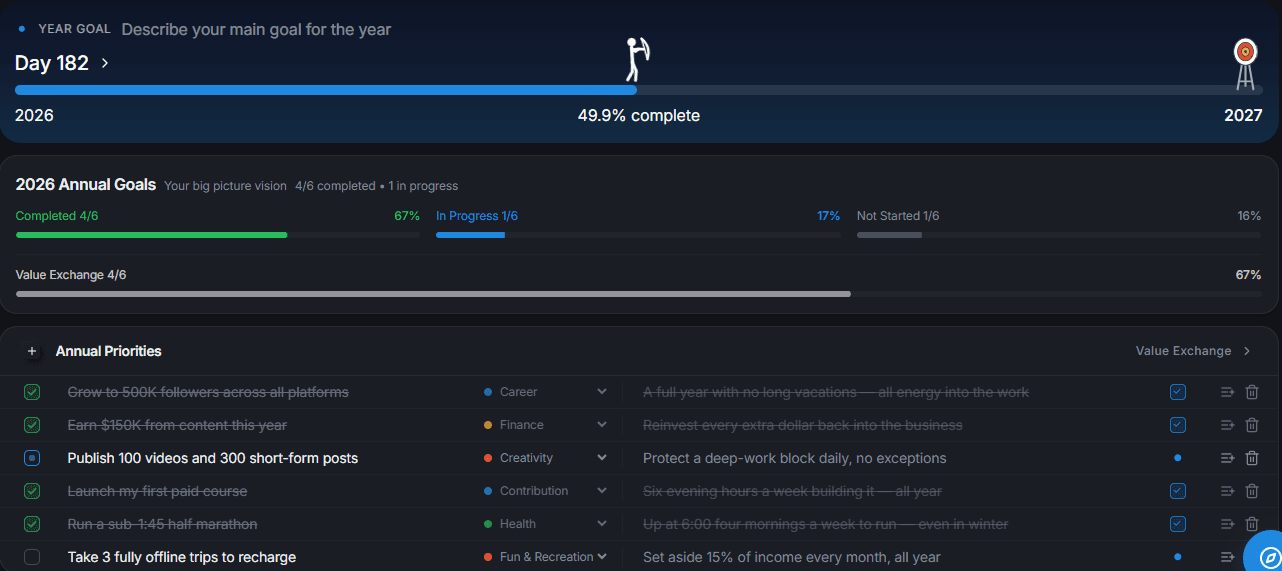
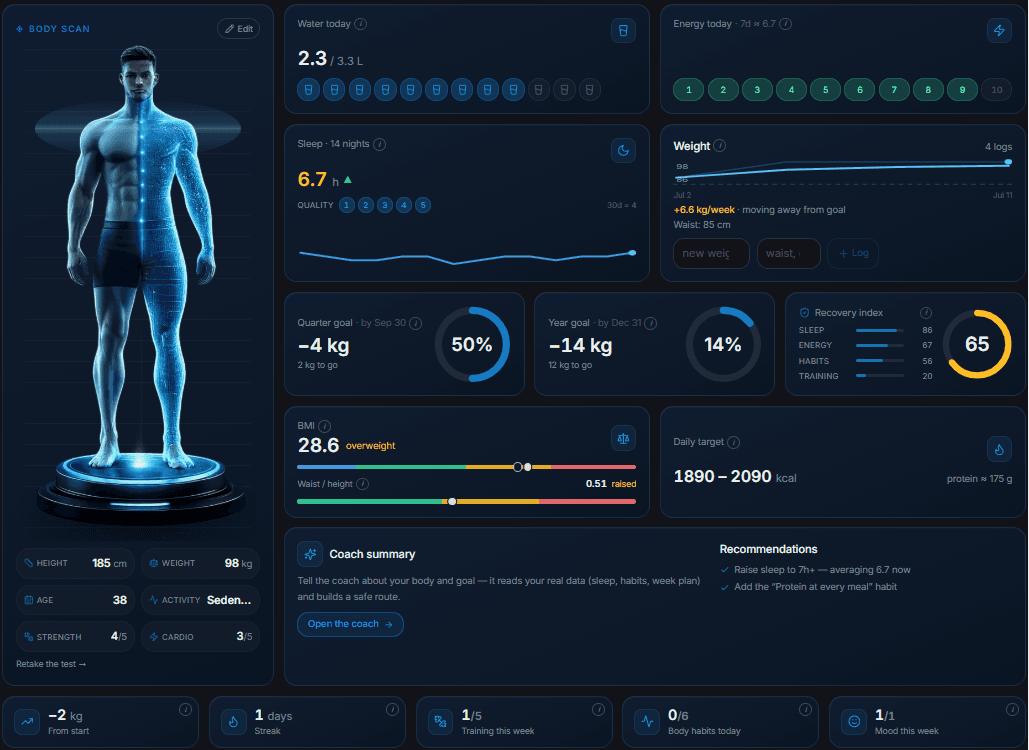
Litak is a free digital life-balance planner built around a 12-area Wheel of Life assessment that feeds into an AI coach, goal system, weekly planner, habit tracker, health logging, and an optional free community space called MentorHub. Instead of juggling separate apps for habits, tasks, and goal-setting, Litak links every part together: rate 12 life areas, see the biggest gaps, and get an AI-generated analysis that turns your weakest areas into goals, starter habits, and a realistic weekly plan. The Year/Quarter/120-day goal structure connects big-picture direction to daily action, while the habit tracker supports rest and light days so recovery isn't punished. Health signals like sleep, water, energy, and training feed into the same picture, and an MCP integration lets you plug in your own compatible AI assistant to set tasks, log habits, or check your week. The free Start tier covers the Wheel, planner, goals, dashboard, six habits, and one AI Wheel analysis; Pro ($5/mo or $50/y...
Key features
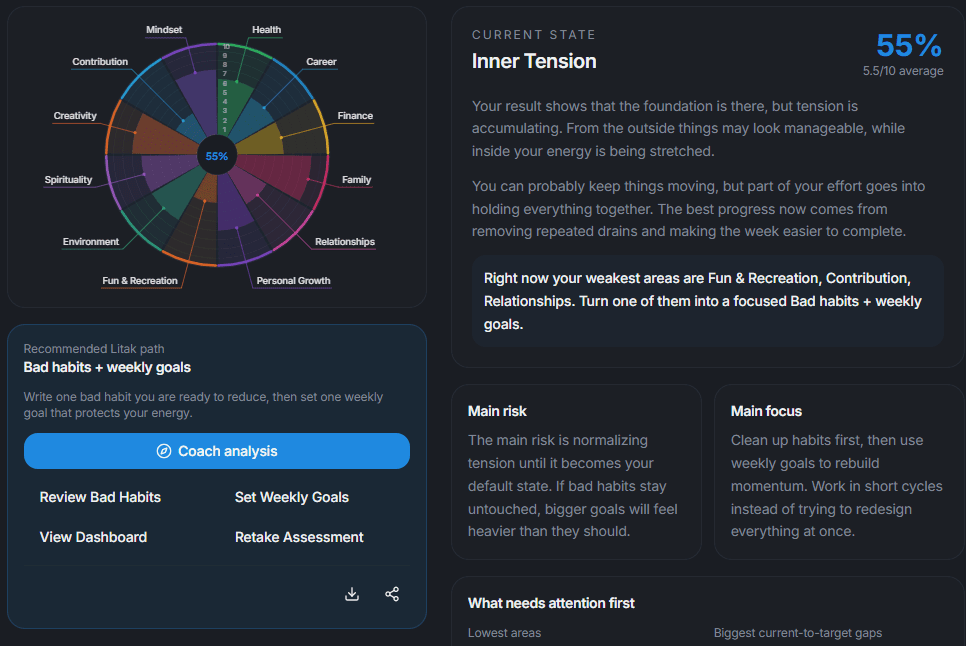
- 112-area Wheel of Life assessment with current vs desired scores, monthly history and a direct path from weak areas into goals and habits.
- 2AI coach that reads the Wheel, goals, habits, week and health signals, then turns the biggest imbalance into a weekly plan.
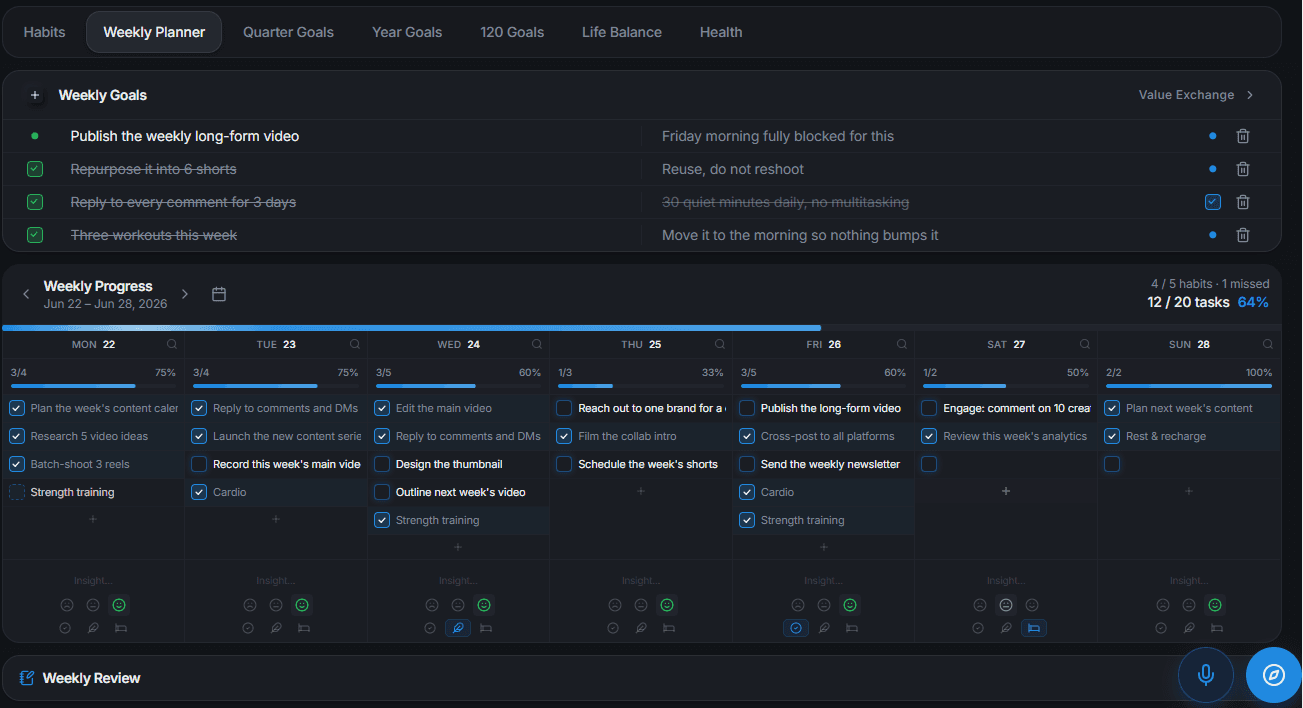
- 3Year / Quarter / 120-day goal structure linked to a weekly planner and habit tracker with rest and light days.
- 4MCP integration letting a compatible AI assistant read and update goals, habits, weekly plans and sleep data, with revocable access.
- 5Optional free MentorHub community plus health logging (sleep, water, energy, training) feeding one connected picture.
Target customer profile
Drawn from the product itself, not from a survey.
Demographic
Overwhelmed knowledge workers and professionals balancing career, family, and personal goals
Pain points
Goals, habits, and weekly tasks scattered across multiple apps; no single view of what actually needs attention
Primary needs
One connected system that shows the biggest life imbalance and turns it into an actionable weekly plan
Demographic
Self-improvement enthusiasts and personal development planners who already use journals or habit apps
Pain points
Habit trackers show checkmarks but not why habits matter; Wheel of Life exercises feel disconnected from daily action
Primary needs
A structured Wheel of Life with history plus an AI coach that connects weak areas to concrete habits and goals
Demographic
Solo entrepreneurs and freelancers managing their own time, energy, and personal wellbeing
Pain points
Burnout risk and drift between big goals and daily execution; no lightweight coach or accountability system
Primary needs
Quarterly goal tracking, weekly planning, health signals, and a proactive AI coach that notices drift early
Demographic
Tech-savvy productivity tinkerers who enjoy connecting tools via AI assistants and APIs
Pain points
Manual context-switching between assistants, planners, and trackers; wanting AI to act on real personal data
Primary needs
MCP support so a compatible AI client can read and update goals, habits, weekly plans, and sleep data securely
Scout Review
Written by AI from measured evidence, scored out of 100.
Litak is a free-to-start life-balance planner that connects a 12-area Wheel of Life assessment to an AI coach, goals, a weekly planner, habit tracking and health logging, with an optional free MentorHub community and MCP support for external AI assistants. The product UI is the standout — a disciplined dark dashboard where the Wheel radar, sleep chart and status rings turn abstract self-tracking into legible summaries. The marketing homepage undersells it: a large empty void below the hero and tiny low-contrast body copy make the site read as unfinished. Speed (Lighthouse 85/100, LCP 2.0s) and security hygiene (12/12 headers) are genuinely strong; accessibility scores 100/100 on automated checks but has a real contrast problem the audit missed. The idea is specific and differentiated against Notion, TickTick, Habitify and Motion, though the category is crowded and the wedge is copyable.
Measure by measure
Usability
63Free Start tier plus a '3 min to first insight' Wheel analysis gives a real path to value, and the dashboard reads status at a glance. The dense habit grid with truncated labels is the weak spot on smaller screens.
Design
58Dark, disciplined dashboard with a meaning-bearing accent palette and a purpose-built bento layout. The marketing homepage is weaker: a large empty void below the hero and tiny low-contrast body copy undercut the polish.
Speed
72Lighthouse 85/100 on both mobile and desktop, LCP 2.0s, CLS 0, FCP 901ms. TBT of 571ms shows some main-thread work but the page paints fast and stays stable.
Security
76Full header hygiene — HSTS, CSP, frame protection, Referrer and Permissions policies, SPF and DMARC — 12/12 on the probe. MCP access is user-scoped and revocable. No published SOC 2 or audit claims found.
Accessibility
80Lighthouse accessibility audit scores a clean 100/100. The caveat is real: the homepage's tiny low-contrast grey body copy is a readability problem automated checks don't catch, and there's no published a11y statement.
Growth
64A real, specific problem — scattered goals, habits and planner — with a genuine wedge: the Wheel of Life diagnosis feeding an AI coach that turns weak areas into a weekly plan. MCP is a smart differentiator.
Improvement areas
- Homepage hero has a large empty void below the headline with no product visual or CTA, reading as unfinished.
- Homepage body copy is tiny and low-contrast grey, hurting readability of the core explanation.
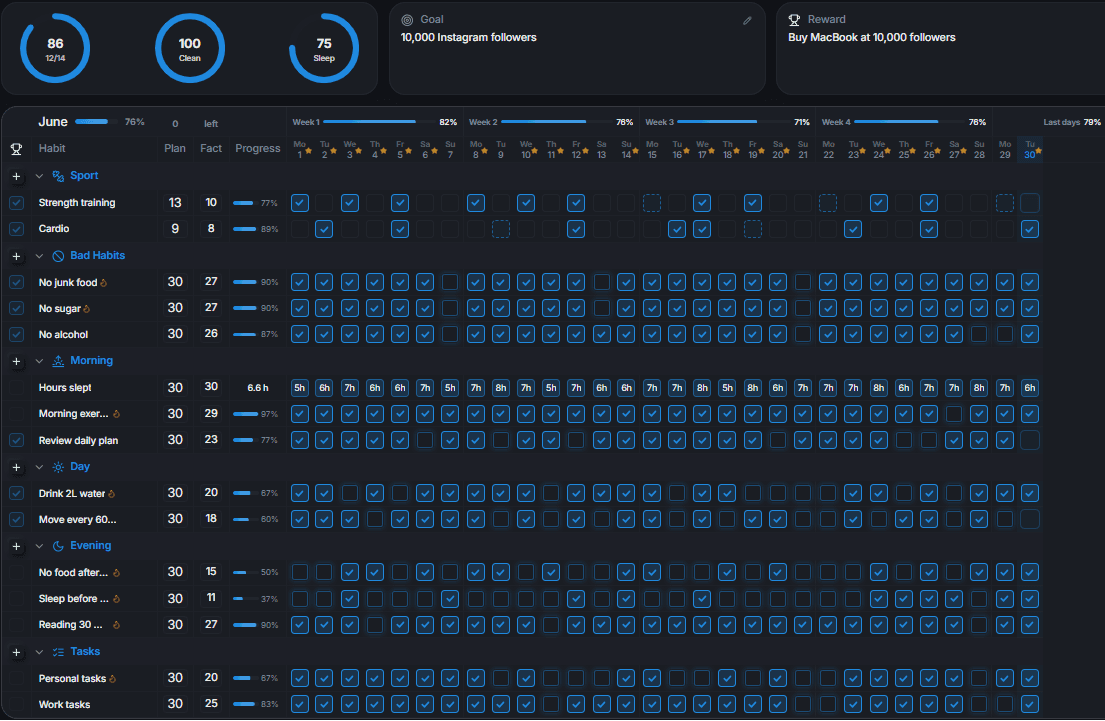
- Habit grid uses small checkboxes and truncated labels, reducing legibility on smaller screens.
- No published accessibility statement, WCAG target, or security/trust page (SOC 2, pen-test) to back up strong hygiene.
Design & Usability
Litak's product UI is the strong half: a dark, dense dashboard where a Today ring, streak, sleep chart and Life Balance Wheel radar sit in a coherent bento grid, with accent colors that actually mean something (blue for habits, green for goals, gold for perfect days). The marketing homepage is the weak half — the captured page shows a large empty void below the hero with no product visual or CTA, and the explanatory paragraph is set in tiny low-contrast grey. Usability leans on a genuinely free Start tier and a '3 min to first insight' Wheel analysis, so there's a real path from signup to value. The habit grid is where it gets cramped: small checkboxes and truncated labels make the densest screen hard to scan on smaller displays.
Speed & Security
Speed is solid and measured: Lighthouse 85/100 on both mobile and desktop, LCP 2.0s, CLS 0, FCP 901ms, with 571ms of total blocking time — fast paint, stable layout, a little main-thread work to trim. Security is the quiet overachiever: the HTTP probe returned 12/12, with HTTPS enforced, HSTS, CSP, frame protection, X-Content-Type-Options, Referrer-Policy, Permissions-Policy, plus SPF and DMARC. The MCP integration page is explicit that users choose what an assistant can read or change and can revoke access in Settings, which is the right posture for handing personal data to an external AI client. What's missing is third-party proof — no SOC 2, ISO, pen-test or bug-bounty claim appears in the site content, so the score reflects strong hygiene rather than audited assurance.
Accessibility & Growth
Accessibility scores a clean 100/100 on the Lighthouse audit, which is a genuinely good automated result. The honest limit: automated checks cover only part of WCAG, and the visual audit caught something the audit didn't — homepage body copy set very small in low-contrast grey. There's also no published accessibility statement or WCAG conformance claim, and multi-language support isn't evidenced. Growth is a judgement on the idea: Litak names a real, specific problem (goals, habits and weekly tasks scattered across Notion, TickTick, Habitify and Motion) and has a concrete wedge — the 12-area Wheel of Life diagnosis feeding an AI coach that turns the weakest areas into goals, starter habits and a weekly plan, with MCP letting an external assistant act on that data. That's a workflow none of the listed alternatives connect end to end, and the $5/mo Pro price undercuts Motion's premium positioning. The limit on the wedge: life-balance apps are a crowded, low-switching-cost category, and the Wheel-to-coach loop is copyable by any competitor with an LLM. It's a good idea with a real hook, not a moat.
Conclusion
If you're the overwhelmed professional with goals in one app, habits in another and a planner in a third, Litak's Wheel-to-coach-to-week loop is a coherent answer, and the free Start tier lets you test it in about three minutes. Go in expecting a strong product wrapped in a homepage that needs another pass — fix the hero void and the grey body copy and the marketing would finally match the dashboard. The $5/mo Pro is a low-risk step up once the free AI analysis convinces you. It won't replace a dedicated task manager for heavy project work, but as a single view of what actually needs attention this week, it earns a look.
Suggestions for improvement
- Fix the homepage hero: the large empty void below the headline needs a product visual or CTA, not dead canvas.
- Raise homepage body copy size and contrast — the tiny grey paragraph is the first thing visitors try to read.
- Publish an accessibility statement and WCAG conformance target to back up the 100/100 automated score.
- Add a security/trust page with any audit, pen-test or data-handling detail to convert the strong header hygiene into visible assurance.
Alternatives comparison
Named competitors, point by point. Nobody paid to appear here or to be left out.
 Litak |  Notion |  TickTick | Habitify |  Motion | |
|---|---|---|---|---|---|
| Wheel of Life life-balance assessment | Built-in 12-area Wheel with current vs desired scores, monthly history and gap analysis | Not built-in; requires manual template setup | Not offered | Not offered | Not offered |
| AI coach with planning context | Reads Wheel, goals, habits, week and health signals to build a weekly plan | Generic AI assistant, no personal planning context | No AI life coach | No AI coach | AI auto-schedules tasks; task throughput, not life balance |
| Habit tracking linked to goals and life areas | Habits support life areas, with rest and light days; 6 free, unlimited on Pro | Manual database setup, no native habit logic | Habits live outside the task layer | Strong streaks and stats, but not linked to life areas or goals | Not a habit tracker |
| Weekly planner tied to year/quarter goals | Tasks connect back to quarter and year goals; 120-day structure | Possible via manual databases, no built-in goal cascade | Strong weekly planner and calendar, goals separate | No weekly planner | AI auto-plans the day for task throughput |
| MCP / external AI assistant integration | MCP support: assistant can read/update goals, habits, plans, sleep; revocable | Notion AI and API, but no MCP-style personal-data actions | API available, no MCP integration | No MCP integration | No MCP integration |
| Free tier and pricing | Free Start tier; Pro $5/mo or $50/yr; Elite $10/mo or $100/yr | Generous free personal plan; paid tiers for teams/AI | Free tier; Premium subscription | Free tier; Premium subscription | Premium-priced, no meaningful free tier |
Notion
Highly flexible notes and database workspace that can be bent into a planner or habit tracker, but requires manual setup and offers no built-in Wheel of Life analysis or AI life coach with real planning context.
TickTick
Popular task manager and weekly planner with calendars and reminders; strong for to-dos, but habits, goals, and life-balance assessment live outside the task layer.
Habitify
Focused habit tracker with clean streaks and statistics; shows whether a habit was done but doesn't link habits back to life areas, quarterly goals, or an AI coach.
Motion
AI-powered calendar and task scheduling tool that auto-plans your day; optimized for professional task throughput rather than personal life balance or self-reflection.
Comparing options? See Litak alternatives, scored side by side
More Productivity apps
View all Productivity
Puzzly – B2B Lead Generation & Sales Intelligence Platform
92Puzzly is an all-in-one B2B lead generation platform that...

Qamarero
92An all-in-one hospitality software for restaurants and ba...

EmbedMyReviews
92White-label reputation management software for agencies s...

StoryPad
92Privacy-first open source journal app with a continuous t...

Notion
92All-in-one AI workspace for docs, projects, and knowledge...

The Stack Newsletter
92A weekly newsletter delivering curated tech jobs, intervi...

Vibe Coding Agent Skills
92A free, open-source platform offering 110 AI agent skills...

QRBliss
91Branded QR codes with AI Brand Sync, 15 free dynamic code...

Gerty
91Private, local AI assistant for Mac that runs offline

Strukchad Property Management
91Property management for Kenyan letting agents: rent invoices raised every month, M-Pesa rent prompts to tenants, arrears tracking and landlord statements.

CC Switch
91Open-source desktop app for switching AI coding providers...

PitchWhip
90AI cold call scripts & direct dials from LinkedIn


A platform dedicated to providing unbiased reviews of newly launched applications, analyzing everything from their features to their full potential.
info@scoutforge.net© 2026 Scoutforge. All rights reserved.
