AI-powered platform for spec management and project docum...
Speed
46
Lighthouse mobile 58/100 with a 10.4s LCP and 5.3s FCP — the hero is dragging the whole page down. Desktop fares better at 70/100, and CLS 0 keeps things from jumping around.
Screenshots
1 / 6
Mifrat
Mifrat
Mifrat
Mifrat
Mifrat
Mifrat
About this app
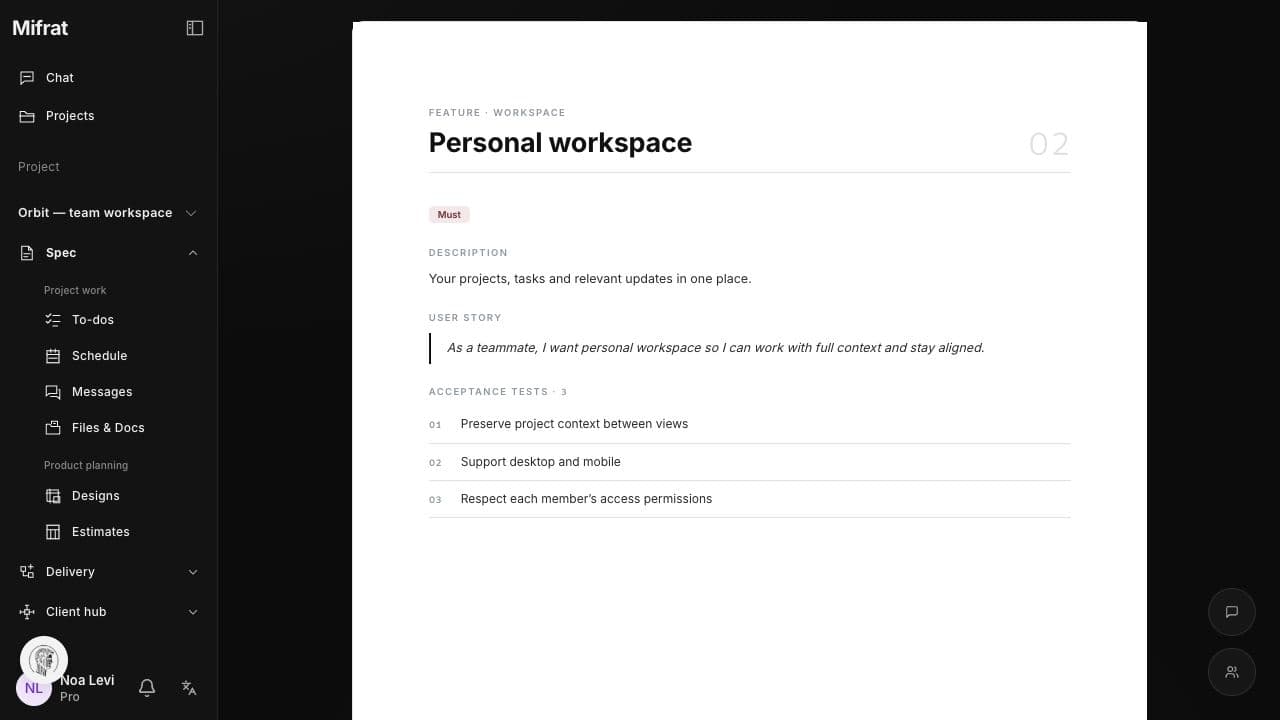
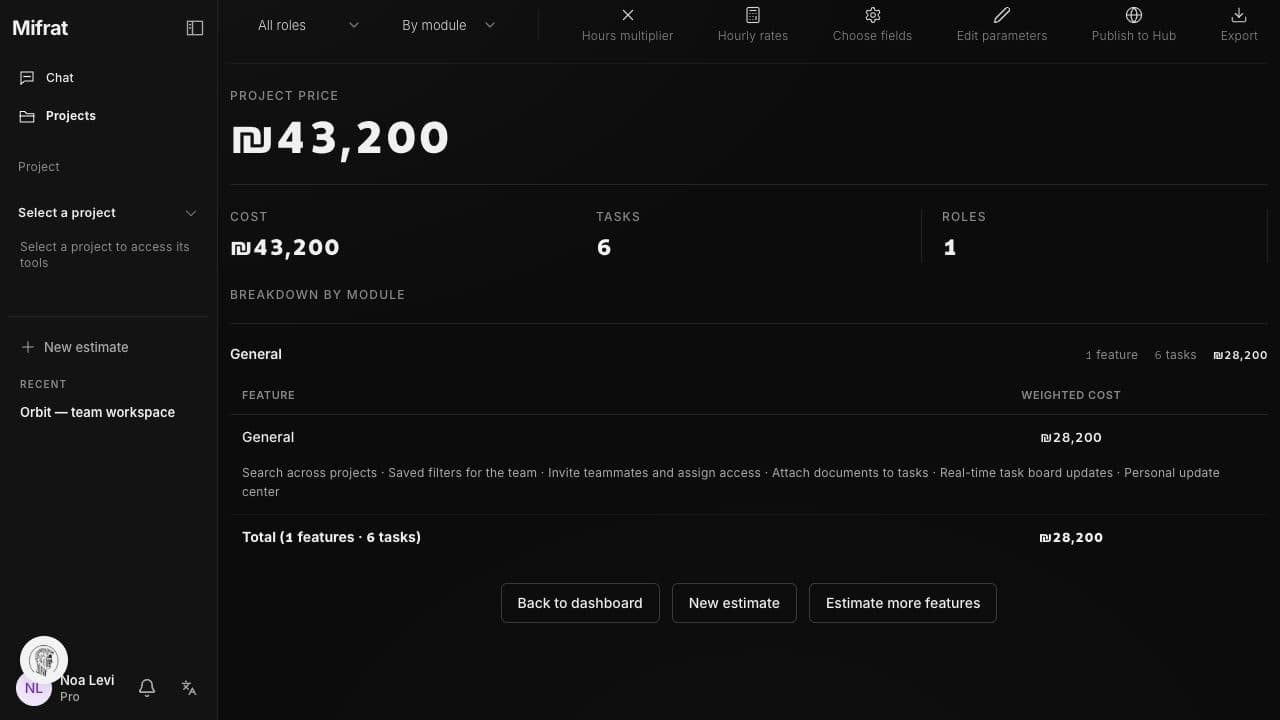
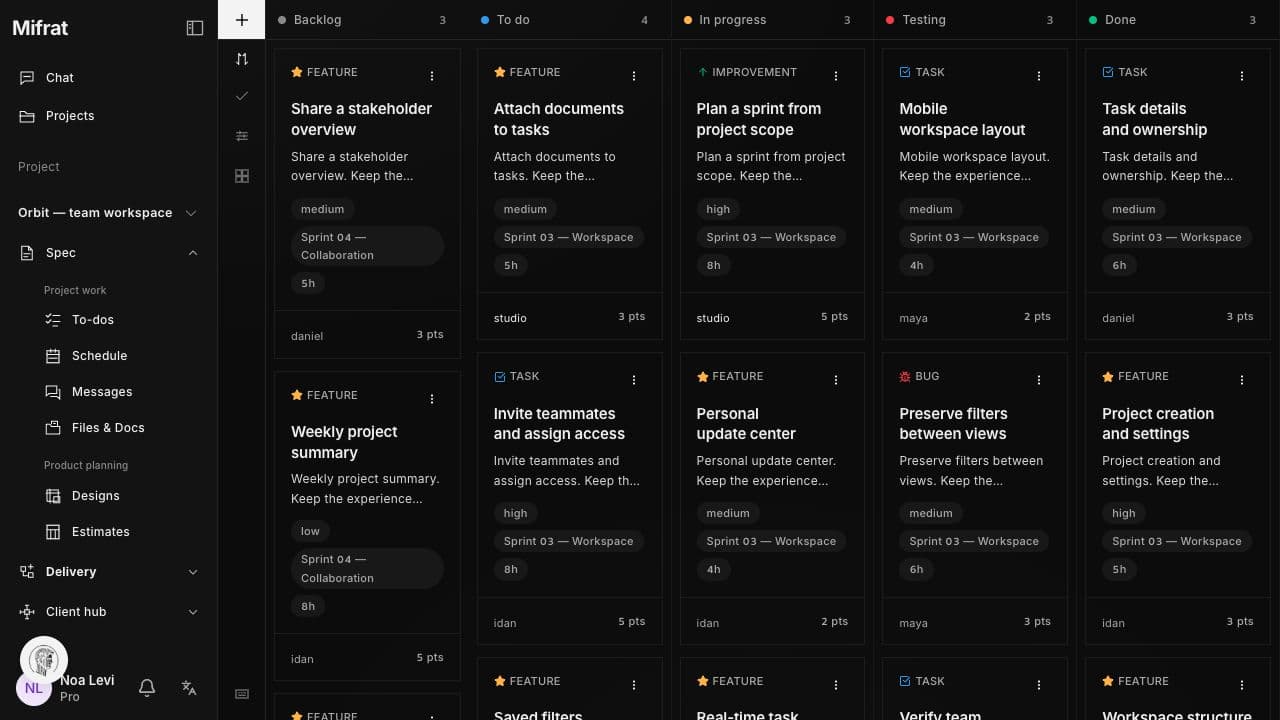
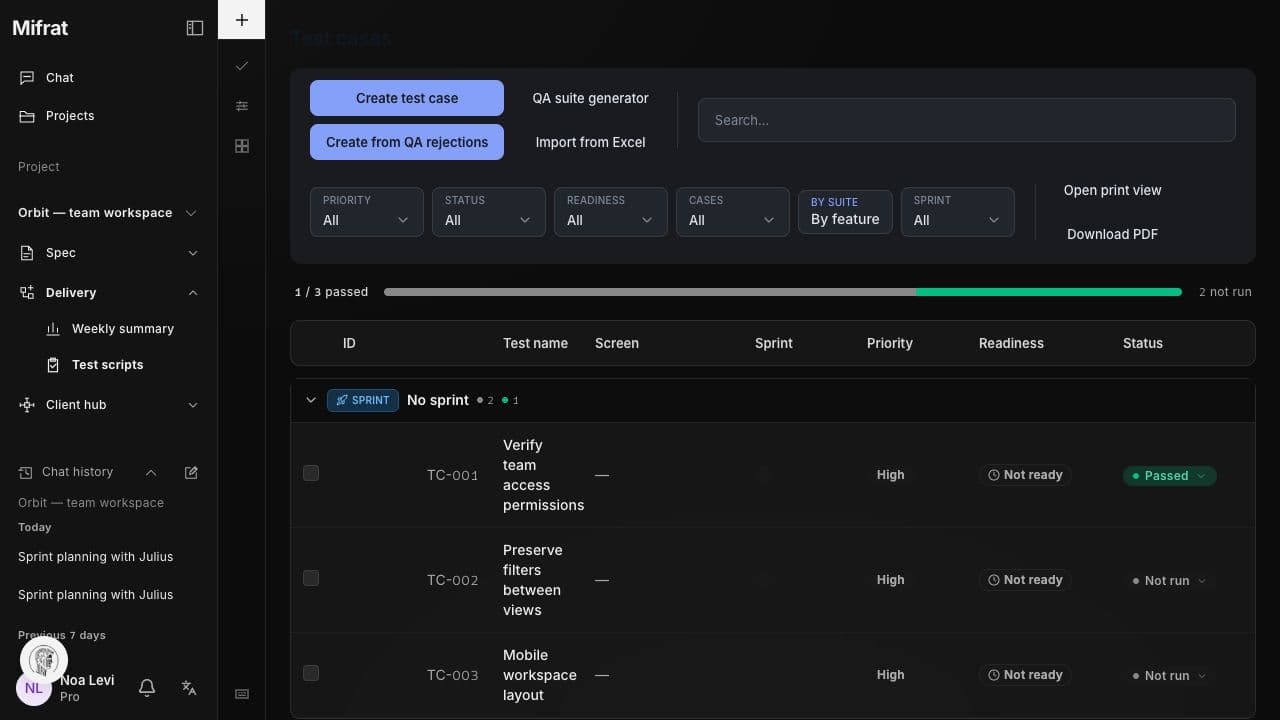
Mifrat is a specialized platform designed to streamline the creation, management, and sharing of technical specifications and project documentation. It leverages AI to help teams generate detailed specs, standardize documentation, and enhance collaboration between stakeholders. The platform is particularly useful for product managers, engineers, and project leads who need to maintain clear, consistent technical requirements across teams.
Key features include AI-assisted spec generation, customizable templates, centralised document management, and integration with popular project management tools. Mifrat aims to reduce the time spent on manual documentation and improve clarity in technical communication. While the landing page is minimal, the platform targets professionals in development, engineering, and product management who value efficiency and precision in their workflows.
Key features
1AI-assisted spec generation with a chat-to-spec workflow and customizable templates.
2Centralized, version-controlled document management for technical specs and project docs.
3Integration with popular project management tools to keep specs in sync with delivery.
Written by Scout Forge members. We do not verify that a reviewer purchased or installed the app.How we handle reviews
Paid review
Funded by the developer, who could not block publication — and the reviewer was paid the same either way.
10credits
Aeris
Oct 12, 2026
I signed up with Google and told Julius about a small dental clinic booking app (6 weeks, tight budget). It asked a few smart clarifying questions (guest vs account, how many practitioners) and then wrote a 38-feature spec in about 4 minutes. The spec is detailed and testable, and each feature has a correction note box, which I liked.
What bugged me: my brief was in English but the chat title and the glossary came back with Hebrew in them. 38 features also feels like a lot for "tight budget, 6 weeks" and nothing warned me about scope. Picking "B – I will specify which" on a question just moved on without asking me what I meant. The "Install the app" popup covered the "Set up later" button during onboarding, so I had to close it first.
I skipped the tasks and estimate step, so I can't say how good those are. Still a solid start for freelancers; I'd fix the language leak first.
Test an app and get paid in credits
Developers fund these. You keep the credits whatever your verdict.
Scout Review
Written by AI from measured evidence, scored out of 100.
Mifrat is a well-built early-stage tool with a real problem in its sights: the spec drift that eats hours between PMs and engineers. The dark app UI is polished, the chat-to-spec workflow is legible from screenshots, and the security header hygiene is genuinely better than most products at this stage. The problems are structural. Mobile performance is poor (10.4s LCP), the homepage recycles the same mockup and copy until it feels padded, and there's no demo, docs, or onboarding preview — you sign up blind. Most importantly, the competitive set is Notion, Confluence, and Craft, all of which already ship AI doc generation and already live inside the customer's stack. Mifrat's wedge is a feature, not a moat. It's a competent product in a crowded room, and it needs a sharper reason to be picked before it can grow.
Measure by measure
Usability
58
The chat-to-spec workflow reads clearly from screenshots and the 'Start free' CTA is everywhere. But there's no visible demo, docs, or onboarding cue — you're signing up blind and figuring it out.
Design
71
Polished dark app UI and a scannable comparison table carry the design. The homepage leans on generic floating-paper mockups and repeats the same 'Orbit' example until the eye glazes over.
Speed
46
Lighthouse mobile 58/100 with a 10.4s LCP and 5.3s FCP — the hero is dragging the whole page down. Desktop fares better at 70/100, and CLS 0 keeps things from jumping around.
Security
76
Strong header hygiene: HTTPS enforced, HSTS, CSP, frame protection, Referrer-Policy, Permissions-Policy — 11/12 on the probe. DMARC is missing and no SOC 2, ISO, or pen-test claim is published.
Accessibility
80
Lighthouse a11y score of 98/100 with a single failing audit — no main landmark. Contrast and layout look clean, but there's no a11y statement or keyboard-support documentation to back it up.
Growth
58
Real problem — spec drift between PMs and engineers is a genuine tax. The AI chat-to-spec wedge is specific, but Notion and Confluence already own the doc layer and can bolt on AI.
Improvement areas
Mobile performance: 10.4s LCP and 58/100 Lighthouse score need urgent attention.
No visible demo, docs, or onboarding preview — users sign up without seeing the product work.
Thin competitive moat: Notion, Confluence, and Craft already ship AI doc generation.
Missing DMARC and no published SOC 2 / ISO / pen-test compliance page for enterprise buyers.
Design & Usability
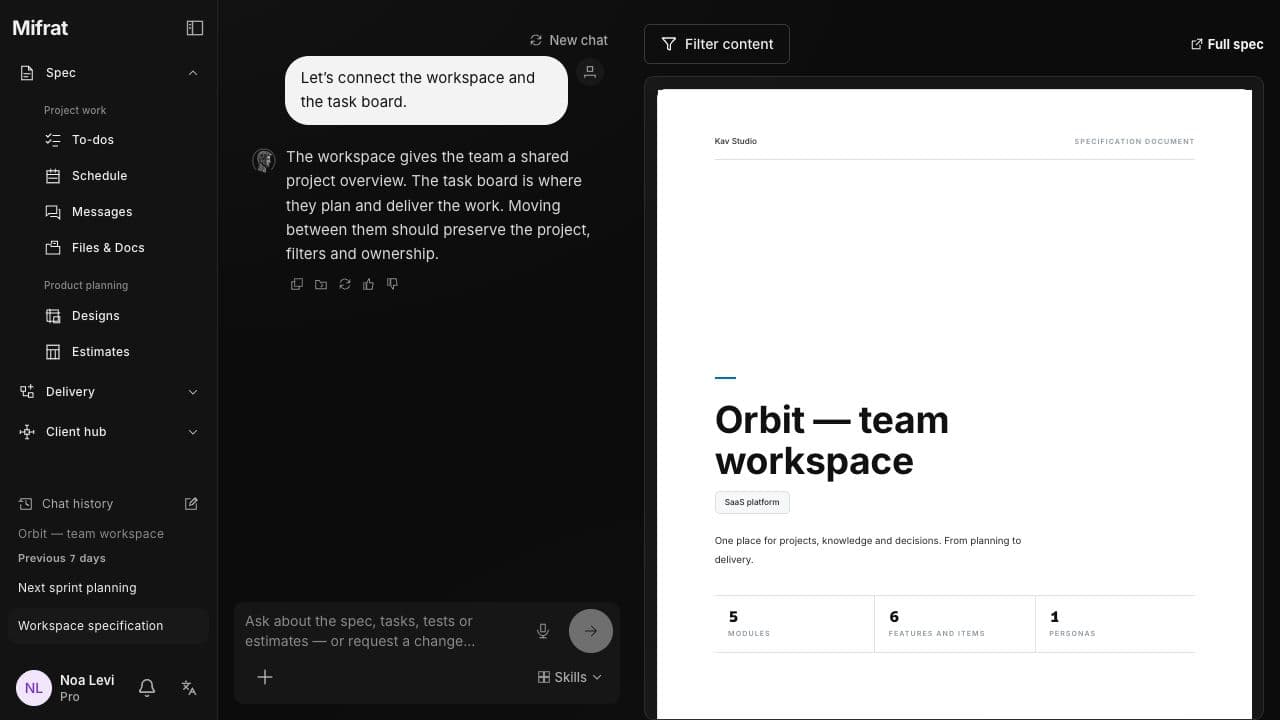
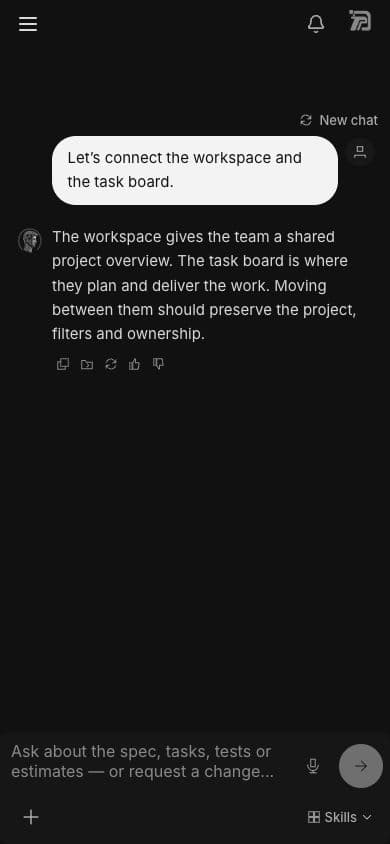
Mifrat's design is its strongest card. The dark app UI is coherent, the sidebar/chat/spec split reads clearly in screenshots, and the comparison table does the value-prop work in one glance. The homepage, though, is a bit of a rerun — floating paper stacks, the same 'Orbit' example three times, and multiple sections restating 'context and scope' in slightly different words. Usability is where it stumbles: the 'Start free' CTA is everywhere, but there's no live demo, no docs link, no onboarding screenshot, and no empty-state preview. You're asked to sign up before you've seen the product do anything. For a tool whose whole pitch is 'clearer specs,' the path to first value is conspicuously unclear. Fix the mockup variety and add a 60-second demo, and this dimension jumps ten points.
Speed & Security
Speed is the weak link. Lighthouse mobile scores 58/100 with a 10.4-second LCP and 5.3-second FCP — the hero is almost certainly a heavy image or render-blocking bundle. Desktop is a more respectable 70/100, and CLS 0 means the layout doesn't jump, so the problem is load weight, not instability. On security, Mifrat punches above its weight class: HTTPS enforced, HSTS, CSP, frame protection, X-Content-Type-Options, Referrer-Policy, and Permissions-Policy all present — 11 of 12 probe checks. The miss is DMARC, which leaves the domain open to spoofing. There's also no published SOC 2, ISO 27001, or pen-test report, which is normal for a product this young but still a gap for enterprise buyers. For a docs platform handling internal specs, that compliance story will need to arrive before the sales team does.
Accessibility & Growth
Accessibility is a genuine bright spot: Lighthouse scores 98/100 with a single failing audit — the page lacks a <main> landmark. Contrast looks strong in the dark UI, the layout is responsive, and there are no obvious keyboard traps. What's missing is the paperwork: no accessibility statement, no documented keyboard shortcuts, no multi-language support mentioned. Growth is the harder question. The problem Mifrat names — PMs and engineers disagreeing about what was actually specified — is real and expensive. The AI chat-to-spec workflow is a specific, demonstrable wedge. But the alternatives list is brutal: Notion, Confluence, and Craft all already do docs, all already have AI, and all already sit inside the customer's existing stack. Mifrat's differentiation is a feature the incumbents can copy in a sprint. The domain was registered in April 2025, so this is early — the idea has room, but the moat is thin.
Conclusion
If you're a small product team drowning in inconsistent spec docs and you want an AI-first tool that treats specs as the primary artifact rather than a page inside a wiki, Mifrat is worth a look — the workflow is coherent and the security posture is solid for its age. But go in knowing you're early-adopting: no demo, no docs, slow mobile load, and a competitive set that can copy your best feature. The team clearly knows how to build; the next job is proving why anyone should switch. Ship a 60-second demo, cut the hero weight, publish a security page, and pick a segment — indie dev teams, agencies, whoever — that Notion isn't already winning. Do that and this becomes a real contender instead of a nice-looking also-ran.
Suggestions for improvement
Cut mobile LCP from 10.4s: compress the hero image, preload the LCP element, and defer non-critical JS.
Add a 60-second product demo or interactive sandbox on the homepage so users see the chat-to-spec flow before signing up.
Publish a security/compliance page (SOC 2 roadmap, data handling, subprocessors) to unblock enterprise buyers.
Pick and name a specific segment (e.g. small product teams, agencies) and lead with it — 'for everyone' loses to Notion by default.

 Mifrat
 Notion
 Confluence
 Craft


