

A platform dedicated to providing unbiased reviews of newly launched applications, analyzing everything from their features to their full potential.
info@scoutforge.net© 2026 Scoutforge. All rights reserved.
A platform dedicated to providing unbiased reviews of newly launched applications, analyzing everything from their features to their full potential.
info@scoutforge.net© 2026 Scoutforge. All rights reserved.
A platform dedicated to providing unbiased reviews of newly launched applications, analyzing everything from their features to their full potential.
info@scoutforge.net© 2026 Scoutforge. All rights reserved.
Cycling through all six. Tap any point to stop.
Measured on six things
Shared OSS abuse intelligence for GitHub maintainers.
Niche tool for OSS maintainers fighting PR spam. Leverages Clankers data and shared intelligence. Early stage with live stats but limited adoption signals; depends on network effects for useful blocklist data.
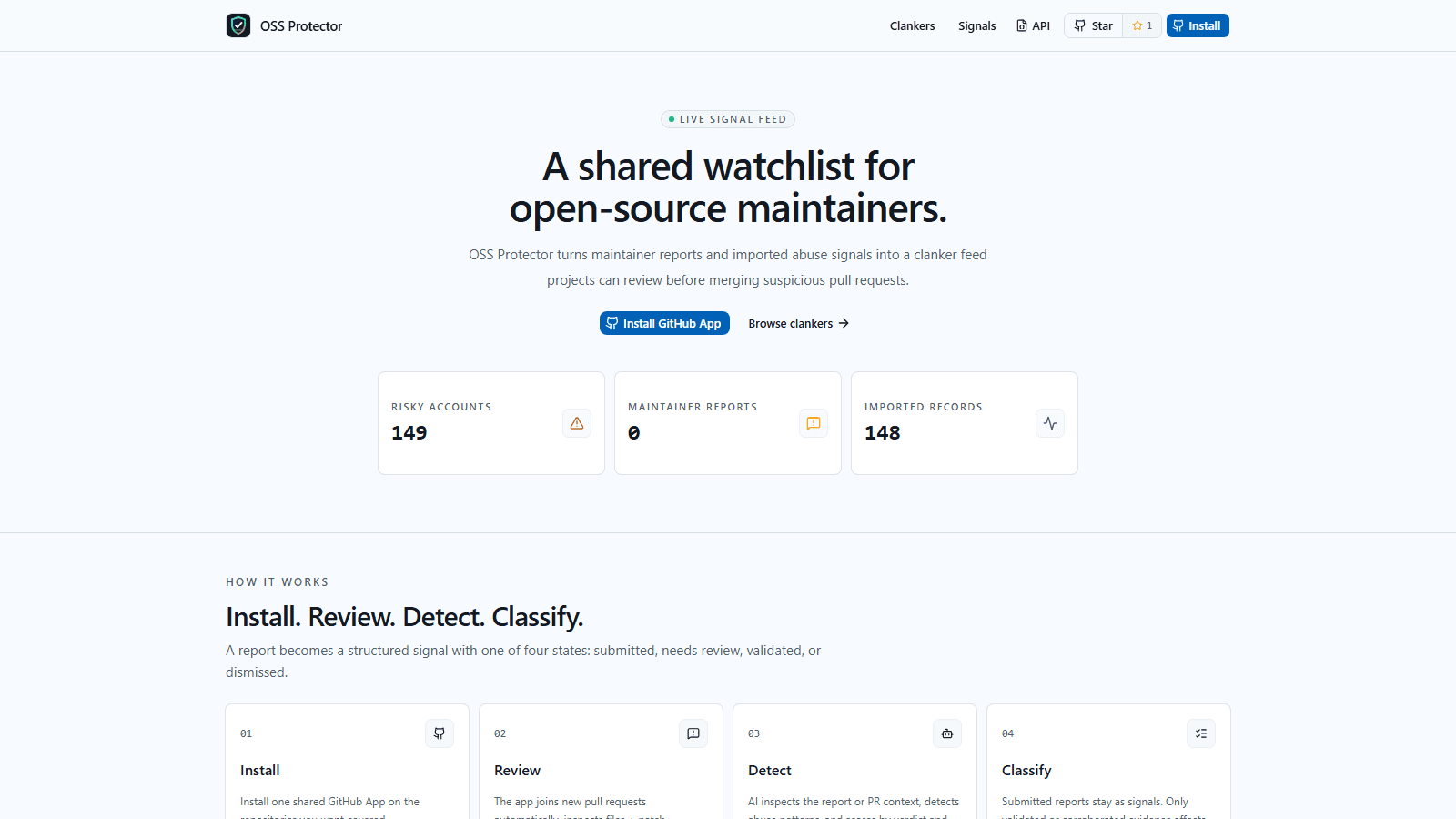
OSS Protector is a game-changer for open-source maintainers tired of sifting through suspicious pull requests. It aggregates abuse signals from maintainer reports, imported blocklists (like the Clankers Leaderboard), and AI analysis into a shared review feed. Install the GitHub App on your repos, and it automatically inspects new PRs, detecting risky patterns before you merge. The scoring system separates imported records, maintainer reports, and AI verdicts, so a single weak signal doesn't ruin someone's reputation. You can confirm, dismiss, or contest reports directly from PR comments. It's private by default—skips repo insiders and automation, and private repos don't send patch content to AI unless you opt in. Auditable assessments show the PR context, reason code, and confidence score. Built from the Clankers Leaderboard idea, it’s a practical tool for protecting open-source projects from abuse.
Drawn from the product itself, not from a survey.
Demographic
Open-source maintainers of popular GitHub projects
Pain points
Overwhelmed by spammy or malicious pull requests, manual review is time-consuming, risk of merging harmful code
Primary needs
Automated PR risk detection, shared abuse intelligence, easy integration with GitHub
Demographic
GitHub organization owners with multiple repos
Pain points
No centralized way to track suspicious contributors across repos, lack of context on PR risks
Primary needs
Organization-wide abuse monitoring, per-repo configuration, shared blocklist
Demographic
Security researchers focused on OSS supply chain
Pain points
Incomplete visibility into abusive patterns, difficulty correlating signals from different projects
Primary needs
Aggregated abuse data, evidence-weighted scoring, open API for integration
Written by AI from measured evidence, scored out of 100.
OSS Protector is a pragmatic tool that fills a real gap in open-source defense: protecting against malicious or spammy PRs and contributors before they waste maintainer time or introduce risks. By combining imported blocklists, maintainer reports, and careful AI analysis with strong privacy and override controls, it avoids the pitfalls of crude automation. The GitHub App integration is seamless, and the evidence-weighted approach is mature. It's not flashy, but it's exactly what many maintainers need. Scores reflect a solid but early-stage product — strong on security and usability for its purpose, weaker on proven growth and visual appeal.
One-click GitHub App install, automatic PR inspection with comment-based actions (confirm/dismiss/contest), clear auditable breakdowns per assessment. Private-by-default reduces onboarding friction.
Clean, minimalist landing page with clear sections on stats (149 risky accounts, 148 imported records), 'Why trust it' guardrails, and a 4-step 'How it works' flow. Simple typography and structure focused on transparency.
GitHub App integration is near real-time for new PRs. AI analysis on patch snippets is lightweight; live signal feed updates quickly. No heavy client-side processing.
Private by default (skips insiders/automation, optional patch content for private repos), evidence-weighted scoring, auditable with reason codes and confidence, maintainer override controls, inspired by real abuse data.
Basic web page structure with headings and lists supports screen readers. GitHub comment interactions are standard. No explicit mention of color contrast, keyboard nav for feed, or advanced a11y features.
Niche tool for OSS maintainers fighting PR spam. Leverages Clankers data and shared intelligence. Early stage with live stats but limited adoption signals; depends on network effects for useful blocklist data.
The landing page is straightforward and transparent, clearly explaining the value prop without hype. Design prioritizes trust signals (guardrails, auditability, privacy defaults). Usability shines in the GitHub-native workflow: install once, get automated PR comments with actionable buttons or commands. No complex dashboards required for basic use. The separation of signal types (imported vs. reports vs. AI) in the UI helps maintainers make informed decisions quickly rather than treating everything as a binary block. It's practical for busy maintainers who just want less spam without false-positive headaches.
Performance is strong for a GitHub App — near-instant PR checks and comment posting backed by serverless infrastructure. Security model is thoughtful: private-first, optional AI data sharing, and weighted scoring prevent single points of failure. Auditable assessments with context, reason codes, and confidence scores add accountability missing from simple blocklists. Compared to Socket or Dependabot (which focus on code vulns), this targets the human/social engineering layer of supply chain attacks. The ability to contest or dismiss directly from PRs gives maintainers control and reduces over-reliance on automated verdicts.
Accessibility is functional but unremarkable — standard GitHub integration helps, but the web dashboard/feed could use more polish for diverse users. Growth is the weakest area: while the concept builds nicely on Clankers Leaderboard, current stats show very few maintainer-contributed reports. Network effects are critical here; without widespread adoption across popular repos, the shared intelligence remains thin. Target customers (overwhelmed maintainers, org owners, security researchers) will only install if the data is reliable and the tool saves real time. Promising foundation but needs more traction.
Conclusion
If you're a maintainer drowning in suspicious PRs, this is worth installing on your key repos. It turns collective pain into shared intelligence without selling your soul to yet another vendor. Early days, but the bones are good.
Named competitors, point by point. Nobody paid to appear here or to be left out.
 OSS Protector OSS Protector |  Socket Socket |  GitHub's built-in CodeQL and Dependabot GitHub's built-in CodeQL and Dependabot |  Clankers Leaderboard Clankers Leaderboard | |
|---|---|---|---|---|
| Primary Focus | PR abuse & suspicious contributors via shared signals + AI | Supply chain attacks in dependencies & package vulnerabilities | Code vulnerabilities & dependency scanning (CodeQL, Dependabot) | Static public list of flagged bot accounts (no review system) |
| Real-time PR Analysis | Yes — posts assessment comments automatically | Limited — focuses on dependency changes, not general PRs | Yes for code/dependencies, no for behavioral abuse patterns | No — static JSON list, requires manual integration |
| Scoring Nuance | High — separates imported, reports, AI; weighted & auditable | Severity-based on package risks | Alert severity levels, no contributor reputation scoring | Simple leaderboard by PR volume, no nuanced scoring |
| Privacy & False Positive Controls | Strong — private by default, overrides, contest paths | Standard for dependency scanning | GitHub-native, but limited overrides for alerts | None — public static list |
Socket
Socket detects supply chain attacks in open-source dependencies, but focuses on package vulnerabilities rather than PR abuse.
GitHub's built-in CodeQL and Dependabot
GitHub's native tools scan for code vulnerabilities and dependency issues, but don't address social engineering or PR spam patterns.
Clankers Leaderboard
A public list of flagged GitHub accounts, which inspired OSS Protector, but lacks the review and scoring system.
Comparing options? See OSS Protector alternatives, scored side by side
What the review was written against. A verdict with no sources is an opinion.

Sidenty is a professional digital identity protection ser...

A native macOS process explorer and advanced monitor that...

Native macOS SSH, SFTP & RDP client with a Keychain-backe...

Real-device browser automation for AI agents

Verifiable parental controls for families in the Philippines

Password manager with no email, no account, no tracking. ...

Simple, affordable compliance certification for ISO 27001...

Reveal No Caller ID, unknown numbers, and private callers...

A zero-config AI-powered vulnerability scanner automating...

A security solution that integrates VPN access with identity platforms to reduce network vulnerabilities and protect against zero-day exploits.

CyberSafe Pro is a completely offline password manager that stores your credentials securely on your device using military-grade encryption.

Advanced parental control software for Windows & Android
A platform dedicated to providing unbiased reviews of newly launched applications, analyzing everything from their features to their full potential.
info@scoutforge.net© 2026 Scoutforge. All rights reserved.