

A platform dedicated to providing unbiased reviews of newly launched applications, analyzing everything from their features to their full potential.
info@scoutforge.net© 2026 Scoutforge. All rights reserved.
A platform dedicated to providing unbiased reviews of newly launched applications, analyzing everything from their features to their full potential.
info@scoutforge.net© 2026 Scoutforge. All rights reserved.
A platform dedicated to providing unbiased reviews of newly launched applications, analyzing everything from their features to their full potential.
info@scoutforge.net© 2026 Scoutforge. All rights reserved.
Cycling through all six. Tap any point to stop.
Measured on six things
AI tool that explains your MRI, CT, or X-ray report in pl...
HTTPS and HSTS are on, but CSP, frame protection, X-Content-Type-Options, Referrer-Policy, Permissions-Policy, and DMARC are all missing — 5/13 checklist points. For a product handling medical PDFs, that header gap is notable.
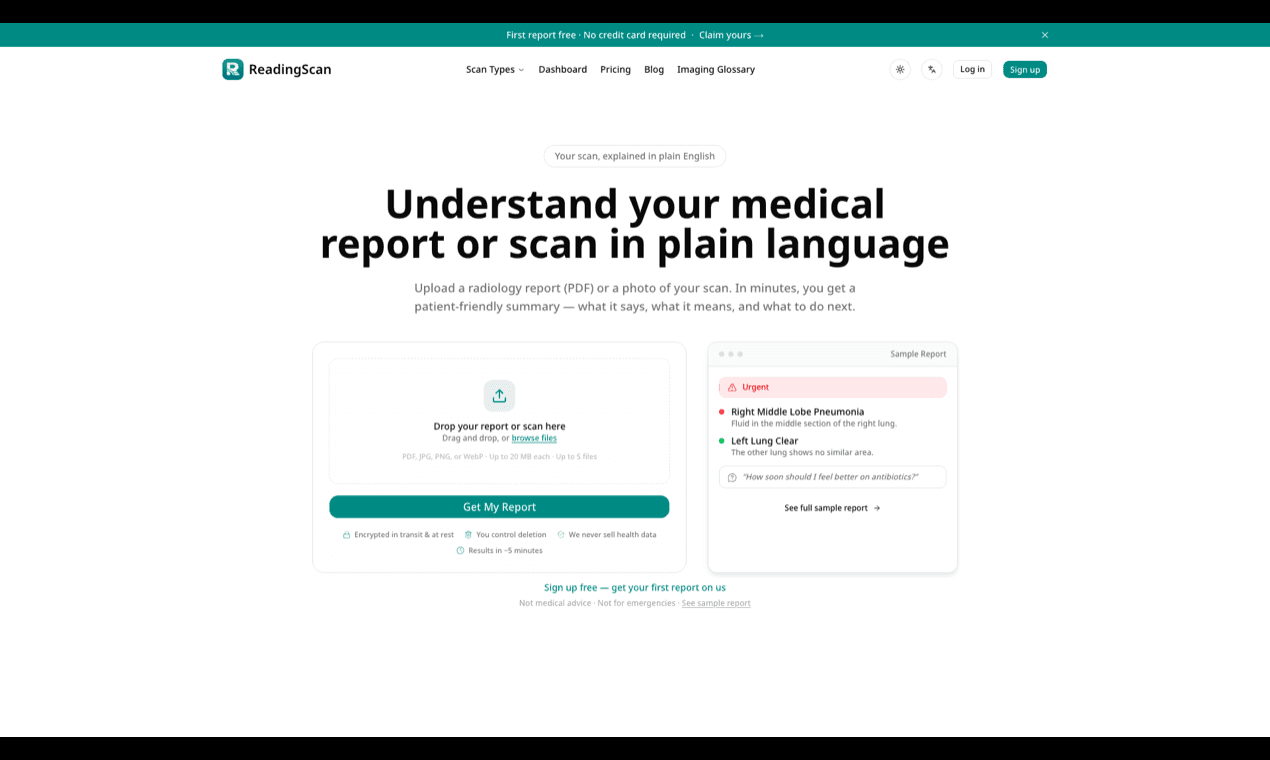
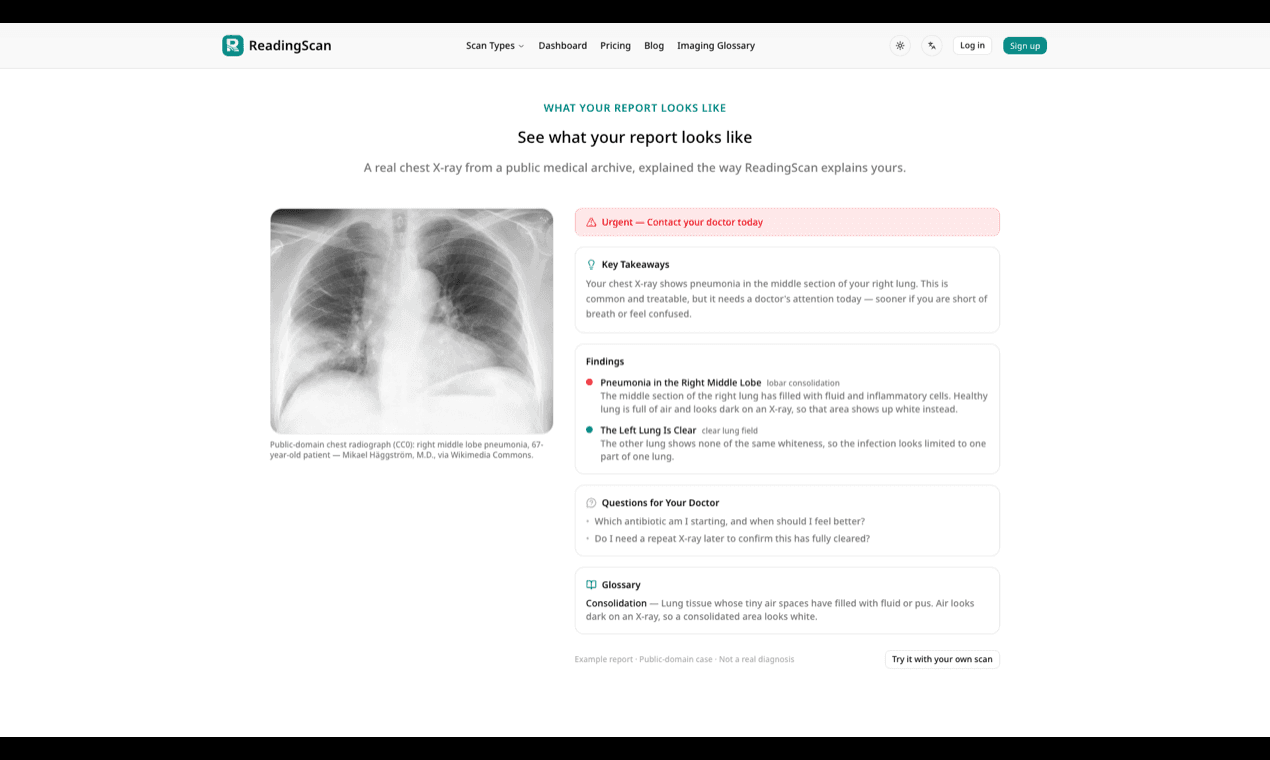
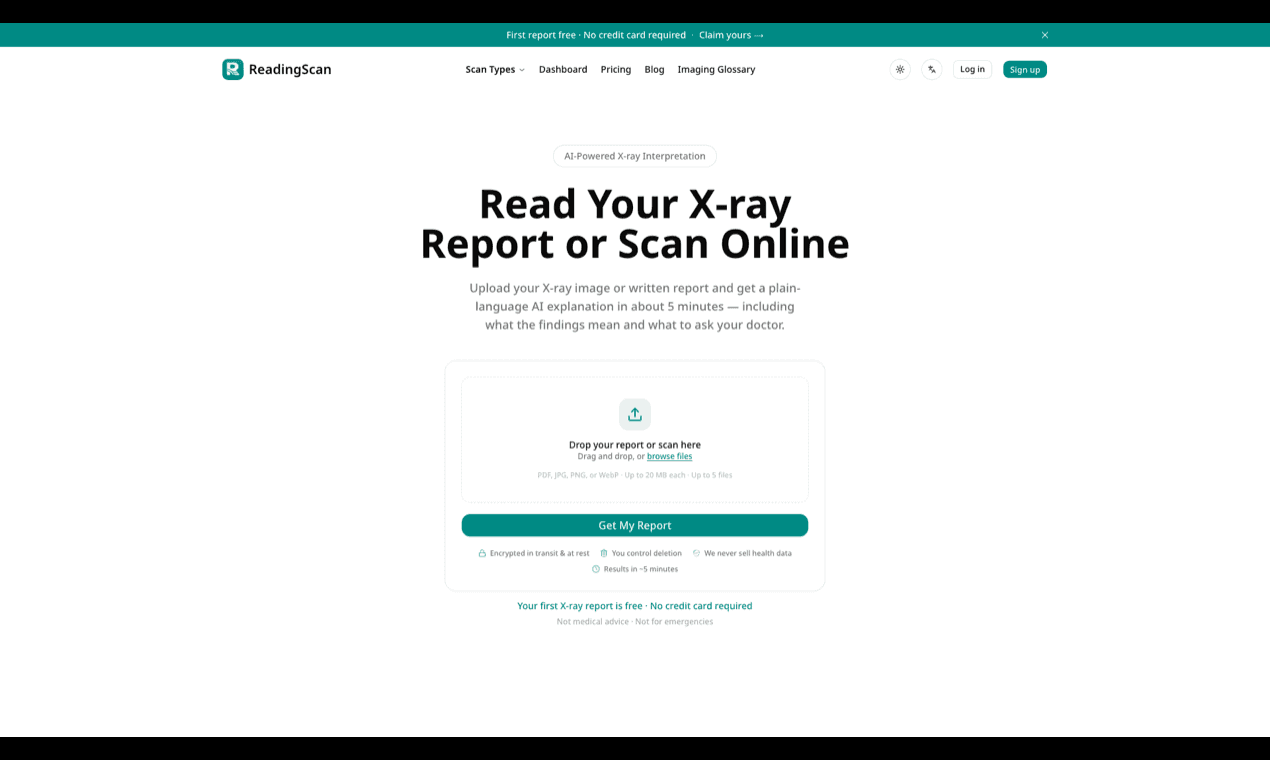
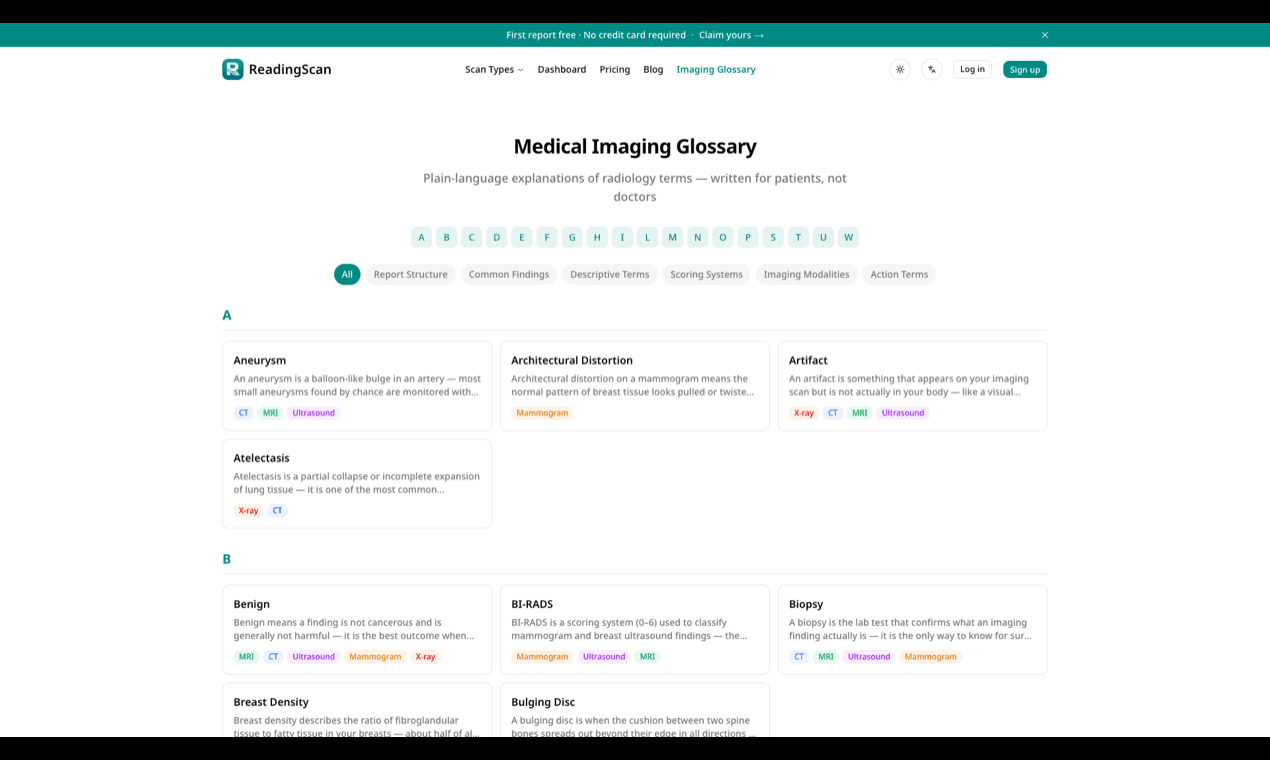
ReadingScan is an AI-powered web application designed to help patients understand their medical imaging reports, including MRI, CT, X-ray, ultrasound, and PET scans. By uploading a PDF of your radiology report or photos of your scans, ReadingScan uses advanced AI to translate complex medical terminology into clear, plain English. Each finding is presented in a simple sentence, along with its urgency level and suggested questions to ask your doctor. The tool also addresses your specific concerns, lists what the scan ruled out, and allows you to ask follow-up questions in a chat interface. ReadingScan emphasizes privacy and security, ensuring your data is encrypted and never sold. It offers a free preview and affordable one-time pricing for full reports, with no subscription required. Since its launch, ReadingScan has explained over 820 reports from patients in 109 countries, with a median turnaround time of 2.5 minutes. It is not a substitute for professional medical advice but serve...
Drawn from the product itself, not from a survey.
Demographic
Patients with recent imaging
Pain points
Confusing medical jargon, anxiety about results
Primary needs
Clear explanation, urgency assessment, questions for doctor
Demographic
Caregivers and family members
Pain points
Difficulty interpreting reports, lack of medical background
Primary needs
Understand findings, prepare for appointments, support patient
Demographic
Individuals with chronic conditions
Pain points
Frequent scans, tracking changes over time
Primary needs
Monitor progress, understand new findings, manage health
Written by AI from measured evidence, scored out of 100.
ReadingScan is a genuinely useful idea executed with more polish than most early-stage health tools. The core loop — upload a PDF or photos, get findings in plain English with urgency levels and doctor questions — is exactly what anxious patients need, and the sample report on the homepage proves the output quality before you sign up. Pricing is honest: $14, $19, or $39 one-time, no subscription, 7-day refund. The FAQ covers the questions that matter. Where it falls short is the infrastructure underneath the nice surface. Lighthouse mobile performance is 63/100 with a 10.8-second LCP, and desktop scores lower at 52/100. Security headers are largely missing — 5/13 checklist points, no CSP, no frame protection, no DMARC — which is a real concern for a product handling medical documents. Accessibility sits at 87/100 with contrast, alt-text, and link-name failures still open. None of these are fatal, and all are fixable. The product's biggest asset is that it solves a problem people actually have, at a price that doesn't require a subscription decision. The biggest risk is trust: patients uploading medical data need to see security done properly, not just claimed.
Upload-to-value path is short: dropzone, big CTA, sample report right beside it. Pricing is clear one-time tiers with a 7-day refund and a solid FAQ. No live demo or interactive trial beyond the free first scan.
Consistent teal branding, strong hero balance, and color-coded sample report cards that sell the output before signup. Footer text runs small and low-contrast, and stacked sample cards feel slightly busy.
Lighthouse mobile 63/100 with a brutal 10.8s LCP; desktop actually scores lower at 52/100. FCP is fine at 1.8s and CLS is tight, but the main content paint is slow enough to lose impatient users.
HTTPS and HSTS are on, but CSP, frame protection, X-Content-Type-Options, Referrer-Policy, Permissions-Policy, and DMARC are all missing — 5/13 checklist points. For a product handling medical PDFs, that header gap is notable.
Lighthouse a11y 87/100 with real failures: low-contrast text, images missing alt attributes, links without discernible names. Multi-language is listed as a feature, but no WCAG statement or accessibility page was found.
Real problem, specific buyer (patients with confusing imaging reports), and a clear wedge: plain-English translation plus doctor questions at $14 one-time. The only listed alternative serves clinicians, not patients.
ReadingScan's design does the hard part well: it shows you the output before asking for anything. The sample knee MRI report sits right next to the upload dropzone, findings are color-coded by concern level, and the teal accent stays consistent from banner to buttons. The hero is balanced and the CTA is unmissable. Where it slips is the details — footer and legal text run small and low-contrast, stacked sample cards get busy, and two different hero headlines appear across renders, which reads as unfinished rather than tested. Usability is similarly strong up front: drop a PDF or photos, get findings back in plain sentences, see urgency levels and doctor questions. Pricing is refreshingly simple — $14, $19, or $39 one-time, no subscription, 7-day refund. The FAQ answers the questions people actually have (accuracy, privacy, DICOM, FDA status). The gap is that there's no interactive demo or sandbox — you see a static sample, then you have to sign up and upload real medical data to see your own. For an anxious patient, that's a bigger ask than it looks.
Speed is the weak spot. Lighthouse mobile performance lands at 63/100 with an LCP of 10.8 seconds — that's the main content taking over ten seconds to paint on a phone. Desktop actually scores lower at 52/100, which is unusual and points to heavy render-blocking assets rather than a mobile-specific problem. FCP at 1.8s and CLS at 0.075 are fine, so the page starts fast and then stalls. For a product whose entire pitch is 'a few minutes later you get your report,' making people wait ten seconds to see the upload box undercuts the promise. Security is a mixed bag. HTTPS is enforced, HSTS is set, SPF exists — the basics are there. But CSP, frame protection, X-Content-Type-Options, Referrer-Policy, Permissions-Policy, and DMARC are all absent, landing at 5/13 checklist points. The site claims encryption in transit and at rest, data deletion, and no data selling, which is the right language. But for a product handling medical imaging reports, missing clickjacking protection and a content security policy is a real gap, not a nitpick. No SOC 2, ISO, HIPAA, or pen-test claims appear anywhere on the site.
Accessibility scores 87/100 on Lighthouse, which sounds strong until you read the failing audits: insufficient color contrast, images without alt attributes, and links without discernible names. Those are the three lowest-effort fixes in the entire WCAG checklist, and they're all still open. The visual audit independently flagged footer and legal text as very small and low-contrast. Multi-language is listed as a feature on the pricing page, which is a genuine plus for a product serving 109 countries, but there's no WCAG statement or accessibility page to point to. Growth is the most interesting dimension here. The problem is real and specific: patients get radiology reports full of jargon and no idea what to do with them. The target customer is clearly named — people with recent imaging, caregivers, chronic-condition patients tracking changes. The wedge is concrete: plain-English findings, urgency levels, doctor questions, and follow-up chat at $14 one-time, no subscription. The only listed alternative, Nuance Dragon Medical, serves clinicians doing dictation, not patients reading their own results — so ReadingScan isn't really competing with it. That's either a wide-open niche or a sign the comparison set is thin. The site claims 820+ reports across 109 countries, which is early but real traction. The limit on this wedge is trust: patients may hesitate to upload medical data to an unknown tool, and the missing security headers don't help. If ReadingScan tightens security, speeds up the page, and fixes the a11y basics, the idea has room to grow.
Conclusion
ReadingScan sits in an interesting spot. It's not competing with Nuance Dragon Medical — that's clinician dictation software, a different buyer entirely. It's competing with the 2am Google search, the WebMD rabbit hole, and the anxiety of staring at a radiology report you can't parse. Against that baseline, a $14 plain-English translation with urgency levels and doctor questions is a clear win. The sample report on the homepage is the strongest sales asset the product has, and it's placed exactly where it should be. What holds ReadingScan back from a higher score is execution on the fundamentals: a 10.8-second LCP on mobile, missing security headers on a medical-data product, and accessibility failures that are trivial to fix but still open. The idea is sound, the pricing is fair, and the traction claims (820+ reports, 109 countries) suggest real users are finding it. Fix the speed, tighten the headers, add alt text and contrast, and this becomes a product worth recommending without caveats. Right now it's a good idea with a fast-fixable infrastructure gap.
Named competitors, point by point. Nobody paid to appear here or to be left out.
 ReadingScan ReadingScan |  Nuance Dragon Medical Nuance Dragon Medical | |
|---|---|---|
| Primary use case | Patients translating their own radiology reports into plain English | Clinicians dictating and documenting clinical notes |
| Target user | Patients, caregivers, and chronic-condition individuals | Doctors, radiologists, and hospital documentation teams |
| Pricing model | One-time $14/$19/$39 per report; first analysis free | Enterprise licensing; quote-based, no public consumer pricing |
| Input format | PDF reports, patient-portal screenshots, JPG/PNG/WebP photos of scans | Live clinician speech and dictation into EHR systems |
| Output | Plain-English findings, urgency levels, doctor questions, follow-up chat | Structured clinical documentation and billing codes |
| Regulatory positioning | Explicitly not FDA-cleared or CE-marked; not a substitute for medical advice | Enterprise healthcare compliance and EHR integration standards |
Comparing options? See ReadingScan alternatives, scored side by side

Privacy-first open source journal app with a continuous t...

Snapkin is a calorie tracker you use by photographing your plate.

An AI-powered emotional support app that acts as a person...

A minimalist, distraction-free meditation timer for mantr...

Adaptive AI personal trainer that evolves with your progr...

AI meal plans for your week, with one aisle-sorted shopping list

Free TDEE calculator that estimates maintenance calories, weight loss targets, muscle gain calories, and macro recommendations based on your body stats and activity level.

AI explained simply for older adults, with safety lessons...

A personalized GLP-1 weight loss platform offering physic...

Free 80-item RAADS-R autism self-assessment for adults, with instant total and domain scores, privacy-first access, and clear non-diagnostic guidance.

An AI-powered healthcare platform that centralizes remote patient monitoring, clinical trial management, and medical device integration for improved efficiency.

An AI-powered voice journaling app that transcribes spoken thoughts into written entries for effortless daily reflection and mental wellness.
A platform dedicated to providing unbiased reviews of newly launched applications, analyzing everything from their features to their full potential.
info@scoutforge.net© 2026 Scoutforge. All rights reserved.