

A platform dedicated to providing unbiased reviews of newly launched applications, analyzing everything from their features to their full potential.
info@scoutforge.net© 2026 Scoutforge. All rights reserved.
A platform dedicated to providing unbiased reviews of newly launched applications, analyzing everything from their features to their full potential.
info@scoutforge.net© 2026 Scoutforge. All rights reserved.
A platform dedicated to providing unbiased reviews of newly launched applications, analyzing everything from their features to their full potential.
info@scoutforge.net© 2026 Scoutforge. All rights reserved.
Cycling through all six. Tap any point to stop.
Measured on six things
One-click static site hosting with drag-and-drop upload.
Zero reviews, no GitHub, no traction signals. Beta with shutdown noted; creator has other projects but this one stalled.

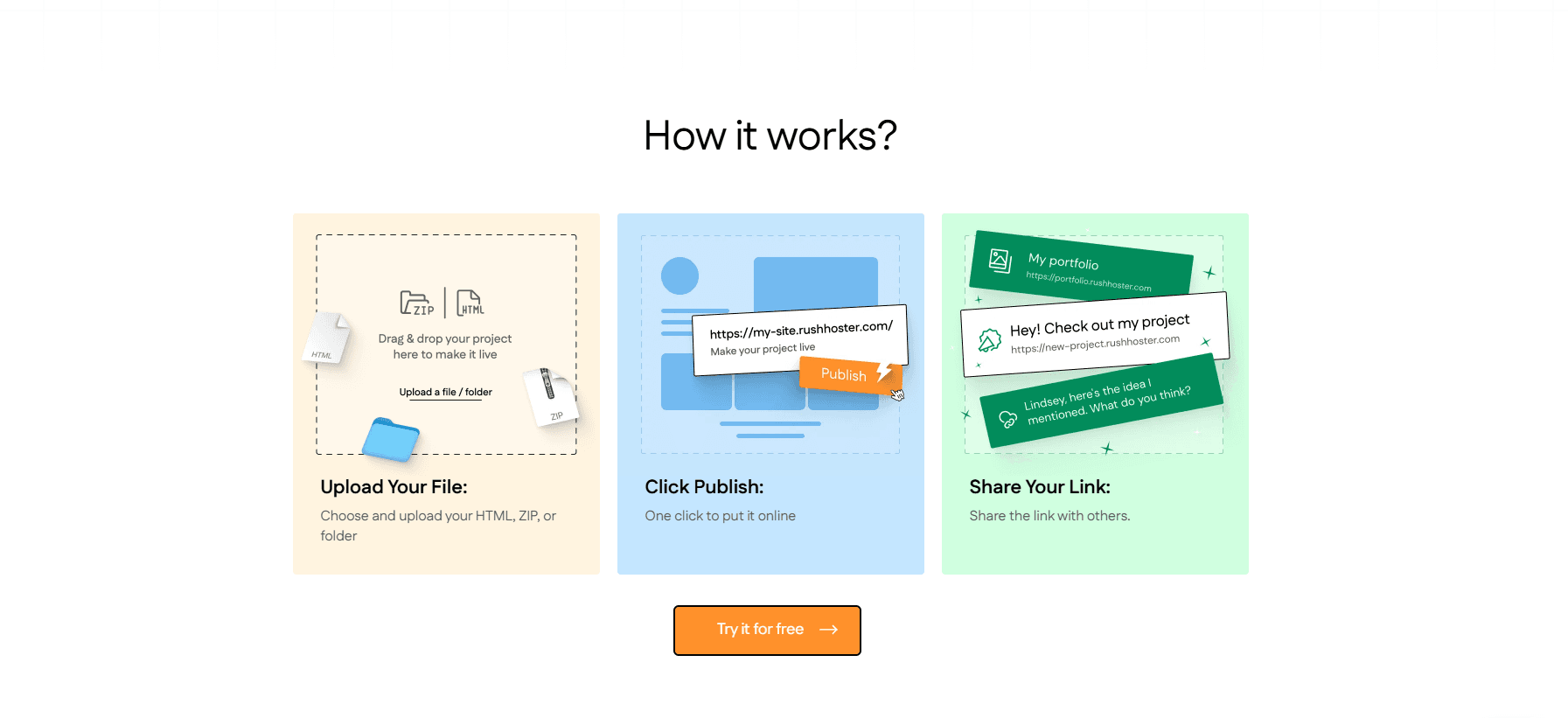

RushHoster is a dead-simple static site hosting service that lets you publish your project online in seconds. Just drag and drop your HTML, ZIP, or folder, click publish, and you get a shareable link. Perfect for developers, designers, and hobbyists who need a no-fuss way to showcase their work. It supports only static sites (no backend), and currently accepts HTML and ZIP files. The creator, John Rush, also offers an AI-driven SEO agent called SEOBOT. The service was free in beta, with planned one-time pricing, but as of now, RushHoster is shutting down. The page notes the shutdown and invites acquisition inquiries. Even so, the concept remains compelling: instant, zero-configuration deployment. If you're looking for a similar tool, check out alternatives like Netlify or Vercel, which offer free tiers and more features. RushHoster's simplicity and one-click publish made it a standout for quick sharing of front-end projects.
Drawn from the product itself, not from a survey.
Demographic
Frontend developers and designers
Pain points
Need to quickly share static prototypes or demos without dealing with complex deployment pipelines.
Primary needs
Simple, fast, one-click publishing of HTML/CSS/JS projects.
Demographic
Hobbyist coders and students
Pain points
Want a free or low-cost way to host personal projects without managing servers or configuration.
Primary needs
Drag-and-drop upload, instant live link, and minimal setup.
Demographic
Freelancers and small agencies
Pain points
Require a quick method to share client mockups or static sites but find traditional hosting too time-consuming.
Primary needs
Shareable links, no recurring fees (one-time payment model), and security.
Written by AI from measured evidence, scored out of 100.
RushHoster offered exactly what it advertised—a dead-simple drag-and-drop static host with instant links and planned one-time pricing. Strengths in raw simplicity and low barrier made it appealing for quick demos. Weaknesses in missing features, zero community, and now shutdown status limit its legacy. It served a niche well in beta but couldn't compete long-term with feature-rich free tiers from Netlify, Vercel, or GitHub Pages.
Drag-and-drop upload, instant publish, and solid FAQ make core flow obvious. Free beta lowers barrier; static-only limits scope.
Clean, minimal landing page with clear 3-step flow and pricing tiers. Simple branding by solo dev, functional but unpolished.
Lightweight static site implies fast loads. No benchmarks or complaints, but nothing exceptional either.
Vague 'stored securely' claim in FAQ. No audits, SSO, or compliance details. Basic expectations met at best.
No a11y statements, contrast checks, or screen-reader mentions. Simple layout may work but unverified.
Zero reviews, no GitHub, no traction signals. Beta with shutdown noted; creator has other projects but this one stalled.
RushHoster delivers a no-nonsense landing page and upload flow that matches its 'dead-simple' promise. The three-step process is immediately clear, and the free beta removes friction for quick tests. However, the design stays firmly in basic territory with minimal visual interest or interactive previews. Usability shines for the exact use case of dropping an HTML/ZIP and getting a link, backed by helpful FAQ entries on file limits and static-only support. It competes directly with Netlify and Vercel on simplicity but lacks their Git integration or preview environments. Overall competent for hobbyist sharing but feels more like a prototype than a finished product.
The site itself is lightweight and should load fast, though no performance benchmarks or tech stack details are published. Security rests on a single FAQ line claiming secure storage, with no audits, encryption specifics, or compliance badges. This puts it behind peers like Vercel (global CDN + SOC 2) and Netlify (detailed security docs). For static files only, the risk is low, but lack of transparency is noticeable. GitHub Pages wins on trust via GitHub's infrastructure. RushHoster's one-time pricing model is appealing but doesn't offset the thin security posture.
Accessibility receives no mentions or documentation, typical for early-stage solo projects but a gap versus established alternatives that publish a11y statements. Growth is essentially nonexistent: no reviews, no community, and explicit shutdown signals mean it's winding down. Creator John Rush's activity on X and other tools like SEObot shows hustle, but RushHoster never gained momentum. Netlify and Vercel dominate with massive communities and review volume; GitHub Pages benefits from GitHub's built-in audience. The concept was solid for quick prototypes, yet execution and timing didn't translate to traction.
Conclusion
If you're hunting for instant static hosting today, skip the corpse and go straight to the living alternatives. The idea was good; the follow-through wasn't.
Named competitors, point by point. Nobody paid to appear here or to be left out.
 RushHoster RushHoster |  Netlify Netlify |  Vercel Vercel |  GitHub Pages GitHub Pages | |
|---|---|---|---|---|
| Deployment method | Drag-and-drop HTML/ZIP upload | Git integration + drag-and-drop | Git integration + CLI | GitHub repo push |
| Pricing model | Planned one-time (beta free) | Generous free tier + paid | Generous free tier + paid | Completely free |
| Additional features | Shareable links only (static) | Forms, serverless functions, CDN | Serverless functions, global CDN | Jekyll/Hugo support, custom domains |
Netlify
Popular static site hosting with continuous deployment from Git, forms, serverless functions, and a generous free tier.
Vercel
Platform for frontend frameworks and static sites, offering instant deployment, serverless functions, and global CDN.
GitHub Pages
Free static site hosting directly from GitHub repositories, ideal for project pages and documentation.
Comparing options? See RushHoster alternatives, scored side by side
What the review was written against. A verdict with no sources is an opinion.

Cloud AI agents with persistent disk, memory, and real CL...

AI-native cloud deployment platform for coding agents wit...

A Docker-based server control panel for easy app deployment, database management, and SSL handling with an intuitive web interface.

Managed hosting platform for self-hosted n8n instances, eliminating DevOps overhead with auto-scaling and analytics.

A Next.js starter kit for AI startups, accelerating development with pre-configured integrations for auth, payments, and AI deployment.

Deploy and manage your own Hermes AI assistant in your Go...

Hourly GPU rentals for AI developers from a community mar...

Free modern image hosting with one-click uploads, transformation tools, and CDN acceleration for fast, secure sharing.

A simple Docker hosting platform in the EU with built-in managed services and GDPR compliance.

Ultra-fast web hosting with NVMe SSDs for speed and reliability, ideal for WordPress and Moodle sites.

A cloud marketplace offering on-demand AI inference with global GPU, NPU, and CPU resources and flexible pay-as-you-go pricing.

Deploy web apps from GitHub with previews, managed Postgr...
A platform dedicated to providing unbiased reviews of newly launched applications, analyzing everything from their features to their full potential.
info@scoutforge.net© 2026 Scoutforge. All rights reserved.