

A platform dedicated to providing unbiased reviews of newly launched applications, analyzing everything from their features to their full potential.
info@scoutforge.net© 2026 Scoutforge. All rights reserved.
A platform dedicated to providing unbiased reviews of newly launched applications, analyzing everything from their features to their full potential.
info@scoutforge.net© 2026 Scoutforge. All rights reserved.
A platform dedicated to providing unbiased reviews of newly launched applications, analyzing everything from their features to their full potential.
info@scoutforge.net© 2026 Scoutforge. All rights reserved.
Cycling through all six. Tap any point to stop.
Measured on six things
Layer-0 OS with integrated L1 blockchain unifying identit...
Testnet shows live blocks and transactions with Cosmos SDK + EVM backend. Claims of scalable off-chain compute exist, but no public TPS benchmarks or independent results yet. Activity (1,500+ contracts, 25k wallets reported) is promising for early stage but unproven at scale.
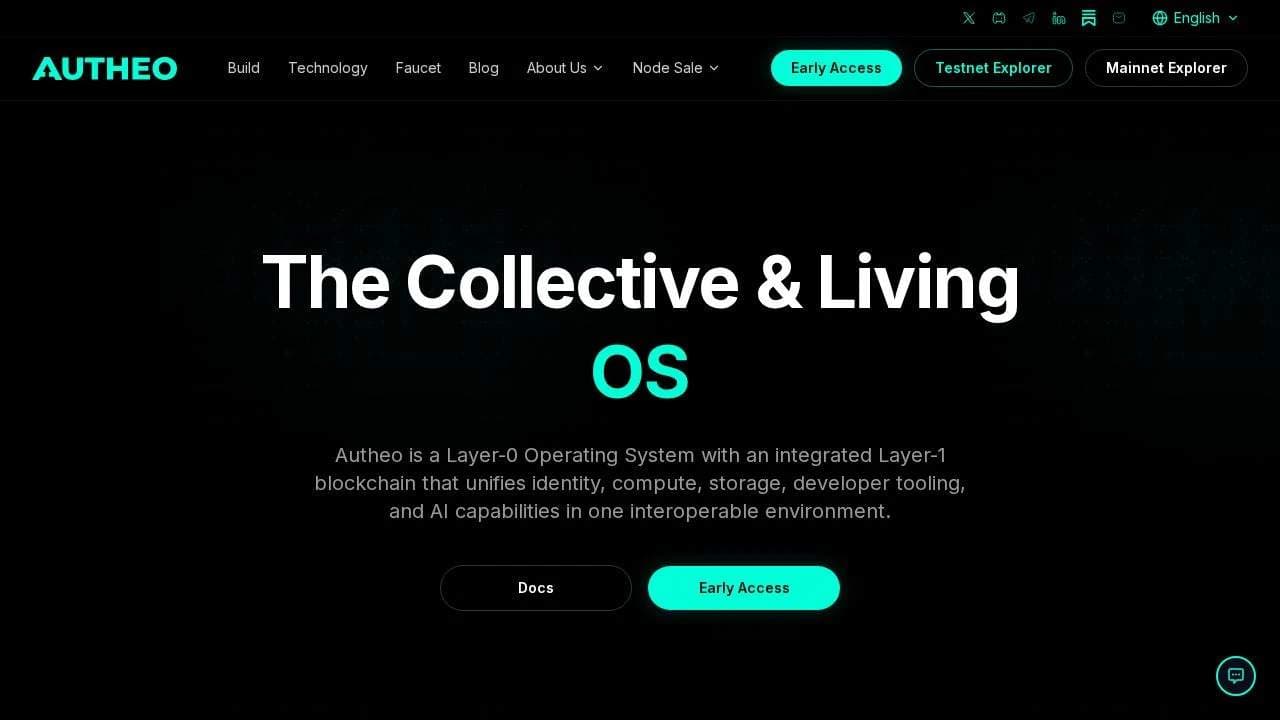
Autheo is a groundbreaking Layer-0 Operating System that integrates a Layer-1 blockchain to unify identity, decentralized compute, persistent storage, developer tooling, and AI capabilities into one interoperable environment. It solves the fragmentation problem in Web3 by offering a single stack where developers can build scalable applications without stitching together multiple services. With post-quantum secure authentication (TheoID), a native DevHub, and a living network that evolves with AI, Autheo promises a sovereign, intelligent internet. The testnet is live, and the mainnet is on the 2025-2026 roadmap. Ideal for developers, enterprises, and node operators who want to own the infrastructure, not rent it.
Drawn from the product itself, not from a survey.
Demographic
Web3 developers building dApps, DeFi protocols, or AI services
Pain points
Fragmented tooling: must integrate multiple vendors for identity, compute, storage, and AI; costly and fragile systems
Primary needs
Unified development environment, native post-quantum security, scalable off-chain compute, and integrated AI inference
Demographic
Enterprise organizations transitioning from Web2 to Web3
Pain points
Gulf between Web2 and Web3; complex integrations, lack of sovereign identity, and scalability issues
Primary needs
Seamless Web2-to-Web3 bridge, sovereign identity management, decentralized infrastructure, and enterprise-grade support
Demographic
Node operators and validators seeking staking opportunities
Pain points
Limited options for decentralized networks with high yields; need secure and scalable network participation
Primary needs
Staking rewards via THEO token, validator node sales, clear emission structure, and long-term network growth
Written by AI from measured evidence, scored out of 100.
Autheo is an ambitious Layer-0 OS + L1 play that intelligently targets real Web3 pain: fragmentation across identity, compute, storage, and AI. Native post-quantum security, unified DevHub, testnet activity, and multi-use THEO token give it credible differentiation in a crowded field. It's not perfect—lacks published performance data, full technical depth is still marketing-heavy, and many components remain unproven at scale. Scores reflect an early-stage project with strong concepts and decent execution so far (testnet with real contracts/wallets), but realistic caution on overpromising the 'sovereign intelligent internet.' Suitable for forward-looking developers and node operators, less so for those needing battle-tested production infrastructure today. Mainnet delivery in 2025-2026 will be make-or-break.
Testnet faucet, EVM-compatible explorer, and DevHub provide a decent onramp for developers. Unified SDKs and docs in one place reduce initial friction compared to stitching services, though full-stack claims need more real-world validation.
Clean, modern marketing site with professional branding and clear component illustrations. DevHub and explorer appear functional but lack standout visual innovation or delightful micro-interactions typical of leading Web3 platforms.
Testnet shows live blocks and transactions with Cosmos SDK + EVM backend. Claims of scalable off-chain compute exist, but no public TPS benchmarks or independent results yet. Activity (1,500+ contracts, 25k wallets reported) is promising for early stage but unproven at scale.
Native post-quantum cryptography (TheoID with Kyber/Dilithium/Falcon) is a genuine differentiator. Halborn audit completed on the platform. Testnet live with regular audits mentioned. Strong focus on quantum threats and sovereign identity.
Public testnet faucet, open explorer, DevHub entry point, and EVM compatibility lower barriers for Web2 developers and node operators. Enterprise bridging features and documentation help, but no specific WCAG or broad accessibility mentions.
Active testnet with reported 1,500+ smart contracts, 25k wallets, node sale, and 2025-2026 mainnet/TGE roadmap. THEO token utility across fees, staking, compute, storage, and AI creates clear demand. Strong marketing via airdrop buzz and partnerships (Zeeve). Early contributor count (>100) signals momentum.
Autheo's sleek website and DevHub deliver a polished first impression for Web3 developers tired of gluing together identity (Auth0/Ceramic), storage (Filecoin/Arweave), compute (various decentralized options), and AI services. The promise of one interoperable Layer-0 OS + L1 (EVM-compatible via Cosmos SDK) is compelling on paper. Usability benefits from native TheoID, unified SDKs, and testnet tools that reduce vendor sprawl compared to Ethereum or Solana ecosystems. However, without deep hands-on benchmarks, it's unclear if the 'single stack' truly eliminates integration headaches or simply repackages them. Design is competent but not revolutionary—functional over flashy. Early testnet activity suggests real usage, yet the experience still feels like a promising beta rather than mature infrastructure. Enterprises and dApp builders will appreciate the Web2-to-Web3 bridge rhetoric, but execution will determine if this beats the status quo of fragmented tooling.
Performance remains the big question mark. While the testnet explorer shows live activity and the team reports thousands of contracts and wallets, Autheo deliberately avoids publishing TPS or latency numbers until third-party validation—smart, but it leaves them behind Solana's proven high throughput or Ethereum's maturing L2 scaling. Decentralized compute (DCC) and storage (ABW34) plus AI inference could deliver real off-chain wins, yet these are still emerging. Security stands out positively: native post-quantum primitives in TheoID address a real future threat most chains ignore, backed by a Halborn audit. The utility token model (THEO for fees, staking, resource consumption) aligns incentives without overpromising governance. Overall, the foundation feels technically sound for a testnet project, but speed and real-world resilience need mainnet proof before it can challenge established L1s or L0s like Polkadot.
Accessibility is solid for the target audience—Web3 devs, enterprises, and node runners. Public faucet, open explorer, EVM support, and DevHub documentation make onboarding easier than piecing together multiple protocols. Sovereign identity and enterprise-grade features target the Web2-to-Web3 gap effectively. Growth indicators are healthy for this stage: active testnet, node sale for validators, airdrop campaigns, reported developer traction, and a clear 2025-2026 mainnet roadmap focused on ID, PQCNet, and DeFi. THEO token has multiple demand drivers (staking, compute, storage, AI usage), supporting long-term network effects. Compared to alternatives, Autheo offers deeper integration than Ethereum (no native identity/storage/AI), Solana (lacks post-quantum and unified OS), or Polkadot (parachain focus vs. full OS). Success hinges on delivering the 'living, evolving with AI' vision without falling into vaporware territory. Early momentum is real; sustaining it through mainnet will be the test.
Conclusion
If Autheo ships a truly cohesive stack that reduces vendor sprawl while delivering quantum-ready security and AI smarts, it could carve out a meaningful niche. Right now it's a compelling testnet worth watching and building on—especially if you're into sovereign infrastructure and hate integration hell. Just don't bet the farm until mainnet proves the vision.
Named competitors, point by point. Nobody paid to appear here or to be left out.
 Autheo Autheo |  Ethereum Ethereum |  Solana Solana |  Polkadot Polkadot | |
|---|---|---|---|---|
| Integrated Identity & Post-Quantum Security | Native TheoID with post-quantum (Kyber/Dilithium/Falcon) | None native; relies on external solutions like ENS | None native; no post-quantum focus | Limited; parachain-focused, no built-in PQC identity |
| Unified Compute, Storage & AI | Native DCC compute, ABW34 storage, THEO AI inference | Requires external (Filecoin, Arweave, various AI oracles) | High perf L1 but needs separate storage/compute/AI | Interoperability focus; limited native compute/storage/AI |
| Developer Experience (Unified Tooling) | Native DevHub + SDKs for full stack in one place | Mature but fragmented across many tools/services | Strong tooling but still requires stitching services | Parachain SDKs; interoperability over unified OS |
| Current Status & Traction | Testnet live (1.5k+ contracts, 25k wallets), mainnet 2025-26 | Mature mainnet with massive adoption and DeFi TVL | High-performance mainnet with strong ecosystem | Established L0 with live parachains |
Ethereum
Layer-1 blockchain focused on smart contracts, but lacks integrated identity, storage, compute, and AI; requires external services.
Solana
High-performance Layer-1 blockchain, but still requires separate solutions for identity, storage, and AI; no native post-quantum cryptography.
Polkadot
Layer-0 protocol with parachains, but focuses on interoperability between chains, not unified OS; less emphasis on integrated compute/storage/AI.
Comparing options? See Autheo alternatives, scored side by side
What the review was written against. A verdict with no sources is an opinion.

A no-code Solana token creator that deploys SPL tokens in...

A free, open-source platform offering 110 AI agent skills...

Open-source desktop app for switching AI coding providers...

Fast EU VAT validation API for developers, covering 27 EU...

Claw Messenger is an iMessage API service that gives AI a...

PERM Processing Time is an independent data analysis platform that helps users navigate the U.S. Department of Labor’s permanent labor certification process.

AI-powered Dubai real estate data platform with 12M+ DLD ...

BeartIMAGE is a free, web-based image processing platform engineered for fast, bulk photo editing and conversion directly in your browser.

macOS app for App Store screenshots: 3D mockups, auto-tra...

Real-time monetization infrastructure for AI products tha...

A native macOS process explorer and advanced monitor that...

A developer-first financial data API providing structured...
A platform dedicated to providing unbiased reviews of newly launched applications, analyzing everything from their features to their full potential.
info@scoutforge.net© 2026 Scoutforge. All rights reserved.