Cycling through all six. Tap any point to stop.
Measured on six things
Open-source platform that lets every team run AI agents — with isolation, spend caps, RBAC, and audit logs built in.
Growth
44191 GitHub stars on platform repo, 27 org followers. Launched ~May/June 2026 with arXiv paper. Minimal community traction.
Screenshots
1 / 1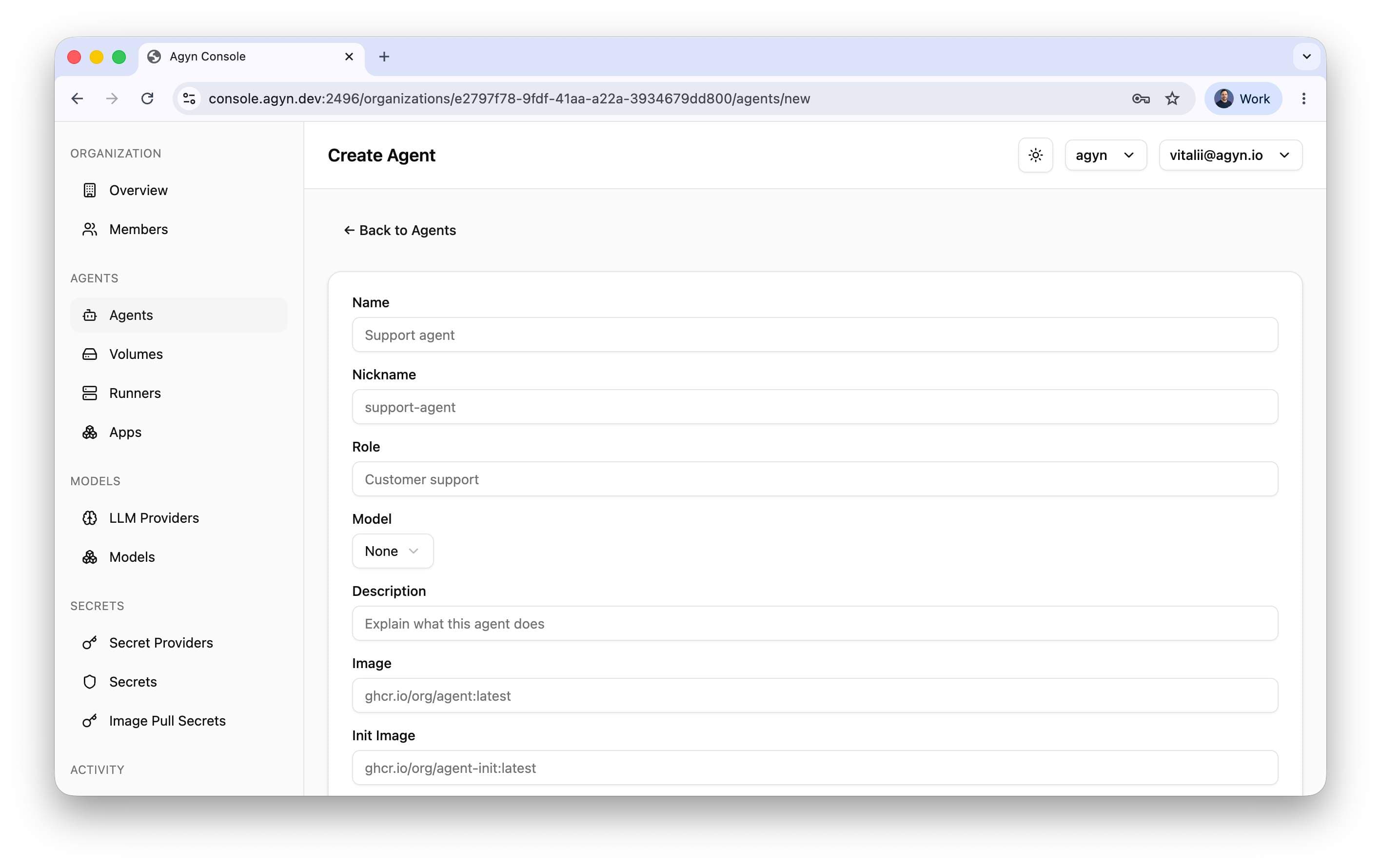
About this app
Agyn is the open-source management layer for AI agents — it takes agents off employee laptops and runs them safely across the whole organization. Every agent runs in an isolated sandbox. Secrets stay hidden from the model. Each team gets its own spend cap, role-based access, and a complete audit trail. Works with any agent (Claude Code, Codex, custom builds) and any model. Self-hosted or cloud. Built for the moment AI stops being a side project and starts touching production data — when security, finance, and IT need real controls before they say yes. Non-technical teams get agents they can actually use. Engineering keeps oversight. Finance sees every dollar spent on tokens. IT stops worrying about shadow AI. If your company is moving from agent experiments to agents in production, Agyn is the layer that makes it possible.
Key features
- 1Isolated sandboxes with secrets vault and zero-trust networking
- 2Per-team spend caps, usage alerts, and full audit trails
- 3Kubernetes-native, Terraform-managed, works with any agent/model
Target customer profile
Drawn from the product itself, not from a survey.
Demographic
Enterprise platform engineering teams
Pain points
Need to deploy AI agents internally but struggle with security, network access, and governance.
Primary needs
Secure deployment into private networks, least-privilege policies, and audit logging.
Demographic
AI/ML operations teams
Pain points
Lack budget controls and cost attribution for agent usage across teams.
Primary needs
Per-agent budgeting, usage alerts, and cost tracking.
Demographic
Security and compliance officers
Pain points
Concerned about prompt injection, data leaks, and unauthorized actions.
Primary needs
Policy gates, secrets vault, and rollback capabilities.
Scout Review
Written by AI from measured evidence, scored out of 100.
Agyn targets the exact pain point of moving AI agents from experiments to governed production use with isolation, budgets, and controls. Strengths in security architecture and open-source model are clear, but the product is too nascent for broad recommendation. Platform teams with K8s expertise may find value; others should wait for maturity.
Measure by measure
Usability
71Self-hosted via Git clone + apply.sh; works with Claude Code/Codex out of box. RBAC and per-team caps simplify governance.
Design
77Clean dashboard with real-time budget tracking, spend alerts, and team overviews. Kubernetes-native with Terraform config shown in demos.
Speed
64Serverless Kubernetes runtime with signal-driven spawning. No public benchmarks beyond their SWE-bench claim of 72.2%.
Security
81Isolated sandboxes, secrets vault (never to LLM), zero-trust networking, least-privilege, audit trails. AGPL-3.0 core.
Accessibility
51No WCAG mentions or screen-reader testing. Web dashboard exists but enterprise focus means mobile/responsive is afterthought.
Growth
44191 GitHub stars on platform repo, 27 org followers. Launched ~May/June 2026 with arXiv paper. Minimal community traction.
Improvement areas
- Lack of independent benchmarks and security audits
- Steep Kubernetes/Terraform learning curve for setup
- Minimal community traction and third-party validation
Design & Usability
Agyn's interface centers on practical enterprise controls: live budget dashboards, team spend caps, and request metrics. The Terraform-driven config and Git-based deployment feel developer-friendly for platform teams. However, the UI remains basic and the self-hosted path demands significant DevOps knowledge, limiting broader adoption beyond engineering orgs.
Speed & Security
The serverless Kubernetes runtime promises efficient on-demand execution with isolation, but lacks independent benchmarks. Security stands out with credential isolation, sandboxes, and audit logging—addressing real shadow AI concerns. Without audits or performance data, these remain promising but unverified claims for production workloads.
Accessibility & Growth
Accessibility documentation is absent, typical for early infrastructure tools. Growth is severely limited: under 200 stars, recent launch, and almost no community signals. This fits the 'early-stage' rubric perfectly—traction is minimal, making high scores inappropriate despite solid technical direction.
Conclusion
Solid foundation for enterprises serious about agent governance, but expect rough edges and a steep setup curve right now.
Suggestions for improvement
- Add public performance benchmarks and case studies
- Publish security audit or bug bounty program
- Improve onboarding docs for non-K8s teams
- Expand integrations beyond Claude/Codex
Alternatives comparison
Named competitors, point by point. Nobody paid to appear here or to be left out.
 Agyn |  LangChain |  CrewAI |  Microsoft Copilot Studio | |
|---|---|---|---|---|
| Enterprise Security & Isolation | Zero-trust networking, sandbox isolation, secrets vault | Basic agent building; no built-in enterprise isolation | Multi-agent orchestration; limited security controls | Strong MS ecosystem governance; less open |
| Cost Controls & Budgeting | Per-team spend caps, alerts, usage tracking | No native budgeting or spend attribution | Minimal cost management features | Enterprise licensing with usage monitoring |
| Open-Source & Self-Hosted | Fully open-source K8s runtime, AGPL core | Open-source framework; self-host possible | Open-source; self-host friendly | Proprietary, cloud-tied to Microsoft |
LangChain
Open-source framework for building LLM apps with some agent management, but lacks enterprise policy enforcement.
CrewAI
Framework for orchestrating multi-agent systems, but not focused on enterprise security and cost controls.
Microsoft Copilot Studio
Enterprise AI agent builder with governance, but more tied to Microsoft ecosystem and less open.
Comparing options? See Agyn alternatives, scored side by side
Sources
What the review was written against. A verdict with no sources is an opinion.
More Cloud Hosting apps
View all Cloud Hosting
Plori
87Cloud AI agents with persistent disk, memory, and real CL...

yourdrive
84YourDrive is a self-hosted file manager and media timeline that runs entirely on your own infrastructure. Organize files in nested folders, move them with drag-and-drop, search instantly, and browse photos and videos by month and year. Files stream straight to your own AWS S3, Azure Blob, MinIO, Cloudflare R2 or Wasabi storage. Install with one command. Free for personal use; teams pay per server, not per seat.

FrameCourier
83Photo & video delivery platform with no per-seat fees

Lizard
82AI-native cloud deployment platform for coding agents wit...

Easypanel
81A Docker-based server control panel for easy app deployment, database management, and SSL handling with an intuitive web interface.

N8Nitro
80Managed hosting platform for self-hosted n8n instances, eliminating DevOps overhead with auto-scaling and analytics.

NextAI
80A Next.js starter kit for AI startups, accelerating development with pre-configured integrations for auth, payments, and AI deployment.

Norse Computer
79Deploy and manage your own Hermes AI assistant in your Go...

Petabyte
79Hourly GPU rentals for AI developers from a community mar...

StarDots
79Free modern image hosting with one-click uploads, transformation tools, and CDN acceleration for fast, secure sharing.

Hostim.dev
79A simple Docker hosting platform in the EU with built-in managed services and GDPR compliance.

Speed of Light Hosting
78Ultra-fast web hosting with NVMe SSDs for speed and reliability, ideal for WordPress and Moodle sites.


A platform dedicated to providing unbiased reviews of newly launched applications, analyzing everything from their features to their full potential.
info@scoutforge.net© 2026 Scoutforge. All rights reserved.
