Sanctions screening with verifiable SHA-256 audit trails.
Growth
62
Real regulated pain, a specific wedge (SHA-256 verifiable reports, transparent match rationale) and a $29 API tier undercutting incumbents. Early stage, single social profile.
Screenshots
1 / 7
Sanctix
Sanctix
Sanctix
Sanctix
Sanctix
Sanctix
Sanctix
About this app
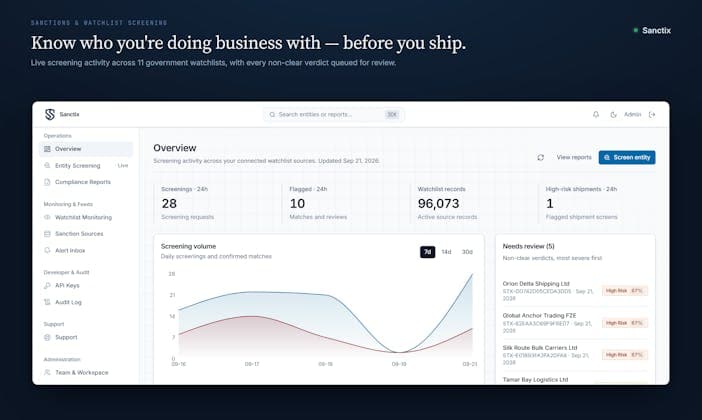
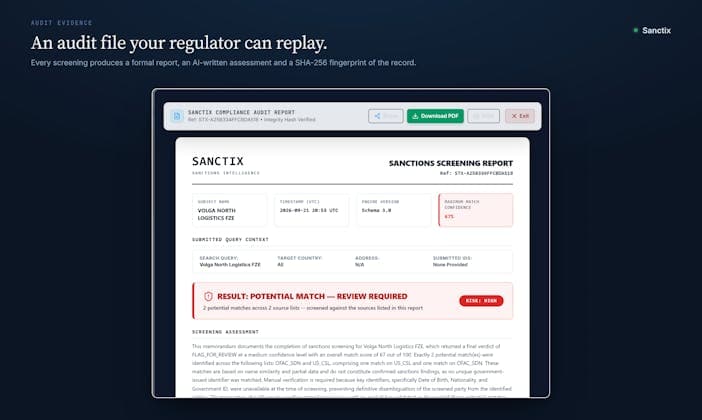
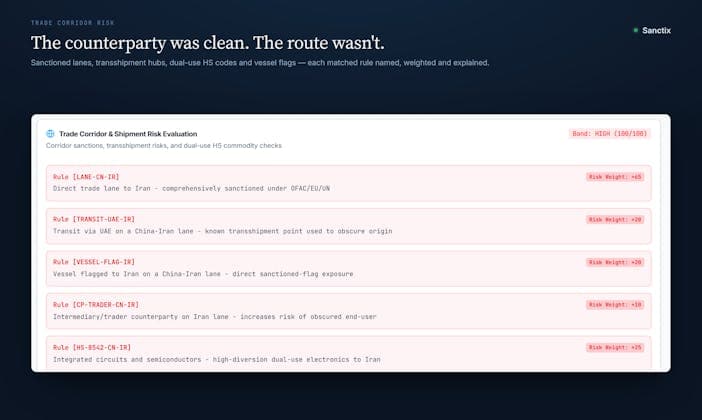
Sanctix is a modern sanctions screening and trade compliance engine that helps businesses quickly check counterparties against major global watchlists. It aggregates 11 live sources, including OFAC, EU, UN, and UK (FCDO) lists, refreshing twice daily to ensure up-to-date data. Each screening produces a detailed report with match scores and rationale, and a unique SHA-256 fingerprint for independent verification. The platform is designed for compliance teams, logistics providers, and fintech companies, offering both a user-friendly web interface and a developer API. With a focus on transparency and ease of use, Sanctix enables companies to onboard customers, partners, and shipments with confidence, reducing regulatory risk and streamlining due diligence. Whether you're a small startup or a large enterprise, Sanctix provides a scalable, audit-ready solution for global trade compliance.
Key features
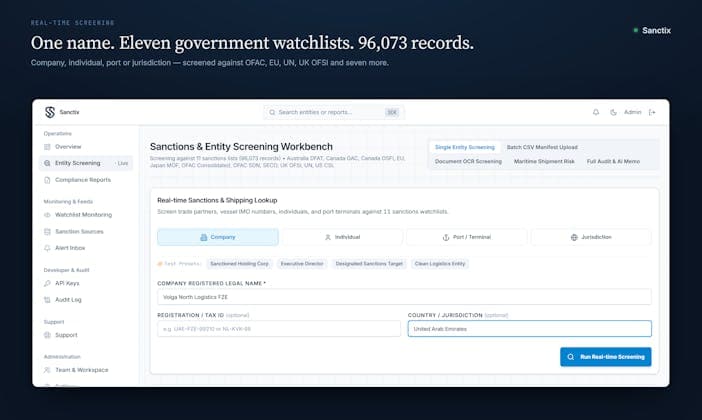
1Screens against 11 live sanctions lists (OFAC SDN/Consolidated, EU, UN, UK FCDO, SECO, Canada GAC/OSFI, Australia DFAT, Japan MOF, US CSL) refreshed twice daily.
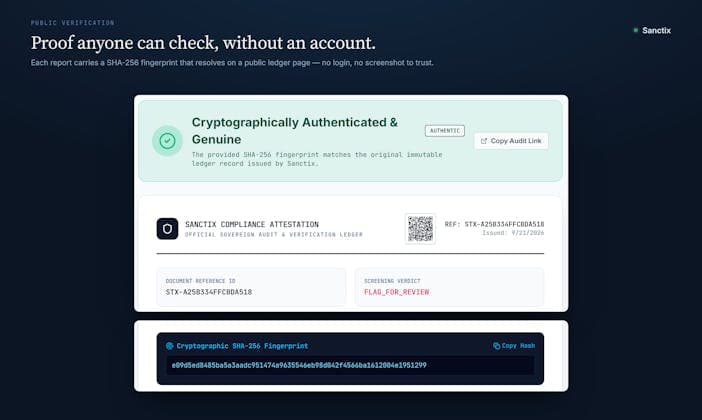
2Every saved report carries a SHA-256 fingerprint so a third party can independently verify the screening record.
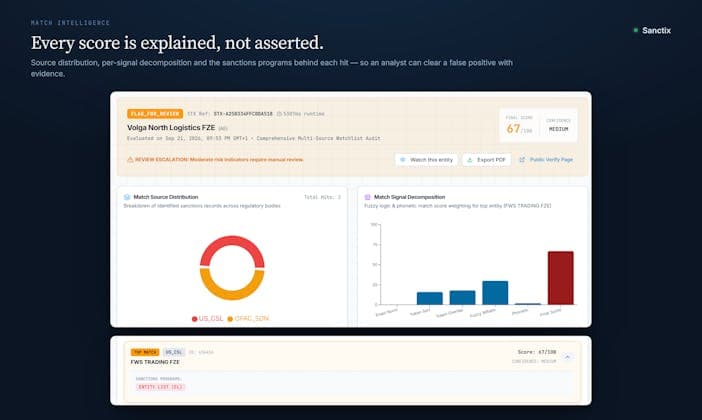
3Transparent match scoring: 0-100 per record with written rationale for capped matches, plus verdicts from CLEAR to DO_NOT_TRANSACT.
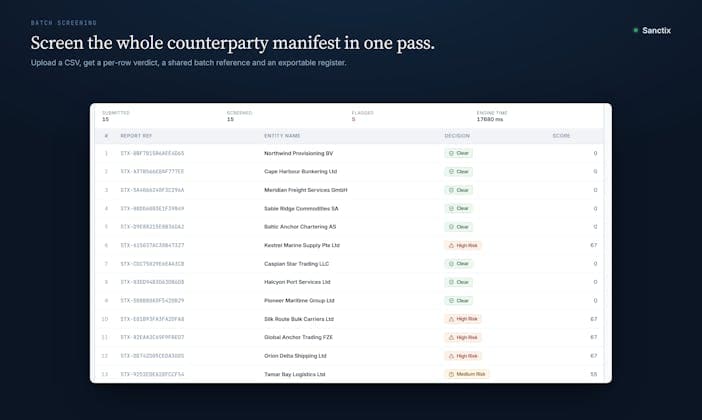
4REST API with a documented three-step curl quickstart (single screen, full screening with stored report, batch) and in-dashboard API key generation.
Target customer profile
Drawn from the product itself, not from a survey.
Demographic
Compliance officers in financial institutions
Pain points
Manual screening is slow and error-prone; auditors demand verifiable records.
Primary needs
Automated, reliable screening with audit trails and easy verification.
Demographic
Logistics and shipping companies
Pain points
Need to vet partners and shipments quickly to avoid penalties and delays.
Primary needs
Fast, accurate sanctions checks integrated into existing workflows.
Affordable, API-driven screening with clear documentation.
Demographic
Legal and consulting firms
Pain points
Clients require thorough due diligence on third parties.
Primary needs
Comprehensive reports with evidence of screening for legal defensibility.
Human reviews
What people found in Sanctix
Written by Scout Forge members. We do not verify that a reviewer purchased or installed the app.How we handle reviews
Paid review
Funded by the developer, who could not block publication — and the reviewer was paid the same either way.
10credits
Aeris
Oct 09, 2026
Signed up for the trial and ran three checks: Sovcomflot (sanctioned), Maersk (should be clean) and "Arkadi Rottenberg", a misspelled sanctioned name, to see if the fuzzy matching holds up.
Honestly the engine is good. Sovcomflot came back 100/100 Do Not Transact in about a second, and it showed which alias matched and every list it's on. Maersk came back clean. The misspelled Rotenberg still got flagged at 76, which is exactly what I'd want. The verify page works too. I changed one character of the hash and it said mismatch right away.
Stuff that bugged me:
- The PDF headline says "POTENTIAL MATCH - REVIEW REQUIRED" for Sovcomflot, but the dashboard and the summary right under it say Do Not Transact. That's the document people will actually hand to auditors, so it should say the same thing.
- If you open /signup directly (new tab, refresh, or the pricing page buttons), it kicks you to login with "your session has expired". I hadn't even signed up yet. It only works if you click through from the homepage.
- In the Sovcomflot report, a couple of OFAC "IDs" are actually dates (effective date / listing date), and the AI summary calls them ID numbers.
- Rotenberg shows up as 3 different people because the Japan and Canada entries didn't get merged with the others.
- Small things: the sidebar shows my user ID instead of my name, and the cookie popup comes back on every subdomain.
A solid tool overall. I'd just fix the PDF and the signup link first.
Test an app and get paid in credits
Developers fund these. You keep the credits whatever your verdict.
Scout Review
Written by AI from measured evidence, scored out of 100.
Re-reviewed Oct 13, 2026 · previously 80/100
Sanctix is a sanctions and trade-compliance screening engine that aggregates 11 live watchlists — OFAC SDN and Consolidated, EU, UN, UK FCDO, SECO, Canada GAC and OSFI, Australia DFAT, Japan MOF, US CSL — refreshing twice daily, roughly 59,579 records in total. Every screening returns a verdict (CLEAR through DO_NOT_TRANSACT), a 0-100 match score with per-record rationale, and a SHA-256 fingerprint on saved reports so a third party can verify the record independently. That fingerprint is the sharpest thing here: in a category where 'we screened them' is normally an unverifiable assertion, it turns a claim into evidence. The pricing is aggressive and unusually legible — a $0 14-day trial with 25 screenings, $49 Starter, $199 Growth, $29 API Developer, $249 API Scale, and custom Enterprise — with overage rates published rather than hidden. The site is fast on desktop, cleanly designed, and the docs page now carries a working curl quickstart. The weaknesses are the ones that matter to a compliance buyer: no CSP header, no SOC 2 or ISO documentation, no accessibility statement, and a mobile LCP of 5.6s. It is a well-built early-stage tool with a genuinely good idea and a paperwork problem.
Measure by measure
Usability
68
Free 14-day trial, no credit card, and a live /docs page with a three-step curl quickstart. Dashboard nav uses many similar-weight items; help center depth unverified.
Design
71
Clean, single-accent blue system with a realistic example result card and legible dashboard screenshots. Pricing cards are dense and maker media breaks the light theme.
Speed
70
Lighthouse desktop 93/100 and mobile 78/100. TBT 19ms and CLS 0 are excellent; a 5.6s mobile LCP is the one number dragging the score down.
Security
74
HTTPS enforced with HSTS, frame protection, Referrer-Policy, Permissions-Policy, SPF and DMARC. No CSP, and no SOC 2, ISO or pen-test documentation published.
Accessibility
79
Lighthouse accessibility 97/100, with two failing audits: insufficient color contrast and visible text labels lacking matching accessible names. No WCAG statement published.
Growth
62
Real regulated pain, a specific wedge (SHA-256 verifiable reports, transparent match rationale) and a $29 API tier undercutting incumbents. Early stage, single social profile.
Improvement areas
No published SOC 2, ISO 27001 or penetration-test documentation despite an audit-readiness positioning.
Missing Content-Security-Policy header; the remaining 10/12 security headers are present.
Mobile Lighthouse LCP of 5.6s drags mobile performance to 78/100 versus 93/100 on desktop.
Two failing accessibility audits (color contrast, accessible label names) and no published WCAG conformance statement.
Design & Usability
Sanctix's homepage does the hard thing well: it shows the product instead of describing it. The example screening result — Bank Markazi Iran, 100/100, DO NOT TRANSACT, eight listed parties with per-record scores and capped-match explanations — is the most persuasive element on the page, because it demonstrates the actual reasoning engine rather than a stock dashboard. The single blue accent keeps CTAs and badges coherent, and the dashboard screenshots read as real software. Where it slips is density: the pricing section stacks five tiers with long feature lists, and the dark maker-media images sit awkwardly against the light page. On usability, the funnel is short — free 14-day trial, no credit card, first screening under two minutes — and the /docs page now carries a genuine three-step curl quickstart covering single screen, full screening with a stored report, and batch. API keys are generated in-dashboard and shown once, which is correct practice. The gaps are depth: the dashboard sidebar uses many similar-weight items with weak grouping, and the help center's actual breadth could not be confirmed from the collected content.
Speed & Security
Speed is a tale of two devices. Lighthouse desktop lands at 93/100, and the underlying metrics are strong — total blocking time of 19ms and a cumulative layout shift of 0 mean the page is light and stable once it starts painting. Mobile is where it stumbles: 78/100 with a 5.6s largest contentful paint, which is the kind of number that costs you a visitor on a phone in a warehouse. Nothing in the collected evidence suggests a heavy SPA or a laggy app; this looks like an unoptimized hero asset or render-blocking resource rather than an architectural problem. Security is solidly above average for the stage. The HTTP probe confirms HTTPS enforcement, HSTS, frame protection, X-Content-Type-Options, Referrer-Policy, Permissions-Policy, plus SPF and DMARC on the mail side — 10 of 12 checklist points. The two absences matter for this specific product: no Content-Security-Policy, and no published SOC 2, ISO 27001 or penetration-test documentation. For a tool whose pitch is handing auditors a verifiable record, the compliance paperwork is the missing half of the story.
Accessibility & Growth
Accessibility scores 97/100 on the automated Lighthouse audit, which is strong, but the two failures are instructive: insufficient color contrast, and visible text labels without matching accessible names. Both are fixable in an afternoon and both hit exactly the colored status pills and score badges that carry the product's most important information — the verdict. There is no published WCAG conformance statement and the site is English-only, so the automated score is the ceiling of what can be verified, not the floor. Growth is the more interesting question. Sanctix is aimed at a real, non-optional problem: sanctions screening is legally mandated, the lists change twice daily, and getting it wrong means fines. The wedge against the listed alternatives is specific and demonstrable — a SHA-256 fingerprint on every saved report that a third party can independently verify, plus transparent match rationale showing why a name was capped at 64/100 rather than silently flagged. Refinitiv World-Check is expensive and heavy, ComplyAdvantage is priced for larger teams, and Sanction Scanner lacks the verifiable fingerprint. Sanctix's $29 API Developer tier and $49 Starter tier sit underneath all of them. The honest limit: screening engines are only as good as their match quality, and the incumbents' moat is curated data and decades of false-positive tuning, not features. Sanctix aggregates 11 public lists — the same lists anyone can download. The fingerprint is a real differentiator, but it is a trust feature, not a data moat.
Conclusion
The question a compliance officer actually asks is not 'does it screen names' — every tool does that — but 'when the regulator asks how I know, what do I hand them.' Sanctix's answer is a SHA-256 fingerprint and a printable report, which is a better answer than most tools at this price point give. The $29 API Developer tier and the $49 Starter tier put real screening within reach of the independent trader and the two-person fintech that World-Check priced out, and the transparent match rationale — showing why a name capped at 64/100 instead of just flagging it — is the kind of thing that builds analyst trust over time. What holds it back from a higher verdict is not the product, it is the proof: no SOC 2, no ISO 27001, no CSP, no accessibility statement. For a tool selling audit-readiness, those documents are not optional garnish, they are the product. Ship the compliance page, fix the mobile LCP, publish a WCAG statement, and this moves up a tier quickly.
Suggestions for improvement
Publish a security and compliance page with SOC 2 status, ISO 27001 roadmap, and a penetration-test summary — this is the missing half of an audit-readiness pitch.
Add a Content-Security-Policy header; the current 10/12 header score is strong but CSP is the one that matters when rendering user-supplied entity names.
Fix the two failing accessibility audits: raise contrast on the colored verdict pills and score badges, and give visible text labels matching accessible names.
Cut mobile LCP from 5.6s by optimizing the hero asset and deferring non-critical scripts; desktop is already at 93/100, so the gap is mobile-specific.


 Sanctix
 Refinitiv World-Check
 Sanction Scanner
 ComplyAdvantage


