Cycling through all six. Tap any point to stop.
Measured on six things
SevenGrid shows your whole week on one screen. A missed day is an empty cell, not a broken streak. No account, no ads, pay once.
Growth
62A real, named problem (streak guilt) with a cited study behind the fix, plus 'At most' goals and rest days that Streaks and Habitica structurally won't copy. Early — no iOS ratings yet, domain under a year old — but the wedge is genuine.
Screenshots
1 / 1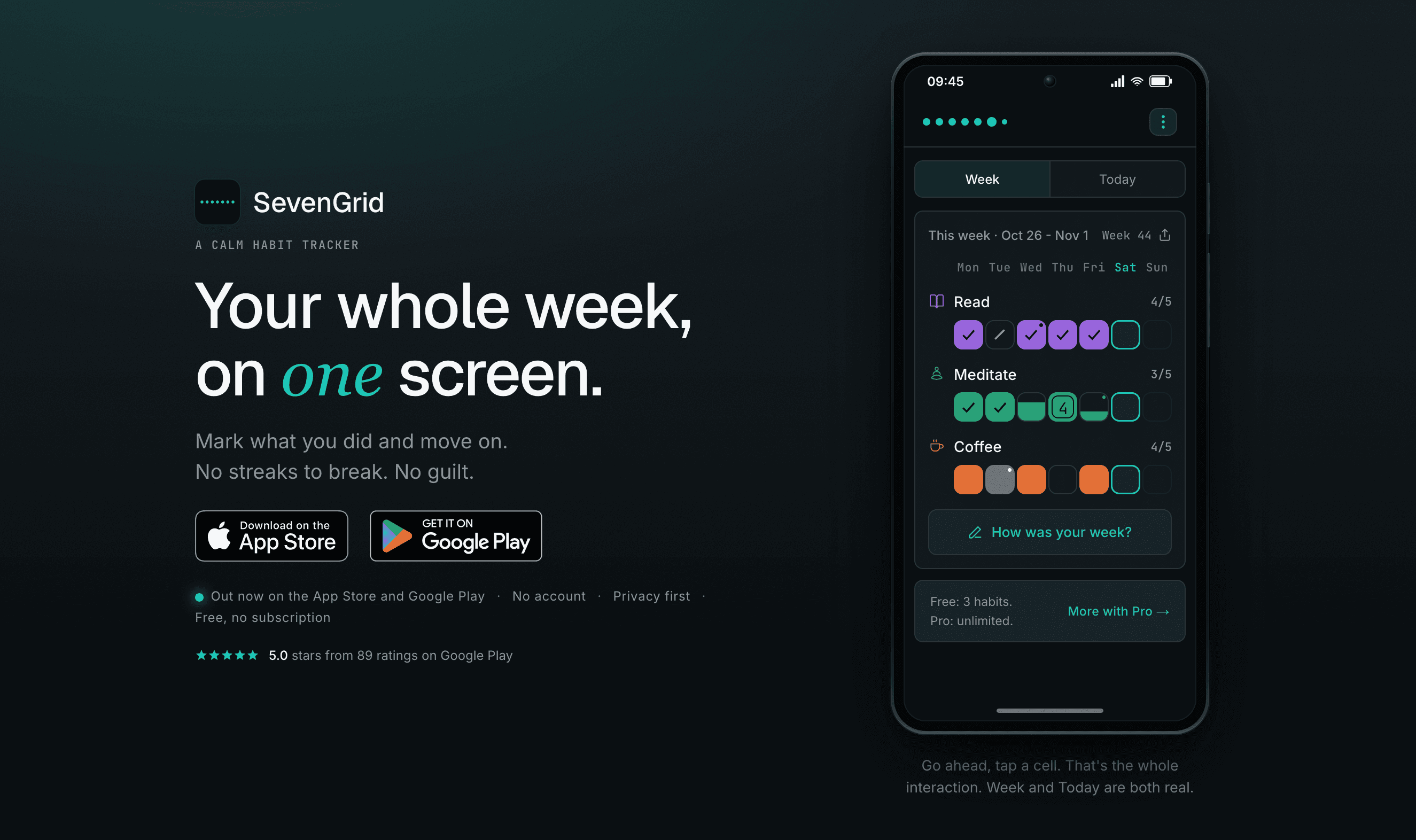
About this app
SevenGrid is a calm, private habit tracker for iPhone and Android that shows your whole week on one screen. Every habit is a row, every day is a tap. There are no streaks: a missed day stays an empty cell instead of resetting a counter, and the next week starts fresh. Rest days for illness or travel and "at most" goals for things you want less of, like coffee or scrolling, are built in. Everything stays on your device: no account, no cloud, no ads. Free for up to three habits; a one-time purchase unlocks the rest, never a subscription. Available in English and German. Home screen widgets are available on Android. It is for people who gave up on habit apps because one missed day felt like failure, and for anyone who wants their habit data to stay on their own phone. Built and maintained by one person in Germany.
Key features
- 1Week-grid habit tracking with no streaks: a missed day stays an empty cell instead of resetting a counter.
- 2Rest days and 'At most' goals for reduction habits like coffee or scrolling, with soft grey feedback instead of red.
- 3Fully offline, no account, no cloud, no ads, no analytics — with complete CSV/JSON export of your data.
- 4One-time purchase unlocks unlimited habits; free tier covers three habits with no subscription.
Target customer profile
Drawn from the product itself, not from a survey.
Demographic
Busy professionals and parents (30–50) who have cycled through multiple habit trackers and abandoned each within weeks
Pain points
Streak guilt and reset anxiety; overbuilt dashboards that demand daily attention; subscription fatigue for a simple routine
Primary needs
A zero-friction weekly overview, missed days that don't punish, and a one-time purchase with no recurring fees
Demographic
Privacy-conscious Android and iOS users who avoid accounts, cloud sync and data collection
Pain points
Sign-ups, email collection and analytics trackers baked into wellness apps; unclear data policies
Primary needs
Fully offline operation, no account, transparent tracker scan, and complete CSV/JSON export of personal data
Demographic
Reduction-focused habit builders (quitting coffee, social scrolling, takeout) rather than 'do more' users
Pain points
Most trackers only reward hitting a daily target; overshoot is shown as failure in red
Primary needs
An 'At most' goal direction, soft grey feedback when over the limit, and weekly rather than daily framing
Demographic
Reflective self-improvers who enjoy journaling, mood logging and weekly reviews but dislike gamification
Pain points
Gamified streaks feel childish; journalling apps are separate from habit data; blank-page paralysis
Primary needs
A guided three-question weekly reflection, mood-and-active-days observation, and a year-at-a-glance tile view
Scout Review
Written by AI from measured evidence, scored out of 100.
SevenGrid is a habit tracker that removed the thing every other habit tracker is built on. No streaks, no counters, no red. A missed day is an empty cell and the week moves on. That's a genuine product thesis, not a marketing angle, and it's backed by a cited study rather than vibes. The execution matches: a clean week grid, twenty themes, eighteen colors, name-and-color onboarding, and a live demo you can tap before installing. The privacy architecture is the real differentiator — no account, no cloud, no analytics, full CSV/JSON export — and it's paired with a genuinely tight security posture on the site. The gaps are honest ones: touch targets too small for a tap-driven app, contrast failures, no accessibility statement, no published audit, and no cross-device backup beyond manual export. At 62 growth and 66 accessibility against 82 speed, this is a well-built indie product with a clear idea and a few fixable edges.
Measure by measure
Usability
71Name-and-color onboarding means value in one tap, and the homepage demo lets you try the grid before installing. No account, no sync, no setup wizard. The trade-off is no cross-device restore — export is the only backup path.
Design
74Judging the app UI from store screenshots and the live site demo: a disciplined week grid, 18 habit colors, 20 themes that carry through consistently. Calm, legible, and clearly ahead of Loop's utilitarian look, though not as crafted as Streaks.
Speed
82Lighthouse mobile 94/100 with CLS 0 and TBT 0ms; desktop a clean 100. The only blemish is a 2.6s mobile LCP, just over the 'good' line, almost certainly the demo phone image. Snappy for a marketing site with a live interactive demo.
Security
76Full 12/12 header and DNS checklist — HSTS, CSP, frame protection, SPF, DMARC all set. The offline, no-account architecture removes most breach surface entirely. No published audit, pen-test or bug bounty, which is normal at this stage but caps the score.
Accessibility
66Lighthouse a11y 94/100 but three real failures: contrast, touch target sizing, and label/accessible-name mismatches — the last two matter a lot for a tap-a-cell app. Two languages shipped, no WCAG statement published.
Growth
62A real, named problem (streak guilt) with a cited study behind the fix, plus 'At most' goals and rest days that Streaks and Habitica structurally won't copy. Early — no iOS ratings yet, domain under a year old — but the wedge is genuine.
Improvement areas
- Touch targets and color contrast fail the accessibility audit — critical for a tap-driven grid interface.
- No cross-device backup or restore beyond manual CSV/JSON export; a lost phone means lost history.
- No published security audit, pen-test, bug bounty or security.txt despite a strong header posture.
- No accessibility conformance statement or WCAG claim anywhere on the site.
Design & Usability
SevenGrid is judged on its app UI, not its landing page, and the app UI holds up: one row per habit, seven columns, a tap fills a cell. Eighteen colors and twenty themes that actually propagate through the interface rather than being a settings-page afterthought. Against Loop Habit Tracker's functional-but-plain Android look and Streaks' award-winning polish, SevenGrid sits comfortably in between — calmer than Loop, less precious than Streaks. Usability is where the philosophy pays off: onboarding is a name and a color, the homepage demo lets you tap before you install, and there is no account to create, no sync to configure, no wizard to dismiss. The cost of that simplicity is real — with no cloud, a lost phone means a lost year unless you exported. That's a deliberate trade, but it's a trade.
Speed & Security
The marketing site is genuinely fast: Lighthouse mobile 94 with zero total blocking time and zero cumulative layout shift, desktop a perfect 100. The one soft metric is a 2.6-second mobile LCP, just past Google's 'good' threshold, which points at the interactive demo phone as the heaviest asset — compressible, not structural. Security is the quiet strength. The HTTP probe returned a full 12/12: HSTS, CSP, frame protection, X-Content-Type-Options, Referrer-Policy, Permissions-Policy, plus SPF and DMARC on the domain. More importantly, the architecture does the heavy lifting — no account, no cloud, no ads, no analytics, habit data on-device. You cannot leak a database you never built. What's missing is the paperwork: no SOC 2, no pen-test summary, no bug bounty, no security.txt. For a one-person offline app that's an understandable gap rather than a red flag, but it's why this lands at 76 and not higher.
Accessibility & Growth
Accessibility is the weakest measured dimension and the failures are pointed rather than cosmetic. Lighthouse scores 94, but three audits fail: insufficient color contrast, touch targets that are too small or too tightly spaced, and visible text labels that don't match their accessible names. For an app whose entire interaction model is tapping small cells in a dense grid, the touch-target finding isn't a checkbox — it's the core gesture. Two languages ship (English, German), which is a real plus, but there's no WCAG conformance statement anywhere. Growth is the most interesting question. The problem is real and named precisely: streak resets make people quit, and the site cites Silverman and Barasch's 2023 Journal of Consumer Research paper to back it. The differentiators are structural — 'At most' goals for reduction habits, rest days that don't count as misses, a three-question weekly reflection — and Streaks and Habitica can't copy them without abandoning their core mechanic. Traction is thin (no iOS ratings yet, domain under a year old), but the wedge is real and the segments are specific.
Conclusion
If you've deleted three habit trackers because a broken streak made you quit, SevenGrid is aimed directly at you and it earns the shot. The one-time purchase and offline-only data model are the right answers to subscription fatigue and privacy anxiety respectively. Before you commit a year of habits to it, export once and confirm the CSV actually restores — that's the only real risk in the whole design. And if you're on Android with larger hands or a smaller screen, test the tap targets in the demo first; the audit says they're tight and the audit is probably right.
Suggestions for improvement
- Increase touch target size and spacing in the week grid — the core gesture is failing its own accessibility audit.
- Fix the contrast failures flagged by Lighthouse and publish a short WCAG 2.1 AA conformance statement.
- Add an in-app reminder to export a backup, or an encrypted local file export, so a lost phone isn't a lost year.
- Compress the hero demo asset to pull mobile LCP under 2.5s and close the last speed gap.
Alternatives comparison
Named competitors, point by point. Nobody paid to appear here or to be left out.
 SevenGrid |  Habitica |  Streaks | Loop Habit Tracker | |
|---|---|---|---|---|
| Streak mechanic | None — deliberately removed; missed days stay empty | Core mechanic — streaks drive XP and party quests | Core mechanic — built entirely around preserving streaks | Streak counters and score-based charts |
| Pricing model | Free for 3 habits; one-time purchase for unlimited | Free with optional subscription (~$5/mo) | One-time purchase on iOS | Free and open source |
| Data privacy / offline | Fully offline, no account, no cloud, no analytics | Account required; cloud-synced social RPG data | On-device with optional iCloud sync | Offline local storage; open-source, no account |
| Reduction ('at most') goals | Built in — at-most limits with soft grey over-limit feedback | Not supported; positive-action habits only | Limited — negative habits exist but streak-framed | Not supported |
| Weekly reflection / journaling | Guided three-question weekly reflection with mood | None — gamification instead of reflection | None | None — charts only |
| Platforms | iOS and Android; Android home screen widgets | iOS, Android, web | iOS, watchOS, macOS | Android only |
Habitica
Gamified habit tracker that turns routines into an RPG with XP, streaks and party quests — great if the game motivates you, stressful if it doesn't.
Streaks
Polished Apple Design Award-winning iOS tracker built around streak preservation, which is exactly the mechanic SevenGrid deliberately rejects.
Loop Habit Tracker
Free, open-source Android habit tracker with strong charts and offline data; leaner on theming and reflection than SevenGrid.
Comparing options? See SevenGrid alternatives, scored side by side
More Health Applications apps
View all Health Applications
StoryPad
92Privacy-first open source journal app with a continuous t...

Pushup RPG: Fitness Quest
90Pushup RPG is a camera-based push-up counter and fitness RPG for home workouts. Real push-ups and squats become attacks as you defeat 48 foes across 8 biomes, earn XP and loot, join guilds, and battle in live 40-second duels. Free on iOS and Android.

Gryper
89Workout tracker with muscle heatmaps and volume landmarks

Snapkin: Photo Calorie Counter
88Snapkin is a calorie tracker you use by photographing your plate.

Innermost
87An AI-powered emotional support app that acts as a person...

Timix - A Modern Timer
84Turn timers into powerful routines with automation, widge...

FitLifeBud
84AI meal plans for your week, with one aisle-sorted shopping list

TheBean.ai
84Adaptive AI personal trainer that evolves with your progr...

WellWired
84AI explained simply for older adults, with safety lessons...

Rael Miracle Patch Pimple Patches
82Top-rated hydrocolloid and microneedle pimple patches for...

RAADS-R Test
82Free 80-item RAADS-R autism self-assessment for adults, with instant total and domain scores, privacy-first access, and clear non-diagnostic guidance.

FormBlends
82A personalized GLP-1 weight loss platform offering physic...


A platform dedicated to providing unbiased reviews of newly launched applications, analyzing everything from their features to their full potential.
info@scoutforge.net© 2026 Scoutforge. All rights reserved.
