Cycling through all six. Tap any point to stop.
Measured on six things
Chat with your bank accounts in plain English for clear m...
Security
52HTTPS enforced with SPF and DMARC, and the read-only Plaid model plus 'never moves your money' is the right architecture for a finance app. But the header probe found 4/12 checklist points — no HSTS, CSP, or frame protection — and no SOC 2, pen-test, or bug-bounty claims.
Screenshots
1 / 1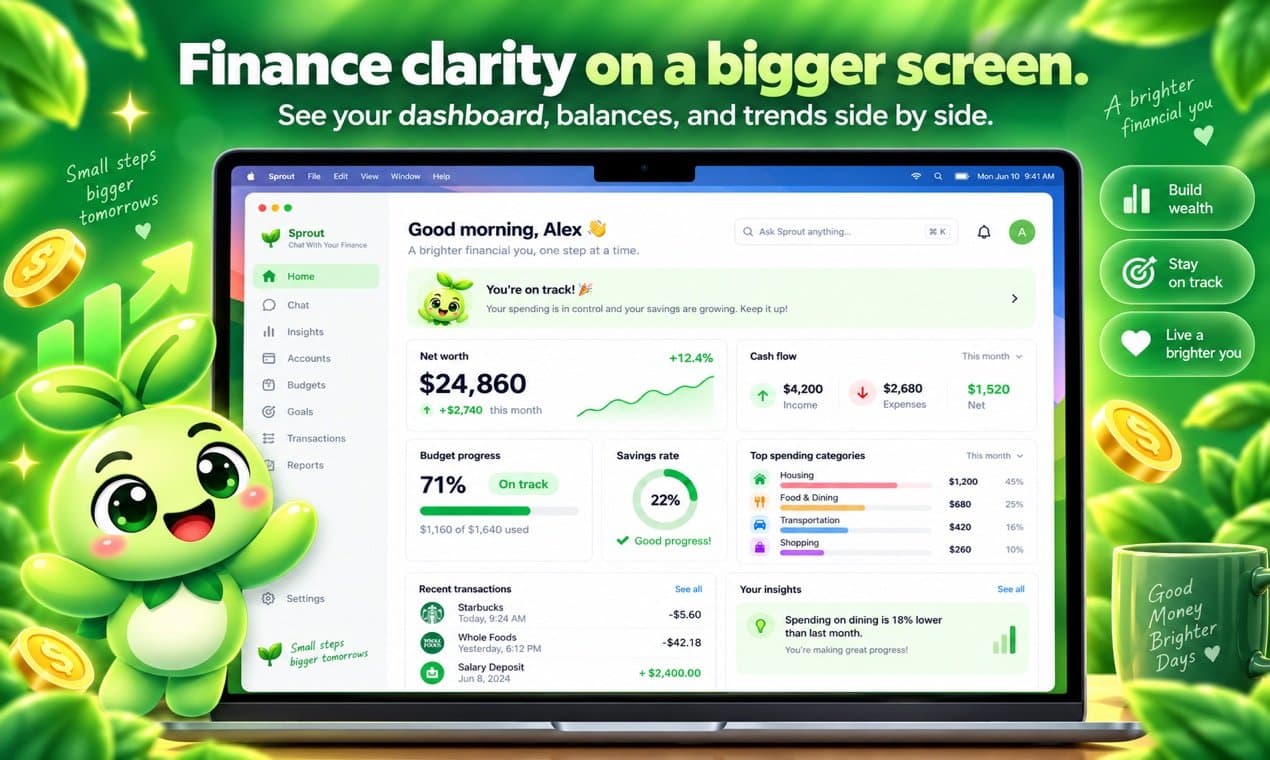
About this app
Sprout AI is a personal finance app that lets you connect your bank accounts read-only and then ask questions in natural language. It pulls fresh transaction data via Plaid, so you can ask where your money went, which subscriptions you're paying, if you can afford a purchase, and more. The app provides answers with receipts—showing the accounts and dates behind each number. It works on iPhone, iPad, Mac, web, and even inside Claude via a plugin. Key features include automatic expense tracking, subscription detection, cash flow analysis, duplicate charge alerts, and a gamified daily check-in with a growing plant. Sprout never moves money, and your bank login stays with your bank. Pricing is $9.99/week or $99.99/year with a 3-day free trial. It's ideal for people who want quick, conversational insights without manually categorizing transactions.
Key features
- 1Natural-language Q&A over read-only Plaid bank connections, with answers showing accounts and dates behind each number.
- 2Automatic expense tracking, subscription detection, cash flow analysis, and duplicate-charge alerts without manual categorization.
- 3Gamified daily Money Minute check-in with a growing plant, plus weekly/monthly Money Wrapped and a Spending Roast.
- 4Cross-platform: iPhone, iPad, Mac, web, widgets, Live Activity, Siri, Shortcuts, and a Claude connector.
Target customer profile
Drawn from the product itself, not from a survey.
Demographic
Busy professionals aged 25-45
Pain points
No time to manually track expenses or build budgets; confused by where money goes each month.
Primary needs
Quick answers about spending, cash flow, and affordability without effort.
Demographic
Freelancers and gig workers
Pain points
Irregular income makes budgeting hard; need to track business vs personal expenses.
Primary needs
Clear view of cash flow, subscription costs, and tax-deductible spending.
Demographic
Young adults and students
Pain points
Overwhelmed by traditional budgeting apps; forget about subscriptions; impulsive spending.
Primary needs
Simple, engaging way to understand spending and build better habits.
Scout Review
Written by AI from measured evidence, scored out of 100.
Sprout AI is a well-branded, fast, conversational personal finance app built on read-only Plaid connections, with a coherent green-and-mascot identity and an answer format that shows its receipts. The idea is sound and the execution is above-average for an indie finance tool. The gaps are concrete: a homepage demo that shows a question without an answer, a clipped store screenshot, thin security headers for a product that touches bank data, single-language localization, and a category full of well-funded incumbents already shipping AI categorization. It's a promising v1.1.8, not a finished product.
Measure by measure
Usability
63Clear path to value: bright 'Try it free on iPhone' CTA, 3-day trial, one-plan pricing, and a genuinely useful /guides library. Tab bar with icon+label is legible. Small-text density on the homepage and a single 5/5 rating leave the learning curve unproven.
Design
70Judging the app UI and store material: a coherent green-and-mascot brand system carries from hero to screenshots, and the Ask Sprout answer format reads as trustworthy. Undercut by a blank homepage demo panel and a clipped store card.
Speed
71Lighthouse mobile 81/100 with a 906ms LCP and near-zero CLS — the page paints fast. Desktop 79/100 and a 686ms TBT show some main-thread work, but nothing that reads as sluggish. No lag complaints in the collected evidence.
Security
52HTTPS enforced with SPF and DMARC, and the read-only Plaid model plus 'never moves your money' is the right architecture for a finance app. But the header probe found 4/12 checklist points — no HSTS, CSP, or frame protection — and no SOC 2, pen-test, or bug-bounty claims.
Accessibility
79Lighthouse accessibility 100/100 on automated checks, responsive layout, and strong CTA contrast. Held back from the top of the band by single-language localization and no published WCAG statement — automated axe checks only cover part of the picture.
Growth
58Real problem, real wedge: ask in plain English and get the number with receipts, plus a Claude connector and a gamified daily check-in. But Monarch, Copilot, and Rocket Money already ship AI categorization, so the moat is UX, not data.
Improvement areas
- Homepage 'Ask anything' demo shows a question with a blank answer panel; a store screenshot has clipped text.
- Security headers incomplete (4/12 checklist points): no HSTS, CSP, frame protection, or Referrer-Policy; no SOC 2/pen-test claims.
- Single-language localization and no published WCAG/accessibility statement; faint low-contrast mono microcopy.
- Only one App Store rating (5/5) — no meaningful social proof or user-review evidence of the learning curve yet.
Design & Usability
Sprout AI's design story is stronger than most indie finance apps: a consistent green-and-mascot system runs from the homepage hero through the App Store screenshots, and the Ask Sprout answer format — number, breakdown, source, date range — is exactly the right visual argument for a trust-based product. The problems are execution-level: the homepage 'Ask anything' demo shows a question and then a blank panel where the answer should be, and one published store screenshot has a suggested-question card clipped mid-text. Usability is competent rather than remarkable. The bright lime 'Try it free on iPhone' CTA, the 3-day trial, the single-plan pricing, and a genuinely useful /guides library of money explainers all lower the barrier. The app's tab bar (Today, Spending, Ask, Accounts) is legible and the persistent Ask input signals the core interaction. What's missing is proof: a 5/5 rating from one reviewer tells you nothing about the learning curve, and the dense small-text regions on the homepage will hurt on phones.
Speed & Security
Speed is a genuine strength. Lighthouse mobile scored 81/100 with a 906ms LCP and a CLS of 0.019 — the page paints fast and doesn't jump around. Desktop came in at 79/100, and the 686ms TBT is the only real drag, suggesting some main-thread work that could be trimmed. No user complaints about lag appear in the collected evidence. Security is the weaker half. The architecture is right: read-only Plaid connections, no money movement, bank credentials staying with the bank, and a /guides explainer on how Plaid works. SPF and DMARC are configured. But the HTTP probe found only 4 of 12 checklist points — no HSTS, no CSP, no frame protection, no X-Content-Type-Options, no Referrer-Policy, no Permissions-Policy. For an app that reads bank statements, that's a gap worth closing, and there are no SOC 2, ISO, pen-test, or bug-bounty claims on the site to compensate.
Accessibility & Growth
Accessibility scores well on the measurable parts: Lighthouse's axe-core audit returned 100/100, the site is responsive, and CTA contrast is strong. The caveats are real but not damning — the app is localized in one language, there's no published WCAG or accessibility statement, and the very small, low-contrast mono microcopy on the homepage is exactly the kind of thing automated audits underweight. Growth is the more interesting question. The problem Sprout names is real and specific: busy professionals and freelancers who won't categorize transactions but will ask 'where did my money go?' The wedge — plain-English Q&A with receipts, a Claude connector, and a gamified daily check-in — is a genuine UX differentiator. But the category is crowded: Monarch Money owns the comprehensive-budgeting slot, Copilot Money owns the beautiful-AI-categorization slot, and Rocket Money owns subscription hunting. Sprout's moat is interface, not data or network effects, which caps how far it can compound. The domain was registered in January 2026 and the store rating is 5/5 from a single reviewer — early, but that's context, not the verdict.
Conclusion
If you're a busy professional or freelancer who wants to ask 'can I afford this?' and get a real number with a source, Sprout is worth the 3-day trial — the core interaction is the right one and the app is fast. If you need deep budgeting, net-worth tracking, or collaborative planning, Monarch or Copilot will serve you better today. The single biggest thing Sprout could do to earn trust is publish a security page with real headers and a pen-test or SOC 2 roadmap; the second is to fix the demo panel and the clipped screenshot, because those are the first things a skeptical buyer sees.
Suggestions for improvement
- Fix the homepage 'Ask anything' demo so it shows a real answer with breakdown and source — the blank panel undercuts the core pitch.
- Re-export the Ask Sprout store screenshot to remove the clipped suggested-question card; it's a visible layout error in a published asset.
- Add HSTS, CSP, frame protection, X-Content-Type-Options, Referrer-Policy, and Permissions-Policy, and publish a security page with a pen-test or SOC 2 roadmap.
- Raise the contrast and size of the mono eyebrow labels and hero trust line, and add a WCAG/accessibility statement plus a second language.
Alternatives comparison
Named competitors, point by point. Nobody paid to appear here or to be left out.
 Sprout AI |  Monarch Money | Copilot Money |  Rocket Money | |
|---|---|---|---|---|
| Core approach | Conversational Q&A over read-only Plaid data with receipts | Comprehensive budgeting and net-worth tracking with collaboration | AI-powered categorization with a polished design-first UI | Subscription tracking and bill negotiation with budgeting tools |
| Natural-language Q&A | Yes — core interaction, with sources and dates | Limited / not the primary interaction | AI categorization, not free-form Q&A | No conversational Q&A |
| Subscription detection | Yes — recurring charges, annual cost, renewals, price hikes | Yes | Yes | Yes — plus bill negotiation |
| Bank connection model | Read-only via Plaid; never moves money | Aggregator-based, read-only | Aggregator-based, read-only | Aggregator-based, read-only |
| Pricing | $9.99/week or $99.99/year; 3-day free trial | Subscription-based (see site for current tiers) | Subscription-based (see site for current tiers) | Freemium with paid tiers; bill negotiation fees |
| Platforms | iPhone, iPad, Mac, web, Claude connector | Web and mobile apps | iOS, Mac, web | iOS, Android, web |
| Gamification / habit features | Daily Money Minute, streaks, growing plant, Money Wrapped, Spending Roast | Not a core feature | Not a core feature | Limited gamification |
Monarch Money
A comprehensive budgeting and net worth tracking app with collaborative features.
Copilot Money
AI-powered personal finance app with beautiful design and smart categorization.
Rocket Money
Subscription tracking and bill negotiation service with budgeting tools.
Comparing options? See Sprout AI alternatives, scored side by side
More Finance apps
View all Finance
CreateMyCoin
92A no-code Solana token creator that deploys SPL tokens in...

CalcFi
92A free, comprehensive financial calculator platform with ...

Flicker: Crypto & Stock Analysis
90Flicker reads any coin or stock and gives you a verdict, its reasons, and the exit before the entry.

Redstone
89Portfolio optimization and risk metrics for investors.

Receipt Bot
88Automated bookkeeping software that extracts data from re...

Stellar Staff
88A top-rated virtual assistant agency that matches busines...

BringMe Money
88AI invoice follow-up that drafts reminders and tracks next steps.

ArbPlay
88Real-time sure bets scanner for Greek bookmakers, exchang...

Prop Firm Consistency Calculator
88Check your prop firm consistency rule and best-day percen...

Stripdo
87Stripdo is a smart invoicing tool that automatically gene...

OpenBudget
87Connect your bank to AI for real answers about your money.

StockFit API
87A developer-first financial data API providing structured...


A platform dedicated to providing unbiased reviews of newly launched applications, analyzing everything from their features to their full potential.
info@scoutforge.net© 2026 Scoutforge. All rights reserved.
