Cycling through all six. Tap any point to stop.
Measured on six things
talat is a local, privacy-first meeting transcription and AI notes app for Mac and Windows that keeps all audio and processing entirely on your device
Security
52HTTPS enforced with SPF and DMARC, and the privacy-by-architecture story (on-device transcription, no account, optional cloud LLM) is real. But the header probe found no HSTS, CSP, frame protection, Referrer-Policy or Permissions-Policy — 4/12 checklist points. No SOC 2, ISO or pen-test claims in evidence.
Screenshots
1 / 1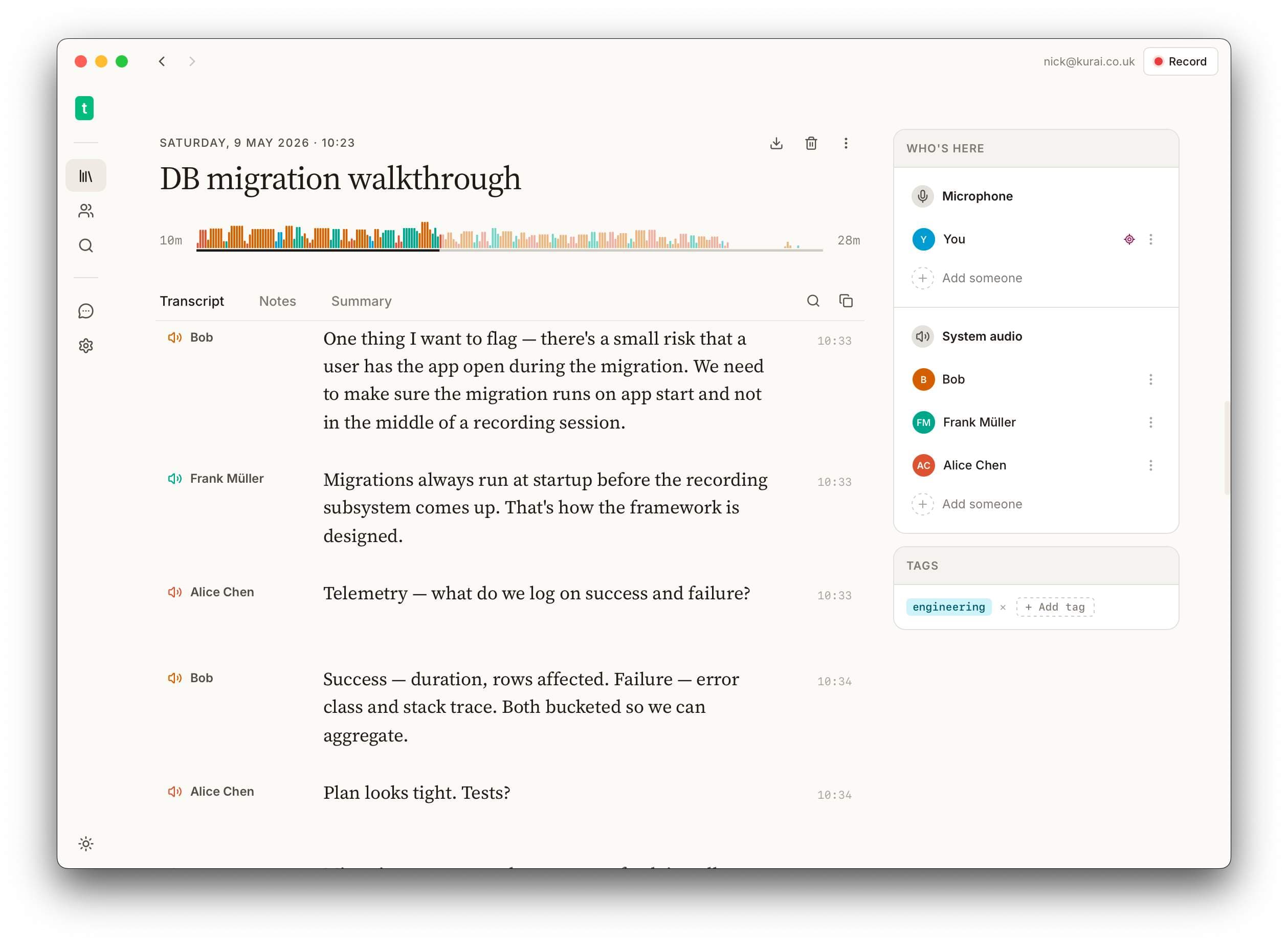
About this app
talat is a private meeting note-taker for macOS (Apple Silicon) and Windows. It records both your microphone and your system audio, so every voice on a call is captured, and it transcribes both in real time using speech models that run on your own machine. It labels speakers automatically and learns the voices of people you meet regularly. After each meeting, a local AI model writes a title, a summary and action points, and every meeting stays searchable. Nothing leaves your device: there's no cloud transcription and no uploads. talat also offers dictation, imports existing recordings, and runs an MCP server so your own AI tools can query your meetings. It's built to keep you in control. When it does something on its own, such as starting a recording, it tells you, and you can change how it behaves.
Key features
- 1Dual-stream capture of microphone and system audio with real-time on-device transcription and automatic speaker identification.
- 2Local or cloud LLM summaries, action points and chapters; every meeting searchable and stored on your machine.
- 3Global hotkey dictation into any app, import of existing audio/video, MCP server, Obsidian export and webhooks.
Target customer profile
Drawn from the product itself, not from a survey.
Demographic
Privacy-conscious professionals and executives
Pain points
Cloud note-takers upload sensitive meeting audio and store data on third-party servers
Primary needs
On-device transcription with optional cloud LLM choice and no account required
Demographic
Consultants, lawyers, and healthcare workers
Pain points
Confidentiality rules make cloud transcription risky; data retention caps are frustrating
Primary needs
Local storage, speaker identification, and searchable history they fully control
Demographic
Developers and productivity power users
Pain points
Need to dictate into any app, import recordings, and connect notes to AI workflows
Primary needs
Global hotkey dictation, MCP connector, Obsidian export, and webhooks
Scout Review
Written by AI from measured evidence, scored out of 100.
talat is a local-first meeting recorder for macOS and Windows that captures mic and system audio, transcribes on-device, labels speakers and writes summaries with a local or cloud LLM — with no account required. The app UI is genuinely well made and the documentation is deeper than most funded competitors'. The measured weaknesses are concrete: a 5.9s mobile LCP, a security header set missing HSTS and CSP entirely, and a comparison table that fails accessibility on table headers. Pricing is fair but the free-tier limit is buried. Against Granola and Otter.ai it wins on privacy by architecture and loses on nothing structural except distribution.
Measure by measure
Usability
68Docs are genuinely deep — permissions, recordings, dictation, sync, assistant, integrations — and the changelog shows weekly fixes. Hero download buttons with file sizes make the action obvious. Pricing copy ('From $9/mo, or $189 once') and the dense 10-row comparison table take work to parse.
Design
71Judging the app UI and store material: the Mac interface has disciplined hierarchy — serif transcript, restrained speaker panel, tidy tags. Homepage is editorial and distinctive, but the hero play button covers a line of copy and small grey captions are hard to read.
Speed
68Desktop Lighthouse 99/100 and mobile 78/100, with CLS 0 and TBT 26ms — the page is stable and non-blocking. The mobile LCP of 5.9s is the one real drag, likely a heavy hero asset. No user lag complaints found in collected evidence.
Security
52HTTPS enforced with SPF and DMARC, and the privacy-by-architecture story (on-device transcription, no account, optional cloud LLM) is real. But the header probe found no HSTS, CSP, frame protection, Referrer-Policy or Permissions-Policy — 4/12 checklist points. No SOC 2, ISO or pen-test claims in evidence.
Accessibility
80Lighthouse accessibility 96/100 with only two failing audits: insufficient color contrast and missing table headers on the large comparison table. Responsive layout and clear primary actions help. No WCAG statement found, and the app is localized in just one language.
Growth
63A real, specific wedge: fully local transcription against cloud-first Granola and Otter.ai, aimed at lawyers, healthcare and consultants who can't upload audio. MCP, Obsidian and one-time pricing sharpen it. Early stage (domain ~0.7 years, no App Store ratings) but the idea has room.
Improvement areas
- Security headers on talat.app: no HSTS, CSP, frame protection, Referrer-Policy or Permissions-Policy (4/12).
- Mobile performance: 5.9s LCP drags Lighthouse mobile to 78/100 despite a 99 desktop score.
- Accessibility: comparison table lacks <th> headers; small grey captions fail contrast; only one language localized.
- Pricing clarity: free-tier limit buried in a footnote and 'From $9/mo, or $189 once' needs a second read.
Design & Usability
The app itself is the product here, and the Mac UI earns its keep: a serif transcript, a restrained speaker panel, tidy tags, and a hierarchy that reads as considered rather than templated. The marketing layer matches that tone with an editorial serif headline, though the hero play button sits on top of the transcript line it's meant to introduce and the feature-card captions are small grey text on near-black. Usability is the stronger half: the documentation covers first launch, permissions, recording, dictation, sync, the assistant and every integration, and the changelog shows weekly shipping. The friction is commercial, not functional — 'From $9/mo, or $189 once' plus a '10 hours free' footnote takes a second read, and the ten-row comparison table is dense on anything narrower than a laptop.
Speed & Security
Speed splits cleanly by device. Desktop Lighthouse lands at 99/100 with CLS 0 and TBT 26ms — the page is stable and doesn't block. Mobile drops to 78/100 on a 5.9s LCP, which points at a heavy hero asset rather than a slow stack. Security is the weakest measured dimension: HTTPS is enforced and SPF/DMARC are in place, but the probe found no HSTS, no Content-Security-Policy, no frame protection, no Referrer-Policy and no Permissions-Policy — 4 of 12 checklist points. For a product whose entire proposition is 'nothing leaves your device,' the site selling it should be the most locked-down page in the category. No SOC 2, ISO or pen-test claim appears in the collected evidence, so the on-device architecture is a strong story without a third-party receipt yet.
Accessibility & Growth
Accessibility scores 96/100 on the automated audit, with two real failures: insufficient color contrast and a large comparison table whose cells have no table headers, which is exactly the element a screen-reader user needs structured. The app is localized in one language, and no WCAG conformance statement was found. Growth is the interesting question. The category is crowded — Granola and Otter.ai both have polish and distribution — but neither can credibly offer fully local processing, and talat names the segments that care: lawyers, healthcare workers, consultants bound by confidentiality rules. MCP, Obsidian export, webhooks and a one-time payment option give it a sharper edge than 'private alternative' alone. The limit is reach: the wedge is real but narrow, and the traction signals (domain under a year old, no App Store ratings) show it hasn't crossed into the mainstream buyer yet.
Conclusion
If your meetings contain anything you'd rather not upload — client privilege, patient detail, an unannounced acquisition — talat is the most credible option in this category right now, and the one-time $189 option makes the maths easy. If you just want tidy notes and don't care where the audio goes, Granola is more polished and Otter has more integrations. The gap between those two verdicts is entirely about what's in your recordings. talat's job now is to make the privacy argument legible to people who aren't already sold on it — and to put a CSP on the page that makes the promise.
Suggestions for improvement
- Add HSTS, Content-Security-Policy, X-Frame-Options, Referrer-Policy and Permissions-Policy — 4/12 headers undercuts a privacy-first pitch.
- Fix the mobile LCP (5.9s): compress or lazy-load the hero asset; desktop already scores 99.
- Add <th> scope attributes to the comparison table and raise contrast on the small grey captions.
- Surface the 10-hour free limit next to the price instead of in a footnote, and simplify 'From $9/mo, or $189 once'.
Alternatives comparison
Named competitors, point by point. Nobody paid to appear here or to be left out.
 talat |  Granola |  Otter.ai | |
|---|---|---|---|
| Where transcription runs | Fully on-device (local speech models) | Cloud processing | Cloud processing on Otter servers |
| Account required | No account required | Account required | Account required |
| Speaker identification | Yes, learns voices over time | Yes | Yes, with meeting bot |
| Meeting bot joins the call | No — captures system audio locally | No — desktop capture | Yes, OtterPilot bot |
| Pricing model | From $9/mo, or $189 one-time; 10 hours free | Free tier plus paid subscription | Freemium subscription tiers |
| Dictation into other apps | Yes — global hotkey, auto-paste | No | Limited |
| AI tool / developer integrations | MCP server, Obsidian export, webhooks | Integrations, no MCP server | API and app integrations |
Granola
AI meeting notetaker with a polished interface and cloud processing; talat is positioned as the fully local alternative.
Otter.ai
Cloud-based meeting transcription with a meeting bot, speaker recognition, and summaries stored on Otter's servers.
Comparing options? See talat alternatives, scored side by side
More Productivity apps
View all Productivity
Puzzly – B2B Lead Generation & Sales Intelligence Platform
92Puzzly is an all-in-one B2B lead generation platform that...

Qamarero
92An all-in-one hospitality software for restaurants and ba...

EmbedMyReviews
92White-label reputation management software for agencies s...

StoryPad
92Privacy-first open source journal app with a continuous t...

Notion
92All-in-one AI workspace for docs, projects, and knowledge...

The Stack Newsletter
92A weekly newsletter delivering curated tech jobs, intervi...

Vibe Coding Agent Skills
92A free, open-source platform offering 110 AI agent skills...

QRBliss
91Branded QR codes with AI Brand Sync, 15 free dynamic code...

Gerty
91Private, local AI assistant for Mac that runs offline

Strukchad Property Management
91Property management for Kenyan letting agents: rent invoices raised every month, M-Pesa rent prompts to tenants, arrears tracking and landlord statements.

CC Switch
91Open-source desktop app for switching AI coding providers...

PitchWhip
90AI cold call scripts & direct dials from LinkedIn


A platform dedicated to providing unbiased reviews of newly launched applications, analyzing everything from their features to their full potential.
info@scoutforge.net© 2026 Scoutforge. All rights reserved.
