Cycling through all six. Tap any point to stop.
Measured on six things
AI research workspace for founders — organized cards, not chat transcripts you'll lose track of.
Security
52HTTPS and HSTS are enforced, SPF is set, but missing CSP, frame protection, and other headers. No SOC 2 or ISO claims. Privacy policy says data isn't used for training, but no third-party verification. Basic security for a small product, but room for improvement.
Screenshots
1 / 1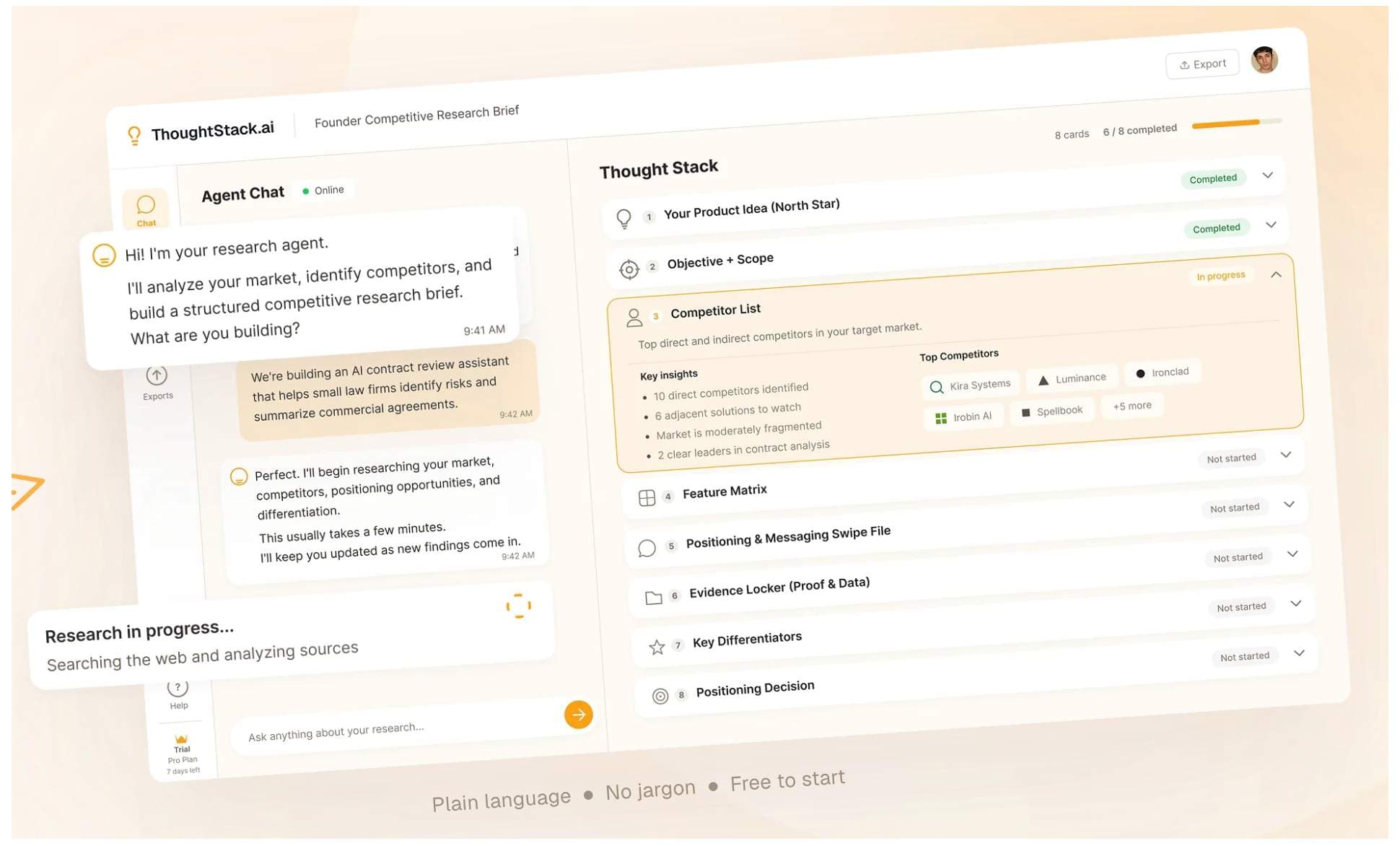
About this app
ThoughtStack is an AI-powered research workspace built for founders and builders who want organized thinking, not scattered chat transcripts. Instead of a single endless conversation you'll lose track of, ThoughtStack's agent works alongside you and automatically organizes everything into structured, reusable Thought cards — the ideas, decisions, and research that actually matter, saved and searchable, not buried in scrollback. Start from a guided workflow instead of a blank page. The agent does the digging — researching, synthesizing, and drafting — while you steer and edit. Every card stays in your workspace: revisit it, update it as things change, export it, or share a read-only link with collaborators. Pricing is pay-as-you-go with no subscriptions or hidden seats — you only pay for what the agent actually does, and a free demo is available instantly with no signup required. ThoughtStack also connects directly to Claude, so your saved Thoughts carry context into every new conver
Key features
- 1Agent-driven workspace that auto-organizes chats into structured Thought cards
- 2Guided workflows (e.g., Founder Competitor Analysis) to avoid blank-page starts
- 3Two-way Claude integration: read Projects for context, save answers as Thoughts
- 4Pay-as-you-go pricing with transparent per-token costs across 207 models
- 5Free demo without signup, with guest mode and trial budget
Target customer profile
Drawn from the product itself, not from a survey.
Demographic
Founders and startup teams
Pain points
Overwhelmed by unstructured AI conversations, struggle to extract actionable insights, need to quickly analyze competitors and markets.
Primary needs
Organized competitive analysis, reusable templates, cost-effective AI tools, time-saving workflows.
Demographic
Content creators and writers
Pain points
Writer's block, disorganized research, difficulty synthesizing information into coherent pieces.
Primary needs
A structured writing space, easy idea organization, integration with AI for drafts, markdown support.
Demographic
Researchers and analysts
Pain points
Information overload, scattered notes, time wasted on re-finding insights.
Primary needs
A persistent knowledge base, searchable Thought cards, ability to synthesize large volumes of data, export options.
Scout Review
Written by AI from measured evidence, scored out of 100.
ThoughtStack is an early-stage AI workspace that aims to turn messy AI chats into structured Thought cards. It offers a clean design, guided workflows, and a free demo without signup. The Claude integration and transparent per-token pricing are notable differentiators. However, mobile performance is poor (LCP 8.5s), security headers are incomplete, and accessibility has minor issues. The category is competitive, but the product's specific wedge and pricing model give it a fighting chance. Overall, a promising tool with room for polish.
Measure by measure
Usability
68Free demo without signup is a big win. Guided workflows replace blank-page anxiety. Chat input pinned with clear send button. But nav links are small and low-contrast, and cards lack drag handles or reordering cues, hurting workspace manipulation.
Design
70Clean, modern landing page with clear state colors (green/orange) and good typography. But hero mockup shows a code editor contradicting 'not a chat transcript' positioning, and two equal CTAs compete. Light gray card borders nearly invisible on cream.
Speed
57Desktop performance is perfect (100/100), but mobile suffers with LCP 8.5s, dragging the score down. TBT is acceptable (171ms) and CLS is zero. The gap suggests heavy images or scripts not optimized for mobile.
Security
52HTTPS and HSTS are enforced, SPF is set, but missing CSP, frame protection, and other headers. No SOC 2 or ISO claims. Privacy policy says data isn't used for training, but no third-party verification. Basic security for a small product, but room for improvement.
Accessibility
70Lighthouse scores 91/100, but fails on color contrast and user-scalable=no. No accessibility statement or WCAG claim. Keyboard navigation seems possible, but no skip links or ARIA landmarks. English-only. Solid baseline but not exemplary.
Growth
62Real problem (organizing AI chats) with a concrete wedge: Claude integration and transparent per-token pricing. But crowded category with incumbents like ChatGPT and Notion. Early stage, but the idea has room if execution lands.
Improvement areas
- Mobile performance: LCP 8.5s needs optimization (image compression, lazy loading)
- Security headers: add CSP, frame protection, X-Content-Type-Options, etc.
- Accessibility: fix color contrast, enable user scaling, add a11y statement
- Usability: add drag-and-drop or reordering cues to Thought cards
Design & Usability
ThoughtStack presents a clean, modern workspace with clear visual states (green/orange pills) and a guided workflow that reduces blank-page anxiety. The free demo without signup is a strong onboarding hook. However, the hero mockup showing a code editor contradicts the 'not a chat transcript' positioning, and two equally weighted CTAs create confusion. Nav links are small and low-contrast, and cards lack drag handles, making workspace manipulation less intuitive. Overall, the design is above average but has some positioning and usability hiccups.
Speed & Security
Desktop performance is flawless (100/100), but mobile suffers with an 8.5s LCP, likely due to heavy images. Security is basic: HTTPS and HSTS are enforced, but missing CSP, frame protection, and other headers. No SOC 2 or ISO claims, but privacy policy states data isn't used for training. For a small product, this is acceptable but not exemplary. The transparent pricing page with 207 models is a plus, but the lack of security certifications might concern enterprise users.
Accessibility & Growth
Accessibility scores 91/100 on Lighthouse, but fails on color contrast and user-scalable=no. No a11y statement or WCAG claim, and the site is English-only. Growth potential is moderate: the problem of organizing AI chats is real, and the Claude integration is a concrete differentiator. However, the category is crowded with incumbents like ChatGPT and Notion, and the early-stage traction (0.4-year-old domain) means it must execute well to carve out a niche. The transparent pricing and pay-as-you-go model could appeal to cost-conscious users.
Conclusion
ThoughtStack is a solid attempt at solving a real pain point for founders and researchers drowning in AI chat transcripts. The demo is frictionless, the pricing is transparent, and the Claude integration is a smart move. But it needs to fix mobile performance, add security headers, and improve accessibility to compete with the big boys. If the team ships fast and listens to the community (as they claim), it could carve out a loyal niche. Worth a try, especially if you're tired of losing your thoughts in endless chat scroll.
Suggestions for improvement
- Optimize hero images and scripts to reduce mobile LCP below 4s
- Add CSP, frame protection, and other security headers to harden the site
- Fix color contrast issues and enable user scaling for better accessibility
- Add drag-and-drop or reordering cues to Thought cards for easier workspace management
Alternatives comparison
Named competitors, point by point. Nobody paid to appear here or to be left out.
 ThoughtStack.ai |  ChatGPT |  Notion AI |  Mem.ai | |
|---|---|---|---|---|
| Organized output structure | Auto-organizes chats into reusable Thought cards with markdown | Single chat thread, no built-in organization or persistent structure | Notes with AI, but not specifically for organizing AI chat outputs | Auto-organizes notes, but not focused on chat transcripts |
| Pricing model | Pay-as-you-go, per-token, no subscription, transparent management fee | Freemium with subscription (ChatGPT Plus) for advanced features | Subscription-based (Notion AI add-on) with monthly fee | Freemium with premium subscription for AI features |
| Claude integration | Two-way: read Projects for context, save answers as Thoughts | No direct Claude integration; separate platform | No native Claude integration; supports various AI models via API | No native Claude integration; focuses on own AI |
| Free demo without signup | Yes, instant guest mode with trial budget | No, requires account creation | No, requires account creation | No, requires account creation |
ChatGPT
General-purpose AI chat, but lacks built-in organization and persistent structure.
Notion AI
Note-taking with AI integration, but not specifically designed for organizing AI chat outputs.
Mem.ai
AI-powered note-taking and knowledge management, focuses on auto-organization.
Comparing options? See ThoughtStack.ai alternatives, scored side by side
More Productivity apps
View all Productivity
Notion
92All-in-one AI workspace for docs, projects, and knowledge...

Qamarero
92An all-in-one hospitality software for restaurants and ba...

EmbedMyReviews
92White-label reputation management software for agencies s...

StoryPad
92Privacy-first open source journal app with a continuous t...

Puzzly – B2B Lead Generation & Sales Intelligence Platform
92Puzzly is an all-in-one B2B lead generation platform that...

The Stack Newsletter
92A weekly newsletter delivering curated tech jobs, intervi...

Vibe Coding Agent Skills
92A free, open-source platform offering 110 AI agent skills...

QRBliss
91Branded QR codes with AI Brand Sync, 15 free dynamic code...

Gerty
91Private, local AI assistant for Mac that runs offline

CC Switch
91Open-source desktop app for switching AI coding providers...

username.md
90One verified handle for your online identity, readable by...

PitchWhip
90AI cold call scripts & direct dials from LinkedIn


A platform dedicated to providing unbiased reviews of newly launched applications, analyzing everything from their features to their full potential.
info@scoutforge.net© 2026 Scoutforge. All rights reserved.
