Cycling through all six. Tap any point to stop.
Measured on six things
Read referral letters, book patients, send intake forms and give every follow up an owner. ZDI ClinicOS frees up reception while clinicians decide.
Security
62HTTPS enforced with HSTS, frame protection, secure cookies and Referrer-Policy — solid basics. But no CSP, no Permissions-Policy, and SPF/DMARC are missing, which for a product handling patient data is a real gap. No SOC 2 or pen-test evidence found.
Screenshots
1 / 1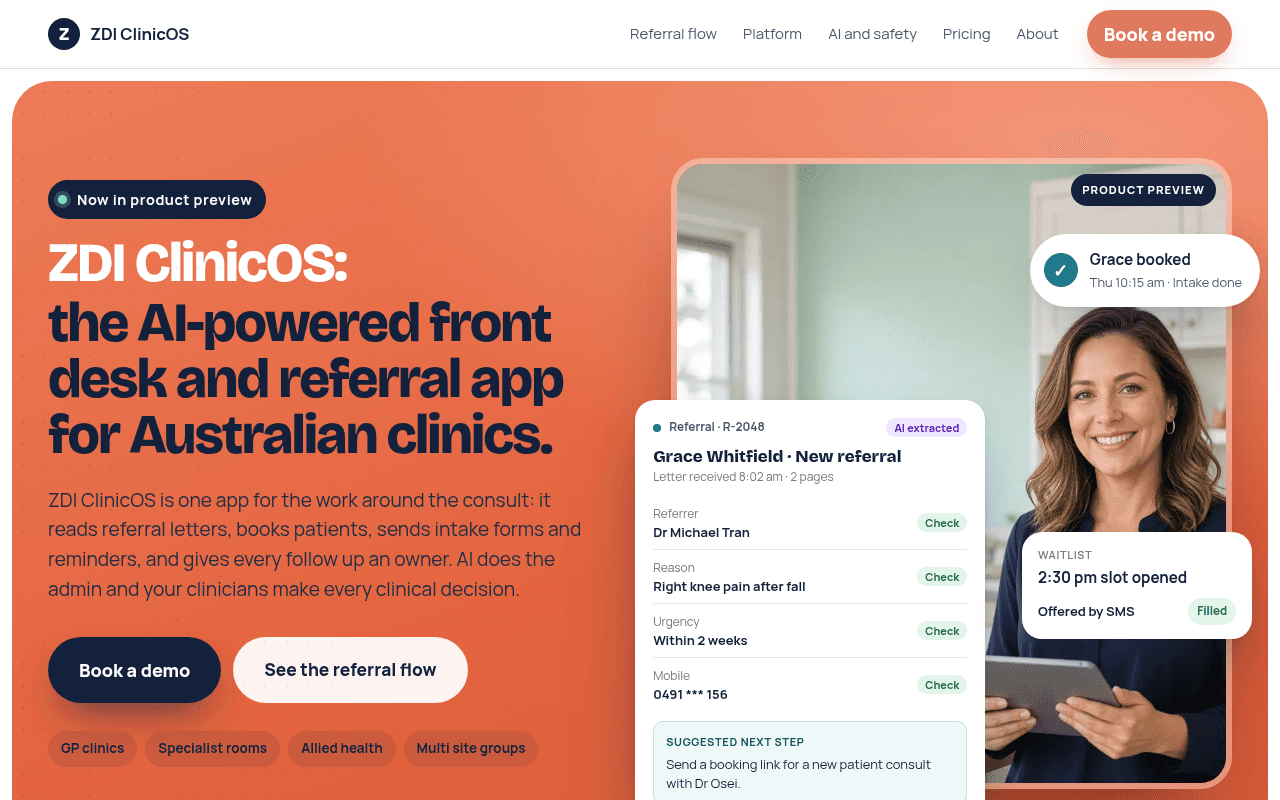
About this app
ZDI ClinicOS is a front desk and referral app for Australian GP clinics, specialist rooms, allied health and multi site groups. When a referral letter arrives, AI pulls out the referrer, reason and urgency for reception to confirm, and the patient gets a booking link and intake form. Reminders go out automatically, cancelled slots are offered to the waitlist by SMS, and every next step has a named owner and a date. Clinicians review any AI drafted note before it is used, and patient privacy is built in from the start.
Key features
- 1AI extracts referrer, reason and urgency from incoming referral letters for reception to confirm.
- 2Patient booking link and intake form sent automatically after referral confirmation.
- 3Automated reminders plus SMS waitlist offers when cancelled slots open up.
- 4Every next step assigned a named owner and a date for task tracking.
- 5Clinician review required before any AI-drafted note is used.
Target customer profile
Drawn from the product itself, not from a survey.
Demographic
Small to mid-sized Australian private clinics (GP, allied health, specialist)
Pain points
Referral letters lost in email; double data entry; front desk overwhelmed
Primary needs
Centralised referral intake, automated bookings, clinician-reviewed AI output
Demographic
Allied health practice managers and admin staff
Pain points
Manual follow-up calls; fragmented intake forms; task handoff chaos
Primary needs
Task tracking, follow-up automation, single source of truth for patient ops
Demographic
Solo practitioners and small specialist practices
Pain points
No dedicated front desk; admin eats clinical time; compliance risk
Primary needs
Affordable AI front desk, privacy-compliant workflows, low setup overhead
Scout Review
Written by AI from measured evidence, scored out of 100.
ZDI ClinicOS is a well-presented, fast, demo-gated referral and front-desk app for Australian clinics. The marketing site is genuinely good — specific mockups, a coherent visual system, and a clear story from referral letter to booked patient. Speed is a real strength (Lighthouse 89 mobile, 90 desktop). Security has the basics but misses CSP, Permissions-Policy and SPF/DMARC, and publishes no compliance certifications. Accessibility is strong on automated checks with a few contrast and heading-order fails. The product idea is differentiated by clinician-reviewed AI referral extraction, but it enters a crowded market against Cliniko, HotDoc and Halaxy. The biggest practical gap for a buyer is the absence of public pricing or a self-serve trial.
Measure by measure
Usability
63Clear hero CTAs, a persistent 'Book a demo' button and a numbered referral-flow strip give visitors an obvious path. But everything routes to a demo — no pricing page, no self-serve trial, so evaluating the product means booking a call first.
Design
71Confident display type, a coherent orange/navy/mint palette and product-specific mockups (referral card, waitlist, Banksia Family Clinic) make the page feel like one product. Stock photos and unreadably small mockup text hold it back.
Speed
73Lighthouse mobile 89/100 (LCP 2.6s, CLS 0.009, TBT 168ms) and desktop 90/100 — a genuinely fast, stable marketing page with near-zero layout shift. Not benchmark-breaking, but comfortably above category norms.
Security
62HTTPS enforced with HSTS, frame protection, secure cookies and Referrer-Policy — solid basics. But no CSP, no Permissions-Policy, and SPF/DMARC are missing, which for a product handling patient data is a real gap. No SOC 2 or pen-test evidence found.
Accessibility
80Lighthouse accessibility 95/100 with a responsive, readable layout. Three failing audits remain — insufficient color contrast, non-sequential heading order, and mismatched accessible names — and there's no published WCAG statement, so it's strong but not certified.
Growth
66A real, specific problem (referrals lost in email, front desk overload) aimed at a defined Australian clinic segment, with clinician-reviewed AI referral extraction as a genuine wedge against Cliniko, HotDoc and Halaxy.
Improvement areas
- No public pricing page or self-serve trial — evaluation requires booking a demo.
- Missing SPF/DMARC, CSP and Permissions-Policy headers for a patient-data product.
- No published SOC 2, ISO 27001, pen-test or bug bounty evidence.
- Three failing accessibility audits (contrast, heading order, accessible names) and no WCAG statement.
Design & Usability
ZDI ClinicOS has one of the more convincing marketing pages in the Australian clinic-software space. The design audit found a coherent orange/navy/mint palette, confident display typography, and — crucially — product mockups that show the actual job: a referral card with a reason field, a suggested next step, a waitlist notification. The same fake clinic (Banksia Family Clinic) and patient (Grace Whitfield) recur across sections, which makes the page read as one product rather than a collage. The weak spots are real: three generic stock photos in the 'whole practice' row undercut the specificity, and the interface text inside the mockups is too small to read, which defeats the screenshots' purpose. Usability is demo-gated — clear CTAs everywhere, but no pricing page and no self-serve trial, so a practice manager can't evaluate cost or kick the tyres without booking a call.
Speed & Security
Speed is a genuine strength: Lighthouse mobile 89/100 with LCP 2.6s, CLS 0.009 and TBT 168ms, and desktop 90/100. The page is light, stable and snappy — no layout shift, no heavy SPA penalty. Security is more mixed. The basics are in place: HTTPS enforced, HSTS, frame protection, X-Content-Type-Options, Referrer-Policy and secure cookies. But there's no Content-Security-Policy, no Permissions-Policy, and — most concerning for a product handling patient referrals and intake forms — no SPF or DMARC records, leaving the domain open to email spoofing. No SOC 2, ISO 27001, pen-test report or bug bounty was found, so the 'privacy built in from the start' claim rests on marketing copy rather than verifiable certification.
Accessibility & Growth
Accessibility scores well on automated checks — Lighthouse 95/100 — with a responsive layout and readable body copy. Three audits still fail: insufficient color contrast, non-sequential heading order, and visible text labels without matching accessible names. There's no published WCAG conformance statement, so a clinic with accessibility obligations would need to ask directly. Growth is the most interesting question. The problem ZDI names is real and specific — referral letters lost in email, double data entry, front desk overload — and the target segment (small-to-mid Australian GP, allied health, specialist and multi-site groups) is clearly defined. The wedge is clinician-reviewed AI referral extraction plus automated waitlist and booking. Against Cliniko, HotDoc and Halaxy, that's a differentiated workflow rather than a me-too booking tool, but the incumbents are entrenched and could bolt on similar AI features. The idea has room; execution and distribution will decide whether it gets any.
Conclusion
If you run a small Australian clinic drowning in referral emails and want AI to do the first pass, ZDI ClinicOS is worth a demo — the workflow it shows is specific and the site loads fast. But go in with questions: ask for their security posture (no SOC 2 or pen-test published, no DMARC), ask what pricing looks like since it isn't on the site, and ask how the AI handles edge cases when a referral is ambiguous. The product looks competent; the transparency around cost and compliance is where it needs to catch up.
Suggestions for improvement
- Publish a pricing page or at least a starting-from range — demo-gating cost is the biggest friction for small clinics.
- Add SPF and DMARC records and a Content-Security-Policy header; for a health app handling patient data these are table stakes.
- Publish a security/compliance page stating SOC 2 or ISO status, data residency and how AI-drafted notes are handled.
- Replace the three stock photos with real product screenshots or clinic-context imagery, and enlarge mockup text so it's readable.
Alternatives comparison
Named competitors, point by point. Nobody paid to appear here or to be left out.
 ZDI ClinicOS | Cliniko |  HotDoc | Halaxy | |
|---|---|---|---|---|
| AI referral letter extraction | Yes — core feature, clinician-reviewed | No native AI extraction | No — booking/engagement focus | Referrals supported, no AI extraction |
| Automated waitlist SMS for cancelled slots | Yes — core feature | Waitlist supported, SMS varies | Reminders and recalls yes | Reminders yes, waitlist limited |
| Public pricing transparency | No public pricing — demo only | Published per-practitioner pricing | Published plans | Published tiered pricing |
| Australian clinic focus | Yes — Australian GP/allied health | Yes — Australian origin | Yes — Australian GP focus | Yes — Australian allied health |
| Published security certifications | None found | Security page published | Security/compliance info published | Security info published |
Cliniko
Popular Australian practice management software for allied health and multi-disciplinary clinics, covering bookings, patient records, and billing.
HotDoc
Australian patient booking and engagement platform widely used by GP clinics for online appointments and reminders.
Halaxy
Cloud-based practice management platform for allied health with referrals, scheduling, and invoicing built in.
Comparing options? See ZDI ClinicOS alternatives, scored side by side
More Productivity apps
View all Productivity
StoryPad
92Privacy-first open source journal app with a continuous t...

Puzzly – B2B Lead Generation & Sales Intelligence Platform
92Puzzly is an all-in-one B2B lead generation platform that...

Qamarero
92An all-in-one hospitality software for restaurants and ba...

Notion
92All-in-one AI workspace for docs, projects, and knowledge...

The Stack Newsletter
92A weekly newsletter delivering curated tech jobs, intervi...

EmbedMyReviews
92White-label reputation management software for agencies s...

Vibe Coding Agent Skills
92A free, open-source platform offering 110 AI agent skills...

QRBliss
91Branded QR codes with AI Brand Sync, 15 free dynamic code...

Gerty
91Private, local AI assistant for Mac that runs offline

Strukchad Property Management
91Property management for Kenyan letting agents: rent invoices raised every month, M-Pesa rent prompts to tenants, arrears tracking and landlord statements.

CC Switch
91Open-source desktop app for switching AI coding providers...

PitchWhip
90AI cold call scripts & direct dials from LinkedIn


A platform dedicated to providing unbiased reviews of newly launched applications, analyzing everything from their features to their full potential.
info@scoutforge.net© 2026 Scoutforge. All rights reserved.
