
"Free plan available" is the most useless sentence in SaaS marketing. It tells you a vendor has a page with a zero-dollar price tag. It tells you nothing about whether that plan will still be usable on day 47, when your second agent needs access or your ticket history vanishes because you crossed an invisible line.
The real question is not which support tools have a free tier — it's which free tier a 1–5 person team can actually run on without hitting a wall in the first quarter.
We spent October 2026 going through official pricing pages and help docs for ten customer support platforms. What we found is a mess of time-limited "free programs," 100-contact caps, 7-day history retention, and branding badges that quietly turn your customer-facing inbox into a billboard. A few tools genuinely let you run support for free. Most are trial balloons dressed up as generosity.
This guide documents the exact ceilings: agent seats, ticket or conversation caps, channels included, automation and AI limits, data retention, and branding restrictions. We also flag the upgrade triggers that will bite first, so you can pick a tool knowing what month two looks like — not just day one.
Why "Free Plan Available" Tells You Nothing
Every vendor on this list says they offer a free plan. Only a handful mean it in a way that matters for a real support operation.
Here's the framework we used to separate genuine free tiers from marketing stunts:
- Agent seats. Can your whole team log in, or are you capped at one or two people?
- Ticket or conversation volume. Is there a monthly ceiling, and what happens when you cross it — do replies get blocked, or do you just lose history?
- Channels. Email ticketing, live chat, social, knowledge base — which ones are actually included?
- Automation and AI. Free tiers almost always strip this out. The question is whether you can still do basic routing and saved replies.
- Data retention. How long does your ticket history stay visible? Seven days is not a support system; it's a notepad.
- Branding. Does your customer see "Powered by [vendor]" on every email and chat widget?
A free plan that caps you at two agents and 100 contacts per month is not a free plan for a growing team. It's a demo environment. That's fine if you're evaluating software. It's not fine if you're running customer support.
The tools below are ranked by how much real, sustained support work you can do before paying. The ones at the top are the closest to "actually free." The ones at the bottom are worth knowing about, but their caps will shape how you use them.
How We Evaluated These Free Support Tools
We verified every claim against primary sources — official pricing pages, help documentation, and vendor FAQs — as of October 2026. We did not rely on review sites, affiliate blogs, or vendor marketing copy.
Our benchmark is a small team: one to five people handling customer questions across email, chat, and maybe a knowledge base. We assumed you need at least two agents on day one, a shared inbox that doesn't block replies, and enough ticket history to resolve a customer issue that spans more than a week.
We excluded Intercom entirely. We could not verify a current free tier from primary sources, and we don't write about plans we can't confirm. We also excluded Groove from the main ranking because it has no free plan — we mention it briefly so you don't waste time looking.
One more thing: "unlimited" is a word vendors love. Tawk.to genuinely means it for core chat features. Other vendors use it while quietly capping history, automation, or seats. We call out the difference where it matters.
The Best Free Customer Support Tools for Small Teams in 2026
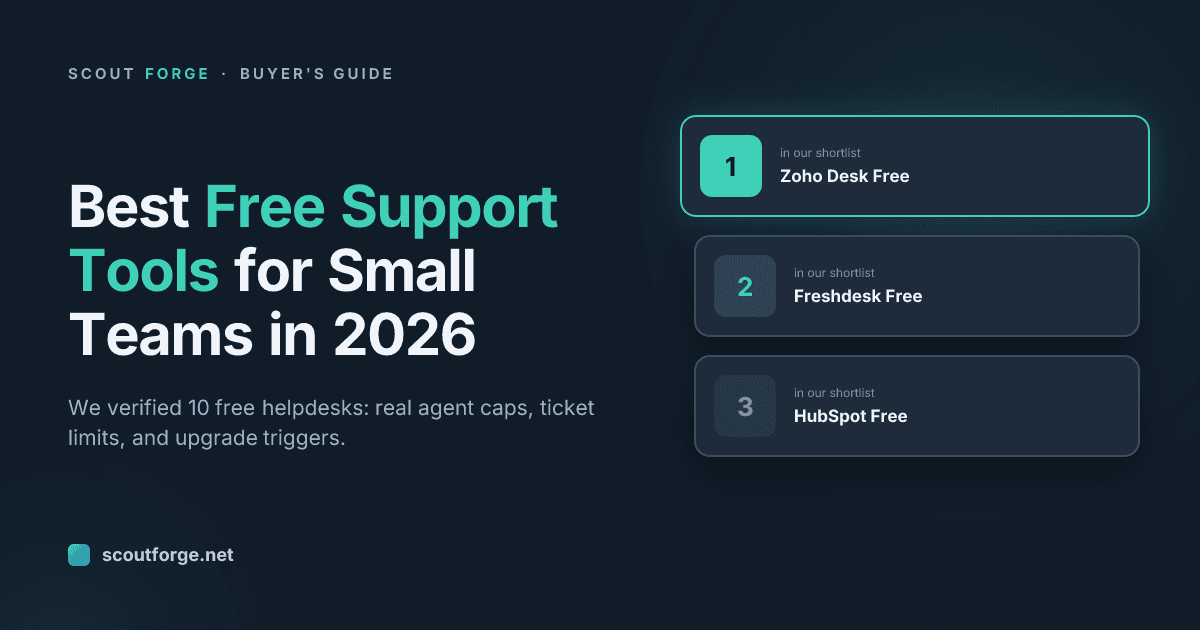
Here's the shortlist, ranked by how much real support work you can do for free before the ceiling hits. The comparison table up front gives you the numbers; the sections below explain what those numbers actually feel like in practice.
| Tool | Free Agents | Free Ticket/Conversation Cap | Channels Included | Automation/AI on Free | Branding/Retention Limits | Best For |
|---|---|---|---|---|---|---|
| Tawk.to | Unlimited | Unlimited | Live chat, ticketing, KB, CRM | None (AI Assist is $29/mo add-on) | "Powered by tawk.to" badge unless you pay $29/mo | Live chat without any volume anxiety |
| Zoho Desk | 3 | Not stated (email ticketing) | Email, customer portal, private KB | Basic reporting only | No major branding flag found | Teams already in Zoho ecosystem |
| Help Scout | 5 | 100 contacts/month | Shared inbox, Docs KB (10 articles) | 10 saved replies, 10 tags | 30-day reporting history | Very small teams wanting polished shared inbox |
| Crisp | 2 | Unlimited conversations | Website chat, shared inbox, mobile | None (no AI credits) | History limits apply on free | Solo founders who need live chat |
| HubSpot Service Hub | 2 | Not stated | Shared inbox, live chat, basic bots | Basic conversational bots | HubSpot branding on customer-facing assets | Teams already using HubSpot CRM |
| Freshdesk | 2 | Not stated (time-limited) | Ticketing, KB, pre-built reports | Limited | 6-month time limit | Short-term evaluation before paying |
| LiveAgent | Not stated | Not stated (7-day history) | Ticketing, live chat, email, KB | None (no integrations or automation) | 7-day ticket history; login required every 4 weeks | Testing the platform before committing |
| Zendesk | None (trial only) | N/A | Trial access | Trial access | 14-day trial or startups program | Qualified startups only |
| Groove | None | N/A | N/A | N/A | No free plan | Teams ready to pay from day one |
Now let's go through each one properly.
1. Tawk.to — The Genuinely Free Live Chat Option (With a Catch)
If you want live chat on your website and you never want to think about agent seats or conversation caps, Tawk.to is the closest thing to a permanent free lunch in this category.
What's actually free forever. The core platform — live chat, ticketing, knowledge base, and a basic CRM — is 100% free with no limits on agents, conversations, or websites, according to Tawk.to's pricing page. You can put it on ten different sites, invite your whole team, and handle thousands of chats a month without paying a cent. That's not a trial or a time-limited program. It's the business model.
The catch. Tawk.to makes money on add-ons. The most visible one is branding removal: if you don't want the "Powered by tawk.to" badge on your chat widget, it costs $29 per month per property. AI Assist, their automated response feature, is another $29 per month. Voice and video features cost extra, and you can hire human agents through their platform for a fee.
Who should pick it. Solo founders and very small teams who need live chat without any volume anxiety. If you're okay with the badge and you don't need AI automation, this is the most generous free tier in the entire support software market. The trade-off is polish: the interface is functional but not beautiful, and the knowledge base is basic compared to dedicated helpdesk tools.
Who should skip it. Teams that need deep automation, SLA management, or a customer-facing knowledge base that looks like part of their brand. The badge is a real consideration — some founders find it unprofessional, and $29 per month to remove it is effectively the price of admission if you care.
2. Zoho Desk Free — Best Free Ticketing for Zoho Users
Zoho Desk's free plan is one of the few that gives you three agent seats without a time limit. For a small team already living in the Zoho ecosystem, it's the obvious first stop.
What you get. According to Zoho's pricing page, the free plan provides three agents, email ticketing, a private knowledge base for your team, a customer portal, basic reporting, and mobile apps. That's a real ticketing system, not a chat widget with a queue attached. You can route emails, assign tickets, and build a modest self-service portal without paying.
What's missing. Automation is minimal on the free tier. You won't get the workflow rules, SLAs, or advanced reporting that make Zoho Desk powerful at higher tiers. The free plan is also limited to email as a primary channel — live chat and social integration sit behind paid plans.
The upgrade trigger. If you need more than three agents or you want any meaningful automation, you'll be looking at Zoho Desk Express, which starts at $7 per agent per month billed annually. That's cheap by helpdesk standards, but it's no longer free.
Who should pick it. Teams already using Zoho CRM, Zoho Mail, or other Zoho products. The integration is the point. If you're not in the Zoho ecosystem, the free plan is still solid, but the pull to upgrade is weaker.
3. Help Scout Free — Best Free Shared Inbox for Very Small Teams
Help Scout's free plan is generous on seats — five users — but brutally tight on contacts. If your support volume is low and your team is small, it's a polished shared inbox that feels like a paid product. If your volume grows, the cap hits fast.
What you get. According to Help Scout's free plan documentation, you get five users, one shared inbox, one Docs site (limited to 10 articles), 10 saved replies, 10 tags, and 100 contacts per month. The 100-contact cap is the headline: it's not 100 tickets, it's 100 unique contacts you can reply to in a monthly cycle. Exceed it and you can't send replies until the next cycle or you upgrade.
What that feels like. For a very early-stage product with a handful of customers, 100 contacts a month is workable. For anything with real traction, it's a wall. The Docs site limit of 10 articles also means your knowledge base is more of a stub than a self-service channel.
The upgrade trigger. The 100-contact cap is the one that bites. Help Scout's paid Standard plan starts at $25 per user per month billed annually, which is a meaningful jump for a bootstrapped team. If you're approaching 80–90 contacts a month, start planning the upgrade or a migration.
Who should pick it. Teams of two to five people who want a genuinely pleasant shared inbox experience and can live within the contact cap. Help Scout's interface is one of the best in the category — clean, fast, no clutter. If your volume is low, it's a joy to use.
4. Crisp Free — Best Free Live Chat with a Real Free Tier
Crisp is a live chat platform first, and its free plan reflects that: two agent seats, unlimited conversations, and a website chat widget that works well.
What you get. According to Crisp's pricing page, the free plan includes two seats, unlimited conversations, the website chat widget, a shared inbox, and mobile access. That's a real live chat operation for a solo founder or a two-person team. You can embed the widget, answer chats from your phone, and keep a shared view of conversations.
What's missing. Per Crisp's free plan guide, the free tier excludes AI workflows, shared email, shortcuts, triggers, and unlimited conversation history. No AI credits, no advanced automation. The free plan is genuinely useful for live chat, but it's not a full helpdesk.
The upgrade trigger. The two-seat limit is the most common one. If you need a third agent, you're looking at Crisp's paid Mini plan, which starts at $45 per month for four seats and includes AI credits. That's a steep jump from free.
Who should pick it. Solo founders and two-person teams who want live chat on their site without paying. The unlimited conversations are the draw — no volume anxiety, just a seat limit.
5. HubSpot Service Hub Free — Best Free Shared Inbox + Ticketing Combo
HubSpot Service Hub's free tools are genuinely useful if you're already in the HubSpot ecosystem. If you're not, they're a decent shared inbox with a branding catch.
What you get. According to HubSpot's pricing page, the free tier includes two users, a shared inbox, live chat, basic conversational bots, and ticketing. The shared inbox is the highlight: it consolidates email and chat into one queue, which is exactly what a small team needs. Basic bots can handle simple routing and FAQs.
The catch. HubSpot branding appears on customer-facing assets, including your live chat widget and email. For some founders, that's a non-starter. The two-user limit is also tight — it's a founder-plus-one setup, not a team tool.
The upgrade trigger. The two-user cap and the branding. HubSpot's paid Service Hub Starter starts at $9 per seat per month, which is reasonable, but it's a different conversation once you're paying for the CRM and marketing tools too.
Who should pick it. Teams already using HubSpot's free CRM. The integration is the point — contacts, deals, and tickets in one place. If you're not on HubSpot, the free tools are still usable, but the branding and seat limits make them less compelling than alternatives.
6. Freshdesk Free — Best Overall Free Helpdesk for Small Teams (With a Time Bomb)
Freshdesk's free offering is the most confusing on this list, because it's not a free plan — it's a free program with a six-month expiry date.
What you get. According to Freshworks' pricing page and their free program documentation, you get two agents, ticketing, a knowledge base, and pre-built reports for six months. That's a real helpdesk experience for a short window. The ticketing is solid, the KB is functional, and the reports give you a taste of what paid Freshdesk looks like.
The catch. After six months, you must upgrade to a paid plan to continue. Freshdesk's Growth plan starts at $15 per agent per month billed annually. The free program is explicitly a trial, not a permanent tier — Freshworks says so in their own documentation.
Who should pick it. Teams that want to evaluate Freshdesk properly before committing. Six months is enough time to know if it fits. Just don't mistake it for a long-term free solution.
Who should skip it. Anyone looking for a permanent free tier. There are better options on this list if you need to run support for free beyond half a year.
7. Zendesk / LiveAgent / Groove — Free Tiers Worth Knowing (and Their Limits)
These three are worth a brief mention, mostly so you don't waste time investigating them.
Zendesk no longer offers a permanent free plan. According to their pricing page, you get a 14-day trial, or you can apply for a startups program that provides up to two years of free access for qualified early-stage companies. Paid plans start at $19 per agent per month billed annually for the Support Team tier. If you're a funded startup, the startups program is worth checking. If you're bootstrapped, Zendesk is effectively a paid product from day one.
LiveAgent has a free plan, but the restrictions are severe. According to their free plan page, you get 7-day ticket history, one email channel, basic reports only, no integrations or automation, and you must log in at least once every four weeks to keep the account active. That's not a support system; it's a sandbox for testing the platform. If you want to evaluate LiveAgent before paying, the free plan works. If you want to run support on it, you'll upgrade quickly.
Groove has no free plan at all. According to their billing FAQ, paid plans start at roughly $24–$29 per user per month billed annually. It's a decent shared inbox tool for small teams, but there's no free tier to evaluate. If you're considering Groove, you're committing to a paid tool from the start.
Free Support Tool Caps Compared: Side-by-Side Table
We've already shown the main comparison table above. Here's what to actually pay attention to when you read it:
- Agent seats are the hardest limit. Two seats means founder-plus-one. Three seats covers a tiny team. Five seats is genuinely useful. Unlimited seats (Tawk.to) is the only one that scales without forcing a decision.
- Contact caps are sneakier than ticket caps. Help Scout's 100 contacts per month sounds fine until you realize it's unique contacts, not conversations. A single customer with a back-and-forth thread can burn through your cap faster than you expect.
- Time limits are the worst kind of cap. Freshdesk's six-month program and Zendesk's 14-day trial are not free plans. They're evaluation windows. If you build your support workflow on them, you'll be migrating in six months.
- Branding is a real cost. Tawk.to and HubSpot both put their name on your customer-facing assets. For some brands, that's unacceptable. For others, it's a fair trade for free software.
When to Upgrade (and Which Trigger to Watch)
Free tiers don't fail gracefully. They usually fail at the worst possible moment — a support spike, a new hire, a customer who needs history you no longer have. Here are the triggers to watch, mapped to the tools where they bite first:
- You need a third agent. Crisp and HubSpot cap at two. Zoho Desk gives you three. Help Scout gives you five. If you're on Crisp or HubSpot and hiring your second support person, start planning the upgrade or a migration.
- You're approaching the contact or ticket cap. Help Scout's 100 contacts is the tightest. If you're at 80+ contacts mid-month, you're one busy week from blocked replies.
- You need automation or SLAs. No free tier on this list includes meaningful automation. Zoho Desk has basic reporting. HubSpot has basic bots. Everything else strips automation out entirely. If you need auto-routing, SLA timers, or workflow rules, you're paying.
- You need multi-channel support. Most free tiers are single-channel: email or chat, not both. Zoho Desk is email-first. Crisp and Tawk.to are chat-first. If customers are reaching you on email, chat, and social, you'll need a paid plan or a patchwork of tools.
- You need reporting and history. LiveAgent's 7-day history is the extreme. Help Scout's 30-day reporting is better but still short. If you need to analyze support trends or audit past tickets, free tiers won't get you there.
- You're embarrassed by the branding. Tawk.to's badge and HubSpot's branding are the most visible. If it bothers you, that's a legitimate upgrade trigger — just know you're paying for aesthetics, not functionality.
Verdict: Which Free Support Tool Should Your Small Team Pick?
Here's the honest answer, by scenario:
Solo founder who needs live chat. Pick Tawk.to. Unlimited everything, no volume anxiety, and the badge is a small price to pay for free. If you need AI responses later, the $29/month AI Assist add-on is cheaper than upgrading to a paid helpdesk.
Two-to-three person team that needs a shared inbox. Pick Help Scout if your contact volume is low. The interface is the best in the category, and five seats covers a real team. If you're worried about the 100-contact cap, Zoho Desk's three-agent free plan is a solid fallback — especially if you're already in the Zoho ecosystem.
Team already on HubSpot. Pick HubSpot Service Hub free. The integration is the point, and the shared inbox plus basic bots cover the essentials. Just accept the branding and the two-user cap, and plan to upgrade when you hire a third support person.
Team that wants to evaluate Freshdesk or Zendesk before paying. Use the Freshdesk six-month program or the Zendesk trial. Both are legitimate evaluation windows. Just don't build anything permanent on them.
Team that needs AI-powered support from day one. None of the traditional free tiers include meaningful AI. This is where Scout Forge's catalogue becomes genuinely useful. We've reviewed several AI-native support tools that offer free tiers with real automation. SiteAgent scores 82 on Scout Forge and converts documents into AI chatbots in under five minutes. Helpyly scores 84 and is an AI-powered support platform with a 90-day pay-nothing guarantee. Communicate scores 84 and grounds AI responses in your help articles with human handoff. These are different tools from traditional helpdesks — they're AI-first, not inbox-first — but for a small team drowning in repetitive questions, they can replace a lot of what a paid helpdesk does.
The uncomfortable truth about free support tools is that most of them are designed to convert you, not to serve you. The ones that are genuinely free — Tawk.to, Zoho Desk's three-agent plan, Help Scout's five-seat plan — are the exceptions. Pick one of those if you need to run support for free. Pick a trial if you're evaluating. But don't mistake a six-month program for a permanent home.
FAQ
Is there a truly unlimited free helpdesk?
Tawk.to comes closest: unlimited agents, conversations, and websites on the core platform, with paid add-ons only for branding removal and AI. Zoho Desk's free plan is unlimited in the sense of no stated ticket cap, but it's limited to three agents and email ticketing. Everything else has a hard ceiling somewhere.
What happens when you hit the free ticket or contact cap?
It depends on the tool. Help Scout blocks replies until the next monthly cycle or an upgrade. Freshdesk's program simply expires after six months. LiveAgent keeps your ticket history for only seven days regardless. Before you commit to any free tier, test what happens at the cap — most vendors don't make this obvious.
Can you migrate to a paid plan or another tool later?
Yes, but export capabilities vary. Most helpdesks let you export tickets and contacts, but the format and completeness differ. Before you build a workflow on any free tier, test an export. You don't want to discover your ticket history is locked in when you're ready to move.
Do free plans include AI features?
Almost never. HubSpot includes basic conversational bots on its free tier. Tawk.to charges $29 per month for AI Assist. Crisp excludes AI credits entirely. If AI-powered responses are a priority, look at AI-native support tools — several of which offer free tiers with real automation, as covered in our AI Chatbots category.
Are free support tools secure enough for customer data?
Security varies by vendor and tier. The major platforms — Zoho, HubSpot, Freshdesk — apply the same security infrastructure across free and paid plans. Smaller vendors may differ. Before you put customer data into any free tool, check their security page and data processing terms. Our how to vet a SaaS vendor guide walks through the checklist.
Why do some vendors call it a "free program" instead of a free plan?
Because it's time-limited. Freshdesk's free program lasts six months. Zendesk's startups program lasts up to two years for qualified companies. These are evaluation windows, not permanent tiers. If a vendor won't call it a free plan, assume it has an expiry date.
If you're comparing support tools, you're probably also thinking about your CRM and email stack. Our guides on free CRM tools for small teams and free email marketing tools apply the same caps-first framework. And if you're building a support tool of your own, list it on Scout Forge — free listing, same scoring as everyone else, and no amount of money buys a better score.
