Vetting a SaaS vendor for a whole team is not the same as deciding whether to trust an app with your own data. When you sign for a team, you are not just accepting a privacy policy — you are committing your colleagues' work product, your budget line, and your company's operational continuity to a third party. If the vendor has a bad quarter, a security lapse, or a pricing model change, you do not feel it alone. Twenty, fifty, or two hundred people feel it with you.
The real question is not "is this tool good?" but "can I defend this decision in twelve months, with evidence, in front of my CFO?"
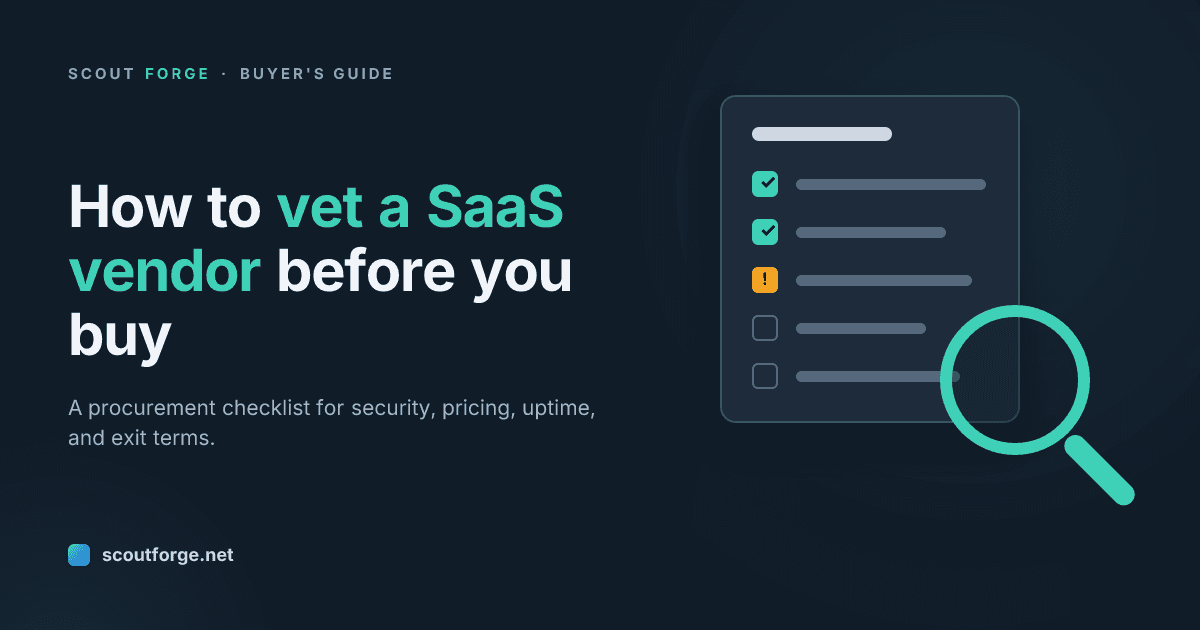
That is the standard we write to here. This guide gives you a repeatable, evidence-based process for evaluating any SaaS vendor before you sign a team-wide contract. It covers security questionnaires and SOC 2 reports, data processing agreements and subprocessor lists, uptime math and status-page reading, the pricing clauses that quietly raise your cost, and the exit paths you need in writing before day one. It ends with a decision framework: when to sign, when to pilot, and when to walk away.
If you are evaluating an app for yourself rather than a team, our guide on how to vet a new app before giving it your data covers the individual-use case. This one is for the person whose signature binds everyone else.
Why Team-Scale Vendor Vetting Is Different From Picking an App for Yourself
An individual user can tolerate a lot. If a personal productivity app goes down for an afternoon, you lose an afternoon. If it raises its price, you cancel. If it gets acquired and the roadmap stalls, you export your notes and move on. The switching cost is measured in hours.
A team-scale decision carries different failure modes. When a team-wide tool breaks, the cost compounds across every seat, every workflow, and every integration. A CRM outage during a sales quarter is not an inconvenience; it is a revenue event. A project management tool that loses data is not a support ticket; it is a legal exposure. A vendor that triples its per-seat price at renewal is not a minor annoyance; it is a budget line you have to defend in front of leadership.
There is also an asymmetry of information. Consumer apps are reviewed by millions of users, and you can usually test the full product before paying. Team SaaS tools are often sold through sales calls, with custom pricing, security details behind NDAs, and contract terms that only surface when you ask. The vendor controls the narrative. Your job is to break that control with a structured process.
That process does not need to be heavy. A small procurement team — one or two ops people, an IT lead, and a legal reviewer on call — can run a solid vendor review in two to three weeks if they know what to ask and what evidence to demand. The checklist below is the spine of that process.
The 10-Point SaaS Vendor Checklist
Here is the checklist we use when we evaluate tools for our own team. It is deliberately broad: security, legal, reliability, pricing, support, roadmap, integration, exit, references, and financial stability. Each point maps to a section later in this guide.
| # | Area | What you need | Red flag if missing |
|---|---|---|---|
| 1 | Security | SOC 2 Type II or ISO 27001 report, pen-test summary, security questionnaire response | Vendor refuses to share any evidence under NDA |
| 2 | Legal | Signed DPA, subprocessor list, data residency options | No DPA or refuses to name subprocessors |
| 3 | Reliability | Uptime SLA with defined exclusions, 12 months of status-page history | "99.99% uptime" with no definition or history |
| 4 | Pricing | Seat minimums, overage rates, auto-renewal window, price-escalation cap in writing | Uncapped price increases or 90-day auto-renewal with no reminder |
| 5 | Support | Support SLA with response-time tiers, named escalation path | No SLA or "best effort" support for a critical tool |
| 6 | Roadmap | Public changelog, shipped-feature velocity, stated direction | No changelog, no visible shipping in 6+ months |
| 7 | Integration | Documented APIs, export formats, existing integrations you need | No API or export beyond CSV |
| 8 | Exit | Data export format and frequency, post-termination retention, egress fees | Punitive export fees or no export path |
| 9 | References | 2–3 reference calls with teams your size in your industry | No references or only hand-picked logos |
| 10 | Financial stability | Funding status, ownership, acquisition history, public filings if any | Early-stage vendor with no revenue and no security program |
We use a simple scoring rubric at the end of this guide to turn this checklist into a sign / pilot / walk-away decision. First, the details.
Security and Compliance: Reading SOC 2, ISO 27001 and Questionnaires Like a Skeptic
Security is where most vendor reviews start, and where most buyers get fooled by badges. A "SOC 2 compliant" logo on a website means almost nothing by itself. You need to know what the report actually covers, when it was issued, and whether it matches the product you are buying.
SOC 2 Type I vs Type II. A SOC 2 Type I report attests that a vendor's controls are suitably designed and implemented as of a specific point in time — a snapshot. A SOC 2 Type II report attests that those controls operated effectively over a defined observation period, typically 3 to 12 months. For any vendor that will hold your team's data, Type II is the minimum bar. Type I tells you the vendor wrote policies; Type II tells you they followed them. We rely on the definitions from Audit Suisse's SOC 2 comparison for this distinction.
ISO 27001 is an international standard for an information security management system. It is broader than SOC 2 in some ways — it covers the whole management system, not just the five SOC 2 trust criteria — but it is also a certification, not a report. A vendor can hold an ISO 27001 certificate for one business unit and sell you a product from another. Ask which scope the certificate covers.
You can typically request the full SOC 2 report under NDA. Do it. The summary page is marketing; the full report shows you the auditor's exceptions, the control failures, and the scope. If a vendor refuses to share the full report under NDA, that is a signal, not necessarily a deal-breaker — some large vendors only share with enterprise customers — but it should push you toward a pilot with limited data rather than a full rollout.
The bridge letter. SOC 2 reports cover a fixed period. If the vendor's latest report ended six months ago, ask for a bridge letter: a document from the vendor's auditor confirming that controls have not materially changed since the report period ended. A vendor that cannot produce a bridge letter or a fresh report is effectively asking you to trust an old audit. The same Audit Suisse guide explains when a bridge letter is appropriate.
The security questionnaire. For most SMB procurement teams, the practical tool is a standardized questionnaire. A SIG Lite questionnaire runs roughly 126–136 questions across security, privacy, and risk domains, according to Inventive's SIG questionnaire guide. A CAIQ v4 questionnaire is longer, around 261 questions mapped to the Cloud Controls Matrix, per RocketDocs' CAIQ guide. You do not need to send a 261-question monster to every vendor. For a first pass, a SIG Lite or a trimmed internal questionnaire of 30–40 questions is enough. Expect a vendor to return it in 5–7 business days if they have an answer library or automation, as Optimum-Web notes; a vendor that takes three weeks to return a basic questionnaire is telling you something about their operational maturity.
If you are on the other side of the table — a startup that needs to answer these questionnaires — tools like ResponseHub (scores 81 on Scout Forge) automate the process with a self-updating knowledge base. Sprinto (scores 81) automates SOC 2 and ISO 27001 compliance itself. For a quick compliance scan of your own site before you start sending questionnaires, PrivacyPilot (scores 80) runs an AI-powered GDPR and SOC 2 audit with automated reporting.
Pen-testing cadence. Ask when the vendor last ran a penetration test and whether they will share the summary. A vendor that has never pen-tested a product holding customer data is not ready for team-scale use. Annual pen-tests are the floor; quarterly or continuous testing is better for high-risk tools.
Data Processing, Subprocessors and Residency: What Your DPA Must Say
The security questionnaire tells you how the vendor protects data. The Data Processing Agreement (DPA) tells you what they are legally allowed to do with it. For any vendor processing personal data of your team or your customers, a signed DPA is non-negotiable.
Under GDPR Article 28(3), a compliant DPA must specify the subject matter and duration of processing, the nature and purpose, the types of personal data, the categories of data subjects, and the processor's obligations. CyberSilo's DPA template guide breaks down each required element. If a vendor hands you a one-page "data addendum" that does not cover those elements, it is not a DPA — it is a liability transfer.
Subprocessors. Every SaaS vendor uses subprocessors: the cloud host, the email provider, the analytics tool. Under GDPR Article 28(2), a processor must obtain prior specific or general written authorization from the controller before engaging a subprocessor, and must notify the controller of intended changes. LegalClarity's subprocessor guide covers the authorization and notification requirements in detail. In practice, this means the vendor should publish a subprocessor list — name, location, purpose, and data categories for each — and commit to notifying you of changes, typically with 30 days' advance notice. If a vendor cannot tell you who their subprocessors are, or treats the list as a trade secret, walk away.
Data residency. Ask where your data will be stored and processed. "EU data residency" is a common requirement for European teams, but it means different things to different vendors. Some offer true residency — data at rest stays in the EU. Others offer "EU access" while data flows through US-based subprocessors. Get the specific commitment in writing, and check it against the subprocessor list. If the vendor's subprocessor list shows a US-based analytics provider and they claim full EU residency, ask how those two statements reconcile.
Verification. The vendor's trust page should link to their DPA, subprocessor list, and security reports. If the trust page is thin — a logo and a sentence — treat that as a signal that security is a sales artifact, not an operational practice. EthicsPortal's subprocessor directory shows what a properly maintained disclosure looks like. For a deeper look at how we evaluate security claims in app reviews, see our methodology.
Uptime, Status Pages and Changelogs: How to Read Them Like a Skeptic
Every SaaS vendor promises uptime. Almost none of them define it the way you would. Learning to read a status page and a changelog like a skeptic is one of the highest-leverage skills in vendor vetting, and it is one almost no procurement guide covers.
The uptime math. A 99.9% uptime SLA sounds impressive. It translates to roughly 43.8 minutes of downtime per month, or 8.76 hours per year. That is a full workday of outage every year, and the vendor is still within SLA. A 99.95% SLA is about 21.9 minutes per month. A 99.99% SLA is about 4.38 minutes per month. Before you accept any uptime number, do the math and ask yourself whether that level of downtime is actually acceptable for the workflow the tool supports.
What counts as downtime. This is where status pages get slippery. Many vendors exclude scheduled maintenance, customer-caused incidents, and force majeure events from their uptime calculation, as Slack's help documentation illustrates. That is not inherently dishonest — scheduled maintenance is a legitimate operational practice — but it means the headline number overstates real availability. Read the SLA definitions, not the marketing page. If the vendor does not publish a definition of what counts as downtime, assume the number is meaningless.
Incident history. A status page with a clean 12-month history is either a sign of exceptional engineering or a sign that the vendor does not report incidents. Look for the pattern: a vendor that has never had a major incident is either very small, very new, or very selective about what they post. A vendor that posts detailed postmortems — what broke, what they fixed, what they changed to prevent recurrence — is showing you their operational maturity. That is a buying signal.
The changelog. A changelog tells you two things: whether the vendor is shipping, and whether they are shipping things that matter. A vendor that ships a steady stream of meaningful improvements is investing in the product. A vendor whose changelog is a list of "bug fixes and performance improvements" for six months is either coasting or hiding something. Look for the ratio of user-requested features to marketing-driven features. A vendor that builds what customers ask for is a vendor that will still be useful in two years.
If you want to monitor a vendor's uptime yourself before you sign, a tool like Dialogs Monitor (scores 72 on Scout Forge) gives you basic uptime monitoring with email and Slack alerts, free for small teams. It is not a substitute for reading the vendor's own status page, but it gives you an independent data point.
Pricing Traps: Seat Minimums, Overage, Auto-Renewal and Price Escalation
SaaS pricing pages are designed to look simple. Contracts are designed to be anything but. The four clauses below are the ones that quietly raise your cost after you have committed, and they are all negotiable if you ask before you sign.
Seat minimums. A vendor quotes you a per-seat price, but the contract specifies a minimum number of seats — often the number you estimated during the sales process, rounded up. If your team shrinks, or if adoption is slower than expected, you pay for empty seats. Ask for the minimum to be set at your actual current headcount, with the ability to reduce at renewal.
Overage rates. Most SaaS plans include a usage allowance, and most overage rates are punitive. A common pattern is overage at 1.5–2x the list price. If you are buying a tool with usage-based meters — API calls, automation steps, storage — get the overage rate in writing before you sign, and model your worst-case month. A tool that looks affordable at list price can be painful at 2x overage.
Auto-renewal windows. Many SaaS contracts auto-renew for a full year unless you cancel within a narrow window — often 30 to 90 days before the renewal date. Miss the window, and you are locked in for another year. Ask for a renewal reminder commitment, a longer cancellation window, or a switch to month-to-month after the initial term. The auto-renewal clause is one of the few things a vendor will almost always negotiate, because they would rather keep you happy than fight a cancellation dispute.
Price escalation. Some contracts include an annual price increase — often 5–10% — with no cap. A 10% annual increase compounds: a $10,000 contract becomes $13,310 in three years. Ask for a cap on annual increases, or a fixed price for the initial term plus a capped increase thereafter. If the vendor will not cap escalation, model the compounded cost and decide whether the tool is still worth it.
These clauses are not hypothetical. Atlassian announced cloud list price increases of roughly 7–10% effective October 13, 2026, with usage-based pricing for automation steps following in December. Salesforce launched new Core, Advanced, and Max editions in September 2026 that bundle Slack and security features. HubSpot rolled out a seats-and-credits model for new EMEA customers in October 2026, as covered by HubEconomy. None of these are traps in themselves — they are pricing model changes — but they illustrate how quickly a SaaS contract can shift under you. For a deeper look at pricing red flags across the SaaS landscape, see our article on SaaS red flags.
Exit Paths: Data Export, Portability and Contract Termination
The moment to negotiate your exit is before you sign, not when you are unhappy. A vendor that makes it easy to leave is a vendor that is confident in their product. A vendor that makes it hard is telling you something.
Export formats. Ask what formats the vendor supports for data export. CSV is the floor; JSON or a documented API is better; a structured export that preserves relationships and attachments is best. If the vendor's only export path is "contact support and we'll see what we can do," treat that as a red flag. You should be able to export your data on demand, without asking permission.
Export frequency. Some vendors limit exports to once per quarter, or charge for additional exports. For a team-scale tool, you want at least monthly export capability, and ideally continuous access via API. If the vendor's API is read-only for your data, that is acceptable for exit purposes; if there is no API at all, factor that into your decision.
Post-termination retention and deletion. The contract should specify what happens to your data after termination: how long the vendor retains it, in what form, and when it is deleted. A common pattern is 30 days of retention for export, then deletion. Get this in writing. Under GDPR, you also have the right to require deletion of personal data, and the DPA should reflect that.
Egress fees. Some vendors charge to export your data — a fee per gigabyte, or a flat "migration assistance" charge. The EU Data Act, applicable from September 2025, requires cloud providers to facilitate data portability and switching with limits on egress fees, as noted in CyberSilo's DPA guide. If you are in the EU, or your data is processed in the EU, this regulation works in your favor. Even outside the EU, egress fees are increasingly seen as a hostile practice. Ask for a written commitment that data export is included in your subscription, with no additional fees.
Support, Roadmap and Financial Stability: The Softer Signals
Security, legal, and pricing are the hard requirements. Support, roadmap, and financial stability are the softer signals that determine whether the vendor will still be a good partner in two years.
Support SLAs. A support SLA with response-time tiers — for example, critical issues within 1 hour, high within 4 hours, normal within 24 hours — tells you the vendor has thought about what happens when things break. "Best effort" support is fine for a free tool; it is not fine for a tool your team depends on daily. Ask for the SLA in writing, and ask what happens when the vendor misses it. A vendor that offers service credits for missed SLAs is showing confidence; a vendor that refuses to commit to any response time is showing something else.
Roadmap honesty. Every vendor has a roadmap. The question is whether it is honest. A vendor that publishes a public roadmap with shipped dates and a track record of hitting them is rare and valuable. A vendor whose roadmap is a list of vague promises — "AI-powered everything, coming soon" — is selling aspiration, not software. Look at the changelog for evidence of shipping velocity. A vendor that has not shipped a meaningful feature in six months is either underfunded, distracted, or winding down.
Financial stability. For early-stage vendors, ask about funding status, runway, and ownership. A seed-stage startup with six months of runway is a different risk profile than a Series C company with a clear path to profitability. That does not mean you should never buy from a startup — some of the best tools are built by small teams — but it does mean you should pilot first, limit the data you put in, and have a clear exit plan. For larger vendors, check acquisition history. A vendor that has been acquired three times in five years may have a fragmented product and an uncertain roadmap.
What to do if the vendor is early-stage. Pilot with a small team, on non-critical data, for a defined period. Get the security basics in writing even if the vendor does not yet have a SOC 2 report — a security questionnaire, a pen-test summary, and a clear plan for certification. And do not sign a multi-year contract with a vendor that has not proven it can survive a bad quarter.
Running the Review: A Repeatable Process for Small Procurement Teams
You do not need a dedicated procurement department to run a solid vendor review. A small team — one ops lead, one IT person, and legal on call — can do it in two to three weeks if you follow a structured process.
Step 1: Intake. Define the problem you are solving, the must-have requirements, and the budget. Write it down. A vendor review without a written requirements doc drifts into feature comparison and never ends.
Step 2: Shortlist. Identify 3–5 vendors that plausibly meet the requirements. Use independent sources — including our category pages — not just vendor marketing sites.
Step 3: Security questionnaire. Send a SIG Lite or your internal questionnaire to each shortlisted vendor. Expect responses in 5–7 business days. A vendor that takes three weeks is already failing the operational maturity test.
Step 4: Evidence review. Request the SOC 2 Type II report under NDA, the DPA, the subprocessor list, and the uptime SLA definitions. Read them. This is where the real differences between vendors emerge.
Step 5: Reference calls. Ask for 2–3 references from teams your size in your industry. Do not accept hand-picked logos from the vendor's website; ask for customers who have been live for at least six months, and ask them what they wish they had known before signing.
Step 6: Scoring. Use a simple rubric. We score each of the 10 checklist areas on a 1–5 scale, weight security and exit highest, and produce a total. A score of 40+ out of 50 is a sign; 30–39 is a pilot with conditions; below 30 is a walk-away.
Step 7: Approval and renewal calendar. Document the decision, the evidence, and the contract terms. Set a renewal reminder 120 days before the contract end date — well before the auto-renewal window. Re-review the vendor annually, or sooner if there is a material change: an acquisition, a security incident, or a pricing model shift.
Red Flags That Should End the Conversation
Some signals are not negotiable. If you see any of these, end the conversation and move on.
Refusal to sign a DPA. For any vendor processing personal data, this is a hard stop. No DPA, no deal.
No SOC 2 or equivalent. A vendor that holds team data but has no SOC 2 Type II, ISO 27001, or equivalent attestation is not ready for team-scale use. There are exceptions for very early-stage vendors, but only with a pilot and a clear certification plan.
Vague uptime claims. "99.99% uptime" with no definition of downtime, no SLA, and no incident history is a marketing claim, not an operational commitment.
Punitive export fees. A vendor that charges to export your own data is telling you they do not want you to leave. Believe them.
Evasive answers on subprocessors. If a vendor will not name their subprocessors, or treats the list as confidential, they are hiding something. Walk away.
Verdict: When to Sign, When to Pilot, When to Walk Away
The checklist and process above reduce to a simple decision framework.
Sign when the vendor scores 40+ on the 10-point rubric, has a SOC 2 Type II report you have read, a signed DPA with a clear subprocessor list, a defined uptime SLA with acceptable downtime math, no punitive pricing clauses, and a clean export path. Sign with confidence, but still set the renewal reminder.
Pilot when the vendor scores 30–39, or when one area is weak but fixable — an early-stage vendor without a SOC 2 report yet, or a pricing clause you have not fully negotiated. Pilot with a small team, on non-critical data, for a defined period, with explicit success criteria and a go/no-go date.
Walk away when the vendor scores below 30, or when you hit any of the red flags above. A vendor that will not sign a DPA, will not share a security report, or will not commit to an export path is not a vendor you want holding your team's data.
The goal of this process is not to eliminate risk — no vendor is perfect — but to make the risk explicit, quantified, and defensible. When your CFO asks why you chose this vendor, you will have an answer with evidence behind it. That is the difference between a procurement decision and a guess.
FAQ
How long should SaaS vendor vetting take?
For a small procurement team, two to three weeks is realistic: one week for intake and shortlisting, one week for security questionnaires and evidence review, and a few days for reference calls and scoring. Complex or high-risk tools may take longer; simple tools with mature vendors can be faster.
Do I need a lawyer to review a SaaS contract?
For most SMB purchases, no — but you should have legal review available for the DPA and any custom terms. The standard clauses are well understood, and many vendors use boilerplate contracts. If the vendor insists on custom terms, or if the deal is large or high-risk, bring in counsel.
What if the vendor is a startup with no SOC 2 report?
Pilot with a small team, on non-critical data, for a defined period. Ask for a security questionnaire response, a pen-test summary, and a written plan for certification. Do not sign a multi-year contract, and do not put sensitive data in the tool until the security program is real.
Is SOC 2 Type II enough on its own?
SOC 2 Type II is a strong signal, but it is not a complete picture. You still need a signed DPA, a subprocessor list, an uptime SLA with defined exclusions, and a clear export path. SOC 2 tells you the vendor runs a security program; the other documents tell you what they will do with your data and how you can leave.
How often should I re-review a SaaS vendor?
At minimum, annually, before renewal. Re-review sooner if there is a material change: an acquisition, a security incident, a pricing model shift, or a significant change in the subprocessor list. Set a renewal reminder 120 days before the contract end date.
What is a bridge letter, and when should I ask for one?
A bridge letter is a document from a vendor's auditor confirming that controls have not materially changed since the end of the last SOC 2 report period. Ask for one if the vendor's latest report is more than six months old and no new report is available.
Can I negotiate SaaS contract terms?
Yes. Seat minimums, auto-renewal windows, price-escalation caps, and export terms are all commonly negotiable, especially for annual contracts. The vendor would rather adjust terms than lose the deal. Ask before you sign, not at renewal.
Ready to evaluate tools with the same skeptical eye we apply to every app we review? Browse our Business & SaaS category for independent scores and honest assessments, or read our guide on how to compare SaaS tools without being misled by sponsored rankings. If you build a SaaS product, list it on Scout Forge — free, with the same scoring as everyone else, and no way to buy a score.
