

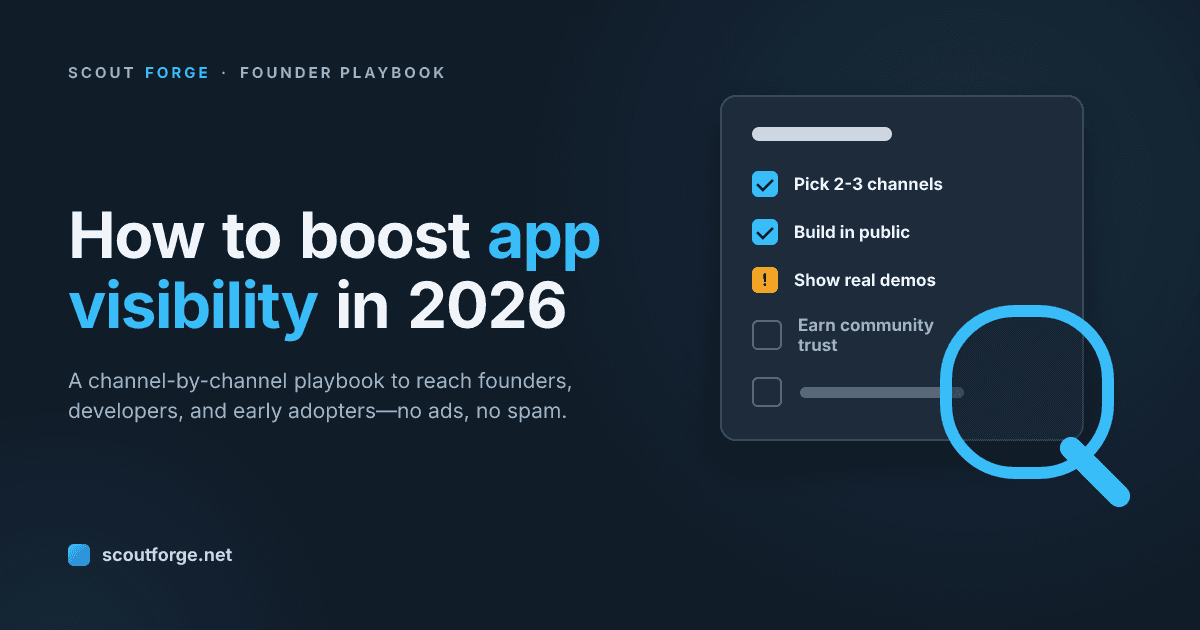
Your app’s biggest visibility problem isn’t a lack of traffic. It’s that the people most likely to adopt it first — founders, developers, and early adopters — are the hardest audiences to reach with ads, and the fastest to ignore anything that smells like marketing. If you want these three groups to find your app, you need to be where they actually look for new tools, and you need to show up in a way they trust.
That means directories they search, communities they participate in, and launch platforms they browse. It means earning visibility channel by channel, not buying it. This playbook maps out exactly where each audience spends time in 2026, what they distrust, and how to get your app in front of them without getting flagged, banned, or ignored.
Why These Three Audiences Matter More Than Raw Traffic
A thousand random visitors who bounce in 12 seconds won’t build your product. Ten founders who try your app, send you detailed feedback, and mention it in their Slack community will.
Founders, developers, and early adopters are the highest-leverage first users you can get. They influence what their teams and networks adopt. They give you the kind of bug reports and feature requests that actually shape a product. And when they like something, they become loud, persistent advocates — the kind of word-of-mouth that no ad budget can replicate.
But they’re also skeptical by default. They’ve seen too many “game-changing” launches fizzle. They read Show HN comments before they click the link. They check if there’s a real repo, a real team, a real free tier they can test without handing over a credit card. Visibility with these audiences isn’t about reach — it’s about credibility, and credibility is earned in specific places, with specific rules.
Know Where Each Audience Actually Hangs Out in 2026
Before you write a single launch post, you need to know which venues each audience actually uses. Spraying the same message everywhere is how you get ignored — or banned. Here’s the map.
Founders cluster on Indie Hackers, r/startups, and launch platforms like Product Hunt. Indie Hackers has no formal self-promotion rules page, but the community norm is clear: share progress, revenue numbers, lessons learned, and useful links — not ads. r/startups prohibits direct promotional posts outside the monthly Share Your Startup thread. Founders also read niche newsletters and browse curated directories; they’re looking for tools that solve a specific, painful problem they’re experiencing right now.
Developers live on Hacker News, GitHub, Dev.to, and Stack Overflow. Hacker News Show HN is the gold standard for getting technical feedback, but the rules are strict: you must share something people can try immediately, and blog posts, landing pages, and fundraisers are off-topic. Dev.to requires posts about your own work to have substantial technical content and not be primarily for promotion. Lobsters, a smaller but influential developer link aggregator, limits self-promotion to less than a quarter of your stories and comments in the last year, and new users can’t submit self-promo for their first 70 days. Stack Overflow’s rules are the tightest of all — linking your product in an answer is only acceptable if it directly and substantively solves the question, with full disclosure.
Early adopters browse Product Hunt, r/SideProject, and niche newsletters. r/SideProject allows sharing side projects with no specific self-promotion rules beyond Reddit’s site-wide policies. r/webdev limits project sharing to Showoff Saturday with a technical focus only. r/selfhosted welcomes self-hostable projects, but those under three months old must use the New Project Megathread. These audiences are curious and willing to try new things, but they’ll punish anything that feels like a drive-by launch with no follow-up.
Get Listed Where Buyers and Makers Search
Directories and review platforms are the quiet workhorses of app visibility. Unlike a launch post that fades in 24 hours, a well-built directory listing keeps working for months — and it catches people at the moment they’re actively searching for a tool like yours.
Scout Forge is an app discovery and review platform where listing is free. Human testers provide reviews, and the platform assigns independent editorial scores on a 0–100 scale across six dimensions — design, usability, speed, security, accessibility, and growth. Scores cannot be bought; paid placements are clearly labeled and never influence the score. Getting listed puts your app in front of an audience that’s specifically looking to discover and evaluate new tools. We’ve written a full guide on how to get your app listed in directories that walks through the process.
G2 is the largest software review marketplace, and as of November 2026, it offers a free basic profile. Paid plans start at roughly $299 per month or $2,999 for the first year on the Starter tier. Recent changes include a unified my.G2 experience across G2, Capterra, and other properties, plus new add-ons like Verified Leads. A G2 profile gives you visibility with buyers who are comparing tools side-by-side, but the platform’s value scales with review volume — a bare profile with zero reviews won’t move the needle.
Curated startup directories — the kind maintained by indie makers, niche newsletters, and “best-of” list curators — are worth hunting down. They’re smaller than G2, but their audiences are more targeted and more trusting. The key to getting accepted: your listing page needs to clearly explain what your app does, who it’s for, and why it’s different, in the first two sentences. Curators reject vague submissions.
When you write a listing, lead with the problem you solve, not your feature list. Include a clear screenshot or demo video. Make sure your pricing is visible or clearly labeled as “free tier available” — early adopters will bounce if they can’t tell whether they can try it without a sales call.
Nail the Launch Platforms: Product Hunt and Show HN
Launch platforms give you a concentrated burst of visibility from exactly the right people — if you do them right. Do them wrong, and you’ll get a handful of upvotes from friends and zero lasting traction.
Product Hunt
Product Hunt’s mechanics shifted in 2025–2026. The platform now uses a points system instead of simple upvotes, and launches go live at 12:01 AM Pacific Time, running for 24 hours. You can schedule up to 30 days in advance. Descriptions are capped at 500 characters. Featuring is an editorial decision based on usefulness, novelty, craft, and creativity — not just vote count.
The non-negotiable rules: you must launch from a personal account that’s at least one week old (company accounts are prohibited), and you cannot ask for upvotes, pay for promotion, or use bots. Violations get you removed or permanently banned.
What actually works: a clear, specific description that tells people what your product does and why it’s different, a demo video under 90 seconds, and a maker who stays in the comments all day answering questions honestly. The products that do well on Product Hunt are the ones where the maker treats launch day as a conversation, not a broadcast.
Hacker News Show HN
Show HN is Hacker News’ section for sharing something you’ve made that others can try immediately. The guidelines are explicit: blog posts, landing pages, sign-up pages, and fundraisers are off-topic. Your submission must be non-trivial, personally worked on by you, and you must stick around to discuss it. No asking for votes or comments.
Based on analysis of over 40,000 Show HN posts, the posts that succeed tend to go up on weekdays between 9 AM and noon Pacific Time, or on weekends. The single biggest factor: remove every barrier between the reader and trying your product. If your demo requires a sign-up, an email confirmation, and a tutorial before someone can see what it does, you’ve already lost. A direct link to a working demo, a clear one-sentence description of what it does, and a maker who answers every comment — that’s the formula.
Realistic outcomes: a successful Show HN can send a few thousand visitors in a day, but the bigger win is the feedback and the network effects. A thoughtful Show HN thread gets indexed, shared, and referenced for years.
Earn Developer Trust in Technical Communities
Developers are the hardest audience to reach with traditional marketing and the most valuable once they trust you. But trust is earned through participation, not promotion.
GitHub is where developers discover tools by using them. Open-sourcing your product — or at least key parts of it — is the single most effective visibility tactic for a developer tool. A well-maintained repo with clear documentation, a permissive license, and responsive issue handling signals that you’re serious. Developers will find your product through search, through dependencies, and through stars and forks from people they follow. If your product isn’t open-source, you can still maintain public repos for SDKs, integrations, or documentation.
Dev.to rewards substantial technical content. A post that walks through a real problem you solved while building your app, with code samples and architectural decisions, will outperform any “announcing our launch” post. The rule: your post must have value even if the reader never tries your product.
Stack Overflow is not a promotion channel, period. But it is a discovery channel. Developers search Stack Overflow for solutions to specific problems. If your tool genuinely solves a problem being discussed, you can answer the question with a detailed solution that includes your tool — with full disclosure that it’s yours, and only if it’s the best answer to the question. Anything less gets flagged and deleted.
Lobsters is smaller but influential, especially in the systems and security communities. Self-promotion is limited to less than a quarter of your stories and comments in the last year, and new users can’t submit self-promo for their first 70 days. The play: become a genuine participant first, share interesting links that aren’t yours, and only submit your own work once you’ve built a reputation.
Turn Early Adopters into a Discovery Engine
Getting an early adopter to try your app is step one. Getting them to tell someone else is where visibility compounds.
Make feedback loops obvious and fast. When an early user reports a bug or suggests a feature, respond quickly and ship the fix if it’s reasonable. Early adopters talk about products where the founder is visibly responsive. A “shipped your suggestion” reply in a community thread is better advertising than any launch post.
Build sharing into the product experience. If your app generates something shareable — a report, a visualization, a result — make it one-click to share. Early adopters want to show off the cool new tool they found. Make it easy for them.
Give them a reason to bring others. This doesn’t mean a spammy referral program. It means a free tier that’s genuinely useful, a team plan that’s easy to invite colleagues to, or a community (Slack, Discord, forum) where users can help each other. The products that grow through early adopters are the ones where using the product is a social experience.
We’ve covered the pre-launch side of this in our first 100 users playbook, which walks through building an audience before you launch.
Make Your App Findable: SEO, Content, and Comparison Pages
Community visibility gets you spikes. Search visibility gets you a steady baseline. The two reinforce each other.
Comparison and alternatives content is the highest-intent traffic you can capture. When someone searches “X vs Y” or “alternatives to Z,” they’re actively evaluating tools and close to a decision. If your app isn’t showing up in those searches, you’re invisible at the worst possible moment. Build a comparison page that honestly explains how your app differs from established competitors — not a hit piece, but a clear, factual breakdown of strengths, weaknesses, and ideal use cases.
Landing pages for specific use cases convert better than a single generic homepage. A page titled “Project management for remote dev teams” will capture search traffic that a page titled “Our product” never will. Each use-case page should explain the problem, show how your app solves it, and include a clear path to try it.
Get listed in “best X” roundups. Many directory and review sites — including Scout Forge — publish curated lists and category pages that rank for high-intent search terms. Being present on those pages with an accurate, well-written listing puts you in front of searchers who are ready to try something new.
Measure What Actually Works
If you’re posting in five communities and listing on three directories, you need to know which ones are sending real users — not just traffic.
Track signups by source. Most analytics tools can capture UTM parameters or referrer data. The metric that matters isn’t pageviews; it’s activated users — people who signed up and actually used the product. A directory that sends 50 visitors and 10 signups is worth more than a launch that sends 2,000 visitors and 5 signups.
Free analytics options exist at every level. Tools like PrettyInsights — which scores 81 on Scout Forge — offer privacy-first, GDPR-compliant analytics without cookies, with a lightweight script under 5KB. For deeper product analytics, you’ll want something that tracks user behavior inside the app, not just landing page visits.
Cut channels that don’t convert after a fair test. A fair test means consistent participation for at least 30 days, not one post. Communities reward presence over time. But if you’ve been genuinely engaged in a community for a month and it’s sending zero signups, redirect that energy to a channel that’s working.
Common Visibility Mistakes That Get You Ignored or Banned
The fastest way to get zero visibility is to get flagged, removed, or silently ignored. Here’s what trips up most makers.
Asking for upvotes. Product Hunt, Hacker News, and Reddit all explicitly prohibit it. Even a well-intentioned “if you like this, please upvote” in a community that bans it can get your post removed and your account flagged.
Drive-by promotion. Dropping a link to your app in a community you’ve never participated in, then leaving. Communities can smell this instantly, and the response is either deletion or hostile comments. You need to be a real participant before you share your own work.
Ignoring community rules. Every subreddit and community has specific self-promotion rules. r/webdev only allows project sharing on Showoff Saturday. r/startups only allows promotion in the monthly thread. r/selfhosted requires new projects to use the megathread. Read the rules before you post — every single time.
Over-indexing on one launch. A single Product Hunt launch or Show HN post is not a visibility strategy. It’s one day. The products that build sustained visibility are the ones that show up consistently across directories, communities, and search over months.
Vague or hype-heavy copy. Founders and developers are allergic to marketing fluff. If your description says “revolutionary AI-powered platform” but doesn’t explain what it actually does, they’ll scroll past. Be specific. Be boring if you have to. Just be clear.
A 30-Day Visibility Plan for Your App
Here’s a sequenced plan that front-loads the highest-leverage, lowest-risk actions.
Week 1: Prep your assets.
- Write a clear, specific description of your app in under 500 characters (for Product Hunt and directory listings).
- Record a demo video under 90 seconds that shows the core workflow.
- Take 3–5 high-quality screenshots.
- Create a public repo or documentation site if you’re targeting developers.
- Set up UTM parameters or source tracking in your analytics.
Week 2: List in directories.
- Submit to Scout Forge (free listing, human-reviewed).
- Claim or create your G2 profile.
- Find 5–10 niche directories or “best-of” lists in your category and submit.
- Write one comparison page targeting a competitor your audience searches for.
Week 3: Schedule your launch and start engaging.
- Schedule your Product Hunt launch (requires a personal account at least one week old).
- Start participating in 2–3 communities where your audience hangs out — not promoting, just answering questions and joining discussions.
- Write one technical post for Dev.to or your own blog about a problem you solved while building.
Week 4: Launch, measure, iterate.
- Execute your Product Hunt or Show HN launch day — stay in the comments, answer everything.
- Post in the communities you’ve been engaging with (where rules allow).
- Review your analytics: which sources sent activated users? Double down on those.
- Publish your comparison page and submit it to relevant “best X” roundups.
Verdict: Where to Start If You Can Only Do One Thing
If you’re a solo founder with limited time, here’s the priority order.
If your audience is developers: open-source your product or its core components on GitHub, write great documentation, and post a Show HN when you have something people can try immediately. That combination — discoverable repo plus credible launch — outperforms everything else for technical audiences.
If your audience is founders: get listed on Scout Forge and one other curated directory, then participate genuinely on Indie Hackers. Share your numbers, your lessons, and your progress. Founders trust other founders who build in public.
If your audience is early adopters: Product Hunt is still the highest-concentration channel, but only if you treat it as a conversation, not a launch-and-leave. Pair it with consistent participation in one subreddit (r/SideProject or the one most relevant to your niche).
Across all audiences, directories are the highest-ROI time investment because they keep working after the work is done. A launch post fades in 24 hours; a directory listing can send traffic for years. Start there, then layer on communities and content.
For more on the launch landscape beyond Product Hunt, see our roundup of Product Hunt alternatives and our guide on how to get featured on Scout Forge.
FAQ
How long does it take for directory listings and community visibility to pay off? Directory listings can start sending referral traffic within weeks, but the compounding effect builds over months — a listing that’s been indexed and reviewed for six months will consistently outperform a new one. Community visibility is slower; expect 30–60 days of genuine participation before you see meaningful signups from a community where you’re new.
Is Product Hunt still worth it in 2026? Yes, but not as a one-day traffic spike. Product Hunt’s value in 2026 is the long-tail discovery from being indexed, linked to, and referenced in “best of Product Hunt” roundups. The launch day itself is a conversation with early adopters — treat it as user research and community-building, not a growth hack.
Do I need paid ads to get visibility among developers? No. Developers actively resist and ignore ads for tools. The channels that work — GitHub, Hacker News, Dev.to, Stack Overflow — are all organic. Paid ads can supplement visibility for founder and early-adopter audiences, but they should never be your primary channel.
How many directories should I list my app in? Start with 5–10 that are genuinely relevant to your category and audience. A listing on Scout Forge (free, human-reviewed) plus G2 (free basic profile) covers the two largest discovery-intent audiences. Then add niche directories that are specific to your space. Quality and accuracy of your listing matters more than quantity.
Can I promote my app on Reddit without getting banned? Yes, but only by following each subreddit’s specific rules. r/SideProject is the most permissive for sharing side projects. r/webdev only allows it on Showoff Saturday. r/startups only allows it in the monthly Share Your Startup thread. Read the rules of every subreddit before posting, and participate as a real community member — don’t just drop links.
What’s the biggest mistake that gets makers ignored on Hacker News? Posting a landing page or sign-up wall instead of something people can try immediately. Show HN requires a working product, not a “coming soon” page. The second biggest mistake: posting and then not answering comments. The discussion is the point.
Ready to get your app in front of the right audience? Browse all Scout Forge categories to see where your product fits, or list your product on Scout Forge — it’s free, human-reviewed, and scored on the same independent scale as everyone else.
