
A platform dedicated to providing unbiased reviews of newly launched applications, analyzing everything from their features to their full potential.
info@scoutforge.net© 2026 Scoutforge. All rights reserved.
A platform dedicated to providing unbiased reviews of newly launched applications, analyzing everything from their features to their full potential.
info@scoutforge.net© 2026 Scoutforge. All rights reserved.
A platform dedicated to providing unbiased reviews of newly launched applications, analyzing everything from their features to their full potential.
info@scoutforge.net© 2026 Scoutforge. All rights reserved.
Cycling through all six. Tap any point to stop.
Measured on six things
Choose your AI model for chat, research and code
Desktop Lighthouse 96/100 but mobile 67/100 with a 6.9s LCP — the mobile experience is the bottleneck. CLS 0 and TBT 340ms are fine.
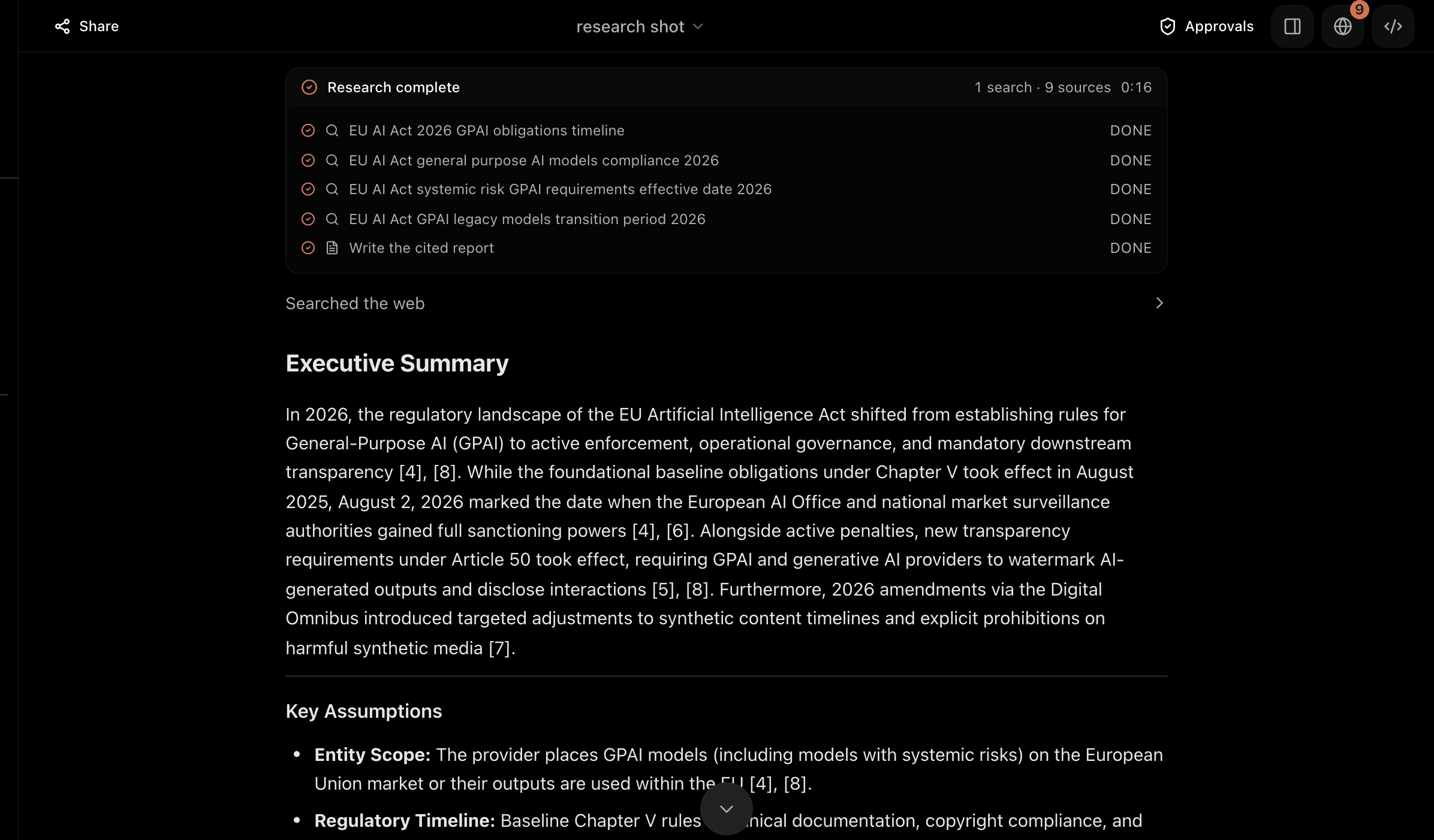
AGI Workforce is a browser-based AI workspace for research, writing and everyday work. Organize conversations in projects, save memory and create artifacts such as documents and code. Choose AI models with visible labels on replies. The web app is available now with a free plan and optional paid subscriptions.
Drawn from the product itself, not from a survey.
Written by AI from measured evidence, scored out of 100.
AGI Workforce is a browser-based AI workspace that routes requests across 300+ models from 10+ providers, with visible model labels on every reply, BYOK support, two local runtimes, and six surfaces (Web, Desktop, Mobile, CLI, Chrome, VS Code) under one account. The product is early — the domain registered in late 2025 — but the execution discipline is unusually mature for its age: 45 documentation guides, a changelog that dates every shipped feature and honestly labels unreleased clients as 'planned,' and a security posture that includes HSTS, CSP, and a dedicated trust page. The weaknesses are concrete: mobile performance lags badly (6.9s LCP), SPF and DMARC are missing, and the JavaScript-only gate blocks non-JS users entirely. Design is clean and distinctive but has layout balance issues. The core idea — a unified router across models and surfaces — is genuinely differentiated in a crowded category. Whether it finds an audience is the open question.
45 docs guides, a dated changelog with GA/beta/alpha labels, and honest 'planned' tags on unreleased clients. Onboarding clarity is strong; the JS-only gate is a friction point.
Clean, restrained light palette with a genuinely distinctive provider-routing diagram. Held back by an unbalanced hero and a half-empty section with a cut-off app window.
Desktop Lighthouse 96/100 but mobile 67/100 with a 6.9s LCP — the mobile experience is the bottleneck. CLS 0 and TBT 340ms are fine.
Strong header hygiene (HSTS, CSP, frame protection, 10/12 checklist points) and a dedicated security/trust doc. SPF and DMARC are missing, which is a real gap.
Lighthouse a11y 100/100 is a strong automated signal. No published WCAG statement or a11y page found, and the JS-only gate blocks non-JS users entirely.
Real problem (model sprawl, no unified workspace), specific wedge (router with visible labels + BYOK + local runtimes), and a category with obvious headroom. Early stage, no traction signals yet.
AGI Workforce's homepage earns its keep with a genuinely distinctive visual: a radial routing diagram that connects OpenAI, Anthropic, Google, xAI and others to a central hub, immediately communicating what the product actually does. The light beige palette and restrained typography give it a premium developer-tool feel rather than the usual AI-startup gradient soup. Where it stumbles is layout balance — the hero pushes the phone mockup far right, leaving a lopsided void on the left, and a later section is so sparsely populated that a cut-off app window floats in whitespace like an unfinished draft. On usability, the product punches above its weight: 45 documentation guides organized by surface, a changelog that dates every shipped feature and labels GA vs beta vs alpha, and honest 'planned' tags on clients that don't exist yet. That transparency is rare. The friction is the JavaScript gate — visitors on old browsers or with JS disabled get a nag screen instead of content, which is a rough first impression for a product this young.
Speed is a tale of two platforms. Desktop Lighthouse lands at 96/100 — genuinely fast. Mobile lands at 67/100 with a 6.9-second Largest Contentful Paint, which is the kind of number that loses users before they see anything. CLS is a clean 0 and TBT sits at 340ms, so the layout is stable and interactivity isn't terrible; it's the initial paint that drags. For a browser-based workspace where the whole pitch is 'zero install, just open it,' a 6.9s mobile LCP undercuts the value proposition. Security is stronger than the category norm for a product this young: HTTPS enforced, HSTS, CSP, frame protection, X-Content-Type-Options, Referrer-Policy and Permissions-Policy all present — 10 of 12 checklist points. The docs include a dedicated 'Security and trust' guide covering isolation, approvals, data handling, retention and deletion, and it explicitly acknowledges 'the limits of current claims,' which is refreshingly honest. The gap is email: no SPF, no DMARC. For a product handling user accounts and billing, that's a real hole worth closing.
Accessibility scores a perfect 100/100 on Lighthouse's axe-core audit, which is a strong automated signal — no missing alt text, no contrast failures, no ARIA violations the tool can catch. But automated checks cover only part of WCAG, and AGI Workforce publishes no accessibility statement, no WCAG conformance claim, and no keyboard-navigation documentation. The JavaScript-only gate is the bigger concern: users on older browsers or with JS disabled see a browser-upgrade message and nothing else, which is a hard wall for assistive tech that doesn't execute scripts. On growth, the idea holds up. The problem — model sprawl, fragmented AI tools, no unified workspace — is real and getting worse. The wedge is specific: a router that picks models by task and cost, prints the label under every answer, supports BYOK and two local runtimes, and spans six surfaces from one account. That's a differentiated position against generic chat wrappers. The category has obvious headroom as multi-model workflows become standard. What's missing is evidence anyone's using it yet — the domain is barely a year old, and no traction signals appear in the collected evidence. The idea can grow; whether it will is still an open question.
Conclusion
AGI Workforce is aiming at a real problem with a real wedge: model sprawl is exhausting, and a router that picks the right model, shows its work, and follows you across six surfaces is a coherent answer. The transparency in the docs and changelog suggests a team that understands trust is earned through specifics, not marketing copy. But the product is young, the mobile experience needs work, and the email security gap is the kind of thing that matters more as the user base grows. If the team keeps shipping at this cadence and closes the obvious gaps — mobile LCP, SPF/DMARC, an accessibility statement — this could become a genuinely useful default workspace. For now, it's a promising early product with unusually good bones and a few rough edges that need sanding.
Named competitors, point by point. Nobody paid to appear here or to be left out.
 AGI Workforce AGI Workforce |  |  |  | |
|---|---|---|---|---|
| Multi-model routing with visible labels | Yes — 300+ models, 10+ providers, label printed under every reply | Not specified | Not specified | Not specified |
| Bring Your Own Key (BYOK) | Yes — provider keys accepted, credentials stored per docs | Not specified | Not specified | Not specified |
| Local model runtimes | Yes — 2 local runtimes available in the CLI | Not specified | Not specified | Not specified |
| Cross-surface availability | 6 surfaces: Web (live), Desktop/Mobile/Chrome/VS Code (planned), CLI | Not specified | Not specified | Not specified |
| Free plan available | Yes — free plan plus optional paid subscriptions (Basic, Pro, Max 5x, Max 20x, Team) | Not specified | Not specified | Not specified |
Comparing options? See AGI Workforce alternatives, scored side by side

All-in-one AI workspace for docs, projects, and knowledge...

A free browser extension that organizes AI conversations ...

Claw Messenger is an iMessage API service that gives AI a...

Cloud AI agents with persistent disk, memory, and real CL...

AI-powered no-code Discord bot maker

Chatzy.ai helps businesses automate customer interactions on WhatsApp, Web, Facebook, Instagram, Voice, and in-app channels using powerful AI agents.

An AI property manager for private landlords. It handles rent, repairs, tenant messages and bookings, and only asks you when a decision needs you.

LinkWise is an AI bookmark manager for people who save links they never find again. Paste any URL for a summary and keywords, then search by tags or m

Helpyly is an AI-powered customer support platform that a...

AI customer support grounded in your knowledge, with human handoff

AI customer support that turns user feedback into Codex and Multica workflows, helping SaaS teams improve every week.

AI explained simply for older adults, with safety lessons...
A platform dedicated to providing unbiased reviews of newly launched applications, analyzing everything from their features to their full potential.
info@scoutforge.net© 2026 Scoutforge. All rights reserved.