Cycling through all six. Tap any point to stop.
Measured on six things
Unified AI API platform for image, video, music, and chat...
Accessibility
68Developer-centric with good contrast implied, language toggle, and responsive hints. Global model access without VPNs is a plus for international users. Lacks explicit WCAG mentions or screen reader optimizations.
Screenshots
1 / 1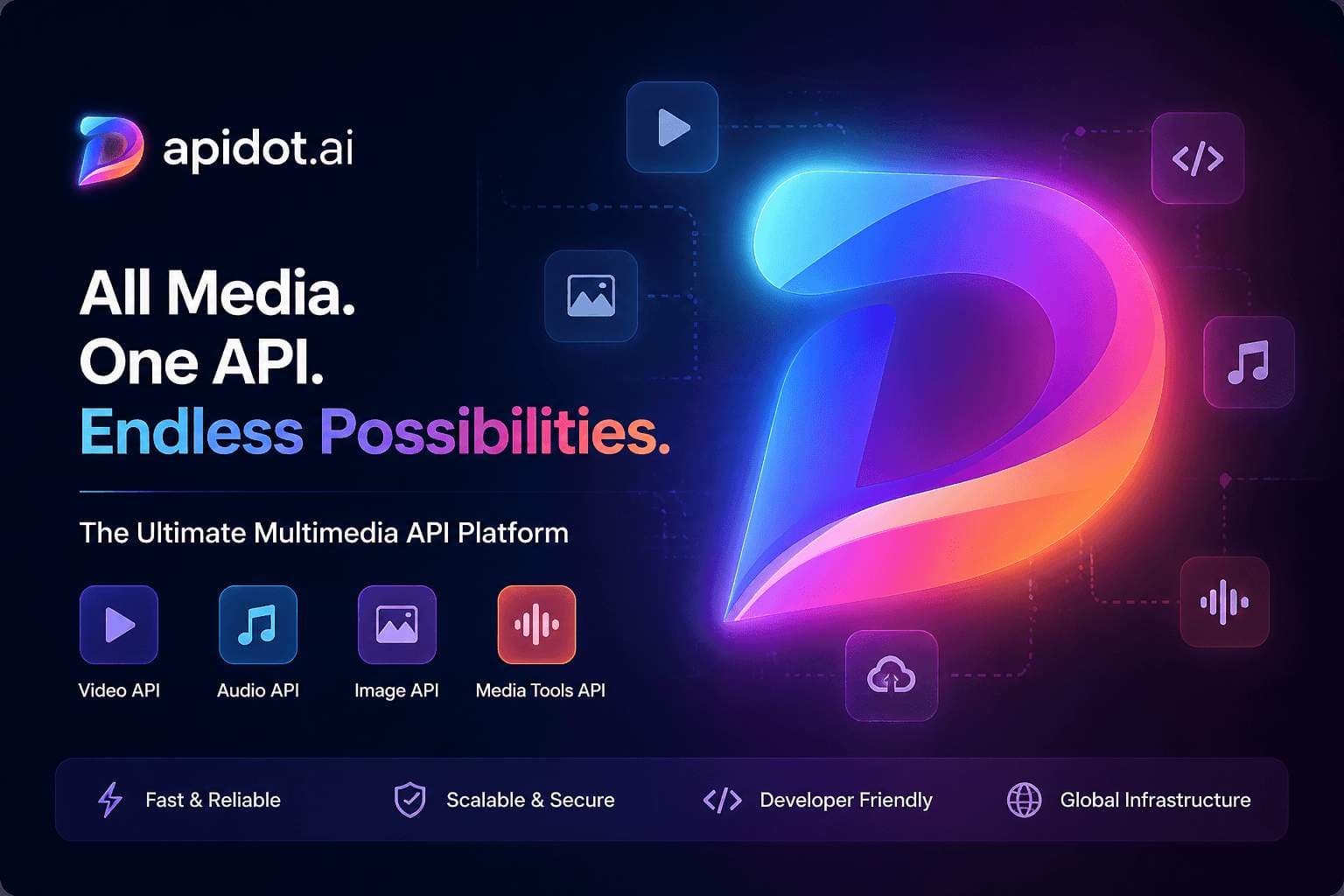
About this app
APIDot is a developer-first AI API platform that consolidates access to premium image, video, music, and chat models—like GPT Image 2, Seedream, FLUX.2, and Claude 4.6—under a single API key. It eliminates the hassle of managing multiple vendor accounts by providing one unified endpoint, async generation with webhook/polling support, and significantly lower costs (average 40% cheaper than official providers or Fal). With production-ready performance, high concurrency support from Fortune 500 engineering veterans, and no charge for failed generations, APIDot is built for teams that need to ship faster, scale reliably, and control spending. Whether you're generating photorealistic product images, editing videos, composing music, or integrating advanced chat agents, APIDot offers global model access without VPNs and responsive technical support via Discord, Telegram, or email. It's the all-in-one toolkit for developers who want to stop juggling fragmented AI APIs and focus on building.
Key features
- 1Single API key for 20+ premium models across image (FLUX.2, Seedream, GPT Image 2), video (Veo 3.1, Kling), music, and chat (Claude 4.6)
- 2Async generation with webhooks + polling, unified billing, and no charges for failed generations
- 3Average 40% lower pricing than official providers or Fal, high concurrency, global access without VPNs
Target customer profile
Drawn from the product itself, not from a survey.
Demographic
Full-stack developers building AI-powered applications
Pain points
Managing multiple API keys and vendor integrations slows down development; high costs from direct providers eat into budgets; lack of unified billing and async workflows.
Primary needs
Single API key for multiple models, lower pricing, reliable async generation with webhooks, and scalable infrastructure.
Demographic
Startup CTOs and engineering leads
Pain points
Need to prototype quickly but constrained by time and cost; fragmented vendor accounts delay time-to-market; uncertain production scalability.
Primary needs
Fast integration, cost-effective pricing (40% cheaper), high concurrency support, and consolidated billing.
Demographic
AI/ML researchers and hobbyists experimenting with generative models
Pain points
Want access to latest models like Seedream or Veo 3.1 without signing up for each provider separately; limited budget for experimentation.
Primary needs
Easy access to cutting-edge models, low-cost trials, and no failure charges to enable risk-free testing.
Scout Review
Written by AI from measured evidence, scored out of 100.
APIDot is a compelling unified AI API platform that solves real developer headaches: too many keys, too many bills, too much ops overhead. With strong curation of cutting-edge models, meaningful cost savings, async reliability, and a clean developer experience, it earns a solid 78. It's not perfect — transparency on security/performance metrics could improve — but for teams building image, video, or multimodal apps, it's a smart way to ship faster and spend less. Truly production-oriented with veteran engineering behind it.
Measure by measure
Usability
85One API key, simple POST to unified endpoint, playground for testing, clear curl examples, webhook + polling support, and consolidated dashboard make integration fast. Great for full-stack devs and teams avoiding vendor sprawl.
Design
82Clean, modern, developer-focused homepage with clear hero sections, model highlights, code examples, and straightforward navigation. Professional sans-serif typography and structured layout emphasize benefits like unified API and cost savings effectively.
Speed
76Claims ultra-high concurrency from Fortune 500 vets, async generation with webhooks/polling, and production-ready performance. No cold-start issues typical of raw GPU platforms; global access without VPNs helps.
Security
70HTTPS API endpoint, unified billing reduces credential sprawl, no failure charges, and professional support channels (Discord/Telegram). No explicit SOC2, encryption, or compliance mentions visible.
Accessibility
68Developer-centric with good contrast implied, language toggle, and responsive hints. Global model access without VPNs is a plus for international users. Lacks explicit WCAG mentions or screen reader optimizations.
Growth
79Targets startups, CTOs, researchers with fast prototyping, 40% lower costs, no-failure billing, and curated premium models (Claude 4.6, Veo 3.1, FLUX.2, Seedream). Strong for scaling AI apps without infrastructure overhead.
Improvement areas
- Publish concrete performance benchmarks, uptime SLAs, and latency metrics
- Add clear security/compliance documentation (SOC2, data retention, prompt privacy)
- Enhance visual design, add interactive demos, and provide official client SDKs
Design & Usability
APIDot nails the developer experience with a clean, no-nonsense design and exceptional usability. One API key unlocks GPT Image 2, Seedream 5.0, FLUX.2, Claude 4.6, Veo 3.1, Kling, and more across image/video/music/chat. The unified endpoint, async webhooks/polling, playground, and simple curl integration let teams ship in minutes instead of days managing vendor accounts. Layout is professional and benefit-focused, though it lacks visual flair or interactive demos on the landing page. For full-stack developers and startup CTOs frustrated with fragmented APIs, this is refreshingly straightforward.
Speed & Security
Performance claims center on high concurrency and production readiness from experienced engineers, with async workflows avoiding the cold starts common on raw GPU platforms like RunPod. Pricing is a highlight — average 40% cheaper than official providers or Fal, with specific examples like GPT Image 2 at $0.005 and no charges for failed generations. Security is adequate (HTTPS, reduced credential management) but lacks transparency on compliance or advanced features. Responsive support via Discord/Telegram helps, yet the absence of hard latency numbers or uptime SLAs keeps it from elite status.
Accessibility & Growth
Accessibility is functional for technical users with global model access sans VPN, but not industry-leading. Growth potential is strong for AI/ML researchers and teams needing quick prototyping on premium models without heavy budgets or infra management. Consolidated billing, lower costs, and risk-free testing (no fail charges) directly address pain points for startups and hobbyists. Compared to alternatives, it offers more managed convenience than RunPod's raw compute and curated premium access beyond basic Replicate models, positioning it well for teams scaling generative AI apps.
Conclusion
If you're tired of vendor sprawl and watching your burn rate on OpenAI/Anthropic/Kling APIs, APIDot is worth testing today. One key, lower prices, no wasted credits on failures — it delivers on the promise of focusing on building instead of API plumbing. Check the playground and see if the 40% savings and webhook simplicity fit your stack.
Suggestions for improvement
- Publish detailed latency/p99 benchmarks and uptime SLAs to build trust in production claims.
- Add SOC2/Type 2 compliance, data processing details, and prompt privacy guarantees.
- Enhance homepage with interactive playground embed, dark mode, and more visual model examples.
- Expand docs with SDKs for Python/TypeScript, more comparison benchmarks vs Fal/Replicate, and success stories.
Alternatives comparison
Named competitors, point by point. Nobody paid to appear here or to be left out.
 APIDot |  Fal.ai |  Replicate |  RunPod | |
|---|---|---|---|---|
| Unified single API key for multiple premium models | Yes — one key for image/video/music/chat/3D models | Partial — strong on generative media but more model-specific endpoints | Yes — unified API across thousands of models | No — focuses on raw GPU/serverless compute, requires more setup |
| Average pricing advantage & no-fail charges | 40% cheaper than official/Fal + no charge for failures | Competitive per-output pricing; charges for attempts | Pay-per-compute-second; standard failure billing | Low GPU-hour rates but higher management overhead |
| Async workflows (webhooks/polling) | Strong native support for both webhooks and polling | Excellent serverless async with fast scaling | Basic async/predictions but webhooks less emphasized | Available via serverless workers but more manual |
| Managed infrastructure vs raw compute | Fully managed APIs, no GPU management needed | Managed serverless with some custom deployment options | Fully managed model hosting and scaling | Raw serverless GPUs — more control, more overhead |
Fal.ai
A similar AI API aggregation platform with a focus on generative media, but APIDot claims average 40% lower pricing and unified billing.
Replicate
Cloud platform for running AI models via API; APIDot offers more curated premium models and async workflows with webhook support.
RunPod
Serverless GPU compute for AI inference; APIDot provides managed APIs with no infrastructure overhead.
Comparing options? See APIDot alternatives, scored side by side
Sources
What the review was written against. A verdict with no sources is an opinion.
More API Service apps
View all API Service
CC Switch
91Open-source desktop app for switching AI coding providers...

TaxID
90Fast EU VAT validation API for developers, covering 27 EU...

Webfetch
89Web scraping API that turns any URL into HTML, text, Mark...

issued.live
89Free certificate transparency search and SSL lookup with ...

OBVELO
88Privacy gateway that masks personal data in LLM traffic

tradutor de mangá com IA
88O tradutor de mangá com IA traduz capítulos em lote, personaliza textos e oferece edição visual para estúdios.

LurkAPI
88Public social media data as clean JSON, in one request

SiftingIO - Market Data API
88Real-time & historical market data API for stocks, forex,...

Claw Messenger
88Claw Messenger is an iMessage API service that gives AI a...

Giftronaut
87.5gift card software, international gift card, international visa gift card, gift card API

StockFit API
87A developer-first financial data API providing structured...

QRocodile
87Design And Animate QR Codes People Want to Scan


A platform dedicated to providing unbiased reviews of newly launched applications, analyzing everything from their features to their full potential.
info@scoutforge.net© 2026 Scoutforge. All rights reserved.
