

A platform dedicated to providing unbiased reviews of newly launched applications, analyzing everything from their features to their full potential.
info@scoutforge.net© 2026 Scoutforge. All rights reserved.
A platform dedicated to providing unbiased reviews of newly launched applications, analyzing everything from their features to their full potential.
info@scoutforge.net© 2026 Scoutforge. All rights reserved.
A platform dedicated to providing unbiased reviews of newly launched applications, analyzing everything from their features to their full potential.
info@scoutforge.net© 2026 Scoutforge. All rights reserved.
Cycling through all six. Tap any point to stop.
Measured on six things
Privacy gateway that masks personal data in LLM traffic
Real regulated problem (PII/PHI into LLMs), specific segments (healthcare, legal, gov, SaaS) and a concrete wedge: one-field base-URL swap. Early — domain registered 2026 — but the idea has room.
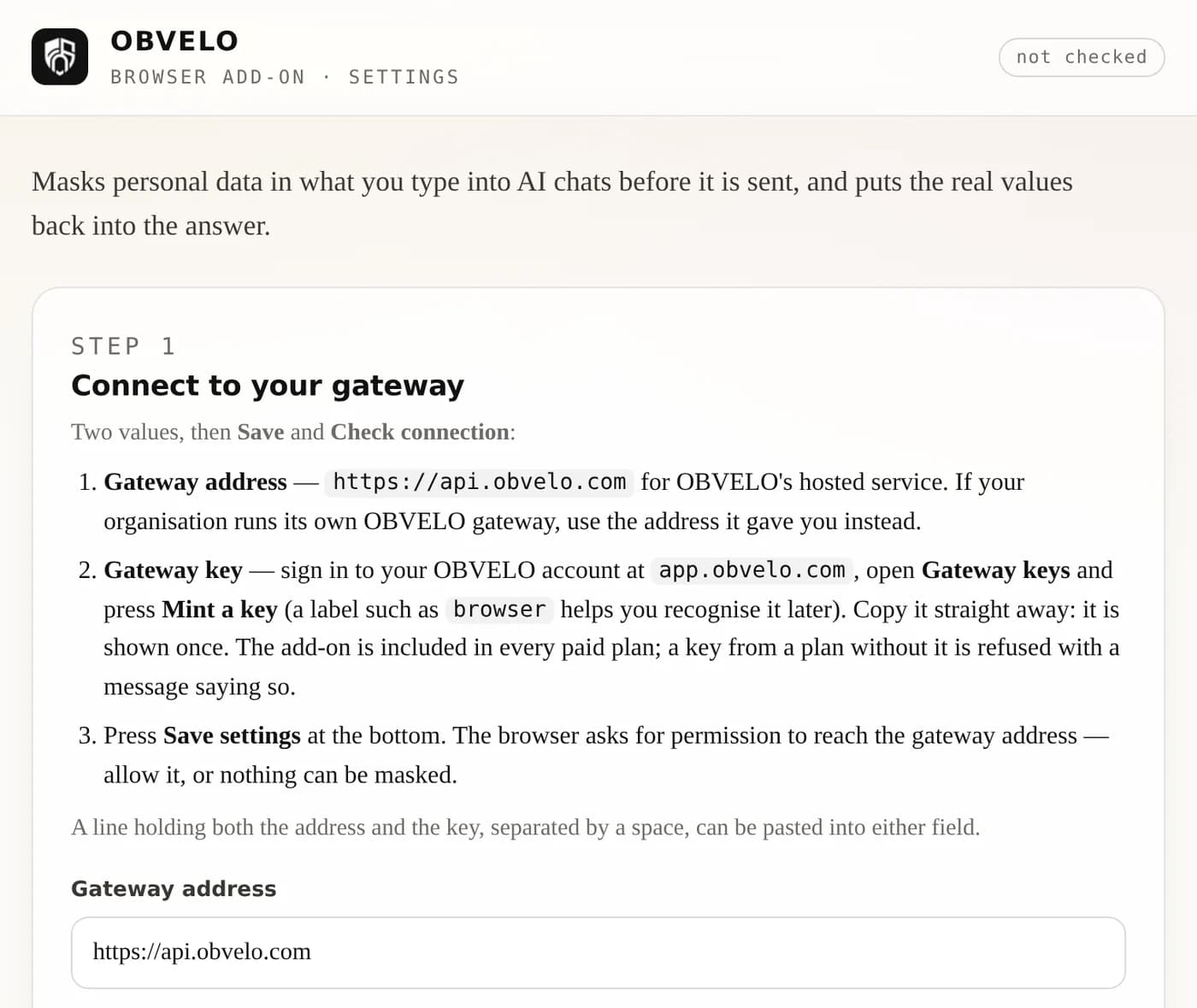
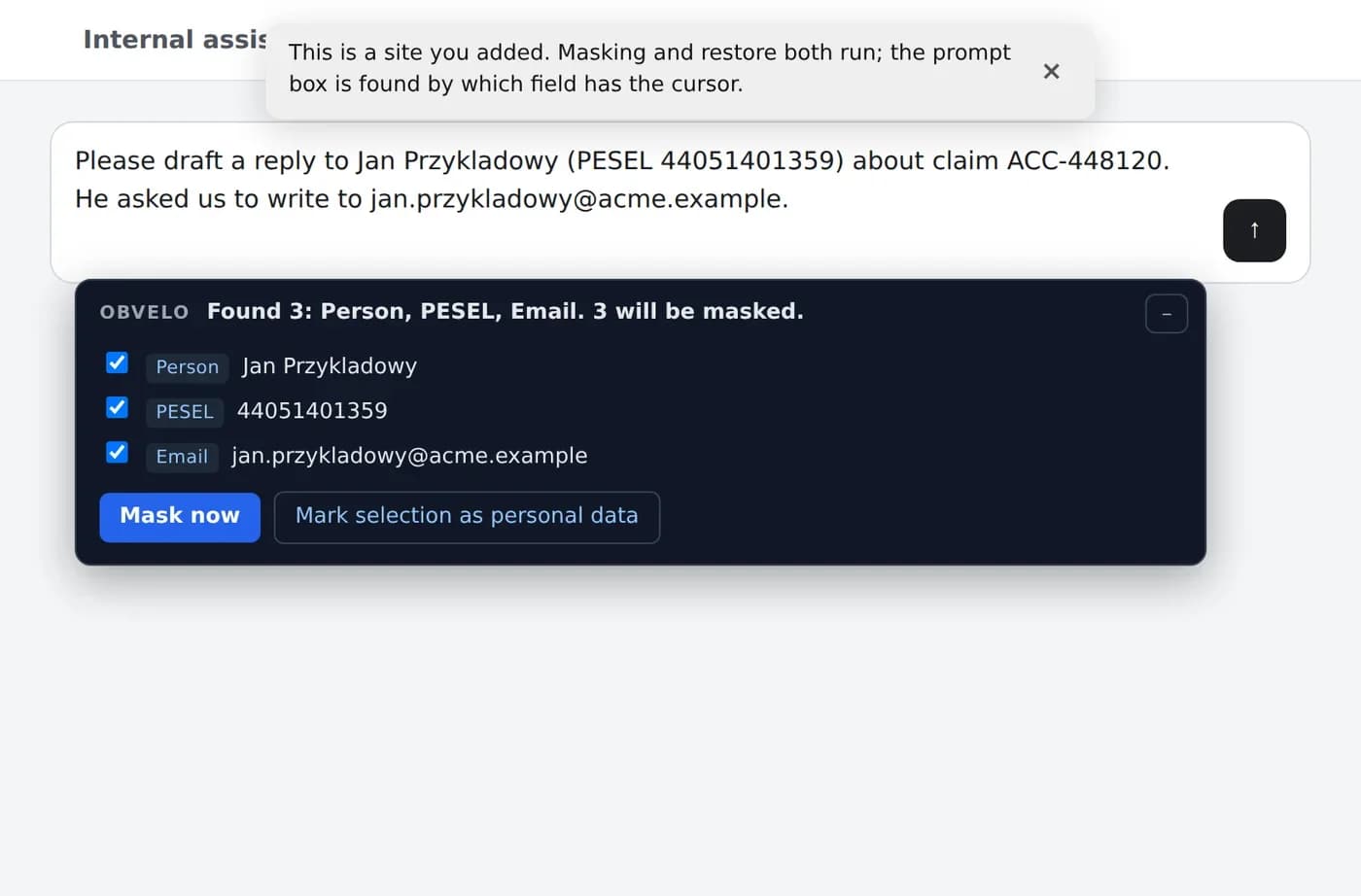
I've been digging into OBVELO, and it's one of those tools that makes you wonder why nobody built it sooner. Picture this: you're using GPT-4o, Claude, or Gemini in your workflow, but you're sending customer names, PESEL numbers, emails, and IBANs straight to the model provider. That's a compliance headache waiting to happen. OBVELO sits as a privacy gateway between your application and your LLM provider. It swaps every personal value with a token before the request leaves your infrastructure, passes the anonymised request to the model, then restores the real values in the answer on your side. The kicker? You change one field — the API base URL — and you're done. No rewriting prompts, no new SDK to learn if you don't want one. It works with OpenAI, Anthropic, Gemini, Mistral, LangChain, and MCP, plus there's a browser add-on for people who paste into ChatGPT or Claude manually. The detection engine is serious: 607 rules across 19 categories and 52 jurisdictions, validated against 16...
Drawn from the product itself, not from a survey.
Demographic
Healthcare organisations and clinics using LLMs for patient documentation
Pain points
Patient names, PESEL/national IDs, and medical details sent to US-based model providers create GDPR and HIPAA exposure
Primary needs
Mask PHI before it reaches the model while keeping clinical answers readable and accurate
Demographic
Legal teams and law firms summarising contracts and case files with AI
Pain points
Client names, case references, and addresses in prompts violate confidentiality and privilege obligations
Primary needs
Pseudonymisation with local mapping control and a per-system rule profile for jurisdictions
Demographic
Public administration and government bodies adopting AI assistants
Pain points
Citizen data cannot leave the EU, and procuring US-hosted AI tools is politically and legally fraught
Primary needs
EU-only hosting, no content storage, audit trail of who sent what without seeing the content
Demographic
SaaS and product engineering teams embedding LLM features into their apps
Pain points
Adding PII protection usually requires rewriting SDK calls, prompts, and streaming logic
Primary needs
Drop-in base URL change with SDK wrappers for Python, TypeScript, and .NET that restore answers locally
Written by AI from measured evidence, scored out of 100.
OBVELO is a privacy gateway that sits between your app and your LLM provider, swapping personal values for tokens on the way out and restoring them on the way back. The pitch is narrow and honest: change one field, the API base URL, and your existing OpenAI, Anthropic, Gemini or Mistral calls get pseudonymised. There's also an SDK mode where your provider key never touches OBVELO, plus Direct API, MCP and tool-gateway paths. The site is fast (98/100 mobile Lighthouse), the docs are genuinely usable, and the security headers are better than most products in this space. What's missing is third-party proof: no SOC 2, no ISO, no pen-test report, and no independent validation of the '607 rules, 52 jurisdictions' detection claim. For a tool asking healthcare and legal teams to route sensitive text through it, that's the gap that matters. The idea is strong and the execution is competent; the trust layer is still self-attested.
Numbered quickstart, two documented integration paths (SDK and one-base-URL proxy) plus Direct API, MCP and tool gateway. Free plan needs no card, but the live demo caps at 3 examples/day and 500 chars.
Clean, developer-first landing page with live code samples and an interactive masked/restored demo. Consistent branding and clear numbered sections; not a distinctive visual identity, but well above typical indie-tool craft.
Lighthouse mobile 98/100 (LCP 1.2s, CLS 0, TBT 0ms) and desktop 100/100. A light marketing/docs site with static code blocks — among the fastest pages in this category.
Strong header posture: HTTPS, HSTS, CSP, frame protection, SPF and DMARC (11/12 probe points). Claims EU-only hosting and zero content storage, but no published SOC 2, ISO or pen-test report to verify.
Lighthouse accessibility 100/100 on automated checks. No WCAG statement or multi-language support found, and the interactive demo's keyboard/screen-reader behaviour wasn't independently verified.
Real regulated problem (PII/PHI into LLMs), specific segments (healthcare, legal, gov, SaaS) and a concrete wedge: one-field base-URL swap. Early — domain registered 2026 — but the idea has room.
OBVELO's site is built for the person who has to ship the integration, not the person who signs the invoice. The homepage leads with a live demo that shows the same sentence in three states — sent, masked, restored — which is the clearest explanation of a pseudonymisation gateway I've seen on a landing page. Code samples for Python, TypeScript and curl sit right there, and the numbered 'why teams switch' section stays short. The docs carry the same discipline: a numbered quickstart, then a table mapping 'your system' to 'how to connect it' across proxy, SDK, Direct API, MCP and tool gateway. The friction is at the demo: 3 examples a day and 500 characters means you cannot meaningfully test your own data without an account. That's a reasonable anti-abuse choice, but it turns the best sales asset into a teaser. Signup is free with no card, which keeps the funnel honest.
Speed is a genuine strength here. Lighthouse mobile performance came back 98/100 with an LCP of 1.2s, zero layout shift and zero blocking time; desktop hit 100/100. For a page carrying code blocks and an interactive demo, that's a well-built front end, and it matters for a product whose pitch is 'drop this in front of your LLM traffic' — nobody wants a slow gateway in the request path. Security is solid on the transport and header layer: HTTPS enforced, HSTS, CSP, frame protection, X-Content-Type-Options, Referrer-Policy, plus SPF and DMARC, hitting 11 of 12 probe checks (Permissions-Policy is the gap). The product claims EU/EEA hosting, no request-content storage, and that the provider key is never stored or logged. Those are exactly the claims a buyer in healthcare or legal needs verified, and there is no published SOC 2, ISO 27001 or pen-test report to back them. The architecture — SDK mode where your key never reaches OBVELO — is a smart trust design, but it's still self-attested.
Automated accessibility is flawless: Lighthouse scored 100/100 on axe-core checks. That's a good floor, not a ceiling — there's no accessibility statement, no WCAG conformance claim, and no multi-language support, and the interactive demo's keyboard and screen-reader behaviour wasn't independently tested. For a product selling into public administration, a published a11y statement would be cheap credibility. On growth, the idea is well-aimed. PII and PHI leaking into US-hosted model providers is a real, growing compliance problem, and OBVELO names specific buyers — clinics, law firms, government bodies, SaaS teams embedding LLM features — rather than 'businesses'. The wedge is concrete: change one base URL, keep your SDK, prompts and provider key. Against Private AI, Skyflow, Presidio and Protecto, the differentiator is deployment friction, not detection depth. The limit is that detection quality is the actual moat in this category, and '607 rules' is a claim, not a benchmark. The domain is brand new, so this is an idea with room, not a proven one.
Conclusion
If you're a SaaS team adding LLM features and you've been quietly ignoring that customer names and emails are going straight to a model provider, OBVELO is the lowest-friction fix I've seen — one base URL, no prompt rewrite, no new SDK required. If you're a clinic or a law firm, the calculus is different: the architecture is sound and the EU-hosting claim is the right one, but you'll want the compliance documentation that isn't published yet before you route patient or client data through it. Try the demo, read the docs, and ask them directly for their security posture. The product earns a look; the paperwork hasn't caught up to the pitch.
Named competitors, point by point. Nobody paid to appear here or to be left out.
 OBVELO OBVELO |  Private AI Private AI |  Skyflow Skyflow |  Microsoft Presidio Microsoft Presidio |  Protecto Protecto | |
|---|---|---|---|---|---|
| Integration effort | Change one base URL or wrap your existing client; no prompt rewrite | API or self-hosted deployment; requires pipeline integration | Vault/tokenisation platform; SDK and policy setup required | Open-source library; you build and host the pipeline yourself | Privacy layer for GenAI; integration into existing AI stack |
| Deployment model | EU-hosted gateway; SDK mode keeps provider key local | Cloud or self-hosted | Cloud data privacy vault | Self-hosted open source | Cloud privacy layer |
| LLM provider coverage | OpenAI, Anthropic, Gemini, Mistral, LangChain, MCP | Provider-agnostic text/document de-identification | Provider-agnostic; keeps PII out of third-party AI pipelines | Provider-agnostic library; you wire it to any model | Anonymises prompts/documents before they reach LLMs |
| Compliance evidence | EU hosting and no-storage claims; no published SOC 2/ISO | Self-hosting option aids data-residency compliance | Enterprise-grade compliance and governance positioning | Open source; compliance is your responsibility | Privacy/compliance-focused GenAI layer |
| Pricing model | Free plan, no card required; paid tiers not detailed in fetched content | Cloud subscription or self-hosted licence | Enterprise pricing, quote-based | Free and open source | Commercial SaaS pricing |
Private AI
PII detection and redaction API that can be self-hosted or cloud-deployed, focused on document and text de-identification across many languages.
Skyflow
Data privacy vault platform offering tokenisation and PII governance, often used to keep sensitive data out of third-party AI and analytics pipelines.
Microsoft Presidio
Open-source PII detection and anonymisation library from Microsoft, popular for building custom redaction pipelines in Python.
Protecto
Privacy layer for generative AI that detects and anonymises sensitive data in prompts and documents before they reach LLMs.
Comparing options? See OBVELO alternatives, scored side by side

Sidenty is a professional digital identity protection ser...

A native macOS process explorer and advanced monitor that...

Real-device browser automation for AI agents

Native macOS SSH, SFTP & RDP client with a Keychain-backe...

Password manager with no email, no account, no tracking. ...

DSAR management software for small teams.

Verifiable parental controls for families in the Philippines

Recovers emails from corrupt mailboxes across 50+ platforms.

Simple, affordable compliance certification for ISO 27001...

Reveal No Caller ID, unknown numbers, and private callers...

A zero-config AI-powered vulnerability scanner automating...

A security solution that integrates VPN access with identity platforms to reduce network vulnerabilities and protect against zero-day exploits.
A platform dedicated to providing unbiased reviews of newly launched applications, analyzing everything from their features to their full potential.
info@scoutforge.net© 2026 Scoutforge. All rights reserved.