Cycling through all six. Tap any point to stop.
Measured on six things
Detect and remove Claude AI text watermarks with a scienc...
Security
41HTTPS is enforced and SPF is set, but HSTS, CSP, frame protection, X-Content-Type-Options, Referrer-Policy and Permissions-Policy are all missing (3/12 checklist). No SOC 2, ISO, or bug-bounty signals found.
Screenshots
1 / 1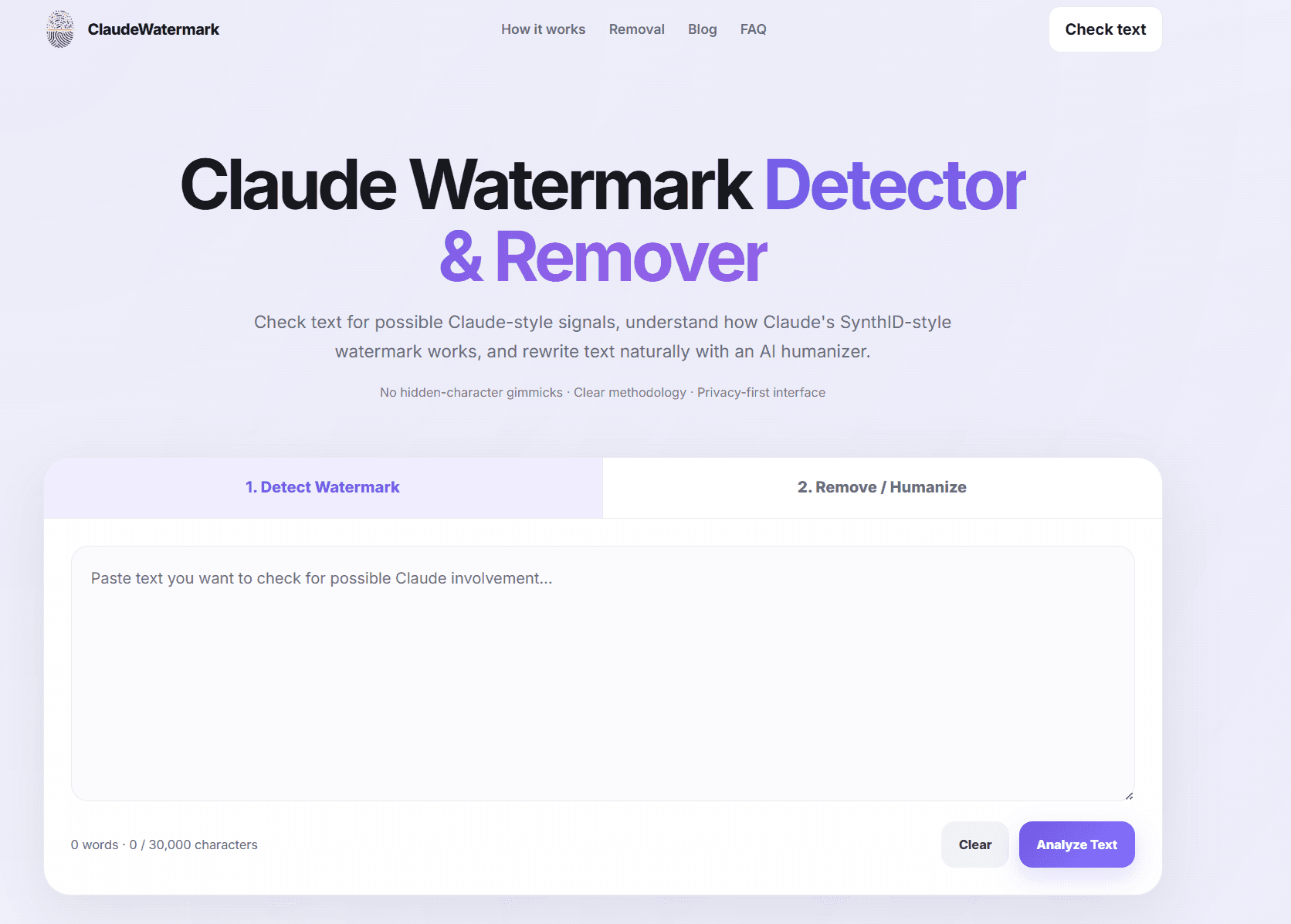
About this app
Claude Watermark Detector & Remover is a web-based tool that helps users check if text might have been generated by Claude AI and then rewrite it to remove the statistical watermark. Unlike typical AI detectors that look for stylistic tells, this tool acknowledges the SynthID-style watermarking used by Anthropic, which embeds a hidden signal in the token selection process. The site provides a clear, science-backed explanation of how the watermark works and offers a two-step workflow: detection using a heuristic AI-likelihood score (powered by GPTHumanizer) and removal through a full rewrite that replaces the original token sequence. It emphasizes that without the official watermark key, no third-party tool can definitively verify the watermark, but users can still get a probabilistic assessment and a clean, humanized version. The interface is privacy-friendly, doesn't rely on hidden-character gimmicks, and is transparent about its methodology. With a focus on clarity and accuracy, t...
Key features
- 1Two-step workflow: heuristic AI-likelihood detection (GPTHumanizer) followed by a full-rewrite humanizer to replace the original token sequence.
- 2Science-first explainer of SynthID-style token-selection watermarking, with a comparison table separating heuristic detection from official key-based verification.
- 3Privacy-first interface with a 30,000-character limit, no hidden-character gimmicks, and explicit labeling of results as probabilistic rather than definitive.
Target customer profile
Drawn from the product itself, not from a survey.
Demographic
Content Writers & Editors
Pain points
Uncertainty about AI detection, need to publish original content, fear of AI flags.
Primary needs
Reliable watermark detection, effective humanization, clear explanations.
Demographic
SEO Professionals & Marketers
Pain points
AI-generated content may rank poorly, risk of penalties, need for unique copy.
Primary needs
Remove AI traces, ensure content originality, maintain SEO performance.
Demographic
Researchers & Academics
Pain points
Need to verify AI involvement in text, ethical concerns, plagiarism checks.
Primary needs
Scientific transparency, understanding of watermarking, detection tools.
Demographic
Developers & AI Enthusiasts
Pain points
Curiosity about AI watermarking, need for API integration, technical insights.
Primary needs
Technical details, API access, up-to-date research.
Scout Review
Written by AI from measured evidence, scored out of 100.
Claude Watermark Detector & Remover is an honest tool in a category that is mostly not. It correctly explains that Claude's watermark lives in token selection rather than hidden Unicode characters, and it refuses to claim it can verify the official watermark without Anthropic's key — a level of candor that most AI detectors would never risk. The two-step workflow is clean, the FAQ answers the right questions, and the page is genuinely fast (98 mobile / 100 desktop on Lighthouse). The weaknesses are structural: security headers are largely absent (3/12 on the probe), accessibility has one contrast failure and no published statement, and the core detection is a third-party heuristic rather than anything proprietary. It's a well-executed, narrowly scoped tool that knows exactly what it is — and says so.
Measure by measure
Usability
68Paste, analyze, read the AI-likelihood score, then jump to the remover — the flow is obvious and the FAQ pre-answers the obvious objections. No account needed, but no API or integrations are visible on the page.
Design
71Clean, modern two-step tool UI with a live character counter and numbered explainer sections. The comparison table and FAQ are well laid out, though the page leans text-heavy and utilitarian rather than visually distinctive.
Speed
88Lighthouse mobile 98/100 (LCP 2.1s, CLS 0, TBT 117ms) and desktop 100/100. Genuinely fast, lightweight page with no measured lag complaints.
Security
41HTTPS is enforced and SPF is set, but HSTS, CSP, frame protection, X-Content-Type-Options, Referrer-Policy and Permissions-Policy are all missing (3/12 checklist). No SOC 2, ISO, or bug-bounty signals found.
Accessibility
79Lighthouse accessibility 96/100, held back by a single contrast-ratio failure. No accessibility statement, WCAG claim, or multi-language support found on the site.
Growth
58A real, timely problem (Claude's SynthID-style watermarking) with an honest, specific wedge: heuristic detection plus a full-rewrite humanizer. The category is crowded and the moat is thin.
Improvement areas
- Security headers are largely missing (3/12 on the probe): no HSTS, CSP, frame protection, X-Content-Type-Options, Referrer-Policy, Permissions-Policy, or DMARC.
- Accessibility has one contrast-ratio failure and no published accessibility statement, WCAG claim, or multi-language support.
- The developer audience is named in the positioning but no API, integration, or account layer is visible on the site.
Design & Usability
The interface is a clean two-step tool: paste text, hit Analyze, get a percentage, then jump to the remover. The live character counter (0 / 30,000) and the numbered 01-05 explainer of token-selection watermarking show real care about making an abstract concept legible. The comparison table — invisible Unicode scanner, em dash detector, generic AI detector, official key — is the sharpest piece of design on the page because it does the teaching work a wall of copy usually fails at. Where it falls short is visual identity: it reads as a well-formatted documentation page rather than a product, and there's no visible API, integration, or account layer for the developer audience it claims to serve. Usability-wise, the flow is obvious and the FAQ pre-empts the exact questions a skeptical user arrives with. It's competent, honest, and unremarkable — which for a tool this narrow is arguably the right call.
Speed & Security
Speed is the standout. Lighthouse mobile performance lands at 98/100 with an LCP of 2.1s, CLS of 0, and TBT of 117ms; desktop hits a perfect 100/100. For a page carrying an explainer, a comparison table, and an FAQ, that's a genuinely lean build, and no user complaints about lag surfaced in the collected evidence. Security is the weak flank. HTTPS is enforced and SPF is configured, but the HTTP probe found no HSTS, no Content-Security-Policy, no frame protection, no X-Content-Type-Options, no Referrer-Policy, and no Permissions-Policy — 3 of 12 checklist points. DMARC is also absent. There's no SOC 2, ISO, pen-test, or bug-bounty signal anywhere on the site. For a tool that asks users to paste unpublished drafts into a text box, the privacy-first framing on the homepage is doing a lot of work that the headers aren't backing up.
Accessibility & Growth
Accessibility scores 96/100 on the Lighthouse audit, with a single failing check: insufficient background/foreground color contrast. That's a fixable, specific flaw rather than a systemic one, but the site publishes no accessibility statement, no WCAG conformance claim, and no multi-language support — so the automated pass is the whole story we can verify. Growth is a judgement on the idea. The problem is real and timely: Anthropic's SynthID-style watermarking is a live concern for writers, editors, and SEO teams, and the site's honesty about what a third-party tool can and cannot prove is a genuine differentiator against GPTZero, Originality.ai, and Undetectable AI, all of which are established and better funded. The wedge is the Claude-specific framing plus the detect-then-rewrite workflow. The limit is that the moat is thin: the detection is a GPTHumanizer heuristic, and the moment Anthropic ships its official detection API, the differentiation narrows to UX and copy.
Conclusion
If you need to know whether a passage carries Claude's statistical watermark, no third-party site can tell you that today, and this one admits it. What it offers instead is a probabilistic AI-likelihood read and a rewrite workflow that, per Anthropic's own guidance, is the only thing that actually removes the signal. That's a narrow but honest value proposition. The gaps worth closing are unglamorous: ship the security headers, fix the contrast issue, publish an accessibility statement, and put the promised API somewhere a developer can actually find it. Do that and this stops being a well-written explainer with a text box attached and starts being infrastructure.
Suggestions for improvement
- Add HSTS, CSP, X-Content-Type-Options, Referrer-Policy and Permissions-Policy — the probe found only 3 of 12 security checklist points.
- Fix the single Lighthouse contrast failure and publish an accessibility statement with a WCAG conformance target.
- Surface the promised API and any integrations on the homepage; the developer audience is named but not served visibly.
- Add DMARC alongside the existing SPF record to complete email authentication.
Alternatives comparison
Named competitors, point by point. Nobody paid to appear here or to be left out.
 Claude Watermark Detector & Remover |  GPTZero |  Originality.ai |  Undetectable AI | |
|---|---|---|---|---|
| Primary function | Detects heuristic AI-likelihood and rewrites text to remove Claude's statistical watermark signal | AI detection across models like ChatGPT and GPT-4 | Plagiarism plus AI content detection for publishers | Humanizes AI text to bypass AI detectors |
| Claude-specific watermark handling | Explicitly explains SynthID-style token-selection watermarking and its limits | General AI detection; not framed around Claude watermarking | General AI detection; not framed around Claude watermarking | Humanization focus; not framed around Claude watermarking |
| Detection plus removal in one flow | Yes — detect, then jump directly to the remover | Detection only | Detection only | Humanization only |
| Honesty about verification limits | States plainly that no third party can verify the official watermark without Anthropic's key | Presents detection scores as authoritative | Presents detection scores as authoritative | Markets bypass capability |
| Target audience | Writers, editors, SEO pros, researchers, developers | Educators, publishers, general users | Publishers, SEO teams, content agencies | Marketers, students, content creators |
GPTZero
AI detection tool that identifies text generated by models like ChatGPT, GPT-4, and more.
Originality.ai
Plagiarism and AI content detector for publishers and writers.
Undetectable AI
Humanizes AI-generated text to bypass AI detectors.
Comparing options? See Claude Watermark Detector & Remover alternatives, scored side by side
More Productivity apps
View all Productivity
Qamarero
92An all-in-one hospitality software for restaurants and ba...

The Stack Newsletter
92A weekly newsletter delivering curated tech jobs, intervi...

EmbedMyReviews
92White-label reputation management software for agencies s...

StoryPad
92Privacy-first open source journal app with a continuous t...

Puzzly – B2B Lead Generation & Sales Intelligence Platform
92Puzzly is an all-in-one B2B lead generation platform that...

Notion
92All-in-one AI workspace for docs, projects, and knowledge...

Vibe Coding Agent Skills
92A free, open-source platform offering 110 AI agent skills...

CC Switch
91Open-source desktop app for switching AI coding providers...

username.md
90One verified handle for your online identity, readable by...

PitchWhip
90AI cold call scripts & direct dials from LinkedIn

What the GIF
89Frame-perfect video-to-GIF maker that runs entirely in yo...

AuditCloser
89White-label website audits that close deals for digital a...


A platform dedicated to providing unbiased reviews of newly launched applications, analyzing everything from their features to their full potential.
info@scoutforge.net© 2026 Scoutforge. All rights reserved.
