Cycling through all six. Tap any point to stop.
Measured on six things
E2X is an AI video and image generation API with transparent, pure pay-as-you-go pricing and no subscriptions. Access leading video and image models through one API at prices up to 93% below rival platforms, with 24/7 support.
Design
58Restrained, data-forward landing page: grotesque display type, mono numerals, one burnt-orange accent. The price-check card and ledger sell the pitch well. Undercut by a blank Seedance thumbnail, badge clutter and barely-legible rival prices.
Screenshots
1 / 1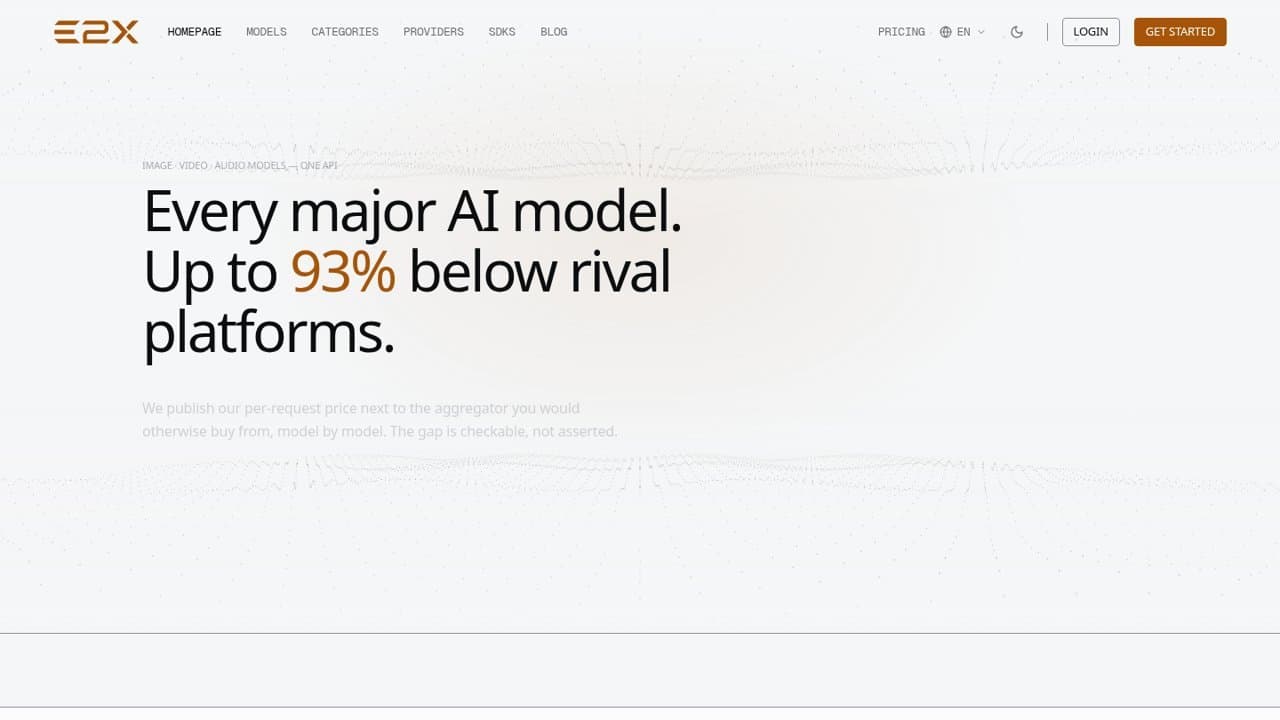
About this app
E2X is a unified API platform that gives developers access to all the major AI video, image, and audio generation models through a single integration. Instead of juggling separate SDKs, auth flows, and pricing pages from Google, OpenAI, and ByteDance, you get one key, one request shape (POST /v1/jobs/submit), and a single per-request price shown before you call it. The headline is cost: E2X publishes dated, model-by-model price checks against aggregators like fal.ai, claiming up to 93% savings (e.g., GPT Image 2.6 at $0.015 vs $0.211 per request; Veo 3.1 Fast at $0.015/sec vs $0.15/sec). That gap comes from three structural choices: no per-provider glue code, cross-provider routing with automatic failover, and a strict unit price with no markup tier or seat fees. Pricing is prepaid-credit and pay-per-use — $100 in equals $100 balance, with no subscription or minimum commitment. The catalog covers text-to-image, image-to-image, text-to-video, image-to-video, reference-to-video, and s...
Key features
- 1Unified API: one key and one request shape (POST /v1/jobs/submit) across OpenAI, Google and ByteDance image/video/audio models.
- 2Dated, model-by-model price checks against fal.ai, claiming up to 93% savings (e.g. GPT Image 2.6 $0.015 vs $0.211).
- 3Prepaid pay-per-use credits: $100 in = $100 balance, no subscription, seat fees or minimum commitment.
- 4Cross-provider routing with automatic failover, plus TypeScript/Python/Go SDKs and a cURL example.
Target customer profile
Drawn from the product itself, not from a survey.
Demographic
Indie developers and solo founders building generative media features
Pain points
Multiple provider SDKs, steep per-call aggregator markups, unpredictable bills
Primary needs
Cheap pay-per-use pricing, one simple API key, fast time-to-first-job
Demographic
Startup engineering teams (2-15 devs) shipping AI video/image products
Pain points
Glue code breaks when providers rewrite APIs; no failover; auth sprawl
Primary needs
Unified request schema, cross-provider routing, SDKs in TypeScript/Python/Go
Demographic
Agencies and creative studios prototyping AI content at scale
Pain points
Per-seat subscription costs, model lock-in, unclear per-request costs
Primary needs
Transparent per-request pricing, broad model catalog, no commitment
Demographic
Cost-conscious CTOs and platform leads evaluating AI infrastructure
Pain points
Hidden markups, unverifiable savings claims, vendor lock-in risk
Primary needs
Dated price comparisons, no lock-in, line-item transaction history
Scout Review
Written by AI from measured evidence, scored out of 100.
E2X is a unified generative-media API that sells one thing hard: cost. One key, one request shape (POST /v1/jobs/submit), a catalog spanning text/image/video/audio models from OpenAI, Google and ByteDance, and dated per-model price checks against fal.ai claiming up to 93% savings. The site backs the claim with a visible price-check card and a full ledger rather than a vague 'save money' banner, and it's fast (Lighthouse 97) with clean security headers (12/13). The weaknesses are execution and trust: a broken-looking model thumbnail, badge clutter, low-contrast comparison numbers, no live demo, and no published compliance or security page for a product handling prepaid balances and API keys. For an indie dev or small team tired of juggling provider SDKs, the pitch is concrete and checkable — just verify the savings on your own workload before you commit.
Measure by measure
Usability
63Cost is visible before signup everywhere — hero card, full table, per-model pages — and the FAQ explains the actual API call. Dense 12-row mono pricing table and a truncated catalog view make scanning tiring, and there's no live demo.
Design
58Restrained, data-forward landing page: grotesque display type, mono numerals, one burnt-orange accent. The price-check card and ledger sell the pitch well. Undercut by a blank Seedance thumbnail, badge clutter and barely-legible rival prices.
Speed
88Lighthouse desktop 97/100 with LCP 511ms, CLS 0 and TBT 89ms — genuinely fast. Static marketing page with a code snippet, no heavy SPA weight, and no lag complaints in the collected evidence.
Security
72Strong header hygiene: HTTPS enforced, HSTS, CSP, frame protection, Referrer-Policy, Permissions-Policy, SPF and DMARC — 12/13 on the probe. No published SOC 2, pen-test or bug-bounty page found, and secure-cookie flag missing.
Accessibility
79Lighthouse accessibility 96/100, but two real failures: insufficient color contrast and visible labels not matching accessible names. The visual audit confirms low-contrast hero copy and tiny grey rival prices. No a11y statement or multi-language support found.
Growth
62Real, specific problem (SDK/auth sprawl + aggregator markups) with a demonstrated wedge: dated per-model price checks, one request shape, cross-provider failover. Early (domain ~0.4yr) and the price lead is copyable, but the segment is clear.
Improvement areas
- Fix the blank Seedance 2.0 Mini thumbnail and reduce badge clutter on model cards.
- Improve contrast on hero body copy and the struck-through rival prices in the comparison table.
- Add a live sandbox or free trial credits so developers can test a real job before loading $100.
- Publish a security/compliance page (SOC 2 status, pen-test, data handling) to match the strong headers.
Design & Usability
E2X's homepage is a disciplined, data-forward pitch: a grotesque display face, monospace numerals and a single burnt-orange accent carry the 'checkable, not asserted' positioning. The PRICE CHECK card and full pricing ledger put the savings claim in front of you before any signup, and the FAQ explains the actual call — POST /v1/jobs/submit, bearer token, model slug, poll GET /v1/jobs/{id}. Usability is front-loaded on cost transparency, which is the right call for a price-led product. It slips on execution: a blank Seedance 2.0 Mini thumbnail makes the model row look unfinished, model cards stack up to five badges, and the rival prices the whole claim depends on are rendered in tiny low-contrast grey mono. The 12-row pricing table is dense and tiring on small screens, and there's no live demo to try before loading credits.
Speed & Security
Speed is the standout: Lighthouse desktop 97/100, LCP 511ms, CLS 0, TBT 89ms — a genuinely snappy static marketing page with no heavy SPA weight and no lag complaints in the collected evidence. Security is solid on the plumbing: HTTPS enforced with HSTS, CSP, frame protection, X-Content-Type-Options, Referrer-Policy, Permissions-Policy, plus SPF and DMARC — 12/13 on the header probe, with only the secure-cookie flag missing. What's absent is the trust layer a paid API platform eventually needs: no SOC 2, ISO, pen-test summary or bug-bounty page surfaced in the collected content, and privacy-policy depth wasn't verifiable. For a product that takes prepaid balances and hands out API keys, publishing even a lightweight security page would close the gap between strong headers and buyer confidence.
Accessibility & Growth
Accessibility scores 96/100 on Lighthouse but carries two real failures — insufficient color contrast and visible text labels that don't match their accessible names — both echoed by the visual audit's low-contrast hero copy and tiny grey rival prices. There's no WCAG statement or multi-language support in the collected content, so the automated score flatters the actual experience. Growth is a judgement on the idea: E2X names a real, specific pain (per-provider SDKs, auth sprawl, glue code that breaks on API rewrites, aggregator markups) and demonstrates a concrete wedge — dated, model-by-model price checks against fal.ai, one request shape, and cross-provider routing with failover. That's a legitimate reason to pick it over fal.ai, Replicate, OpenAI or Vertex AI for an indie dev or small team. The honest limit: the price lead is copyable and the category is crowded, so the durable advantage has to be the routing and reliability layer, not the discount. Domain age (~0.4 years) is context, not the score.
Conclusion
E2X is early — the domain is months old — but it's aimed at a real, specific buyer and it puts its money where its marketing is with dated, per-model price checks you can audit yourself. The fastest path to credibility isn't a bigger discount headline; it's fixing the blank thumbnail, making the rival prices readable, adding a live sandbox, and publishing a security/compliance page. Do those and the 'checkable, not asserted' promise actually holds up end to end. Until then, treat it as a promising, transparently-priced aggregator worth a small prepaid test rather than a production dependency.
Suggestions for improvement
- Fix the blank Seedance 2.0 Mini thumbnail and trim model cards to 2-3 badges so the catalog row looks finished.
- Raise contrast on hero body copy and the struck-through rival prices — they're the numbers the whole claim depends on.
- Add a live sandbox or free trial credits so developers can send one real job before loading $100.
- Publish a security/compliance page (SOC 2 status, pen-test summary, data handling) to match the strong header hygiene.
Alternatives comparison
Named competitors, point by point. Nobody paid to appear here or to be left out.
 E2X |  fal.ai |  Replicate |  OpenAI API |  Google Vertex AI | |
|---|---|---|---|---|---|
| Pricing model | Prepaid credits, per-request, $100 in = $100 balance, no subscription | Pay-per-use inference, per-request/per-second, no subscription | Pay-per-second compute billing, no subscription | Usage-based token/request billing, prepaid credits | Usage-based per-token/per-second, enterprise commitments available |
| Model catalog breadth | 40 models across OpenAI, Google, ByteDance (image/video/audio) | Very broad catalog of generative media models | Large open-source model library plus hosted models | OpenAI-only models (GPT Image, etc.) | Google-only models (Veo, Gemini) |
| Single unified API across providers | Yes — one key, one request shape, cross-provider routing with failover | Yes — single API across many models | Yes — single API across hosted models | No — OpenAI only; separate integration per other provider | No — Google only; separate integration per other provider |
| Published price comparison vs rivals | Yes — dated, model-by-model checks vs fal.ai, up to 93% savings | No dated cross-platform comparison published | No dated cross-platform comparison published | No cross-platform comparison published | No cross-platform comparison published |
| Published compliance / security certifications | None found in collected content; strong HTTP headers only | Enterprise/security page present (not independently verified here) | Security/trust documentation present (not independently verified here) | SOC 2 and enterprise compliance documentation | Extensive enterprise compliance (SOC 2, ISO, etc.) |
fal.ai
Popular generative media inference platform with a broad model catalog and fast inference; E2X benchmarks its pricing directly against fal.ai, listing it as the higher-cost comparison point on 12 of 15 models.
Replicate
Established model-hosting API aggregator with a large open-source model library and pay-per-second billing; a common alternative for developers wanting multi-model access via one API.
OpenAI API
Direct access to OpenAI's image models (GPT Image) with native tooling and documentation; requires separate integration per provider if you also need Google or ByteDance video models.
Google Vertex AI
Google's first-party platform for Veo and Gemini image models with enterprise controls; more setup and per-provider integration overhead than a unified aggregator.
Comparing options? See E2X alternatives, scored side by side
More API Service apps
View all API Service
CC Switch
91Open-source desktop app for switching AI coding providers...

TaxID
90Fast EU VAT validation API for developers, covering 27 EU...

Webfetch
89Web scraping API that turns any URL into HTML, text, Mark...

issued.live
89Free certificate transparency search and SSL lookup with ...

OBVELO
88Privacy gateway that masks personal data in LLM traffic

tradutor de mangá com IA
88O tradutor de mangá com IA traduz capítulos em lote, personaliza textos e oferece edição visual para estúdios.

LurkAPI
88Public social media data as clean JSON, in one request

SiftingIO - Market Data API
88Real-time & historical market data API for stocks, forex,...

Claw Messenger
88Claw Messenger is an iMessage API service that gives AI a...

Giftronaut
87.5gift card software, international gift card, international visa gift card, gift card API

StockFit API
87A developer-first financial data API providing structured...

QRocodile
87Design And Animate QR Codes People Want to Scan


A platform dedicated to providing unbiased reviews of newly launched applications, analyzing everything from their features to their full potential.
info@scoutforge.net© 2026 Scoutforge. All rights reserved.
