Cycling through all six. Tap any point to stop.
Measured on six things
Amazon research data APIs for developers and AI agents
Security
52HTTPS enforced with HSTS and valid SPF/DMARC, plus revocable API keys and usage monitoring. But zero CSP, frame protection, or the other four standard headers — 6/12 checklist points, and no published compliance certifications.
Screenshots
1 / 1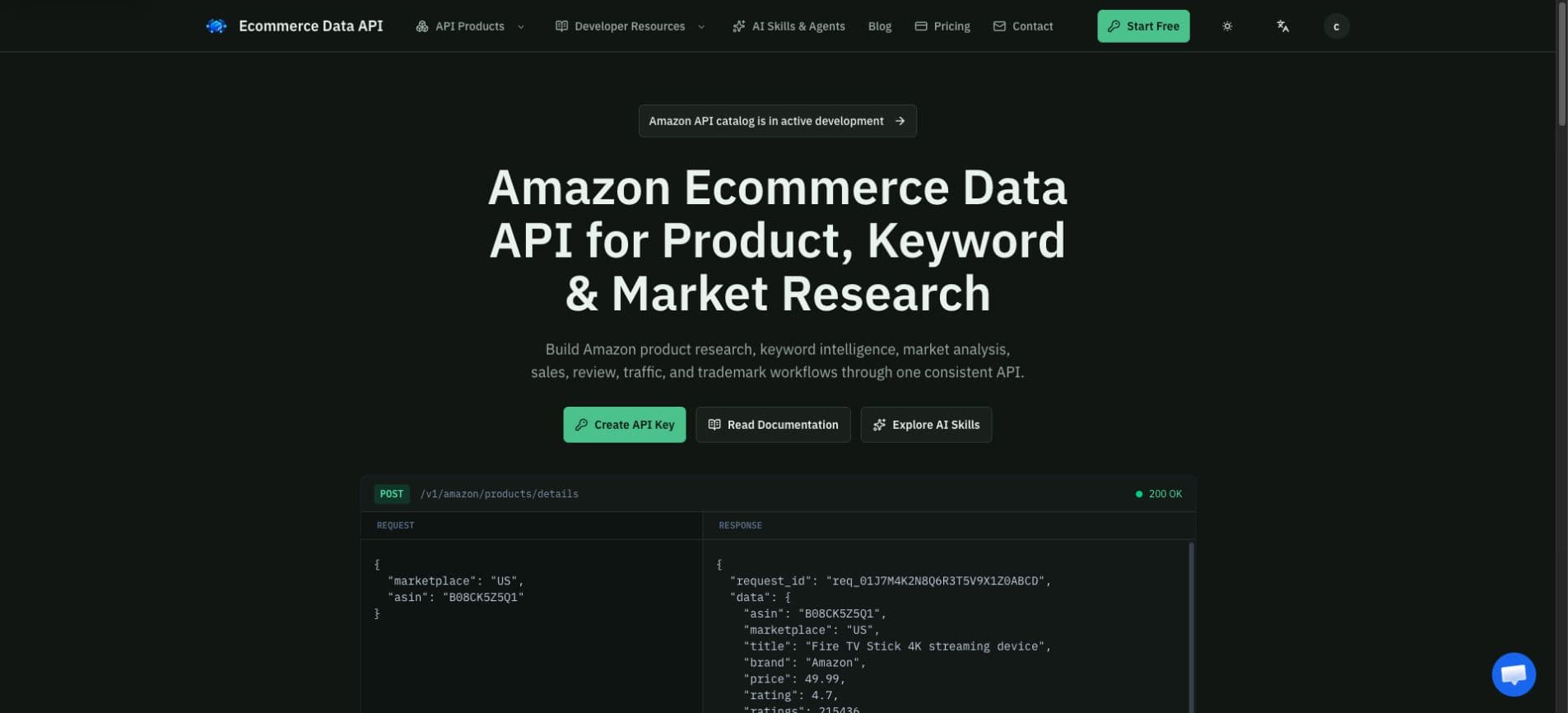
About this app
Ecommerce Data API provides Amazon product, keyword, market, review and traffic data through REST APIs, a remote MCP server and an Agent Skill. Developers and ecommerce teams use structured data for product research, sales estimates and competitive analysis. Access is paid through usage-based API credits.
Key features
- 145 documented REST endpoints across Amazon products, keywords, markets, traffic, global trademarks and OCR tools.
- 2Remote MCP server and Agent Skill for Codex, Claude Code and Cursor — natural-language endpoint selection.
- 3Usage-based credits from US$9/month (900 calls) to US$79/month (13,000 calls), one shared balance across all endpoints.
- 4OpenAPI and Postman imports, per-request usage monitoring, and revocable API keys.
Target customer profile
Drawn from the product itself, not from a survey.
Pain points
Manual product research is time-consuming and lacks depth; struggles to identify profitable niches and track competitors
Demographic
E-commerce developers and data engineer
Scout Review
Written by AI from measured evidence, scored out of 100.
Ecommerce Data API is a developer-first Amazon data platform with 45 documented REST endpoints, a remote MCP server and an Agent Skill for AI coding tools, priced from US$9/month on usage-based credits. The docs are genuinely strong — two clear integration paths, OpenAPI/Postman imports, and a pricing FAQ that defines billable calls. Design is polished but bilingual in a way that will confuse English-only developers. Mobile performance (68/100, 5.3s LCP) needs work while desktop is near-perfect. Security headers are half-missing and there are no published compliance certifications. Accessibility has three concrete Lighthouse failures. Growth potential is real: the MCP/Agent angle is a genuine differentiator in a crowded Amazon data market, though the product is very early.
Measure by measure
Usability
74Docs split cleanly into REST vs. Agent paths, 45 endpoints grouped by domain, OpenAPI/Postman imports, and a pricing page that actually explains what counts as a call. Onboarding is a clear 4-step flow.
Design
71Clean developer-first landing page: consistent green accent, 3-column API card grid with endpoint counts, and a real request/response code block. Undermined by mixed Chinese/English nav and three competing hero button styles.
Speed
57Desktop Lighthouse 99/100 is excellent, but mobile drops to 68/100 with a 5.3s LCP and 470ms TBT — the heavy syntax-highlighted code block is likely the culprit. CLS 0 and 1.5s FCP are solid.
Security
52HTTPS enforced with HSTS and valid SPF/DMARC, plus revocable API keys and usage monitoring. But zero CSP, frame protection, or the other four standard headers — 6/12 checklist points, and no published compliance certifications.
Accessibility
58Lighthouse 87/100 with three real failures: insufficient color contrast, images missing alt text, and links without discernible names. Chinese-first site with no proper language switcher beyond a banner.
Growth
63Real paid problem (Amazon seller research), specific buyer (developers and ecommerce teams), and a genuine wedge: remote MCP + Agent Skill for Codex/Claude Code/Cursor. Early-stage (domain ~0.3 years) but the idea has room.
Improvement areas
- Missing five standard security headers (CSP, frame protection, X-Content-Type-Options, Referrer-Policy, Permissions-Policy).
- Mobile Lighthouse performance 68/100 with 5.3s LCP — the hero code block needs lazy-loading.
- Three accessibility failures: contrast, missing alt text, and links without discernible names.
- Bilingual nav with no proper language toggle; Chinese-first UX limits international developer adoption.
Design & Usability
The landing page does the hard part right: a real POST request and JSON response side by side, six API cards with endpoint counts and tags, and a 4-step onboarding row that tells you exactly what happens after signup. The docs are the strongest asset — they split users into a direct REST path and an Agent path (Codex, Claude Code, Cursor via ecomdata CLI), document all 45 endpoints across six groups, and point to OpenAPI and Postman imports. Pricing is unusually honest: US$9/29/79 for 900/3,500/13,000 calls, one shared balance across every endpoint, and an FAQ that defines what counts as a billable call. The friction is visual and linguistic: the nav mixes Chinese and English with no real toggle, the hero uses three different button styles, and the long Chinese headline wraps awkwardly on desktop. For a Chinese-first product that's tolerable, but English-speaking developers will feel like they walked into the wrong room.
Speed & Security
Speed is a tale of two devices. Desktop Lighthouse scores 99/100 — essentially flawless. Mobile scores 68/100 with a 5.3s LCP and 470ms TBT, almost certainly the syntax-highlighted request/response block dragging the first paint. CLS of 0 and 1.5s FCP show the underlying build is sound; the mobile hero just needs lazy-loading or a lighter code renderer. Security is the weaker half: HTTPS is enforced with HSTS, SPF and DMARC are valid, and the product uses revocable API keys with per-request usage monitoring. But the HTTP probe found no CSP, no frame protection, no X-Content-Type-Options, no Referrer-Policy and no Permissions-Policy — 6/12 checklist points. There's no published SOC 2, ISO 27001 or pen-test report on the site. For a paid data API handling customer keys and billing, that's a gap worth closing before enterprise buyers show up.
Accessibility & Growth
Accessibility lands at 87/100 on Lighthouse, which sounds better than it is: three concrete failures remain — insufficient color contrast (likely the green accent on white), images without alt attributes, and links with no discernible name. The site is Chinese-first with English nav items mixed in and no proper language switcher beyond a top banner, which is a real barrier for the international developer audience the product is clearly courting. Growth is the most interesting dimension. The problem is real and paid: Amazon sellers and ecommerce teams already spend on product research, keyword/ABA data and market sizing. The differentiator is concrete — a remote MCP server and Agent Skill that let Codex, Claude Code or Cursor pick endpoints from natural language, with new endpoints going live without reinstalling the Skill. That's a wedge most Amazon data APIs don't have. The limit: the domain is roughly 0.3 years old, there are no third-party traction signals in the collected evidence, and the category is crowded with established players. The idea has room; execution and distribution will decide whether it gets any.
Conclusion
If you're a developer or ecommerce team already paying for Amazon data, this is worth a trial — the Agent path in particular is a workflow most competitors haven't shipped. Start on the US$9 tier, confirm the endpoints you need are among the 45 live, and watch the mobile docs experience if you work on the go. Before committing production budget, ask support about security headers and any compliance roadmap; the current 6/12 header score is fine for a side project and thin for an enterprise integration. The product's bet is that AI agents will increasingly fetch ecommerce data on demand, and it's positioned well for that. Whether it wins depends on endpoint depth and reliability, not on the landing page.
Suggestions for improvement
- Add CSP, X-Frame-Options, X-Content-Type-Options, Referrer-Policy and Permissions-Policy to close the 6/12 header gap.
- Fix the three Lighthouse a11y failures: contrast on green accent text, alt attributes on images, and accessible names on icon links.
- Ship a proper language toggle in the nav instead of a banner, and separate Chinese and English menu items visually.
- Lazy-load or lightweight-render the hero code block to bring mobile LCP from 5.3s under 2.5s.
Alternatives comparison
Named competitors, point by point. Nobody paid to appear here or to be left out.
 Ecommerce Data API |  |  |  | |
|---|---|---|---|---|
| Pricing model | Usage-based credits: US$9/29/79 per month for 900/3,500/13,000 calls, shared balance | Not specified in provided details | Not specified in provided details | Not specified in provided details |
| AI Agent / MCP integration | Remote MCP server + Agent Skill for Codex, Claude Code, Cursor | Not specified in provided details | Not specified in provided details | Not specified in provided details |
| API endpoint coverage | 45 endpoints: Amazon products, keywords, markets, traffic, trademarks, OCR | Not specified in provided details | Not specified in provided details | Not specified in provided details |
| Documentation quality | Two integration paths, OpenAPI/Postman imports, per-endpoint examples | Not specified in provided details | Not specified in provided details | Not specified in provided details |
Comparing options? See Ecommerce Data API alternatives, scored side by side
More API Service apps
View all API Service
CC Switch
91Open-source desktop app for switching AI coding providers...

TaxID
90Fast EU VAT validation API for developers, covering 27 EU...

SiftingIO - Market Data API
88Real-time & historical market data API for stocks, forex,...

Claw Messenger
88Claw Messenger is an iMessage API service that gives AI a...

OBVELO
88Privacy gateway that masks personal data in LLM traffic

tradutor de mangá com IA
88O tradutor de mangá com IA traduz capítulos em lote, personaliza textos e oferece edição visual para estúdios.

Giftronaut
87.5gift card software, international gift card, international visa gift card, gift card API

QRocodile
87Design And Animate QR Codes People Want to Scan

StockFit API
87A developer-first financial data API providing structured...

Plori
87Cloud AI agents with persistent disk, memory, and real CL...

QVeris AI
86Connect AI agents to 10,000+ real-world tools and APIs

Split Forms
86Free contact form backend for any website


A platform dedicated to providing unbiased reviews of newly launched applications, analyzing everything from their features to their full potential.
info@scoutforge.net© 2026 Scoutforge. All rights reserved.
