Cycling through all six. Tap any point to stop.
Measured on six things
Moderation, routing, intent and scoring for any text over one Jev-compatible API, hosted in the EU.
Growth
58Real problem (LLM classification is slow and parse-fragile), specific wedge (Jev wire-format compatibility + Perspective API sunset + flat $5/M pricing), clear target (developers shipping moderation/routing). Differentiated but the category is crowded and the moat is thin.
Screenshots
1 / 1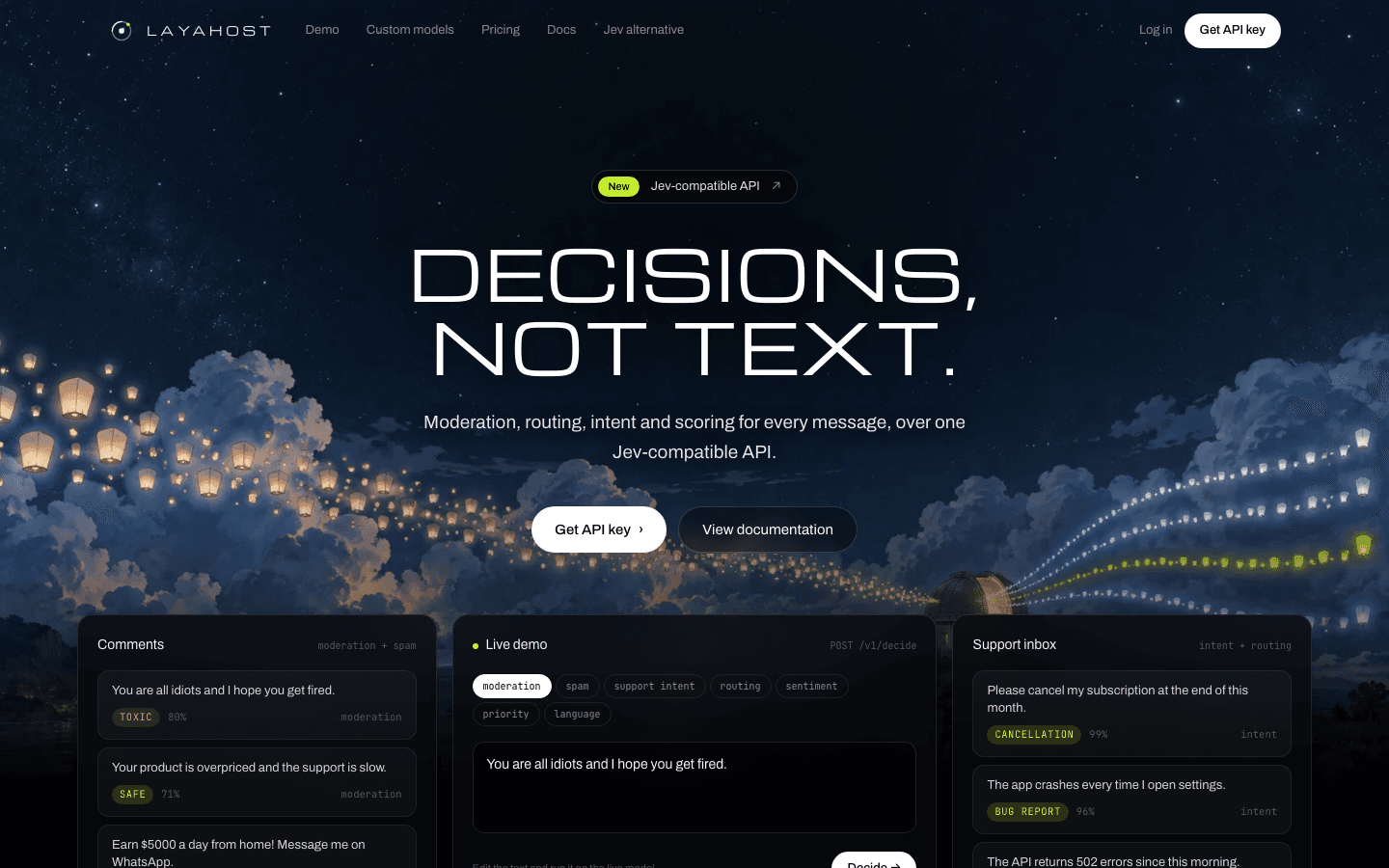
About this app
layahost is a hosted API for typed decisions. You send a piece of text and a question with a fixed set of answers - a choice, a yes/no or a score - and get back the answer with a probability for every option, as JSON your code can branch on. Use it for comment moderation and spam, support intent and routing, sentiment, priority and language detection, without prompting an LLM and parsing its output. It runs Laya, the open-source (Apache-2.0) decision model, and implements the wire format of the Jev System One API, so code written for Jev, including the official Python and JavaScript SDKs, works after you change the base URL and the key. Pricing is flat: $5 per million decisions regardless of text length, prepaid, hosted in the EU.
Key features
- 1Typed decisions over HTTP: choice, yes/no, or score questions return the answer plus a probability for every option as JSON.
- 2Jev System One wire-format compatibility — official Python and JavaScript SDKs work after changing the base URL and key.
- 3Flat $5 per million decisions regardless of text length, prepaid, EU-hosted, with $1 welcome credit on email verification.
Target customer profile
Drawn from the product itself, not from a survey.
Demographic
Developers and product teams
Pain points
Prompting an LLM for classification and parsing its output is slow and unreliable
Primary needs
Fast, cheap, reliable text classification in production (moderation, intent, routing)
Scout Review
Written by AI from measured evidence, scored out of 100.
layahost is a hosted classification API that returns typed decisions — a choice, a yes/no, a score — with probabilities, as JSON your code can branch on. It runs the open-source Laya model and speaks Jev's wire format, so existing Python and JavaScript SDKs work after a base-URL change. The landing page is genuinely good: a live demo in the hero, recorded answer cards, and a docs site that explains question types and endpoints without padding. Onboarding is three steps with $1 of welcome credit. Lighthouse desktop performance is 99, mobile 84 with a 3.8s LCP. Security headers are 9 of 13 with no HSTS or CSP and no published audits. Accessibility is 97 with one contrast failure and no a11y statement. The idea is well-positioned — real problem, specific wedge, flat pricing — but the differentiation leans on a competitor's API format and a rival's shutdown date. A competent, honest indie API with a clear pitch and a thin moat.
Measure by measure
Usability
71Three-step quickstart, $1 welcome credit on email verification, copy-paste curl, Python/JS/PHP samples, migration guide from Jev, and a template library. Docs are real docs. Onboarding is short and the free tier is usable, not a sandbox.
Design
76Dark, terminal-flavored landing page with a live decision demo in the hero and three-column answer cards that show the product working before you read a word. Docs match the marketing. Polished for an indie API tool, though the aesthetic is familiar.
Speed
74Lighthouse desktop 99, mobile 84 with LCP 3.8s, CLS 0, TBT 80ms. Docs claim tens-of-milliseconds server-side latency and every response reports latency_ms. Mobile LCP is the weak spot; no third-party benchmarks found.
Security
63HTTPS enforced, frame protection, X-Content-Type-Options, Referrer-Policy, Permissions-Policy, secure cookies, SPF and DMARC all present. Missing HSTS and CSP. No SOC 2, ISO, pen-test, or bug bounty published — normal for a brand-new indie API, but unverified.
Accessibility
79Lighthouse accessibility 97/100 with one failing audit: insufficient color contrast. No a11y statement, WCAG claim, or keyboard-nav docs found. The model handles 35 languages but the UI itself isn't documented as localized.
Growth
58Real problem (LLM classification is slow and parse-fragile), specific wedge (Jev wire-format compatibility + Perspective API sunset + flat $5/M pricing), clear target (developers shipping moderation/routing). Differentiated but the category is crowded and the moat is thin.
Improvement areas
- Missing HSTS and Content-Security-Policy headers; no SOC 2, ISO, pen-test report, or bug bounty published.
- No accessibility statement or WCAG claim, and one failing contrast audit on an otherwise 97/100 Lighthouse score.
- No published latency benchmarks or reproducible accuracy numbers for the shipped templates — buyers must test blind.
Design & Usability
The landing page does the one thing most API sites fail at: it shows the product working. A live 'Decide' widget sits in the hero, flanked by recorded answer cards for moderation, spam, intent and routing — you see probabilities before you read a paragraph. The dark, monospace aesthetic is the standard dev-tool look, executed without the usual gradient soup, and the docs inherit the same typography. Usability is where layahost earns its keep: three steps to a first request, $1 of welcome credit on email verification (66.7K decisions), copy-paste curl, and SDK samples in Python, JavaScript and PHP. There's a migration guide from Jev, a template library, and test sets for measuring accuracy on your own data before you ship. The docs explain the three question types (choice, yes/no, score) and the two endpoints without hand-waving. For an indie API, the onboarding is unusually short and the free tier is genuinely usable rather than a demo sandbox.
Speed & Security
Speed is split. Lighthouse desktop scores 99/100, but mobile lands at 84 with an LCP of 3.8 seconds — the marketing site is slower to paint on a phone than the product it's selling claims to be. CLS is 0 and TBT is 80ms, so the page isn't janky, just heavy on first paint. The API itself claims tens-of-milliseconds server-side processing and reports latency_ms on every response, which is the number that actually matters for a classification endpoint; no third-party benchmark was found to confirm it. Security is competent but incomplete. HTTPS is enforced, and frame protection, X-Content-Type-Options, Referrer-Policy, Permissions-Policy, secure cookies, SPF and DMARC are all present — 9 of 13 checklist points. Missing are HSTS and CSP, both cheap wins. There's no SOC 2, ISO certification, pen-test report, or bug bounty published, which is normal for a domain registered this year but means enterprise buyers have nothing to point at.
Accessibility & Growth
Accessibility scores 97/100 on Lighthouse with exactly one failing audit: insufficient background/foreground contrast. That's a fixable bug, not a structural problem, but there's no accessibility statement, no WCAG conformance claim, and no documentation of keyboard navigation. The model supports 35 languages; the interface itself isn't documented as localized. Growth is a judgement on the idea, not the traction. The problem layahost names is real and specific: prompting an LLM for classification is slow, expensive, and returns text you have to parse and retry. The wedge is concrete — it implements Jev's wire format so existing SDKs work after a base-URL swap, and it positions as a drop-in for Google's Perspective API, which shuts down at the end of 2026. Flat $5 per million decisions, prepaid, EU-hosted, is a defensible price against per-token LLM calls. The category is crowded (OpenAI's moderation endpoint is free, and every LLM provider ships a classifier), and the moat is thin — compatibility with someone else's API shape and another company's shutdown date are not durable advantages. Room to grow, but not much room to defend.
Conclusion
If you're currently prompting an LLM to classify support tickets and regexing the output, layahost is a straight upgrade: typed answers, probabilities, no parse failures, and $5 per million decisions is cheap enough to stop thinking about. The Jev compatibility means migration is a base-URL change, and the Perspective API sunset gives you a deadline-shaped reason to look. What you're not getting is enterprise assurance — no SOC 2, no pen test, no HSTS — and no proof beyond the vendor's own claims that the model is accurate on your traffic. That's what the test sets are for: upload a few hundred of your own labeled texts before you route anything real through it. The product is honest about this, which is more than most API landing pages manage. Worth a weekend prototype. Worth a production dependency only after you've measured it on your data.
Suggestions for improvement
- Add HSTS and a Content-Security-Policy header — both are cheap and close two of the four missing security checklist points.
- Fix the single failing contrast audit and publish a short accessibility statement with WCAG conformance level.
- Publish real latency benchmarks (p50/p95/p99) on a representative text mix, not just 'tens of milliseconds'.
- Add a public accuracy page or reproducible eval results for the shipped templates so buyers can sanity-check before testing.
Alternatives comparison
Named competitors, point by point. Nobody paid to appear here or to be left out.
 layahost |  OpenAI Moderation API | |
|---|---|---|
| Pricing model | Flat $5 per million decisions, prepaid, regardless of text length | Free for OpenAI moderation models (omni-moderation-latest) |
| Output format | Typed answer (choice / yes-no / score) with probability per option, as JSON | Category flags with per-category scores (harassment, hate, violence, etc.) |
| Custom question types | Yes — define your own options, yes/no, or 2-10 ordered score levels | No — fixed taxonomy of harm categories only |
| SDK / migration compatibility | Jev System One wire format; official Jev Python and JS SDKs work after base-URL swap | OpenAI SDKs; endpoint is part of the broader OpenAI API surface |
| Data residency / hosting | Hosted in the EU | OpenAI global infrastructure; region not user-selectable |
| Use case breadth | Moderation, spam, intent, routing, sentiment, priority, language, PII, prompt injection | Content moderation only |
Comparing options? See layahost alternatives, scored side by side
More API Service apps
View all API Service
CC Switch
91Open-source desktop app for switching AI coding providers...

TaxID
90Fast EU VAT validation API for developers, covering 27 EU...

SiftingIO - Market Data API
88Real-time & historical market data API for stocks, forex,...

Claw Messenger
88Claw Messenger is an iMessage API service that gives AI a...

OBVELO
88Privacy gateway that masks personal data in LLM traffic

tradutor de mangá com IA
88O tradutor de mangá com IA traduz capítulos em lote, personaliza textos e oferece edição visual para estúdios.

Giftronaut
87.5gift card software, international gift card, international visa gift card, gift card API

QRocodile
87Design And Animate QR Codes People Want to Scan

StockFit API
87A developer-first financial data API providing structured...

Plori
87Cloud AI agents with persistent disk, memory, and real CL...

QVeris AI
86Connect AI agents to 10,000+ real-world tools and APIs

Split Forms
86Free contact form backend for any website


A platform dedicated to providing unbiased reviews of newly launched applications, analyzing everything from their features to their full potential.
info@scoutforge.net© 2026 Scoutforge. All rights reserved.
