

A platform dedicated to providing unbiased reviews of newly launched applications, analyzing everything from their features to their full potential.
info@scoutforge.net© 2026 Scoutforge. All rights reserved.
A platform dedicated to providing unbiased reviews of newly launched applications, analyzing everything from their features to their full potential.
info@scoutforge.net© 2026 Scoutforge. All rights reserved.
A platform dedicated to providing unbiased reviews of newly launched applications, analyzing everything from their features to their full potential.
info@scoutforge.net© 2026 Scoutforge. All rights reserved.
Cycling through all six. Tap any point to stop.
Measured on six things
Real-time AI video generation with 4K quality in seconds.
Lighthouse desktop performance lands at 55/100 with a punishing 5.4s total blocking time, even though LCP (1.3s) and FCP (333ms) are quick. The '2-4 second' claim on the site refers to model generation latency, not page speed. Heavy main-thread work is the bottleneck.
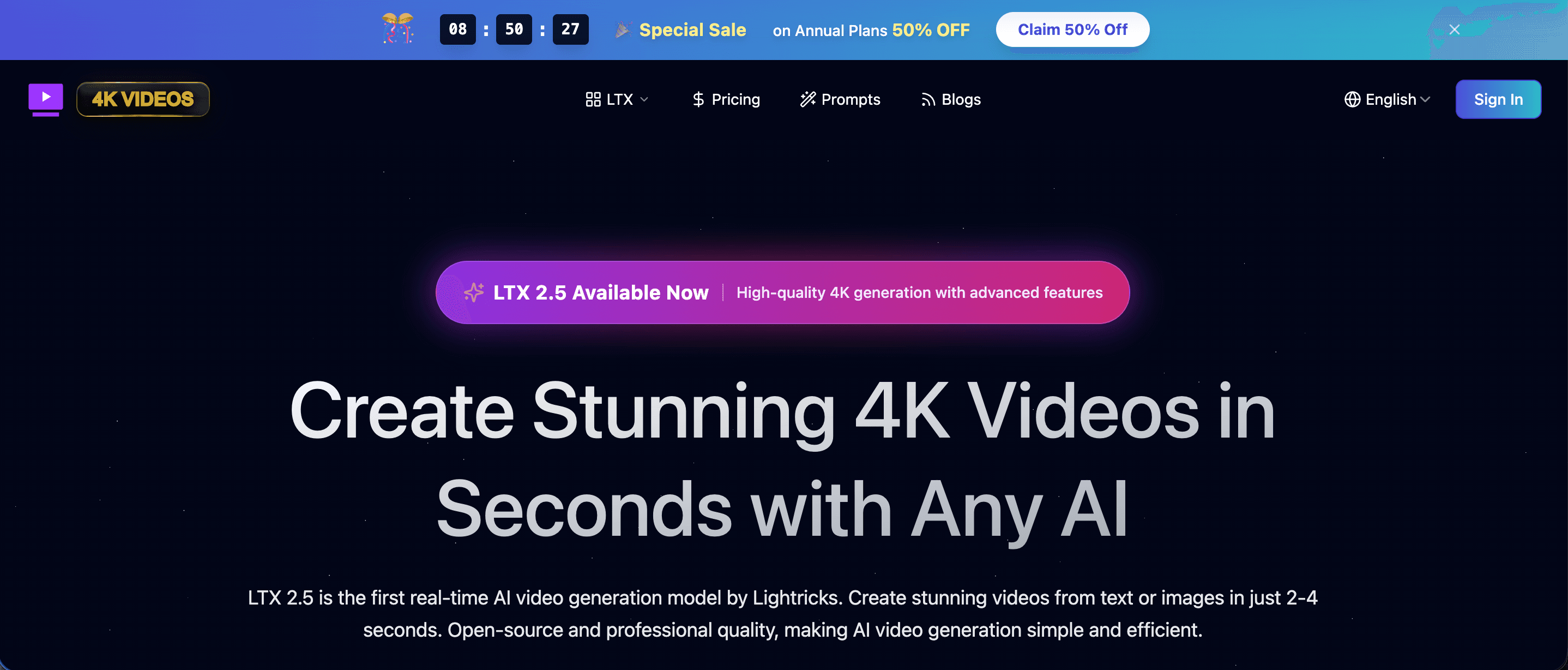
LTX Studio, powered by Lightricks' LTX model, is a cutting-edge AI video generation platform that leverages the first DiT-based real-time model to create stunning 4K videos from text, images, or audio in just 2-4 seconds. It integrates multiple world-class AI models like Veo, Kling, and Seedance, offering a unified ecosystem for seamless workflow integration. With features like multi-model support, open-source accessibility, and commercial usage rights, it's ideal for creators, filmmakers, and businesses looking to streamline video production. The platform includes a user-friendly studio with text-to-video, image-to-video, and audio-to-video capabilities, along with advanced editing tools. Pricing plans range from starter to ultimate, with credit-based options, making it accessible for various needs. Whether you're a solo creator or a large team, LTX Studio empowers you to generate professional-grade videos efficiently, backed by robust support and community insights.
Drawn from the product itself, not from a survey.
Demographic
Content Creators & Social Media Influencers
Pain points
Slow video production, high costs, limited editing skills
Primary needs
Fast, affordable, high-quality video generation for social media
Demographic
Filmmakers & Video Producers
Pain points
Time-consuming post-production, need for realistic effects
Primary needs
Real-time generation, temporal consistency, multi-model flexibility
Demographic
Marketing & Creative Teams
Pain points
Scaling video content, maintaining brand consistency
Primary needs
Efficient workflow integration, commercial licensing, collaboration
Written by AI from measured evidence, scored out of 100.
LTX Studio is an early-stage AI video platform built on Lightricks' LTX 2.5 model, wrapped in a polished dark-mode site with a real generator workspace in the hero. The product story is coherent: multi-model aggregation (LTX, Veo, Kling, Seedance), open-source positioning, commercial licensing on every tier, and pricing from $7.49/mo to $49.99/mo plus credit packs. The execution has gaps. The hero demo is sign-in gated and shows an empty output pane, so visitors never see the product actually work. Lighthouse desktop performance is 55/100 with 5.4s of blocking time. Security hardening stops at HTTPS/HSTS/SPF/DMARC with six of thirteen checklist items missing. Accessibility fails four real audits despite an 87/100 automated score. There's no visible documentation or help center. The domain is roughly six months old, so this is a product still finding its footing — promising positioning, unfinished edges.
The hero workspace exposes real model and parameter controls (LTX 2.5, Veo 3.1, Kling 3.0, resolution, FPS, duration), and pricing is clear. But generation is sign-in gated, there's no visible docs or help center, and feature cards are dense paragraphs rather than scannable bullets.
Coherent dark theme, purple gradients and consistent iconography, with a real generator workspace embedded in the hero instead of a stock image. Undercut by a sign-in-gated demo showing an empty output pane, plus a countdown timer and 'We've moved!' banner crowding the top.
Lighthouse desktop performance lands at 55/100 with a punishing 5.4s total blocking time, even though LCP (1.3s) and FCP (333ms) are quick. The '2-4 second' claim on the site refers to model generation latency, not page speed. Heavy main-thread work is the bottleneck.
HTTPS is enforced with HSTS, SPF and DMARC in place, which covers the basics. But the probe found no CSP, no frame protection, no X-Content-Type-Options, no Referrer-Policy, no Permissions-Policy and no secure cookies — 6/13 checklist points. No SOC 2, ISO or bug bounty claims surfaced.
Lighthouse scores 87/100, but four real audits fail: buttons with no accessible name, insufficient color contrast, links distinguishable only by color, and touch targets too small. No WCAG statement or a11y page found. The dark purple-gradient theme is the likely contrast culprit.
A real, expensive problem (slow, costly video production) with a specific wedge: a multi-model open ecosystem spanning LTX, Veo, Kling and Seedance, plus open-source, workflow-embeddable positioning and commercial licensing on every tier. Crowded category, but the aggregation angle is defensible.
LTX Studio's homepage is a genuinely well-built dark-mode marketing page: consistent purple-gradient branding, clean iconography, and — unusually — a real generator workspace embedded directly in the hero rather than a stock screenshot. That's a strong design decision. The problem is what's inside it: the workspace is sign-in gated, shows a '225 credits' balance, and renders a large empty black output pane, so the demo reads as incomplete rather than inviting. A persistent 'We've moved!' banner and a live countdown timer add visual noise at the very top. On usability, the workspace exposes real controls — model picker (LTX 2.5, Veo 3.1, Kling 3.0, Seedance 2.0), resolution, FPS, duration — and the pricing page is clear about monthly, annual and credit-pack options. But there's no visible documentation, help center or API reference, and the feature cards are dense paragraphs rather than scannable bullets. Signup-to-value is blocked by the sign-in gate before a visitor sees a single output.
Speed is the weakest measured dimension. Lighthouse desktop performance is 55/100, dragged down by a 5.4-second total blocking time, even though first contentful paint (333ms) and largest contentful paint (1.3s) are fast. The site's '2-4 second' headline refers to model generation latency, not page responsiveness — don't confuse the two. Cumulative layout shift at 0.095 is borderline. On security, the probe shows HTTPS enforced with HSTS, plus SPF and DMARC records, which covers the fundamentals. What's missing is the hardening layer: no Content-Security-Policy, no frame protection, no X-Content-Type-Options, no Referrer-Policy, no Permissions-Policy and no secure cookie flags — 6 of 13 checklist points. No SOC 2, ISO 27001, penetration-test summary or bug bounty program surfaced in the site content, and privacy-policy depth couldn't be verified from the collected evidence.
Accessibility scores 87/100 on the automated Lighthouse audit, but four concrete audits fail: buttons without accessible names, insufficient color contrast, links distinguishable only by color, and touch targets too small or too tightly spaced. The dark theme with purple gradients is the likely driver of the contrast failures. No WCAG conformance statement, accessibility page or multi-language support was found. On growth, the idea itself holds up: video production is genuinely slow and expensive, and LTX Studio's wedge is aggregation — one workspace spanning LTX 2.5, Veo 3.1, Kling 3.0 and Seedance 2.0, with open-source positioning, workflow embedding and a commercial-use license on every tier. Pricing spans $7.49/mo to $49.99/mo plus one-time credit packs. The category is crowded (Runway, Synthesia, Pika), and the aggregation advantage is copyable by the model vendors themselves, but the open-source and licensing angles are real differentiators.
Conclusion
The core bet — that creators want one workspace for every major video model rather than five subscriptions — is a reasonable one, and the open-source plus commercial-licensing angle gives LTX Studio something the closed competitors can't easily match. But the site currently asks visitors to trust a demo they can't run, on a page that blocks the main thread for five seconds, with no docs to fall back on. Fix the hero so it shows a real output, ship a CSP and the missing security headers, publish a help center, and fix the four failing accessibility audits. None of those are hard. The positioning is the hard part, and that part is already done.
Named competitors, point by point. Nobody paid to appear here or to be left out.
 LTX Studio LTX Studio |  Runway ML Runway ML |  Synthesia Synthesia |  Pika Labs Pika Labs | |
|---|---|---|---|---|
| Core video generation approach | Multi-model aggregation: LTX 2.5, Veo 3.1, Kling 3.0, Seedance 2.0 in one workspace | Proprietary Gen-series models with advanced editing and motion controls | AI avatar-based video generation from scripts, no camera or actors | Creative text/image-to-video generation with playful effects |
| Entry-level pricing | $7.49/month (Starter, annual) or $9.99 one-time credit pack | Free tier available; paid plans start around $12/month | Free demo; paid plans start around $18-29/month | Free tier available; paid plans start around $8-10/month |
| Open-source / self-hostable | Marketed as open-source and workflow-embeddable | Closed-source, cloud-only | Closed-source, cloud-only | Closed-source, cloud-only |
| Commercial usage rights | Commercial Use License included on every tier, including $7.49 Starter | Commercial rights on paid plans | Commercial rights on paid plans | Commercial rights on paid plans |
| Avatar / talking-head video | Not offered — focuses on generative scene and motion video | Limited; primarily generative footage and effects | Core strength — 230+ AI avatars in 140+ languages | Not offered — focuses on creative motion generation |
| Target user | Creators, filmmakers and marketing teams wanting multi-model flexibility | Filmmakers and professional video editors | Corporate L&D, training and marketing teams needing avatar presenters | Social creators and hobbyists making short-form content |
Runway ML
AI-powered video editing and generation platform with advanced features.
Synthesia
AI video creation platform for generating videos with avatars.
Pika Labs
AI video generation tool focusing on creative and dynamic content.
Comparing options? See LTX Studio alternatives, scored side by side

Privacy-first open source journal app with a continuous t...

A free, open-source platform offering 110 AI agent skills...

An all-in-one hospitality software for restaurants and ba...

All-in-one AI workspace for docs, projects, and knowledge...

White-label reputation management software for agencies s...

A weekly newsletter delivering curated tech jobs, intervi...

Puzzly is an all-in-one B2B lead generation platform that...

Open-source desktop app for switching AI coding providers...

One verified handle for your online identity, readable by...

Frame-perfect video-to-GIF maker that runs entirely in yo...

White-label website audits that close deals for digital a...

PERM Processing Time is an independent data analysis platform that helps users navigate the U.S. Department of Labor’s permanent labor certification process.
A platform dedicated to providing unbiased reviews of newly launched applications, analyzing everything from their features to their full potential.
info@scoutforge.net© 2026 Scoutforge. All rights reserved.