Cycling through all six. Tap any point to stop.
Measured on six things
AI-powered writing and editing platform for authors, stor...
Security
41HTTPS is enforced and DMARC is set, but HSTS, CSP, frame protection, and referrer policy are all missing — 3/12 on the header checklist. Privacy claims ('encrypted at rest and in transit', 'no AI training') have no SOC 2, ISO, or security page backing them.
Screenshots
1 / 1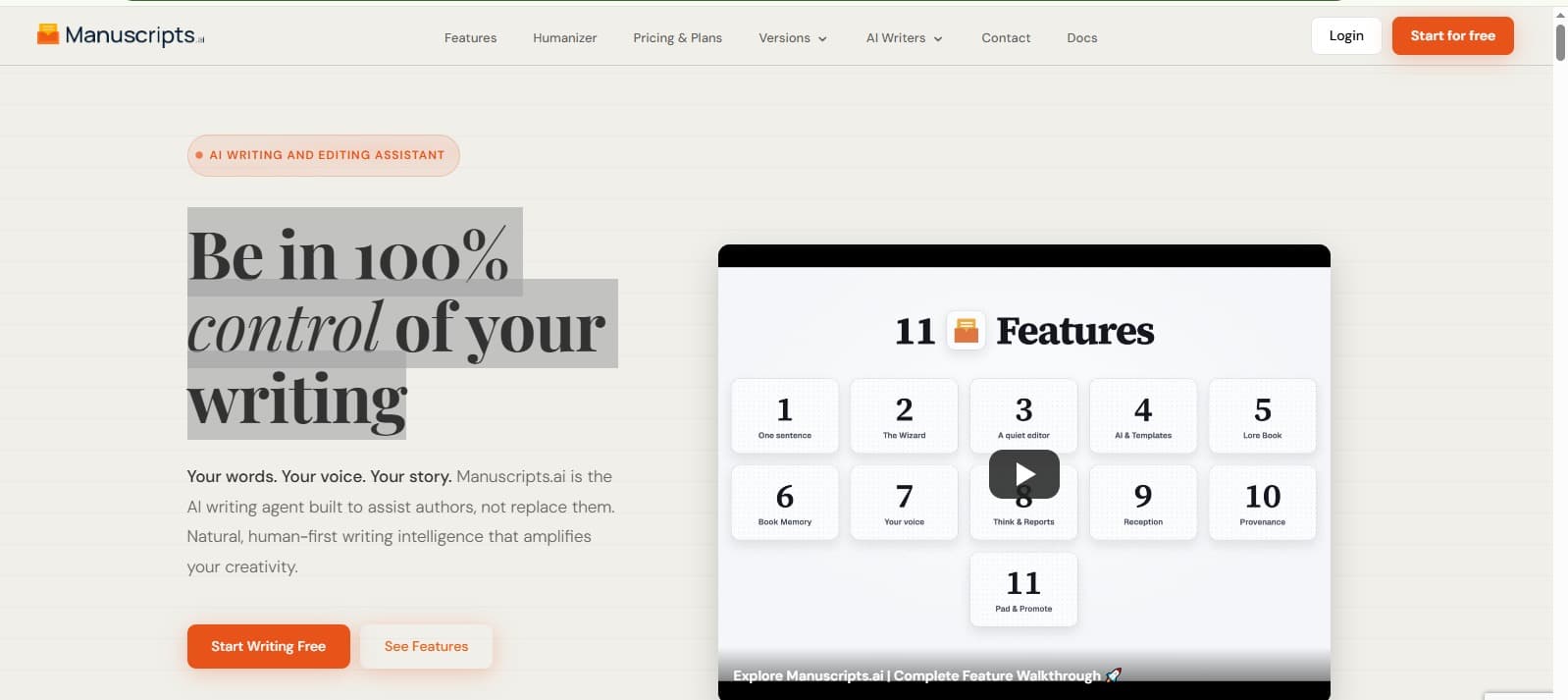
About this app
I’ve been testing a bunch of AI writing tools lately, and Manuscripts.ai is one that genuinely surprised me. It’s not just another text generator; it’s a full-fledged assistant built specifically for long-form writing—novels, short stories, academic papers, and even non-fiction. What sets it apart is its "author-first" philosophy: you stay in control, and every AI suggestion is just that—a suggestion. The platform offers a huge suite of 30+ analysis reports (pacing, readability, stylometry, sentiment arcs), a persistent Lore Book to keep your world consistent, and a Humanizer that makes AI-assisted prose read naturally. It supports .DOCX, .RTF, .TXT, PDF, and ePub imports/exports, and it even handles citation formats like APA/MLA for academic writing. The pricing is fair—free trial, then $29/month or $300/year for unlimited projects and 2M tokens. Whether you’re a novelist stuck in the second act or a blogger looking to polish drafts, Manuscripts.ai feels like a writing partner that...
Key features
- 1Lore Book and Book Memory keep characters, locations, and plot threads consistent across a full manuscript.
- 230+ analysis reports covering pacing, readability, stylometry, sentiment arcs, and structural feedback.
- 3Humanizer plus a Provenance record showing what you wrote versus where AI assisted, with .DOCX/.RTF/.TXT/PDF/ePub import-export.
Target customer profile
Drawn from the product itself, not from a survey.
Demographic
Fiction authors (novelists, short story writers)
Pain points
Writer's block, inconsistent world-building, expensive structural feedback, high AI detection scores
Primary needs
Tools to maintain plot consistency, generate prose that sounds human, and get professional-level manuscript analysis
Demographic
Academic and non-fiction writers (students, researchers, essayists)
Pain points
Citation formatting, plagiarism concerns, readability and flow issues, time-consuming editing
Primary needs
Accurate citation management, plagiarism detection, grammar and style checks, and structural feedback
Demographic
Content creators and bloggers
Pain points
Producing engaging content quickly, maintaining brand voice, low readability, high competition
Primary needs
AI writing assistance that preserves personal style, SEO-friendly readability reports, and fast humanization of drafts
Scout Review
Written by AI from measured evidence, scored out of 100.
Manuscripts.ai is a long-form writing assistant with a genuine point of view: the author stays in control, the AI suggests, and the tooling is built around manuscript-scale problems — lore consistency, book memory, pacing and readability reports, citation formats, and a provenance record of AI involvement. The design is the best-executed part of the site, with a cohesive illustration system and a distinctive type treatment. Usability is solid on the path to signup but thin on the feature grid. Speed is fine on mobile and sluggish on desktop. Security is the real gap: HTTPS and DMARC, but no HSTS, CSP, or frame protection, and no audit backing the encryption claims. Accessibility has six failing Lighthouse audits including a zoom-blocking viewport. Growth is the strongest dimension — a specific segment, a structural wedge, and a category with room. Worth trying on the free tier; worth scrutinizing before you upload a full manuscript.
Measure by measure
Usability
63Compact nav, obvious orange CTA, and a clear three-tier pricing page with a 7-day free trial make signup easy to find. Feature cards are scannable but the repeated 'SEE MORE' links preview nothing, and small body copy slows reading.
Design
71Cohesive custom illustrations, a distinctive serif-plus-orange-italic type system, and clear section rhythm put this ahead of typical indie SaaS. Emoji icons and eleven identical 'SEE MORE' buttons undercut the polish.
Speed
56Mobile Lighthouse 68/100 with LCP 2.4s and CLS 0 is respectable, but desktop drops to 48/100 and TBT of 699ms shows real main-thread blocking. A marketing site this heavy should be lighter.
Security
41HTTPS is enforced and DMARC is set, but HSTS, CSP, frame protection, and referrer policy are all missing — 3/12 on the header checklist. Privacy claims ('encrypted at rest and in transit', 'no AI training') have no SOC 2, ISO, or security page backing them.
Accessibility
58Lighthouse 78/100 with six failing audits: contrast, heading order, missing alt text, unnamed links, no main landmark, and a viewport that blocks zoom. No accessibility statement or WCAG mention found. Solid basics, real gaps.
Growth
68A specific, underserved wedge: long-form authors who need lore consistency, manuscript-scale memory, and analysis reports that ChatGPT and Jasper structurally don't offer. Real category headroom in indie publishing.
Improvement areas
- Security headers and audit trail: no HSTS, CSP, frame protection, or SOC 2/pen-test backing the encryption claims.
- Accessibility: six failing Lighthouse audits including a zoom-blocking viewport and missing alt text.
- Feature grid UX: eleven identical 'SEE MORE' links preview nothing and small body copy slows reading.
Design & Usability
The design is the strongest part of the site: a custom illustration set with consistent stroke and palette, a serif display face with orange italic accents that repeats deliberately across sections, and a warm off-white palette with one dark section for rhythm. It reads as a product with a point of view, not a template. The cracks are in the details — emoji icons in the privacy cards, eleven identical 'SEE MORE' buttons that preview nothing, a play button sitting on feature tile 8. Usability is competent: compact nav, obvious orange CTA, a clear three-tier pricing page with a 7-day free trial. But the feature grid asks you to click 'SEE MORE' eleven times with no idea what's behind any of them, and the body copy is small enough to make you squint. Good bones, unfinished edges.
Speed & Security
Speed is a split verdict. Mobile Lighthouse lands at 68/100 with LCP 2.4s and CLS 0 — genuinely fine. Desktop drops to 48/100 with TBT of 699ms, which means the marketing site is doing real main-thread work it doesn't need to. For a page whose job is to convince you to write, it's heavier than it should be. Security is the weak flank: HTTPS is enforced and DMARC is set, but HSTS, CSP, frame protection, X-Content-Type-Options, Referrer-Policy, and Permissions-Policy are all absent — 3/12 on the header checklist, with SPF missing too. The site claims encryption at rest and in transit and promises no AI training on your data, but there's no SOC 2, no ISO, no security page, no bug bounty. For a product asking authors to upload entire manuscripts, 'industry-standard protocols' with no audit trail is a claim, not a control.
Accessibility & Growth
Accessibility scores 78/100 on Lighthouse with six failing audits: insufficient contrast, non-sequential headings, missing alt attributes, links without discernible names, no main landmark, and a viewport that disables zoom. That last one is a direct WCAG failure and it's on a writing app — the exact product where readers need to scale text. No accessibility statement or WCAG mention appears anywhere in the fetched content. Growth is where the product earns its keep: the target is specific (long-form fiction authors, academics needing APA/MLA citations, bloggers wanting readability reports), and the differentiators are structural rather than cosmetic. Lore Book, Book Memory, 30+ analysis reports, the Humanizer, and a Provenance record of what you wrote versus where AI helped — ChatGPT has no persistent manuscript memory, Jasper is built for marketing copy, and Sudowrite has brainstorming but not this analysis depth. The category has real headroom as indie publishing grows, and the wedge is one incumbents can't easily copy without rebuilding around long-form. The '50K+ authors' claim is unverified, but the idea doesn't need it.
Conclusion
The free 7-day trial with 50k tokens is enough to test whether the Lore Book and Book Memory actually hold a novel together, and that's the right way to evaluate this — not the landing page, the manuscript. If the reports and memory work as advertised, $29/month is fair against the $4,000 structural edit the site name-drops. If they don't, you've lost a week. The thing to watch before committing a full draft: the security posture. Ask support directly whether there's a SOC 2 or pen-test report, whether manuscripts are encrypted at rest with customer-managed keys, and what the data retention policy is. A writing tool that holds your unpublished book deserves that question. The product's instincts are right — author-first, suggestion-not-replacement, provenance over plausible deniability — and that's rarer in this category than it should be.
Suggestions for improvement
- Publish a security page with SOC 2 or a pen-test summary, and add HSTS, CSP, and frame protection headers — the encryption claims need receipts.
- Fix the viewport meta to allow zoom and add alt text, discernible link names, and a main landmark; the six failing audits are cheap to close.
- Replace the eleven identical 'SEE MORE' buttons with expandable cards or descriptive labels so users know what they're opening.
- Swap the emoji icons in the privacy section for the custom illustration set and lighten the desktop bundle to lift the 48/100 score.
Alternatives comparison
Named competitors, point by point. Nobody paid to appear here or to be left out.
 Manuscripts.ai |  ChatGPT |  Jasper |  Sudowrite | |
|---|---|---|---|---|
| Persistent manuscript memory / lore consistency | Yes — Lore Book and Book Memory track characters, locations, and plot threads across the whole book. | No — context resets per conversation; no persistent manuscript memory. | No — built for marketing copy, not book-length continuity. | Partial — story bible features, but not full manuscript-scale memory. |
| Manuscript analysis reports (pacing, readability, structure) | Yes — 30+ report types including pacing, readability, stylometry, sentiment arcs. | No — ad hoc analysis only, no structured report suite. | Limited — SEO and readability scoring for marketing content. | Partial — critique and brainstorming, fewer structured reports. |
| Academic citation formatting (APA/MLA) | Yes — handles APA/MLA citation formats for academic writing. | Partial — can format citations on request, no persistent citation manager. | No — not an academic writing tool. | No — fiction-focused, no citation support. |
| AI humanization / low AI-detection prose | Yes — dedicated Humanizer plus 'Your Voice' style learning. | No — output often flagged as AI-generated. | No — brand voice tuning, not AI-detection reduction. | Partial — style matching, no dedicated humanizer. |
| Pricing model | Free 7-day trial; $29/mo or $300/yr with 2M tokens and unlimited projects. | Free tier; Plus ~$20/mo, no manuscript-specific features. | Paid tiers starting higher, aimed at marketing teams. | Subscription tiers with credit-based usage for fiction writing. |
ChatGPT
General-purpose AI chatbot that can write and edit text, but lacks persistent memory, citation management, and long-form workflow tools.
Jasper
AI writing assistant focused on marketing copy and blog posts, with fewer features for book-length manuscripts and academic writing.
Sudowrite
AI writing tool for fiction authors with story brainstorming features, but fewer editing and analysis reports compared to Manuscripts.ai.
Comparing options? See Manuscripts.ai alternatives, scored side by side
More Writing Assistants apps
View all Writing Assistants
Gerty
91Private, local AI assistant for Mac that runs offline

Voqusa
89Transcribe social media video and audio links into text (free signup, 5 free credits, then pay-as-you-go)

English Test Coach
89English Test Coach checks your IELTS essays and letters, gives an estimated band score across all four criteria, and tells you exactly what to revise next.

Remove AI Traces
87Scans text for AI traces and removes them: invisible characters, AI watermarks, citation leftovers, AI-style punctuation. Runs in your browser.

Book Cover Generator
87AI book cover generator for indie authors—turn your story...

ContentIQ
87AI writer that fact-checks before writing, with real sour...

Prizm
87Your CV and cover letter tailored to every job offer in a minute.

eety.ai — AI Patent Drafting Assistant
87An AI-powered patent drafting assistant that acts like a ...

Voice Memo Exporter
87Export all your Apple Voice Memos to one text file.

Boost My Resume
85Build and export a base resume for free, then use AI to tailor it and a matching cover letter to each job from your real experience.

SpicyLores AI
85Uncensored AI smut writer for stories, role-play and fanfic

AISmutWriter.me
85Uncensored AI smut writer for long fiction, with chapters of several thousand words and a memory that keeps every thread.


A platform dedicated to providing unbiased reviews of newly launched applications, analyzing everything from their features to their full potential.
info@scoutforge.net© 2026 Scoutforge. All rights reserved.
