Cycling through all six. Tap any point to stop.
Measured on six things
AI prediction for decisions you can rehearse.
Security
52HTTPS enforced with SPF/DMARC and two security headers, but HSTS, CSP, frame protection, and Permissions-Policy are all missing — 6/12 on the header checklist and no published compliance claims.
Screenshots
1 / 1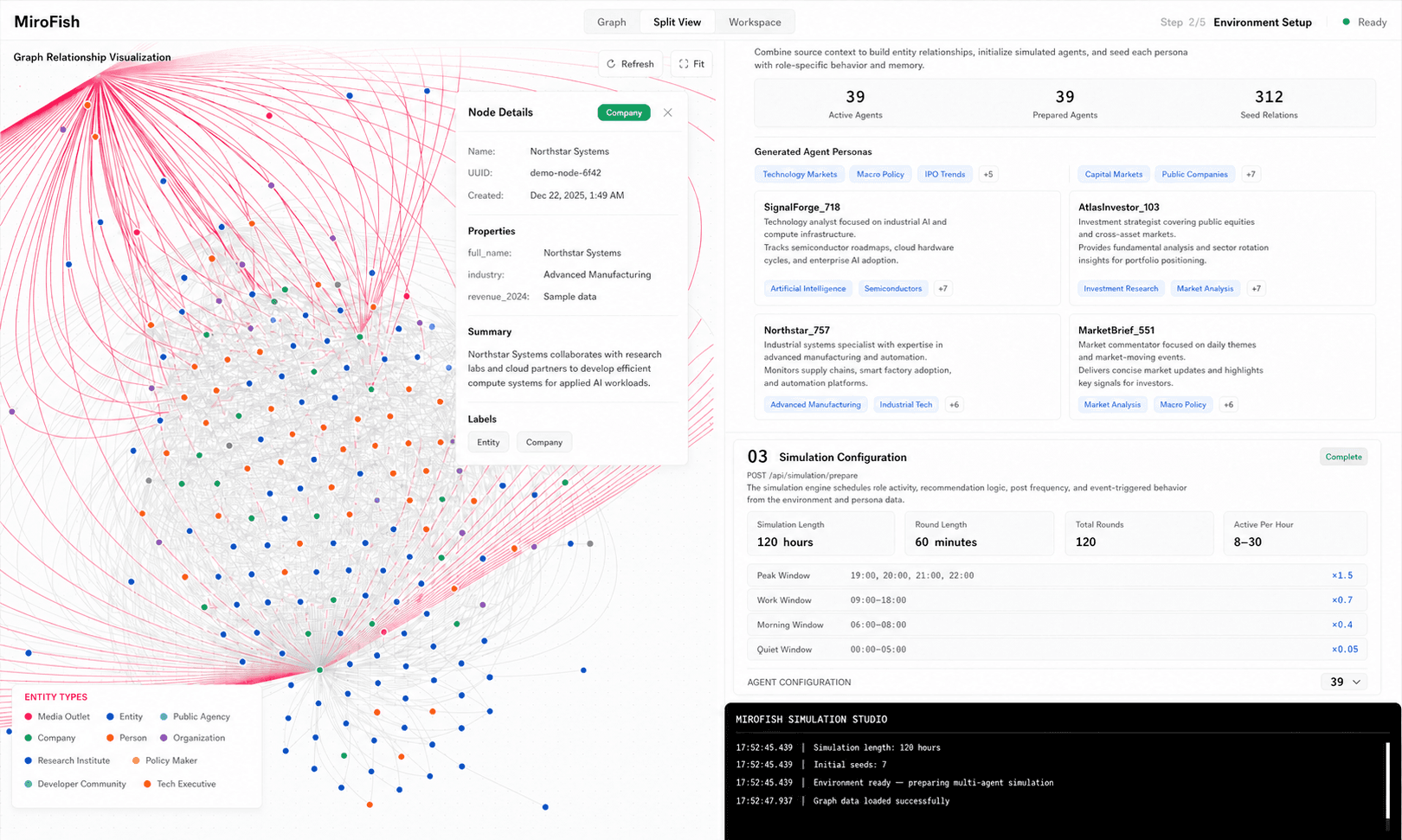
About this app
MiroFish turns a question and source material into a knowledge graph, a multi-agent simulation, and a report. It helps teams explore launch reactions, policy debates, market narratives, and other uncertain scenarios, inspect assumptions, compare possible outcomes, and ask follow-up questions.
Key features
- 1Knowledge graph (GraphRAG) built from uploaded text, PDF, Markdown, and TXT source material.
- 2Multi-agent simulation with configurable personas, relationships, and temporal memory rounds.
- 3Structured prediction reports with branch points, probabilities, and follow-up chat with agents.
Target customer profile
Drawn from the product itself, not from a survey.
Scout Review
Written by AI from measured evidence, scored out of 100.
MiroFish is an AI prediction engine that turns a question plus source material into a knowledge graph, a multi-agent simulation, and an inspectable report. The site is fast and the workflow is clearly articulated, with a free tier and three paid plans from $9 to $59/month. The weaknesses are concrete: a card-required free trial capped at three simulations on a single model, no public documentation, a thin security posture (no CSP, HSTS, or frame protection), and accessibility failures that include a keyboard trap. The idea is legitimate and the category has room, but 'predict anything' is a positioning problem — the product hasn't told us who it's actually for.
Measure by measure
Usability
58Free tier exists (1 guest / 2 signed-in sims, plus 3 over 7 days) and the five-step workflow is spelled out, but no public docs or help center surfaced and the free tier is locked to one model.
Design
63Coherent dark landing page with a clear product tour and honest 'illustrative mockup' labels, but the visual language leans on emoji feature cards and jargon-heavy copy that undercuts polish.
Speed
82Lighthouse mobile 91/100 (LCP 1.5s, CLS 0, TBT 51ms) and desktop 100/100 — genuinely fast, with lazy-loaded video walkthroughs keeping the initial payload light.
Security
52HTTPS enforced with SPF/DMARC and two security headers, but HSTS, CSP, frame protection, and Permissions-Policy are all missing — 6/12 on the header checklist and no published compliance claims.
Accessibility
68Lighthouse 89/100 with real failures: insufficient color contrast, ARIA role/children mismatches, and aria-hidden elements containing focusable descendants — a keyboard trap for screen-reader users.
Growth
58Real, growing category (scenario simulation, opinion forecasting) with a specific multi-agent + GraphRAG wedge and tiered pricing — but 'predict anything' positioning blurs the target customer.
Improvement areas
- No public documentation or help center for the five-step workflow.
- Security headers incomplete (no CSP, HSTS, frame protection) and no published compliance page.
- Accessibility failures including a keyboard trap from aria-hidden focusable descendants.
Design & Usability
MiroFish's landing page is competently built: a dark, coherent layout, a five-step product tour, and honest 'illustrative mockup' labels on the screenshots. The problem is that the design leans on emoji-bulleted feature cards and jargon ('God's-eye variable injection', 'swarm intelligence') that read more like a pitch deck than a product. Usability is where it stumbles: there's a free tier, but it requires a card, caps you at three simulations over seven days, and locks you to DeepSeek V4 Flash. The workflow is described but no public documentation or help center surfaced in the collected content, so a new user's path from signup to a useful report is guesswork.
Speed & Security
Speed is the standout: Lighthouse mobile 91/100 with a 1.5s LCP and zero layout shift, desktop a clean 100/100, and the video walkthroughs are lazy-loaded so they don't drag the initial load. Security is the weak flank. HTTPS is enforced and SPF/DMARC are in place, but HSTS, CSP, frame protection, and Permissions-Policy are all absent — 6/12 on the header checklist. For a product asking users to upload source material and decision notes into an AI simulation pipeline, the absence of a published security page, compliance claim, or bug bounty is a real gap, not just an unverified nice-to-have.
Accessibility & Growth
Accessibility lands at 68: Lighthouse scores 89/100, but four audits fail — insufficient color contrast, ARIA role/children mismatches, and aria-hidden elements containing focusable descendants, which is a genuine keyboard trap. There's no accessibility statement and the site is English-only. Growth is a judgment on the idea: scenario simulation for launch reactions, policy debates, and market narratives is a real and expanding category, and the multi-agent + GraphRAG approach is a specific enough wedge. But 'predict anything' is positioning that names no customer, and the $9/$29/$59 tiers don't clarify who this is for. The domain is barely half a year old, so traction is context, not a verdict.
Conclusion
If you're evaluating MiroFish, start with the free tier to see whether the simulation output is genuinely inspectable or just a confident-sounding report. Ask the team directly about data handling for uploaded source material — the header checklist suggests security is not yet a priority. And push on documentation: a five-step workflow with no help center is a workflow you'll be reverse-engineering. The bones are here — fast site, real methodology, tiered pricing — but the product needs to pick a customer and harden its security before it earns a place in a serious decision workflow.
Suggestions for improvement
- Publish real product screenshots instead of 'illustrative interface · fictional sample data' mockups.
- Add a public docs/help center covering the five-step workflow and model options.
- Ship HSTS, CSP, frame protection, and Permissions-Policy; publish a security page.
- Fix the four failing axe audits, especially the aria-hidden focusable-descendant trap.
Alternatives comparison
Named competitors, point by point. Nobody paid to appear here or to be left out.
 MiroFish (mirofish.work) | ||
|---|---|---|
| Free tier available | Yes — 1 guest / 2 signed-in sims, plus 3 over 7 days (card required) | Not assessed |
| Starting paid price | $9/month (Starter) | Not assessed |
| Multi-agent simulation | Yes — up to 50/100/200 agents by tier | Not assessed |
| Knowledge graph from source material | Yes — GraphRAG; knowledge base on Pro and above | Not assessed |
| Public documentation | Not found in collected content | Not assessed |
Comparing options? See MiroFish (mirofish.work) alternatives, scored side by side
More Productivity apps
View all Productivity
The Stack Newsletter
92A weekly newsletter delivering curated tech jobs, intervi...

Qamarero
92An all-in-one hospitality software for restaurants and ba...

EmbedMyReviews
92White-label reputation management software for agencies s...

StoryPad
92Privacy-first open source journal app with a continuous t...

Notion
92All-in-one AI workspace for docs, projects, and knowledge...

Puzzly – B2B Lead Generation & Sales Intelligence Platform
92Puzzly is an all-in-one B2B lead generation platform that...

Vibe Coding Agent Skills
92A free, open-source platform offering 110 AI agent skills...

Gerty
91Private, local AI assistant for Mac that runs offline

CC Switch
91Open-source desktop app for switching AI coding providers...

username.md
90One verified handle for your online identity, readable by...

PitchWhip
90AI cold call scripts & direct dials from LinkedIn

What the GIF
89Frame-perfect video-to-GIF maker that runs entirely in yo...


A platform dedicated to providing unbiased reviews of newly launched applications, analyzing everything from their features to their full potential.
info@scoutforge.net© 2026 Scoutforge. All rights reserved.
