Cycling through all six. Tap any point to stop.
Measured on six things
AI journaling, values mapping, and a personal AI coach for daily self-reflection.
Speed
46Lighthouse mobile 59/100 with an 8.9s LCP — nearly four times the 'good' threshold. Desktop fares better at 69/100. CLS is a clean 0 and TBT is modest at 292ms, so the weight is in the hero media, not the JS.
Screenshots
1 / 1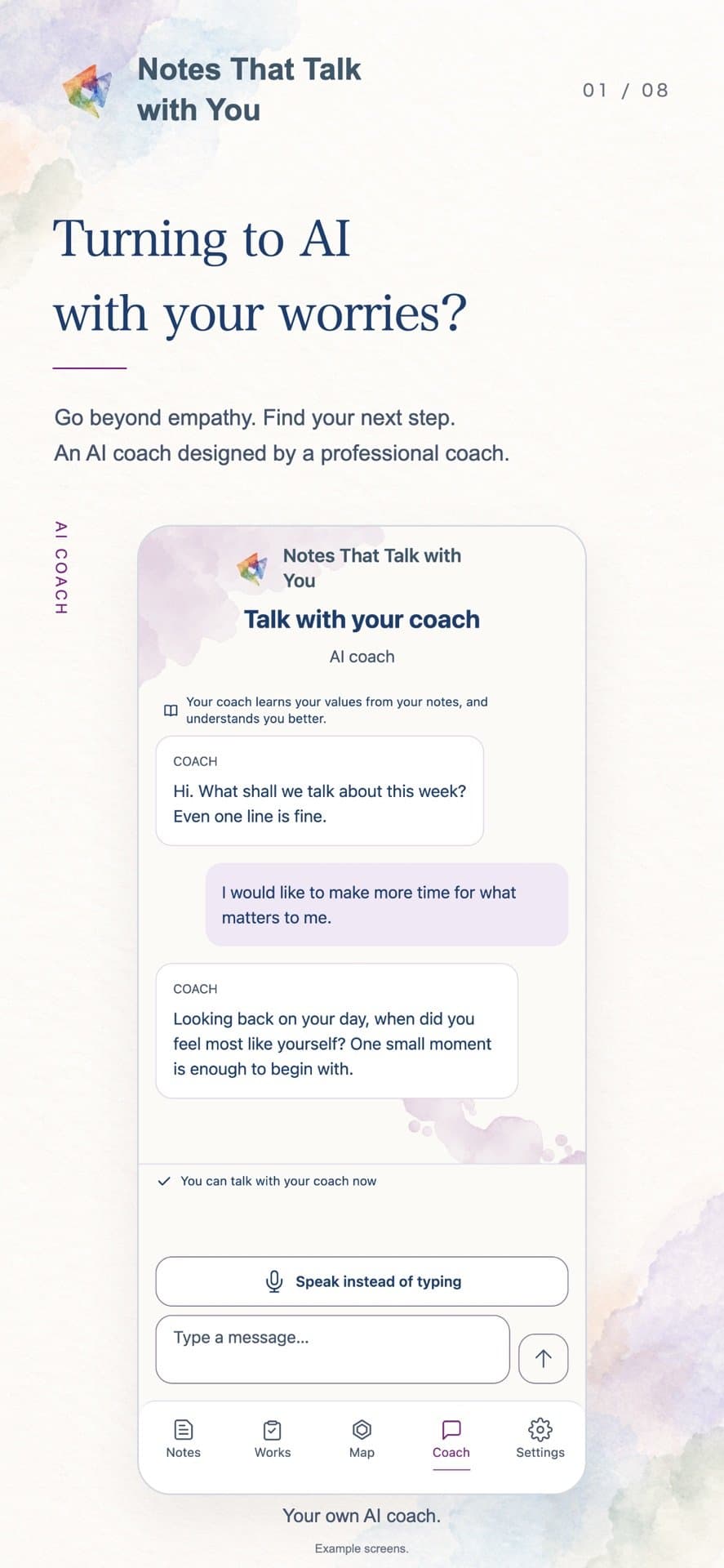
About this app
Notes that talk with you (自分と話すノート) is a journaling and self-reflection app by Rin, Inc., available on iOS and Android in Japanese and English. Start with a daily writing prompt and a short note. The app helps you reflect on what matters to you through an eight-axis values map, guided self-coaching exercises, and conversations with a personal AI coach. You can also compare values maps with someone close to you to explore how you relate; private notes and coach conversations are not shared through this feature. The app is free to download and includes free features, with optional in-app subscriptions. It supports self-understanding and reflection and does not diagnose or treat medical conditions. Official website: https://rin-connect.com/jibun-note/ iOS: https://apps.apple.com/us/app/notes-that-talk-with-you/id6791957170 Android: https://play.google.com/store/apps/details?id=com.rin.app
Key features
- 1Daily writing prompts with an eight-axis values map grounded in Schwartz's basic values theory.
- 2AI coach designed by a Gallup-certified CliftonStrengths coach, with memory of notes, values map, and prior conversations.
- 3Two-person values comparison that shares only axes and type — never notes or coach conversations.
- 4Crisis-safety mechanism that halts coaching and surfaces hotline numbers on risk language.
Target customer profile
Drawn from the product itself, not from a survey.
Demographic
People seeking self-understanding through journaling and reflection, in Japanese or English.
Pain points
Finding it hard to put feelings into words, recognize personal values, or choose a next step.
Primary needs
Daily writing prompts, an eight-axis values map, guided exercises, and a personal AI coach.
Scout Review
Written by AI from measured evidence, scored out of 100.
Notes that talk with you is a focused, well-built reflection app with a real point of view: a Gallup-certified coach designed the AI, the values map is grounded in Schwartz's basic values theory, and the safety handling around crisis language is more careful than most wellness apps bother with. The app UI is calm and legible; the marketing site is pretty but Japanese-only and slow on mobile. The honest limits are speed (8.9s mobile LCP), a thin security header profile, and a niche small enough that growth depends on retention rather than reach.
Measure by measure
Usability
68Progressive disclosure on the daily note (tags first, reflection after) keeps the form short, and the coach chat exposes voice and text input without scrolling. The site adds an intro video, FAQ, and an explicit ChatGPT comparison table. Pricing lives only in-app.
Design
71Judging the app UI from store screenshots: consistent pastel palette, rounded cards, clear 5-tab bottom nav, and a calm chat layout that matches the watercolor homepage. The marketing site is polished but Japanese-only, and overlapping phone mockups add noise.
Speed
46Lighthouse mobile 59/100 with an 8.9s LCP — nearly four times the 'good' threshold. Desktop fares better at 69/100. CLS is a clean 0 and TBT is modest at 292ms, so the weight is in the hero media, not the JS.
Security
52HTTPS enforced with secure cookies, SPF and DMARC — but zero of HSTS, CSP, frame protection, Referrer-Policy or Permissions-Policy, landing 5/13 on the header checklist. The safety design is thoughtful: crisis language halts coaching and surfaces hotlines. No audit or bug bounty found.
Accessibility
80Lighthouse accessibility scored a perfect 100/100 on automated checks, the site ships a skip-to-content link, and the app is localized in Japanese and English. No published WCAG conformance statement, so the top of the band is earned on measured audits plus multi-language coverage, not on a claim.
Growth
63A real, specific problem — putting feelings into words — with a genuine wedge: a persistent 8-axis values map plus a two-person comparison ChatGPT can't replicate. Published usage (3,776 conversations, 484 people) shows early pull, but the niche caps how far it scales.
Improvement areas
- Mobile performance: 8.9s LCP and 59/100 Lighthouse score need real optimization.
- Security headers: missing HSTS, CSP, frame protection, Referrer-Policy and Permissions-Policy.
- Homepage localization: Japanese-only site despite English App Store presence.
- Pricing transparency: subscription tiers only visible in-app, not on the website.
Design & Usability
The app itself is the product here, and the store screenshots show a genuinely coherent interface: soft pastels, rounded cards, a five-tab bottom nav with clear active states, and a coach chat that puts voice and text input right where your thumb lands. The daily note uses progressive disclosure well — date counter and two value tags first, reflection after — so the form never feels like homework. The website is a different story: beautifully watercolored, but entirely in Japanese despite English store screenshots, with overlapping phone mockups that read as clutter rather than craft. Pricing is deferred to the store, which is a usability tax on anyone comparing options before installing.
Speed & Security
Speed is the weak link. Lighthouse mobile lands at 59/100 with an 8.9-second LCP — the hero video and stacked mockups are doing the damage, since CLS is a clean 0 and TBT is only 292ms. Desktop recovers to 69/100, so it's a mobile-media problem, not an architecture problem. Security is a mixed bag: HTTPS, secure cookies, SPF and DMARC are in place, but HSTS, CSP, frame protection, Referrer-Policy and Permissions-Policy are all missing, giving 5/13 on the header checklist. What does stand out is the safety design — crisis language halts coaching and surfaces real hotline numbers, and the two-person feature explicitly shares only values axes, never notes or conversations.
Accessibility & Growth
Accessibility is the strongest measured dimension: a 100/100 Lighthouse audit, a skip-to-content link, and Japanese/English localization. There's no published WCAG statement, so this is measured competence rather than a certified claim. Growth is a judgement on the idea, and the idea holds up: the problem — not being able to name what you feel or value — is real, and the wedge is concrete. An eight-axis values map built from your own notes, plus a two-person comparison that shares only axes and type, is something a general chatbot structurally cannot offer. The published usage report (3,776 conversations, 484 people since July 2026) shows early pull, but the addressable niche is narrow and the app is months old.
Conclusion
If you want a journaling app that pushes back with questions instead of just storing text, this is a credible pick — especially if the values map and the two-person comparison are what you're after. Go in expecting a young product: no published audits, pricing only visible in-app, and a website that assumes you read Japanese. The core loop is sound; the polish around the edges is still catching up.
Suggestions for improvement
- Fix the 8.9s mobile LCP: lazy-load or replace the hero video with a poster image and compress the stacked mockups.
- Add HSTS, CSP, and Referrer-Policy headers — five of thirteen is a cheap fix away from a much better profile.
- Put a language switcher on the homepage; English store screenshots with a Japanese-only site is a conversion leak.
- Publish pricing (or at least the Hanasu+ tiers) on the site so people can evaluate before installing.
Alternatives comparison
Named competitors, point by point. Nobody paid to appear here or to be left out.
 Notes that talk with you Notes that talk with you |  ChatGPT ChatGPT | |
|---|---|---|
| Primary purpose | Guided self-reflection and values mapping with a dedicated AI coach | General-purpose assistant for writing, research, and conversation |
| Persistent personal values model | Eight-axis values map built from notes and answers, with radar and bar charts | No structured values model; memory is conversational and settings-dependent |
| Two-person comparison | Overlay values maps with a partner, friend, or colleague; shares only axes and type | Not offered |
| Crisis safety handling | Halts coaching and surfaces hotline numbers (よりそいホットライン 0120-279-338) on risk language | Policy-based safety responses; not a dedicated crisis-routing flow |
| Pricing model | Free download with free features; optional in-app subscription (Hanasu+) | Free tier plus paid subscription plans |
Comparing options? See Notes that talk with you alternatives, scored side by side
More AI Chatbots apps
View all AI Chatbots
Notion
92All-in-one AI workspace for docs, projects, and knowledge...

MindMarks
88A free browser extension that organizes AI conversations ...

Claw Messenger
88Claw Messenger is an iMessage API service that gives AI a...

Plori
87Cloud AI agents with persistent disk, memory, and real CL...

VibeBot
86AI-powered no-code Discord bot maker

Dardaris
85An AI property manager for private landlords. It handles rent, repairs, tenant messages and bookings, and only asks you when a decision needs you.

PromptTrace
85Free hands-on AI security labs for prompt injection and L...

Chatzy AI
85Chatzy.ai helps businesses automate customer interactions on WhatsApp, Web, Facebook, Instagram, Voice, and in-app channels using powerful AI agents.

Mortgage Tools by Jenny
85Free Canadian mortgage calculators and AI mortgage tools by Jenny Tate, a licensed Ontario mortgage agent.

Helpyly
84Helpyly is an AI-powered customer support platform that a...

linkwise.link
84LinkWise is an AI bookmark manager for people who save links they never find again. Paste any URL for a summary and keywords, then search by tags or m

Zens AI
84AI customer support that turns user feedback into Codex and Multica workflows, helping SaaS teams improve every week.


A platform dedicated to providing unbiased reviews of newly launched applications, analyzing everything from their features to their full potential.
info@scoutforge.net© 2026 Scoutforge. All rights reserved.