Cycling through all six. Tap any point to stop.
Measured on six things
Shopify license key app for software, plugins, and digita...
Speed
35Lighthouse mobile 35/100 with a 15.8s LCP and 1.5s TBT; desktop only 50/100. The broken video embed sits on the critical path and drags the load further.
Screenshots
1 / 1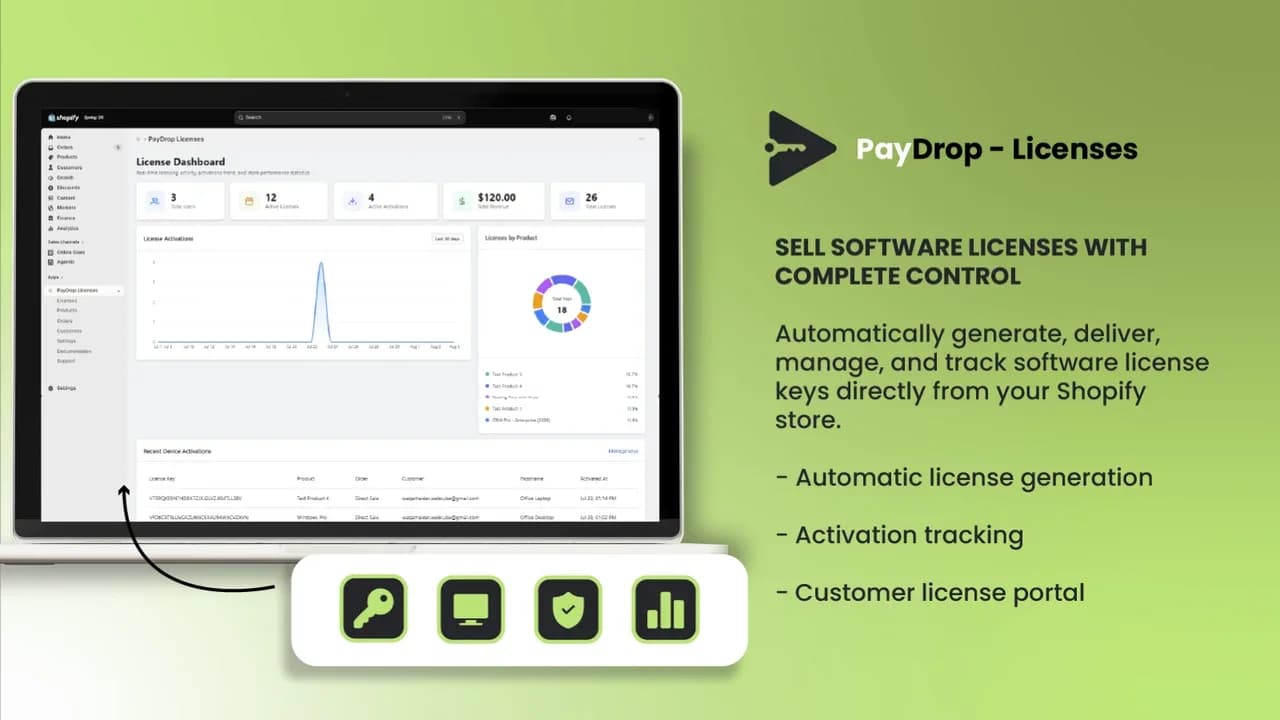
About this app
PayDrop Licenses is a Shopify app built by TheShopNinjas that turns your store into a proper software licensing operation. When you enable licensing on any product, PayDrop automatically generates a unique license key at checkout and delivers it to the customer. You control the key format, activation limit, and expiry date. From a single dashboard synced with your Shopify orders and customers, you can track activations by device, see revenue and key counts, and extend, renew, regenerate, or revoke any license with one click. Customers get a self-service portal to view keys, check activation counts, and confirm status without contacting support. It removes the spreadsheet-and-email workflow that most stores use for license management, keeping everything connected to the original transaction. For merchants selling software, plugins, templates, courses, or bundled digital products, it closes the gap between checkout and license fulfillment that Shopify doesn't handle natively.
Key features
- 1Automatic license key generation at Shopify checkout with configurable format, activation limit and expiry date.
- 2Device-level activation tracking with a dashboard showing active licenses, activations, revenue and keys issued.
- 3One-click extend, renew, regenerate or revoke from the license list or detail view, synced to Shopify orders.
- 4Customer self-service portal to view keys, copy them, check activation counts and confirm active/expired/revoked status.
- 5Customers page rolling up orders, license count, most recent license and last activity per buyer.
Target customer profile
Drawn from the product itself, not from a survey.
Demographic
Indie software and plugin developers selling on Shopify
Pain points
Manual key generation via spreadsheets, slow support responses for lost keys
Primary needs
Automated key delivery, device activation limits, easy revocation on abuse
Demographic
Digital product creators (templates, courses, ebooks with licenses)
Pain points
Unclear license expiry tracking, no customer self-service for key access
Primary needs
Expiry date control, self-service portal, renewal options
Demographic
Small agencies managing Shopify stores for SaaS or digital brands
Pain points
Fragmented licensing tools outside Shopify, revenue visibility gaps
Primary needs
Unified dashboard, activation analytics, bulk license actions
Scout Review
Written by AI from measured evidence, scored out of 100.
PayDrop Licenses solves a problem Shopify genuinely doesn't: turning a checkout into a delivered, trackable, revocable license key. The four-step explainer, the real dashboard mockup and the self-service portal concept are all credible, and the positioning against LicenseSpring and Keygen — native Shopify integration, no external API glue — is the right wedge. Execution is where it stumbles. The homepage loads in 15.8 seconds on mobile, the product video is broken and apologizing in Dutch, security headers are largely absent, and there's no pricing or trial visible before you commit to the install. None of that is fatal for an early Shopify app, but it's the difference between a page that converts and one that gets closed.
Measure by measure
Usability
63The four-step flow and FAQ explain the product clearly, and a docs hub exists. No visible pricing or trial on the page, and five nav dropdowns add friction before you reach anything.
Design
57Cohesive green palette and a real dashboard mockup carry the page, but a broken video embed showing Dutch error text and mismatched illustration styles drag it back to average.
Speed
35Lighthouse mobile 35/100 with a 15.8s LCP and 1.5s TBT; desktop only 50/100. The broken video embed sits on the critical path and drags the load further.
Security
42HTTPS is enforced and SPF is set, but there's no HSTS, CSP, frame protection or DMARC, and no SOC 2, ISO or pen-test claims anywhere. 3/12 on header checklist.
Accessibility
68Lighthouse a11y 90/100, but five failing audits remain: unnamed buttons and links, prohibited ARIA, SVGs without text alternatives. English-only, no accessibility statement.
Growth
62Real gap — Shopify has no native license fulfillment — with a genuine wedge: native checkout integration and a self-service portal that LicenseSpring and Keygen don't offer inside Shopify.
Improvement areas
- Mobile performance: 15.8s LCP and 35/100 Lighthouse score will cost installs before the product is even seen.
- Security posture: no HSTS, CSP, frame protection or DMARC, and no published compliance or data-handling documentation.
- Broken video embed showing untranslated Dutch error text on the primary feature section.
- No visible pricing or trial on the homepage — the only CTA is an App Store install with no cost signal.
Design & Usability
The homepage does the hard part right: it explains a genuinely confusing workflow — selling software licenses through Shopify — in four numbered steps, then backs it with a real dashboard screenshot instead of stock art. The green palette is consistent and the feature cards are scannable. What holds it back is craft: a broken video embed displaying untranslated Dutch error text sits right under 'App Overview & Features', and the hero illustration and feature cards look like they came from two different designers. Usability is stronger than design. The FAQ pre-answers the obvious objections, a docs hub exists, and the CTA is repeated. But there's no pricing or trial visible on the page, and five dropdown menus stand between a visitor and the app they came for.
Speed & Security
Speed is the weakest measured dimension. Lighthouse mobile scores 35/100 with a 15.8-second LCP and 1.5s total blocking time; desktop manages only 50/100. For a page whose entire job is to get a merchant to click 'Install', that's a lot of waiting, and the broken video embed adds a failed request to the critical path. Security is thin for a product that stores license keys and activation records. HTTPS is enforced and SPF is configured, but there's no HSTS, no CSP, no frame protection, no DMARC, and no SOC 2, ISO 27001 or pen-test claim anywhere on the site. The header checklist lands at 3/12. For a Shopify app, Shopify itself carries a lot of the compliance weight, which softens this — but a licensing product handling revocation and activation data should be publishing more than a privacy policy link in the footer.
Accessibility & Growth
Accessibility scores 90/100 on Lighthouse, which is genuinely above average, but the failing audits are the kind that hurt real users: buttons and links with no accessible name, prohibited ARIA attributes, and SVGs with an img role but no text alternative. The site is English-only and publishes no accessibility statement. Growth is the most interesting dimension. The problem PayDrop names is real and specific — Shopify has no native license-key fulfillment, so merchants genuinely do run spreadsheets and email support threads. The wedge against LicenseSpring and Keygen is clear: both are powerful APIs, neither lives inside Shopify checkout or gives customers a self-service portal. That's a defensible position for indie devs and digital product sellers. The limit is scope: the addressable market is Shopify merchants who sell licensed software, which is a niche inside a niche, and the domain is barely a year old.
Conclusion
If you sell software, plugins or licensed digital goods on Shopify and you're currently managing keys in a spreadsheet, PayDrop is aimed squarely at you and the workflow it describes is the right one. Install it, test the key generation and revocation flow on a staging product, and check whether the self-service portal actually reduces your support load before you scale it. But go in knowing the marketing site is slower and rougher than the product deserves, and ask the team directly about their security posture — headers and compliance documentation — before you route customer license data through it.
Suggestions for improvement
- Fix or remove the broken video embed — it's showing Dutch error text to English buyers on the main feature section.
- Cut mobile LCP from 15.8s: compress hero images, defer the video, and audit third-party scripts on the homepage.
- Add HSTS, CSP, X-Frame-Options and DMARC, and publish a security page describing how license and activation data is stored.
- Show pricing or a trial path on the homepage — 'Install' with no cost signal is a conversion leak for a paid Shopify app.
Alternatives comparison
Named competitors, point by point. Nobody paid to appear here or to be left out.
 PayDrop Licenses |  LicenseSpring |  Keygen | |
|---|---|---|---|
| Native Shopify checkout integration | Yes — keys generated automatically on qualifying Shopify orders | No — requires external API integration outside Shopify | No — developer API, no native Shopify checkout hook |
| Customer self-service license portal | Yes — customers view keys, activation counts and status | Yes — customer portal included in platform | No — no built-in customer-facing portal |
| Device activation limits and tracking | Yes — per-license activation limit, logged by device and hostname | Yes — activation tracking with device fingerprinting | Yes — activation policies and machine tracking via API |
| One-click revoke / renew / regenerate | Yes — row-level and detail-page actions in dashboard | Yes — full lifecycle management in admin console | Yes — via API calls, no GUI one-click |
| Setup effort for a Shopify merchant | Low — install app, enable licensing on a product | High — API integration and configuration work | High — developer integration, custom code required |
| Published compliance / security certifications | None found — no SOC 2, ISO or pen-test claims | Enterprise-oriented compliance documentation | Security-focused docs; open-source core available |
LicenseSpring
Full-featured software licensing platform with API-based key generation and activation tracking, but typically requires integration work outside Shopify and can be overkill for small merchants.
Keygen
Developer-focused license API that handles key generation and activation policies; powerful for custom software but lacks native Shopify checkout integration and customer self-service portal.
Comparing options? See PayDrop Licenses alternatives, scored side by side
More E-commerce apps
View all E-commerce
Qamarero
92An all-in-one hospitality software for restaurants and ba...

Portrait Gift
88AI-powered personalized face swap art platform creating c...

Creastor
88An all-in-one platform for creators to sell digital produ...

CraftPilot
87AI tools for Etsy sellers — keyword research, listing optimization, and shop insights

Stripdo
87Stripdo is a smart invoicing tool that automatically gene...

BlueVetaUpright
86API that detects product photo rotation and tells you how...

EchoWi
83Track and optimize your brand's visibility in AI answers.

Stellar
82Lightweight A/B testing platform with no-code visual editor for fast, simple website optimization.

Avenum
82Avenum is a self-checkout app that streamlines retail shopping with QR code scanning and payments.

Cartylabs
82AI-powered Shopify app for boosting sales with smart upselling, rewards, and urgency tools.

Userlink.ai
82AI-powered customer service agents that automate support ...

Furnea
82AI-powered furniture photography tool that creates stunni...


A platform dedicated to providing unbiased reviews of newly launched applications, analyzing everything from their features to their full potential.
info@scoutforge.net© 2026 Scoutforge. All rights reserved.
